1
STRATEGIC TALENT
MANAGEMENT
WHAT IS TALENT MANAGEMENT?
Talent Management is about identifying, attracting, integrating,
developing, motivating and retaining key people across the
whole of the business, not just the ‘elite few’ decision-makers,
as is so commonly the case.
TM introduced by Mc Kinsey consultants, late 1990’s
2
Why Organizations Need Talent
Development?
3
• To compete effectively in a complex and dynamic
environment to achieve sustainable growth
• To develop leaders for tomorrow from within an organization
• To maximize employee performance as a unique source of
competitive advantage
• To empower employees:
Cut down on high turnover rates
Reduce the cost of constantly hiring new people to train
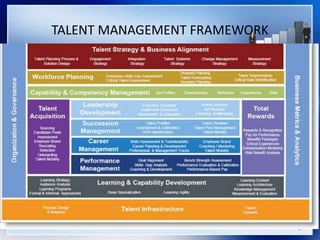
TALENT MANAGEMENT FRAMEWORK
4
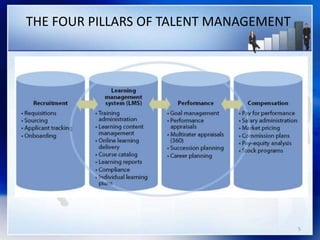
THE FOUR PILLARS OF TALENT MANAGEMENT
5
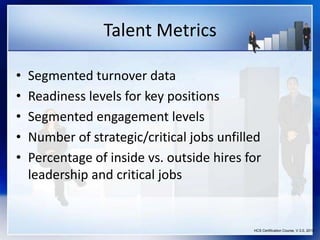
Talent Metrics
• Segmented turnover data
• Readiness levels for key positions
• Segmented engagement levels
• Number of strategic/critical jobs unfilled
• Percentage of inside vs. outside hires for
leadership and critical jobs
HCS Certification Course, V.3.0, 2010
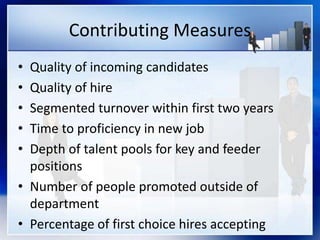
Contributing Measures
• Quality of incoming candidates
• Quality of hire
• Segmented turnover within first two years
• Time to proficiency in new job
• Depth of talent pools for key and feeder
positions
• Number of people promoted outside of
department
• Percentage of first choice hires accepting
COMPETENCY BASED HRM
10
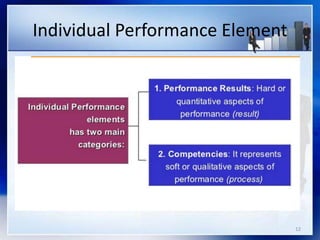
Individual Performance Element
12
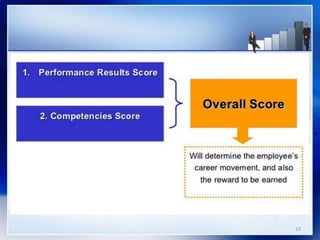
13
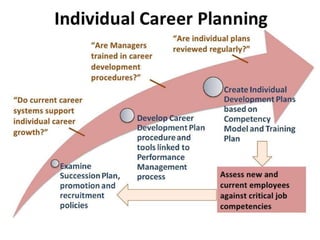
CBHRM Career Planning
15
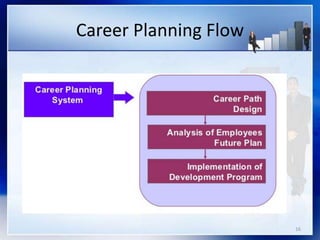
Career Planning Flow
16
TALENT PLANNING &
DEPLOYMENT
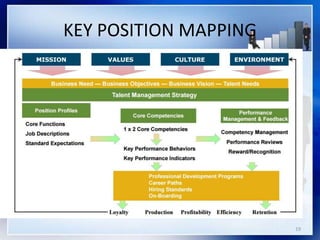
KEY POSITION MAPPING
19
20
What is a critical skill?
• A critical skill is one that, if not present, results
in a task not being completed satisfactorily, if
at all.
• The lack of a critical skill causes problems, but
the possession of it allows work to continue.
21
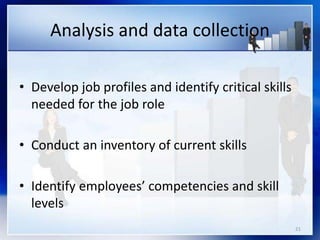
Analysis and data collection
• Develop job profiles and identify critical skills
needed for the job role
• Conduct an inventory of current skills
• Identify employees’ competencies and skill
levels
TALENT ACQUISTITION
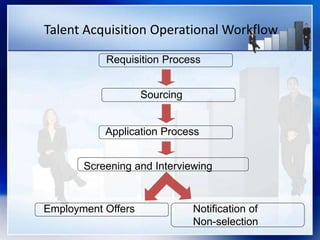
Talent Acquisition Operational Workflow
Requisition Process
Sourcing
Application Process
Screening and Interviewing
Employment Offers Notification of
Non-selection
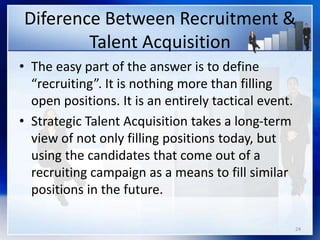
Diference Between Recruitment &
Talent Acquisition
• The easy part of the answer is to define
“recruiting”. It is nothing more than filling
open positions. It is an entirely tactical event.
• Strategic Talent Acquisition takes a long-term
view of not only filling positions today, but
using the candidates that come out of a
recruiting campaign as a means to fill similar
positions in the future.
24
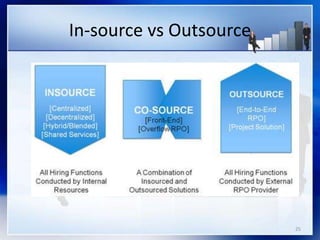
In-source vs Outsource
25
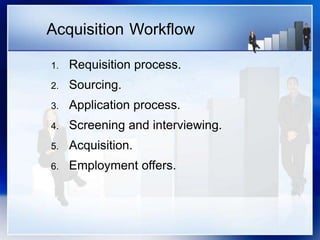
Acquisition Workflow
1. Requisition process.
2. Sourcing.
3. Application process.
4. Screening and interviewing.
5. Acquisition.
6. Employment offers.
PERFORMANCE MANAGEMENT
ELEMENTS OF PERFORMANCE
MANAGEMENT
• Reliable measures
• Clear goals
• Performance monitoring
• Rewards and recognition
• Initiatives and corrective actions
28
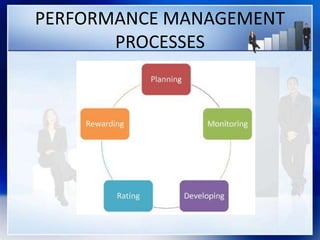
PERFORMANCE MANAGEMENT
PROCESSES
IDENTIFYING AND ASSESSING
HIGH- POTENTIAL TALENT
Defining High Potential Talent
• high-potential employee is one who has been
identified as having the potential, ability, and
aspiration to hold successive leadership
positions in an organization
31
Identify High Potentials
• Step 1: Plan for the future.
• Step 2: Define high-potential criteria
• Step 3: Make the high-potential criteria
measureable.
• Step 4: Identify high-potential candidates.
32
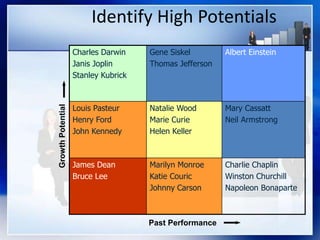
Identify High Potentials
Charles Darwin
Janis Joplin
Stanley Kubrick
Gene Siskel
Thomas Jefferson
Albert Einstein
Louis Pasteur
Henry Ford
John Kennedy
Natalie Wood
Marie Curie
Helen Keller
Mary Cassatt
Neil Armstrong
James Dean
Bruce Lee
Marilyn Monroe
Katie Couric
Johnny Carson
Charlie Chaplin
Winston Churchill
Napoleon Bonaparte
Past Performance
GrowthPotential
34
ASSESSMENT TOOLKIT TO IDENTIFY HIGH
POTENTIAL EMPLOYEE
How can organizations assess existing staff to track high potentials
and ensure new hires meet the future needs of the business?
Assessment:
• Online Psychometric Assessments
• Leadership/Management Assessment Batteries
• Assessment and Development Centers
• 360 degree feedback surveys and business assessments
• Competency model profiling, behavioral based interviews,
multi-rater assessment tools
LEADERSHIP DEVELOPMENT
PROGRAM
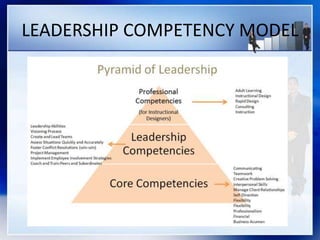
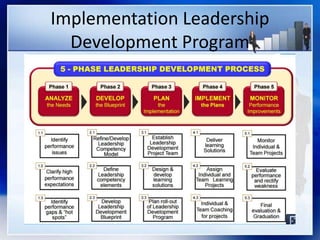
Leadership Development Program
The Leadership Development Program (LDP)® develops
leaders who are capable of bridging levels and
functions in the organisation, leading other
managers and turning strategy into action.
LEADERSHIP COMPETENCY MODEL
Implementation Leadership
Development Program
MENTORING AND COACHING FOR
DEVELOPMENT
MENTORING
The knowledge, advice, and resources a mentor shares depend
on the format and goals of a specific mentoring relationship.
A mentor may share with a mentee (or protege) information
about his or her own career path, as well as provide guidance,
motivation, emotional support, and role modeling
40
COACHING
Coaching is training or development in which a
person called a coach supports a learner in
achieving a specific personal or professional
goal.
41
SUCCESSION PLANNING
42
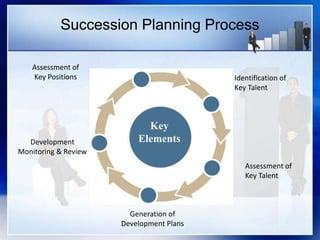
Assessment of
Key Positions Identification of
Key Talent
Assessment of
Key Talent
Generation of
Development Plans
Development
Monitoring & Review
Key
Elements
Succession Planning Process
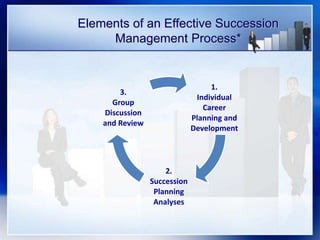
Elements of an Effective Succession
Management Process*
1.
Individual
Career
Planning and
Development
2.
Succession
Planning
Analyses
3.
Group
Discussion
and Review
RETENTION STRATEGY
45
46
Employee retention, a set of actions
designed to keep good employees
once they have been hired.
The Reality Of "Managing Expectations" Revolves
Around 3 Simple Principles:
1. Managers communicate their expectations
consciously and unconsciously.
2. Employees consciously and unconsciously
understand these expectations.
3. Employees perform in ways that are
consistent with their manager's expectations.
47
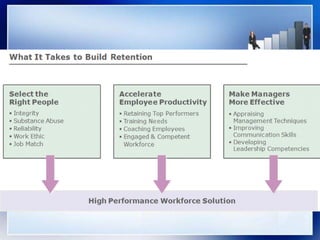
DEVELOPING RETENTION PLANNING
48
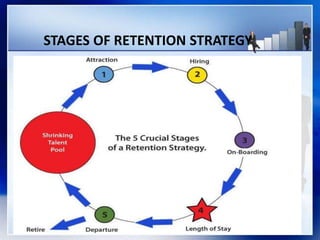
STAGES OF RETENTION STRATEGY
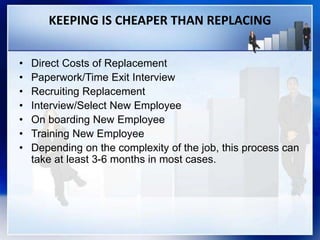
KEEPING IS CHEAPER THAN REPLACING
• Direct Costs of Replacement
• Paperwork/Time Exit Interview
• Recruiting Replacement
• Interview/Select New Employee
• On boarding New Employee
• Training New Employee
• Depending on the complexity of the job, this process can
take at least 3-6 months in most cases.
TOP 10 LOW & NO CO$T EMPLOYEE RETENTION
1. Hire the Right Person
2. Open & Effective Communication
3. Clear Expectations
4. Outstanding Feedback & Recognition
5. Treat People with Respect
6. Share Training Responsibility
7. Have Fun
8. Promote Work/Life Balance
9. Demonstrate Corporate Social Responsibility
10. Utilize Connection & Exit interviews

Talent management

  • 1.
  • 2.
    WHAT IS TALENTMANAGEMENT? Talent Management is about identifying, attracting, integrating, developing, motivating and retaining key people across the whole of the business, not just the ‘elite few’ decision-makers, as is so commonly the case. TM introduced by Mc Kinsey consultants, late 1990’s 2
  • 3.
    Why Organizations NeedTalent Development? 3 • To compete effectively in a complex and dynamic environment to achieve sustainable growth • To develop leaders for tomorrow from within an organization • To maximize employee performance as a unique source of competitive advantage • To empower employees: Cut down on high turnover rates Reduce the cost of constantly hiring new people to train
  • 4.
  • 5.
    THE FOUR PILLARSOF TALENT MANAGEMENT 5
  • 6.
    Talent Metrics • Segmentedturnover data • Readiness levels for key positions • Segmented engagement levels • Number of strategic/critical jobs unfilled • Percentage of inside vs. outside hires for leadership and critical jobs HCS Certification Course, V.3.0, 2010
  • 7.
    Contributing Measures • Qualityof incoming candidates • Quality of hire • Segmented turnover within first two years • Time to proficiency in new job • Depth of talent pools for key and feeder positions • Number of people promoted outside of department • Percentage of first choice hires accepting
  • 8.
  • 10.
  • 12.
  • 13.
  • 15.
  • 16.
  • 18.
  • 19.
  • 20.
    20 What is acritical skill? • A critical skill is one that, if not present, results in a task not being completed satisfactorily, if at all. • The lack of a critical skill causes problems, but the possession of it allows work to continue.
  • 21.
    21 Analysis and datacollection • Develop job profiles and identify critical skills needed for the job role • Conduct an inventory of current skills • Identify employees’ competencies and skill levels
  • 22.
  • 23.
    Talent Acquisition OperationalWorkflow Requisition Process Sourcing Application Process Screening and Interviewing Employment Offers Notification of Non-selection
  • 24.
    Diference Between Recruitment& Talent Acquisition • The easy part of the answer is to define “recruiting”. It is nothing more than filling open positions. It is an entirely tactical event. • Strategic Talent Acquisition takes a long-term view of not only filling positions today, but using the candidates that come out of a recruiting campaign as a means to fill similar positions in the future. 24
  • 25.
  • 26.
    Acquisition Workflow 1. Requisitionprocess. 2. Sourcing. 3. Application process. 4. Screening and interviewing. 5. Acquisition. 6. Employment offers.
  • 27.
  • 28.
    ELEMENTS OF PERFORMANCE MANAGEMENT •Reliable measures • Clear goals • Performance monitoring • Rewards and recognition • Initiatives and corrective actions 28
  • 29.
  • 30.
  • 31.
    Defining High PotentialTalent • high-potential employee is one who has been identified as having the potential, ability, and aspiration to hold successive leadership positions in an organization 31
  • 32.
    Identify High Potentials •Step 1: Plan for the future. • Step 2: Define high-potential criteria • Step 3: Make the high-potential criteria measureable. • Step 4: Identify high-potential candidates. 32
  • 33.
    Identify High Potentials CharlesDarwin Janis Joplin Stanley Kubrick Gene Siskel Thomas Jefferson Albert Einstein Louis Pasteur Henry Ford John Kennedy Natalie Wood Marie Curie Helen Keller Mary Cassatt Neil Armstrong James Dean Bruce Lee Marilyn Monroe Katie Couric Johnny Carson Charlie Chaplin Winston Churchill Napoleon Bonaparte Past Performance GrowthPotential
  • 34.
    34 ASSESSMENT TOOLKIT TOIDENTIFY HIGH POTENTIAL EMPLOYEE How can organizations assess existing staff to track high potentials and ensure new hires meet the future needs of the business? Assessment: • Online Psychometric Assessments • Leadership/Management Assessment Batteries • Assessment and Development Centers • 360 degree feedback surveys and business assessments • Competency model profiling, behavioral based interviews, multi-rater assessment tools
  • 35.
  • 36.
    Leadership Development Program TheLeadership Development Program (LDP)® develops leaders who are capable of bridging levels and functions in the organisation, leading other managers and turning strategy into action.
  • 37.
  • 38.
  • 39.
    MENTORING AND COACHINGFOR DEVELOPMENT
  • 40.
    MENTORING The knowledge, advice,and resources a mentor shares depend on the format and goals of a specific mentoring relationship. A mentor may share with a mentee (or protege) information about his or her own career path, as well as provide guidance, motivation, emotional support, and role modeling 40
  • 41.
    COACHING Coaching is trainingor development in which a person called a coach supports a learner in achieving a specific personal or professional goal. 41
  • 42.
  • 43.
    Assessment of Key PositionsIdentification of Key Talent Assessment of Key Talent Generation of Development Plans Development Monitoring & Review Key Elements Succession Planning Process
  • 44.
    Elements of anEffective Succession Management Process* 1. Individual Career Planning and Development 2. Succession Planning Analyses 3. Group Discussion and Review
  • 45.
  • 46.
    46 Employee retention, aset of actions designed to keep good employees once they have been hired.
  • 47.
    The Reality Of"Managing Expectations" Revolves Around 3 Simple Principles: 1. Managers communicate their expectations consciously and unconsciously. 2. Employees consciously and unconsciously understand these expectations. 3. Employees perform in ways that are consistent with their manager's expectations. 47
  • 48.
  • 49.
  • 51.
    KEEPING IS CHEAPERTHAN REPLACING • Direct Costs of Replacement • Paperwork/Time Exit Interview • Recruiting Replacement • Interview/Select New Employee • On boarding New Employee • Training New Employee • Depending on the complexity of the job, this process can take at least 3-6 months in most cases.
  • 52.
    TOP 10 LOW& NO CO$T EMPLOYEE RETENTION 1. Hire the Right Person 2. Open & Effective Communication 3. Clear Expectations 4. Outstanding Feedback & Recognition 5. Treat People with Respect 6. Share Training Responsibility 7. Have Fun 8. Promote Work/Life Balance 9. Demonstrate Corporate Social Responsibility 10. Utilize Connection & Exit interviews