Succession PlanningMaya Kurian
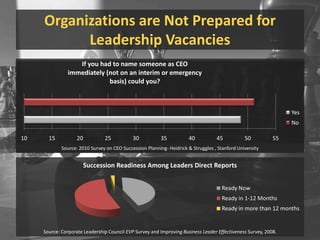
Organizations are Not Prepared for Leadership VacanciesSource: 2010 Survey on CEO Succession Planning- Heidrick & Struggles , Stanford UniversitySuccession Readiness Among Leaders’ Direct ReportsSource: Corporate Leadership Council EVP Survey and Improving Business Leader Effectiveness Survey, 2008.
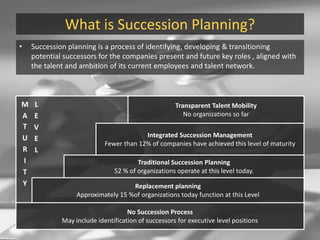
What is Succession Planning?Succession planning is a process of identifying, developing & transitioning potential successors for the companies present and future key roles , aligned with the talent and ambition of its current employees and talent network.Transparent Talent MobilityNo organizations so farMATURITYLEVELIntegrated Succession ManagementFewer than 12% of companies have achieved this level of maturityTraditional Succession Planning52 % of organizations operate at this level today.Replacement planningApproximately 15 %of organizations today function at this Level No Succession ProcessMay include identification of successors for executive level positions
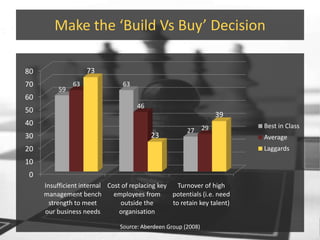
Make the ‘Build Vs Buy’ DecisionSource: Aberdeen Group (2008)
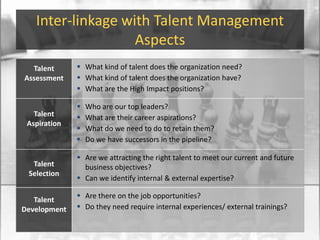
Inter-linkage with Talent Management Aspects
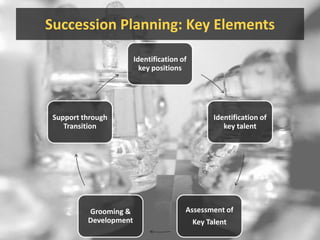
Succession Planning: Key Elements
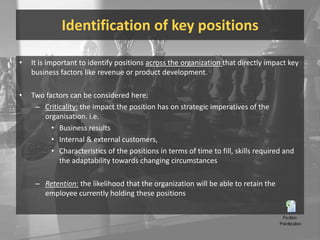
Identification of key positionsIt is important to identify positions across the organization that directly impact key business factors like revenue or product development.Two factors can be considered here:Criticality: the impact the position has on strategic imperatives of the organisation. i.e. Business resultsInternal & external customers, Characteristics of the positions in terms of time to fill, skills required and the adaptability towards changing circumstancesRetention: the likelihood that the organization will be able to retain the employee currently holding these positions
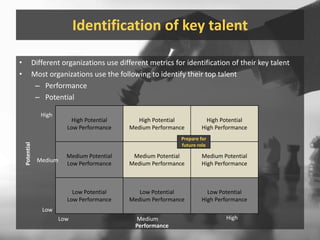
Identification of key talentDifferent organizations use different metrics for identification of their key talentMost organizations use the following to identify their top talentPerformancePotentialHighPotentialPrepare for future roleMediumLowHighMediumLowPerformance
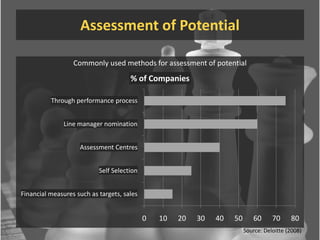
Assessment of PotentialCommonly used methods for assessment of potentialSource: Deloitte (2008)
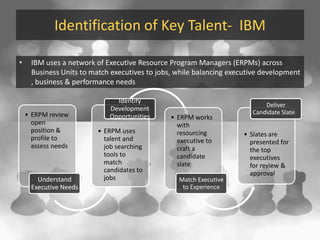
Identification of Key Talent-  IBMIBM uses a network of Executive Resource Program Managers (ERPMs) across Business Units to match executives to jobs, while balancing executive development , business & performance needs
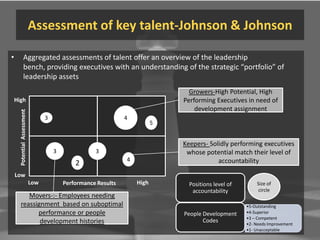
Assessment of key talent-Johnson & JohnsonAggregated assessments of talent offer an overview of the leadership bench, providing executives with an understanding of the strategic “portfolio” of leadership assetsMovers-:- Employees needing reassignment  based on suboptimal performance or people development historiesKeepers- Solidly performing executives whose potential match their level of accountabilityPositions level of accountabilityHighGrowers-High Potential, High Performing Executives in need of development assignmentSize of circlePotential  AssessmentPeople Development Codes5-Outstanding
4-Superior
3 – Competent
2- Needs Improvement
1- Unacceptable4353342LowLowHighPerformance Results
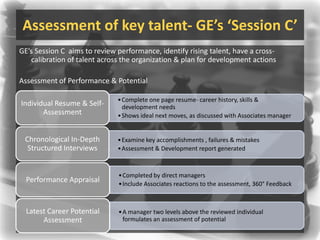
Assessment of key talent- GE’s ‘Session C’GE’s Session C  aims to review performance, identify rising talent, have a cross- calibration of talent across the organization & plan for development actionsAssessment of Performance & Potential
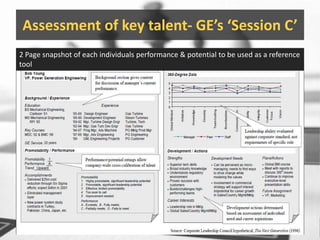
Assessment of key talent- GE’s ‘Session C’2 Page snapshot of each individuals performance & potential to be used as a reference tool

Succession planning

  • 1.
  • 2.
    Organizations are NotPrepared for Leadership VacanciesSource: 2010 Survey on CEO Succession Planning- Heidrick & Struggles , Stanford UniversitySuccession Readiness Among Leaders’ Direct ReportsSource: Corporate Leadership Council EVP Survey and Improving Business Leader Effectiveness Survey, 2008.
  • 3.
    What is SuccessionPlanning?Succession planning is a process of identifying, developing & transitioning potential successors for the companies present and future key roles , aligned with the talent and ambition of its current employees and talent network.Transparent Talent MobilityNo organizations so farMATURITYLEVELIntegrated Succession ManagementFewer than 12% of companies have achieved this level of maturityTraditional Succession Planning52 % of organizations operate at this level today.Replacement planningApproximately 15 %of organizations today function at this Level No Succession ProcessMay include identification of successors for executive level positions
  • 4.
    Make the ‘BuildVs Buy’ DecisionSource: Aberdeen Group (2008)
  • 5.
    Inter-linkage with TalentManagement Aspects
  • 6.
  • 7.
    Identification of keypositionsIt is important to identify positions across the organization that directly impact key business factors like revenue or product development.Two factors can be considered here:Criticality: the impact the position has on strategic imperatives of the organisation. i.e. Business resultsInternal & external customers, Characteristics of the positions in terms of time to fill, skills required and the adaptability towards changing circumstancesRetention: the likelihood that the organization will be able to retain the employee currently holding these positions
  • 8.
    Identification of keytalentDifferent organizations use different metrics for identification of their key talentMost organizations use the following to identify their top talentPerformancePotentialHighPotentialPrepare for future roleMediumLowHighMediumLowPerformance
  • 9.
    Assessment of PotentialCommonlyused methods for assessment of potentialSource: Deloitte (2008)
  • 10.
    Identification of KeyTalent- IBMIBM uses a network of Executive Resource Program Managers (ERPMs) across Business Units to match executives to jobs, while balancing executive development , business & performance needs
  • 11.
    Assessment of keytalent-Johnson & JohnsonAggregated assessments of talent offer an overview of the leadership bench, providing executives with an understanding of the strategic “portfolio” of leadership assetsMovers-:- Employees needing reassignment based on suboptimal performance or people development historiesKeepers- Solidly performing executives whose potential match their level of accountabilityPositions level of accountabilityHighGrowers-High Potential, High Performing Executives in need of development assignmentSize of circlePotential AssessmentPeople Development Codes5-Outstanding
  • 12.
  • 13.
  • 14.
  • 15.
  • 16.
    Assessment of keytalent- GE’s ‘Session C’GE’s Session C aims to review performance, identify rising talent, have a cross- calibration of talent across the organization & plan for development actionsAssessment of Performance & Potential
  • 17.
    Assessment of keytalent- GE’s ‘Session C’2 Page snapshot of each individuals performance & potential to be used as a reference tool

Editor's Notes

  • #2 Going to talk about succession planning from my experience & the research that I have done on this topic.I will run you through the various aspects of succession planning, illustrating a few examples of best practices in organisations, making it more interesting as well as something that one can relate to betterYou will see that I have chosen a chess theme in all my slides as I believe SP is of great strategic important & making the right move ic crucial.In 1980, the CEO of GE, Reginald Jones, made one of the most important decisions in Corporate History. He named Jack Welch as his successor, despite his being considered "too young, too impatient, and too reckless." By thoughtfully considering his successor, Reginald Jones set the stage for one of the most successful leadership positions in Corporate America.On the other hand, inspite of the training done by the legenedaryCeo of Coke, Roberto Goizueta for his successor Doug Ivester , he was found to be unfit and resigned from the post of CEO in a couple of years.
  • #3 In todays scenario, Organizations do face potential leadership vacancies, which can undermine trajectory toward economic recovery. In the 2010 CEO SP survey, only 51% of the CEOs asked, could name a successor for their roleA majority of potential successors are not prepared to assume their managers’ role. In fact, nearly 1/3 of leaders’ direct reports will not be ready within the next two years.
  • #4 Transparent Talent Mobility : Companies completely understand the capabilities and potential of their workforces and talent decisions are made based on what is best for the business Integrated Succession Management: Targets critical positions across levels. Tightly aligned with business strategy & integrated with other talent management process. Traditional Succession Planning: Target critical senior-level positions and conduct Talent reviews , and create development plans. Replacement planning: When vacancies arise , identification of successors is done but there is no formal development process in place.
  • #5 Organisations do prefer to groom successors internally as about 66% of senior managers hired from the outside usually fail within the first 18 months (Center for Creative Leadership)Best in Class organizations are more likely than Industry Average and Laggard organizations (respectively) to cite “ cost of replacing key employees from outside the organisation”Best in class organizations focus on identifying, developing/ nurturing and retaining key talent that already exists within the organisation“Businesses could fill the leadership vacuum from their internal ranks if they knew how to spot and develop their real potential leaders. Butthey don’t, despite the enormous resources and thought they pour into the task.”Ram Charan, “Leaders at all Levels”
  • #6  It is important to tie up SP with other aspects of Talent Management.By doing this you will be able to align talent needs & development with business strategy.
  • #9  Key talent will usually be your HIPOT population.
  • #10 Most organizations have well designed competency models as a foundation to help leaders assess their current talent and identify high potentials (via rating scales on competency dimensions). This can be used to assess skills that employees may not currently demonstrate but are capable of demonstratingAssessing potential based on the line manager nomination may not be the most objective method but it is one of the most commonly used methods
  • #12  To give you a background, J&J launches the talent review process with a letter addressed to executive VPs reinforcing a year over year theme of the imp or leadership development but highlighting a new point of focus for each year.The “Credo,” contains details of J&J’s core values, and provides a key foundation for understanding leadership development. Also have the company’s Standards of Leadership define five “supporting pillars” on which leaders are evaluated.They use a series of bottom up succession review to surface and grow talent:Level 1(operating companies):identify executive talent & calibrate thatLevel 2(group):focuses on ways to further develop & expose talent to other business areasLevel 3: identify last mile developmental moves & final executive placementThen focus on slide and –Senior executive conversations then focus on the growers and movers to ensure that talent conversations center on executives with the greatest potential long-term impact on the business.
  • #13 During April and May each year, GE’s CEO and SVP of Corporate HR travel to each of GE’s operating units to lead Session C: a daylong‘audit’ of the performance of the management team and the potential of rising talent.Performance and talent are appraised and discussed with reference to GE’s leadership competency frameworkDiscussion are based on information from several sources( go to slide)e.g. Jeffery Immelt
  • #14 Will consider readiness to move into next role
  • #15 P&G identifies crucible roles in terms of their complexity—which requires the mastery of a broad range of skills—and business impact. The company reserves these crucible roles for its highest potential talent.Schlumberger finds it crucial to systematically encourage business unit managers to take calculated risks in placing leaders in cross-organizationalstretch moves(non-obvious) to ensure a future pipeline of enterprise-wide leaders.
  • #16 In the ADC, the assessment elements include realistic stimulations, have multiple assessors, & next level assessmentShell designs specific interventions to ensure executives address behaviours they must change as they transition to senior rolesPoint 2: accountability lies with individual & they have to convene their own personal devpt meetingHR focuses invesment by witholdingdevept interventions until all previous steps r completeOnboarding challenge analysis through employment brand research, interviews with current executives, organisational surveys,(common expecations would be immediate global exposure, have an immediate & significant impact, opportunity to introduce new perspectives & leaderhsipstylles..At a new hires 6 month anniversary, an on-boarding working is conducted at one of its major offices and a ‘new hire cohort’ of sorts is createdAmerican Express leverages knowledge gained during the recruitment process which provides the foundation for a long term development plan put in place within 30 days of a new hire’s arrival.
  • #17 The CEO invests a significant amount of time in talent-related activities such as Session C — in his time as CEO of GE, Jack Welch acknowledges that most of his time has been spent on evaluating people: “I’m the top personnel guy around here.”