STRATEGIC TALENT
MANAGEMENT
WHAT IS TALENT MANAGEMENT?
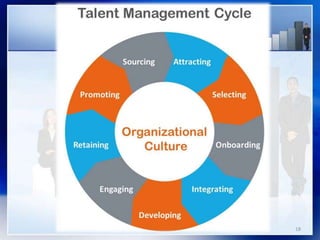
Talent Management is about identifying, attracting, integrating,
developing, motivating and retaining key people across the
whole of the business, not just the ‘elite few’ decision-makers,
as is so commonly the case.
Talent management activities can include performance
management, succession planning, talent reviews,
development planning and support, career development,
workforce planning and recruiting”
2
TM introduced by Mc Kinsey consultants, late 1990’s
TM is identified as the critical success factor in corporate world
TM focuses on
differentiated performance: A, B, C players influencing
company performance and success
identifying key positions in the organization
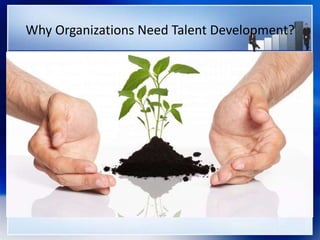
Why Organizations Need Talent Development?
Why Organizations Need Talent
Development?
5
• To compete effectively in a complex and dynamic
environment to achieve sustainable growth
• To develop leaders for tomorrow from within an
organization
• To maximize employee performance as a unique
source of competitive advantage
• To empower employees:
Cut down on high turnover rates
Reduce the cost of constantly hiring new people to
train
STRATEGIC TALENT MANAGEMENT
• In the same way that a successful business strategy is
underpinned by an effective HR strategy, to be
successful, the talent strategy must be aligned to the
business, and both drive and deliver business
directives.
• Strategic talent management ensures that effective and
timely people strategies are in place to reduce the
business risk of being under human-capitalised.
• Business goals need to be translated into workforce
needs in order to drive success (Farley, 2005).
The key to inciting a workforce to greatness is to align your talent
management with company strategy, define consistent
leadership criteria across all functional areas, and identify
specific competencies (analytical, technical, education,
experience) to cultivate for continuing growth.
7
The Talent Strategy
Describes what type of people the organization will invest in and
how it will be done
Besides the specific elements of their creed, the talent strategy
of all high performing organizations should have these
directives:
1) Identify key positions in the organization (not more than 20,
30 %)
2) Assess your employees and identify the high performers
(classify according to their current and future potential)
3) Retain key position backups
4) Make appropriate investments (select, train, develop, reward)
What is talent ?
9
What is talent ?
10
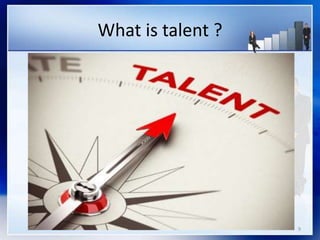
• a person’s abilities,
• his or her intrinsic gifts,
• skills, knowledge, experience ,
• intelligence,
• judgment, attitude, character, drive,
• his or her ability to learn and grow.
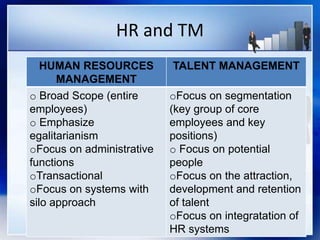
HR and TM
HUMAN RESOURCES
MANAGEMENT
TALENT MANAGEMENT
o Broad Scope (entire
employees)
o Emphasize
egalitarianism
oFocus on administrative
functions
oTransactional
oFocus on systems with
silo approach
oFocus on segmentation
(key group of core
employees and key
positions)
o Focus on potential
people
oFocus on the attraction,
development and retention
of talent
oFocus on integratation of
HR systems
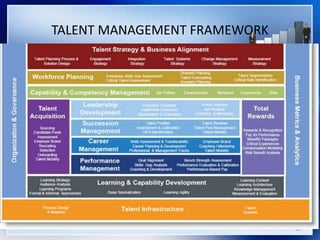
TALENT MANAGEMENT FRAMEWORK
12
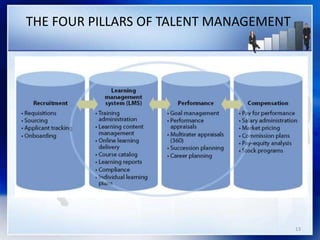
THE FOUR PILLARS OF TALENT MANAGEMENT
13
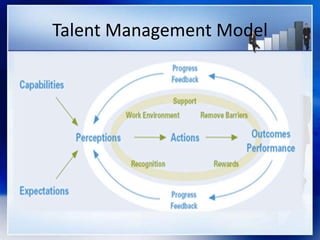
Talent Management Model
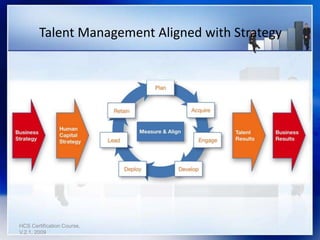
Talent Management Aligned with Strategy
HCS Certification Course,
V.2.1, 2009
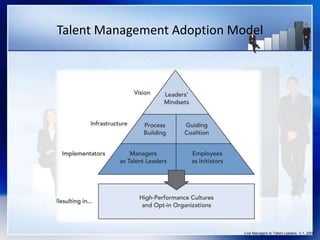
Talent Management Adoption Model
Line Managers to Talent Leaders, V.1, 2009
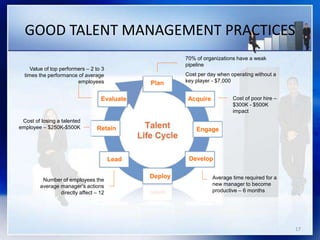
GOOD TALENT MANAGEMENT PRACTICES
17
Cost of losing a talented
employee – $250K-$500K
Number of employees the
average manager’s actions
directly affect – 12
Cost of poor hire –
$300K - $500K
impact
Acquire
Engage
Develop
Deploy
Retain
Plan
Evaluate
Lead
Value of top performers – 2 to 3
times the performance of average
employees
Average time required for a
new manager to become
productive – 6 months
70% of organizations have a weak
pipeline
Cost per day when operating without a
key player - $7,000
18
19
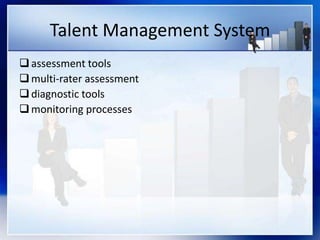
Talent Management System
assessment tools
multi-rater assessment
diagnostic tools
monitoring processes
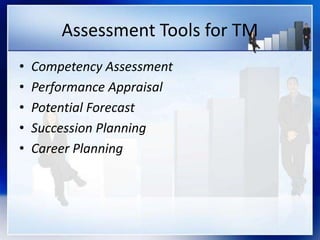
Assessment Tools for TM
• Competency Assessment
• Performance Appraisal
• Potential Forecast
• Succession Planning
• Career Planning
Multi-Rater Assessment
• Employee. The owner of the career plan that is
aligned with the succession plan
• Boss. The primary assessor
• Boss’s boss. The key link in the vertical
succession and career plan
• Boss’s peer group. Source of potential new
assignments in the same or other function
Monitoring Processes
Results & reviewing regularly:
• quality,
• timeliness and
• credibility
Talent Metrics
• Segmented turnover data
• Readiness levels for key positions
• Segmented engagement levels
• Number of strategic/critical jobs unfilled
• Percentage of inside vs. outside hires for
leadership and critical jobs
HCS Certification Course, V.3.0, 2010
Contributing Measures
• Quality of incoming candidates
• Quality of hire
• Segmented turnover within first two years
• Time to proficiency in new job
• Depth of talent pools for key and feeder
positions
• Number of people promoted outside of
department
• Percentage of first choice hires accepting

1. strategic talent management

  • 1.
  • 2.
    WHAT IS TALENTMANAGEMENT? Talent Management is about identifying, attracting, integrating, developing, motivating and retaining key people across the whole of the business, not just the ‘elite few’ decision-makers, as is so commonly the case. Talent management activities can include performance management, succession planning, talent reviews, development planning and support, career development, workforce planning and recruiting” 2
  • 3.
    TM introduced byMc Kinsey consultants, late 1990’s TM is identified as the critical success factor in corporate world TM focuses on differentiated performance: A, B, C players influencing company performance and success identifying key positions in the organization
  • 4.
    Why Organizations NeedTalent Development?
  • 5.
    Why Organizations NeedTalent Development? 5 • To compete effectively in a complex and dynamic environment to achieve sustainable growth • To develop leaders for tomorrow from within an organization • To maximize employee performance as a unique source of competitive advantage • To empower employees: Cut down on high turnover rates Reduce the cost of constantly hiring new people to train
  • 6.
    STRATEGIC TALENT MANAGEMENT •In the same way that a successful business strategy is underpinned by an effective HR strategy, to be successful, the talent strategy must be aligned to the business, and both drive and deliver business directives. • Strategic talent management ensures that effective and timely people strategies are in place to reduce the business risk of being under human-capitalised. • Business goals need to be translated into workforce needs in order to drive success (Farley, 2005).
  • 7.
    The key toinciting a workforce to greatness is to align your talent management with company strategy, define consistent leadership criteria across all functional areas, and identify specific competencies (analytical, technical, education, experience) to cultivate for continuing growth. 7
  • 8.
    The Talent Strategy Describeswhat type of people the organization will invest in and how it will be done Besides the specific elements of their creed, the talent strategy of all high performing organizations should have these directives: 1) Identify key positions in the organization (not more than 20, 30 %) 2) Assess your employees and identify the high performers (classify according to their current and future potential) 3) Retain key position backups 4) Make appropriate investments (select, train, develop, reward)
  • 9.
  • 10.
    What is talent? 10 • a person’s abilities, • his or her intrinsic gifts, • skills, knowledge, experience , • intelligence, • judgment, attitude, character, drive, • his or her ability to learn and grow.
  • 11.
    HR and TM HUMANRESOURCES MANAGEMENT TALENT MANAGEMENT o Broad Scope (entire employees) o Emphasize egalitarianism oFocus on administrative functions oTransactional oFocus on systems with silo approach oFocus on segmentation (key group of core employees and key positions) o Focus on potential people oFocus on the attraction, development and retention of talent oFocus on integratation of HR systems
  • 12.
  • 13.
    THE FOUR PILLARSOF TALENT MANAGEMENT 13
  • 14.
  • 15.
    Talent Management Alignedwith Strategy HCS Certification Course, V.2.1, 2009
  • 16.
    Talent Management AdoptionModel Line Managers to Talent Leaders, V.1, 2009
  • 17.
    GOOD TALENT MANAGEMENTPRACTICES 17 Cost of losing a talented employee – $250K-$500K Number of employees the average manager’s actions directly affect – 12 Cost of poor hire – $300K - $500K impact Acquire Engage Develop Deploy Retain Plan Evaluate Lead Value of top performers – 2 to 3 times the performance of average employees Average time required for a new manager to become productive – 6 months 70% of organizations have a weak pipeline Cost per day when operating without a key player - $7,000
  • 18.
  • 19.
  • 20.
    Talent Management System assessmenttools multi-rater assessment diagnostic tools monitoring processes
  • 21.
    Assessment Tools forTM • Competency Assessment • Performance Appraisal • Potential Forecast • Succession Planning • Career Planning
  • 22.
    Multi-Rater Assessment • Employee.The owner of the career plan that is aligned with the succession plan • Boss. The primary assessor • Boss’s boss. The key link in the vertical succession and career plan • Boss’s peer group. Source of potential new assignments in the same or other function
  • 23.
    Monitoring Processes Results &reviewing regularly: • quality, • timeliness and • credibility
  • 24.
    Talent Metrics • Segmentedturnover data • Readiness levels for key positions • Segmented engagement levels • Number of strategic/critical jobs unfilled • Percentage of inside vs. outside hires for leadership and critical jobs HCS Certification Course, V.3.0, 2010
  • 25.
    Contributing Measures • Qualityof incoming candidates • Quality of hire • Segmented turnover within first two years • Time to proficiency in new job • Depth of talent pools for key and feeder positions • Number of people promoted outside of department • Percentage of first choice hires accepting