








... back to the Leadership Development Program
© LIW 2011
             5
What are we trying to achieve?
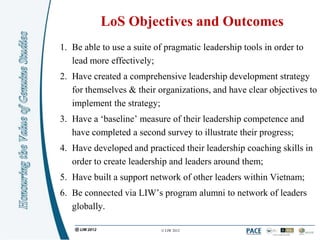
LoS Objectives and Outcomes
1. Be able to use a suite of pragmatic leadership tools in order to
   lead more effectively;
2. Have created a comprehensive leadership development strategy
   for themselves & their organizations, and have clear objectives to
   implement the strategy;
3. Have a „baseline‟ measure of their leadership competence and
   have completed a second survey to illustrate their progress;
4. Have developed and practiced their leadership coaching skills in
   order to create leadership and leaders around them;
5. Have built a support network of other leaders within Vietnam;
6. Be connected via LIW‟s program alumni to network of leaders
   globally.

                           © LIW 2012
A world class leadership development program
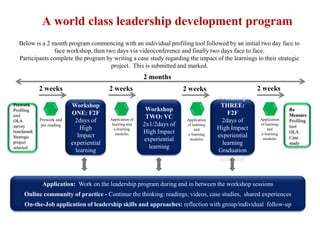
  Below is a 2 month program commencing with an individual profiling tool followed by an initial two day face to
                face workshop, then two days via videoconference and finally two days face to face.
  Participants complete the program by writing a case study regarding the impact of the learnings to their strategic
                                      project. This is submitted and marked.
                                                          2 months
            2 weeks                      2 weeks                         2 weeks                       2 weeks
                                                                                        Workshop
Prework                   Workshop                                                       THREE:
Profiling                                                  Workshop                                                  Re
tool                      ONE: F2F                                                          F2F                      Measure
                                         Application of
                                                           TWO: VC                                     Application
OLA         Prework and    2days of                                       Application     2days of                   Profiling
survey      pre reading                   learning and    2x1/2days of    of learning                  of learning
                                                                                                                     tool
                              High         e-learning                         and       High Impact        and
benchmark
                                            modules       High Impact     e-learning                   e-learning    OLA
Strategic                    Impact                                                     experiential                 Case
                                                          experiential     modules                      modules
project                   experiential                                                    learning                   study
selected                                                    learning
                            learning                                                    Graduation
                                                                                         ceremony


             Application: Work on the leadership program during and in between the workshop sessions
     Online community of practice - Continue the thinking: readings, videos, case studies, shared experiences
     On-the-Job application of leadership skills and approaches: reflection with group/individual follow-up
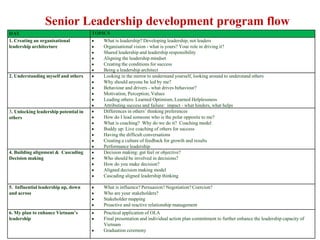
Senior Leadership development program flow
DAY                                    TOPICS
1. Creating an organisational             What is leadership? Developing leadership, not leaders
leadership architecture                   Organisational vision - what is yours? Your role in driving it?
                                          Shared leadership and leadership responsibility
                                          Aligning the leadership mindset
                                          Creating the conditions for success
                                          Being a leadership architect
2. Understanding myself and others        Looking in the mirror to understand yourself, looking around to understand others
                                          Why should anyone be led by me?
                                          Behaviour and drivers - what drives behaviour?
                                          Motivation, Perception, Values
                                          Leading others: Learned Optimism, Learned Helplessness
                                          Attributing success and failure: impact - what hinders, what helps
3. Unlocking leadership potential in      Differences in others‟ thinking preferences
others                                    How do I lead someone who is the polar opposite to me?
                                          What is coaching? Why do we do it? Coaching model
                                          Buddy up: Live coaching of others for success
                                          Having the difficult conversations
                                          Creating a culture of feedback for growth and results
                                          Performance leadership
4. Building alignment & Cascading         Decision making: gut feel or objective?
Decision making                           Who should be involved in decisions?
                                          How do you make decision?
                                          Aligned decision making model
                                          Cascading aligned leadership thinking

5. Influential leadership up, down        What is influence? Persuasion? Negotiation? Coercion?
and across                                Who are your stakeholders?
                                          Stakeholder mapping
                                          Proactive and reactive relationship management
6. My plan to enhance Vietnam’s           Practical application of OLA
leadership                                Final presentation and individual action plan commitment to further enhance the leadership capacity of
                                          Vietnam
                                          Graduation ceremony
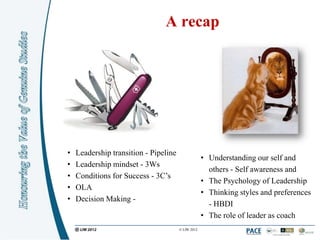
A recap


•   Leadership transition - Pipeline
                                                    • Understanding our self and
•   Leadership mindset - 3Ws
                                                      others - Self awareness and
•   Conditions for Success - 3C‟s
                                                    • The Psychology of Leadership
•   OLA
                                                    • Thinking styles and preferences
•   Decision Making -
                                                      - HBDI
                                                    • The role of leader as coach
                                       © LIW 2012
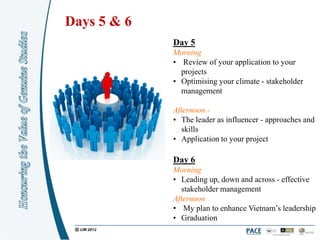
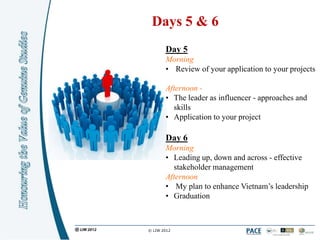
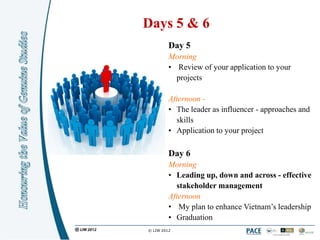
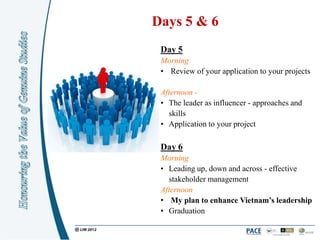
Days 5 & 6
             Day 5
             Morning
             • Review of your application to your
               projects
             • Optimising your climate - stakeholder
               management

             Afternoon -
             • The leader as influencer - approaches and
               skills
             • Application to your project

             Day 6
             Morning
             • Leading up, down and across - effective
               stakeholder management
             Afternoon
             • My plan to enhance Vietnam‟s leadership
             • Graduation
Project Presentations


   © LIW 2012
Days 5 & 6
       Day 5
       Morning
       • Review of your application to your projects

       Afternoon -
       • The leader as influencer - approaches and
         skills
       • Application to your project

       Day 6
       Morning
       • Leading up, down and across - effective
         stakeholder management
       Afternoon
       • My plan to enhance Vietnam‟s leadership
       • Graduation


© LIW 2012
© LIW 2011
Leading other people’s people

How it can go all wrong!
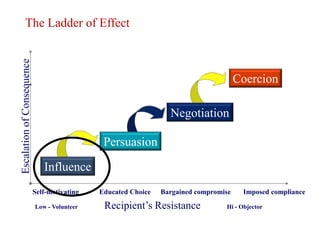
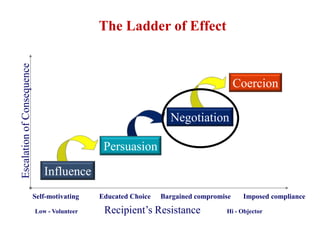
The Ladder of Effect
Escalation of Consequence


                                                                                       Coercion

                                                                  Negotiation

                                               Persuasion

                               Influence
                            Self-motivating   Educated Choice   Bargained compromise    Imposed compliance

                            Low - Volunteer    Recipient‟s Resistance             Hi - Objector
“The power of producing effects by invisible or
                            insensible means”

                                      “Astrol”

                                  (Macquarie)
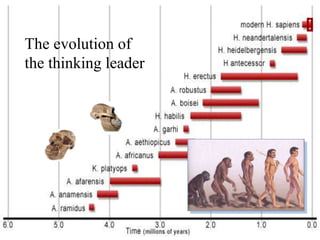
Where did it all start?
The evolution of
the thinking leader
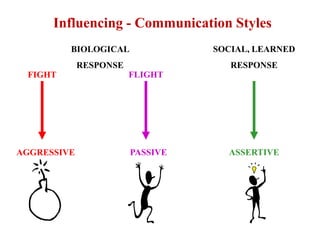
Influencing - Communication Styles
         BIOLOGICAL               SOCIAL, LEARNED
             RESPONSE                RESPONSE
 FIGHT                  FLIGHT


AGGRESSIVE              PASSIVE     ASSERTIVE
Aggressive
Aggressive behaviour is:

Believing that one‟s own needs, opinions, thoughts
and feelings are more important than others‟, and
showing a lack of respect for the needs of others.


Aggressive behaviour ranges from interrupting
others, „telling‟ and being very directive, to extreme
aggression, making threats and being hostile.
Passive

Passive behaviour is:

Believing that one‟s own needs, opinions, thoughts
and feelings are less important than others, and
deferring to the thoughts and needs of others.


Passive behaviour ranges from saying yes when we
really want to say no, through not or sharing in
team discussions to sulking and isolation.
Assertive

Assertive behaviour is defined as:

 Believing that one‟s own needs, opinions, thoughts
 and feelings are as important as anyone else‟s, and
 showing respect for the needs and thoughts of others.
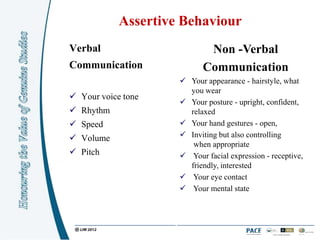
Assertive Behaviour
Verbal                      Non -Verbal
Communication              Communication
                      Your appearance - hairstyle, what
                       you wear
 Your voice tone
                      Your posture - upright, confident,
 Rhythm               relaxed
 Speed               Your hand gestures - open,
 Volume              Inviting but also controlling
                        when appropriate
 Pitch               Your facial expression - receptive,
                       friendly, interested
                      Your eye contact
                      Your mental state
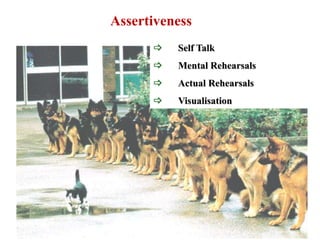
Assertiveness
         Self Talk
         Mental Rehearsals
         Actual Rehearsals
         Visualisation
Assertive Responses
Definites ………………………How, What or Why?
Universals…………………….Challenge with facts
Linked Statements…………..Why or How?
Beliefs, Declarations,
suppositions……………..What or Why
Cause & Effect……………….What or Why?
Predictions……………………What, Why or Facts
Incomplete Comparisons…..Compared to? Why?
Judgement…………………….Who? Why?
Incomplete requests………...Ask for Specifics
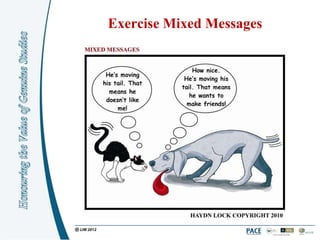
Exercise Mixed Messages
First Round

I‟d like some help with this


        © LIW 2012
Second Round

I‟m not able to deliver that on time


           © LIW 2012
Third Round

You don‟t seem to understand me


          © LIW 2012
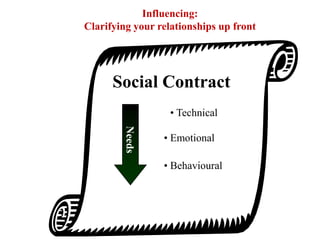
Influencing:
Clarifying your relationships up front


      Social Contract
                   • Technical
        Needs
                 • Emotional

                 • Behavioural
Needs
                         Addressing
                        the needs of
                             Others
        How can we understand these?
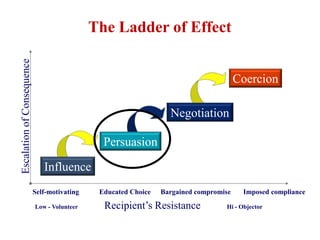
Escalation of Consequence                     The Ladder of Effect


                                                                                        Coercion

                                                                   Negotiation

                                                Persuasion

                               Influence
                            Self-motivating    Educated Choice   Bargained compromise    Imposed compliance

                            Low - Volunteer     Recipient‟s Resistance             Hi - Objector
Persuasion
Leading Other People’s People

Persuasion:

“to prevail on a person by logic, reasons,
 inducements to do something. To induce
to believe or convince”

(Macquarie)
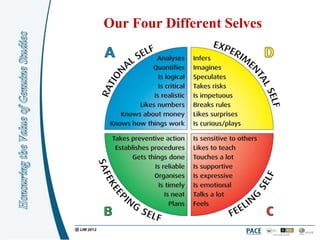
Our Four Different Selves
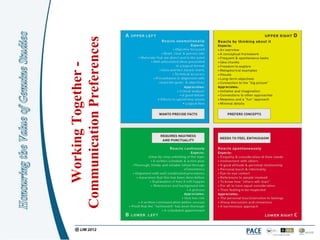
Working Together -
Communication Preferences
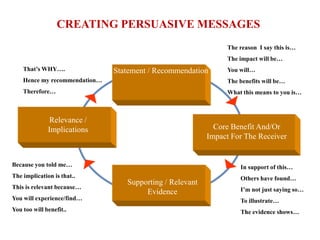
CREATING PERSUASIVE MESSAGES
                                                               The reason I say this is…
                                                               The impact will be…
    That’s WHY….               Statement / Recommendation      You will…
    Hence my recommendation…                                   The benefits will be…
    Therefore…                                                 What this means to you is…


              Relevance /
              Implications                                  Core Benefit And/Or
                                                          Impact For The Receiver


Because you told me…                                               In support of this…
The implication is that..                                          Others have found…
                                  Supporting / Relevant
This is relevant because…                                          I’m not just saying so…
                                       Evidence
You will experience/find…                                          To illustrate…
You too will benefit..                                             The evidence shows…
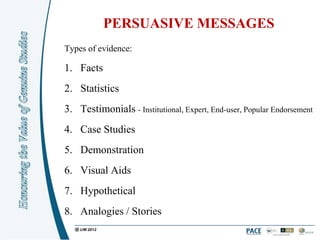
PERSUASIVE MESSAGES
Types of evidence:

1. Facts
2. Statistics
3. Testimonials - Institutional, Expert, End-user, Popular Endorsement
4. Case Studies
5. Demonstration
6. Visual Aids
7. Hypothetical
8. Analogies / Stories
Exercise in Pairs

You have to persuade your buddy on the following.....
Escalation of Consequence                     The Ladder of Effect


                                                                                       Coercion

                                                                  Negotiation

                                               Persuasion

                               Influence
                            Self-motivating   Educated Choice   Bargained compromise    Imposed compliance

                            Low - Volunteer    Recipient‟s Resistance             Hi - Objector
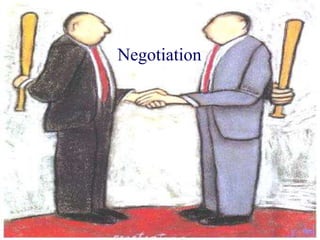
Negotiation


  The art of
  making an
  argument
Outcomes of Negotiation
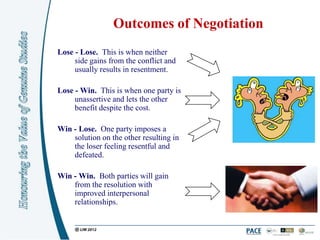
Lose - Lose. This is when neither
     side gains from the conflict and
     usually results in resentment.

Lose - Win. This is when one party is
     unassertive and lets the other
     benefit despite the cost.

Win - Lose. One party imposes a
    solution on the other resulting in
    the loser feeling resentful and
    defeated.

Win - Win. Both parties will gain
    from the resolution with
    improved interpersonal
    relationships.
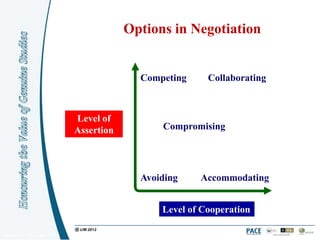
Options in Negotiation


                                     Competing     Collaborating


                       Level of
                       Assertion         Compromising


                                     Avoiding    Accommodating


                                         Level of Cooperation

Source - Thomas 1976
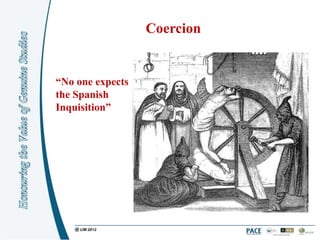
Coercion


“No one expects
the Spanish
Inquisition”
Leading Other People’s People
Coercion:

“To force to do something by threat, law or authority. To
compel by forcible action”


(Macquarie)
Leading Other People’s People

Coercion Discussion:

What constitutes coercion?

When would you consider ever using it?

What are the consequences?
Coercion

“Coercion attempts to force people to change
beliefs, ideas, attitudes or behaviours using
psychological pressure, undue influence, threats,
anxiety, intimidation and/or stress.”


(Martyn Carruthers 2005)


    What does this look like in the day-to-day workplace?
Coercion
When do employees or peers feel coerced?

 •   I demand that you do it.
 •   I criticize you for not doing it.
 •   I yell until you do it
 •   I curse until you do it
 •   I threaten with punishment if you don’t
     do it.

 (Buss et.al. 1987, 1995, 2003)
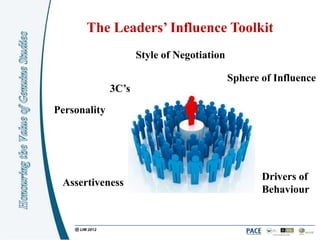
The Leaders’ Influence Toolkit
                     Style of Negotiation

                                            Sphere of Influence
              3C’s

Personality


                                                   Drivers of
 Assertiveness
                                                   Behaviour
© LIW 2011
             6
Days 5 & 6
         Day 5
         Morning
         • Review of your application to your
           projects

         Afternoon -
         • The leader as influencer - approaches and
           skills
         • Application to your project

         Day 6
         Morning
         • Leading up, down and across - effective
           stakeholder management
         Afternoon
         • My plan to enhance Vietnam‟s leadership
         • Graduation
© LIW 2012
© LIW 2011
© LIW 2011
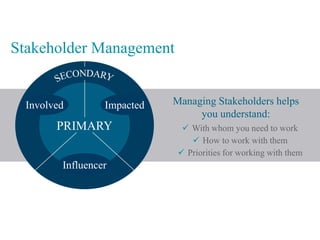
Stakeholder Management
Managing Stakeholders


   Involved        Impacted   Managing Stakeholders helps
                                   you understand:
         PRIMARY                 With whom you need to work
                                   How to work with them
                                Priorities for working with them
          Influencer
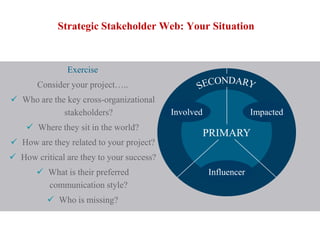
Strategic Stakeholder Web: Your Situation


               Exercise
       Consider your project…..
 Who are the key cross-organizational
             stakeholders?                 Involved                Impacted
     Where they sit in the world?
                                                      PRIMARY
 How are they related to your project?
 How critical are they to your success?
        What is their preferred                      Influencer
         communication style?
           Who is missing?
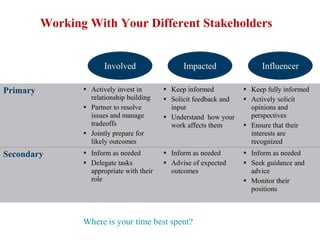
Working With Your Different Stakeholders


                        Involved                  Impacted                Influencer

Primary           Actively invest in        Keep informed           Keep fully informed
                   relationship building     Solicit feedback and    Actively solicit
                  Partner to resolve         input                    opinions and
                   issues and manage         Understand how your      perspectives
                   tradeoffs                  work affects them       Ensure that their
                  Jointly prepare for                                 interests are
                   likely outcomes                                     recognized
Secondary         Inform as needed          Inform as needed        Inform as needed
                  Delegate tasks            Advise of expected      Seek guidance and
                   appropriate with their     outcomes                 advice
                   role                                               Monitor their
                                                                       positions


                 Where is your time best spent?
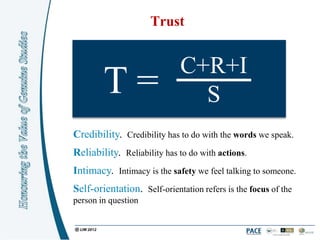
Trust


                             C+R+I
        T=                     S
Credibility. Credibility has to do with the words we speak.
Reliability. Reliability has to do with actions.
Intimacy. Intimacy is the safety we feel talking to someone.
Self-orientation. Self-orientation refers is the focus of the
person in question
Days 5 & 6
 Day 5
 Morning
 • Review of your application to your projects

 Afternoon -
 • The leader as influencer - approaches and
   skills
 • Application to your project

 Day 6
 Morning
 • Leading up, down and across - effective
   stakeholder management
 Afternoon
 • My plan to enhance Vietnam’s leadership
 • Graduation
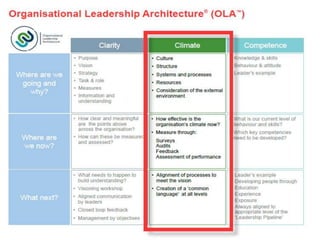
®
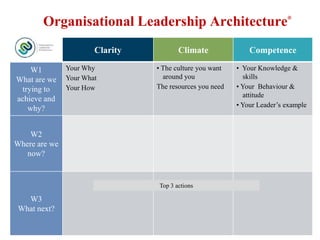
       Organisational Leadership Architecture
                       Clarity          Climate               Competence

     W1        Your Why          • The culture you want   • Your Knowledge &
What are we    Your What           around you               skills
  trying to    Your How          The resources you need   • Your Behaviour &
                                                            attitude
achieve and
                                                          • Your Leader‟s example
    why?


    W2
Where are we
   now?


                                 Top 3 actions

   W3
 What next?
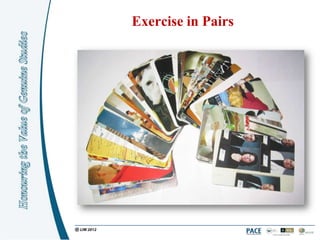
Exercise in Pairs
Graduation
Finally...

Ldp leadership development - eng

  • 2.
    ... back tothe Leadership Development Program
  • 3.
  • 4.
    What are wetrying to achieve?
  • 5.
    LoS Objectives andOutcomes 1. Be able to use a suite of pragmatic leadership tools in order to lead more effectively; 2. Have created a comprehensive leadership development strategy for themselves & their organizations, and have clear objectives to implement the strategy; 3. Have a „baseline‟ measure of their leadership competence and have completed a second survey to illustrate their progress; 4. Have developed and practiced their leadership coaching skills in order to create leadership and leaders around them; 5. Have built a support network of other leaders within Vietnam; 6. Be connected via LIW‟s program alumni to network of leaders globally. © LIW 2012
  • 6.
    A world classleadership development program Below is a 2 month program commencing with an individual profiling tool followed by an initial two day face to face workshop, then two days via videoconference and finally two days face to face. Participants complete the program by writing a case study regarding the impact of the learnings to their strategic project. This is submitted and marked. 2 months 2 weeks 2 weeks 2 weeks 2 weeks Workshop Prework Workshop THREE: Profiling Workshop Re tool ONE: F2F F2F Measure Application of TWO: VC Application OLA Prework and 2days of Application 2days of Profiling survey pre reading learning and 2x1/2days of of learning of learning tool High e-learning and High Impact and benchmark modules High Impact e-learning e-learning OLA Strategic Impact experiential Case experiential modules modules project experiential learning study selected learning learning Graduation ceremony Application: Work on the leadership program during and in between the workshop sessions Online community of practice - Continue the thinking: readings, videos, case studies, shared experiences On-the-Job application of leadership skills and approaches: reflection with group/individual follow-up
  • 7.
    Senior Leadership developmentprogram flow DAY TOPICS 1. Creating an organisational What is leadership? Developing leadership, not leaders leadership architecture Organisational vision - what is yours? Your role in driving it? Shared leadership and leadership responsibility Aligning the leadership mindset Creating the conditions for success Being a leadership architect 2. Understanding myself and others Looking in the mirror to understand yourself, looking around to understand others Why should anyone be led by me? Behaviour and drivers - what drives behaviour? Motivation, Perception, Values Leading others: Learned Optimism, Learned Helplessness Attributing success and failure: impact - what hinders, what helps 3. Unlocking leadership potential in Differences in others‟ thinking preferences others How do I lead someone who is the polar opposite to me? What is coaching? Why do we do it? Coaching model Buddy up: Live coaching of others for success Having the difficult conversations Creating a culture of feedback for growth and results Performance leadership 4. Building alignment & Cascading Decision making: gut feel or objective? Decision making Who should be involved in decisions? How do you make decision? Aligned decision making model Cascading aligned leadership thinking 5. Influential leadership up, down What is influence? Persuasion? Negotiation? Coercion? and across Who are your stakeholders? Stakeholder mapping Proactive and reactive relationship management 6. My plan to enhance Vietnam’s Practical application of OLA leadership Final presentation and individual action plan commitment to further enhance the leadership capacity of Vietnam Graduation ceremony
  • 8.
    A recap • Leadership transition - Pipeline • Understanding our self and • Leadership mindset - 3Ws others - Self awareness and • Conditions for Success - 3C‟s • The Psychology of Leadership • OLA • Thinking styles and preferences • Decision Making - - HBDI • The role of leader as coach © LIW 2012
  • 9.
    Days 5 &6 Day 5 Morning • Review of your application to your projects • Optimising your climate - stakeholder management Afternoon - • The leader as influencer - approaches and skills • Application to your project Day 6 Morning • Leading up, down and across - effective stakeholder management Afternoon • My plan to enhance Vietnam‟s leadership • Graduation
  • 10.
  • 11.
    Days 5 &6 Day 5 Morning • Review of your application to your projects Afternoon - • The leader as influencer - approaches and skills • Application to your project Day 6 Morning • Leading up, down and across - effective stakeholder management Afternoon • My plan to enhance Vietnam‟s leadership • Graduation © LIW 2012
  • 12.
  • 13.
    Leading other people’speople How it can go all wrong!
  • 15.
    The Ladder ofEffect Escalation of Consequence Coercion Negotiation Persuasion Influence Self-motivating Educated Choice Bargained compromise Imposed compliance Low - Volunteer Recipient‟s Resistance Hi - Objector
  • 16.
    “The power ofproducing effects by invisible or insensible means” “Astrol” (Macquarie)
  • 17.
    Where did itall start?
  • 18.
    The evolution of thethinking leader
  • 20.
    Influencing - CommunicationStyles BIOLOGICAL SOCIAL, LEARNED RESPONSE RESPONSE FIGHT FLIGHT AGGRESSIVE PASSIVE ASSERTIVE
  • 21.
    Aggressive Aggressive behaviour is: Believingthat one‟s own needs, opinions, thoughts and feelings are more important than others‟, and showing a lack of respect for the needs of others. Aggressive behaviour ranges from interrupting others, „telling‟ and being very directive, to extreme aggression, making threats and being hostile.
  • 22.
    Passive Passive behaviour is: Believingthat one‟s own needs, opinions, thoughts and feelings are less important than others, and deferring to the thoughts and needs of others. Passive behaviour ranges from saying yes when we really want to say no, through not or sharing in team discussions to sulking and isolation.
  • 23.
    Assertive Assertive behaviour isdefined as: Believing that one‟s own needs, opinions, thoughts and feelings are as important as anyone else‟s, and showing respect for the needs and thoughts of others.
  • 24.
    Assertive Behaviour Verbal Non -Verbal Communication Communication  Your appearance - hairstyle, what you wear  Your voice tone  Your posture - upright, confident,  Rhythm relaxed  Speed  Your hand gestures - open,  Volume  Inviting but also controlling when appropriate  Pitch  Your facial expression - receptive, friendly, interested  Your eye contact  Your mental state
  • 25.
    Assertiveness  Self Talk  Mental Rehearsals  Actual Rehearsals  Visualisation
  • 26.
    Assertive Responses Definites ………………………How,What or Why? Universals…………………….Challenge with facts Linked Statements…………..Why or How? Beliefs, Declarations, suppositions……………..What or Why Cause & Effect……………….What or Why? Predictions……………………What, Why or Facts Incomplete Comparisons…..Compared to? Why? Judgement…………………….Who? Why? Incomplete requests………...Ask for Specifics
  • 27.
  • 28.
    First Round I‟d likesome help with this © LIW 2012
  • 29.
    Second Round I‟m notable to deliver that on time © LIW 2012
  • 30.
    Third Round You don‟tseem to understand me © LIW 2012
  • 31.
    Influencing: Clarifying your relationshipsup front Social Contract • Technical Needs • Emotional • Behavioural
  • 32.
    Needs Addressing the needs of Others How can we understand these?
  • 33.
    Escalation of Consequence The Ladder of Effect Coercion Negotiation Persuasion Influence Self-motivating Educated Choice Bargained compromise Imposed compliance Low - Volunteer Recipient‟s Resistance Hi - Objector
  • 34.
  • 35.
    Leading Other People’sPeople Persuasion: “to prevail on a person by logic, reasons, inducements to do something. To induce to believe or convince” (Macquarie)
  • 36.
  • 37.
  • 38.
    CREATING PERSUASIVE MESSAGES The reason I say this is… The impact will be… That’s WHY…. Statement / Recommendation You will… Hence my recommendation… The benefits will be… Therefore… What this means to you is… Relevance / Implications Core Benefit And/Or Impact For The Receiver Because you told me… In support of this… The implication is that.. Others have found… Supporting / Relevant This is relevant because… I’m not just saying so… Evidence You will experience/find… To illustrate… You too will benefit.. The evidence shows…
  • 39.
    PERSUASIVE MESSAGES Types ofevidence: 1. Facts 2. Statistics 3. Testimonials - Institutional, Expert, End-user, Popular Endorsement 4. Case Studies 5. Demonstration 6. Visual Aids 7. Hypothetical 8. Analogies / Stories
  • 40.
    Exercise in Pairs Youhave to persuade your buddy on the following.....
  • 41.
    Escalation of Consequence The Ladder of Effect Coercion Negotiation Persuasion Influence Self-motivating Educated Choice Bargained compromise Imposed compliance Low - Volunteer Recipient‟s Resistance Hi - Objector
  • 42.
    Negotiation Theart of making an argument
  • 43.
    Outcomes of Negotiation Lose- Lose. This is when neither side gains from the conflict and usually results in resentment. Lose - Win. This is when one party is unassertive and lets the other benefit despite the cost. Win - Lose. One party imposes a solution on the other resulting in the loser feeling resentful and defeated. Win - Win. Both parties will gain from the resolution with improved interpersonal relationships.
  • 44.
    Options in Negotiation Competing Collaborating Level of Assertion Compromising Avoiding Accommodating Level of Cooperation Source - Thomas 1976
  • 46.
    Coercion “No one expects theSpanish Inquisition”
  • 47.
    Leading Other People’sPeople Coercion: “To force to do something by threat, law or authority. To compel by forcible action” (Macquarie)
  • 48.
    Leading Other People’sPeople Coercion Discussion: What constitutes coercion? When would you consider ever using it? What are the consequences?
  • 49.
    Coercion “Coercion attempts toforce people to change beliefs, ideas, attitudes or behaviours using psychological pressure, undue influence, threats, anxiety, intimidation and/or stress.” (Martyn Carruthers 2005) What does this look like in the day-to-day workplace?
  • 50.
    Coercion When do employeesor peers feel coerced? • I demand that you do it. • I criticize you for not doing it. • I yell until you do it • I curse until you do it • I threaten with punishment if you don’t do it. (Buss et.al. 1987, 1995, 2003)
  • 51.
    The Leaders’ InfluenceToolkit Style of Negotiation Sphere of Influence 3C’s Personality Drivers of Assertiveness Behaviour
  • 52.
  • 53.
    Days 5 &6 Day 5 Morning • Review of your application to your projects Afternoon - • The leader as influencer - approaches and skills • Application to your project Day 6 Morning • Leading up, down and across - effective stakeholder management Afternoon • My plan to enhance Vietnam‟s leadership • Graduation © LIW 2012
  • 54.
  • 55.
  • 56.
    Stakeholder Management Managing Stakeholders Involved Impacted Managing Stakeholders helps you understand: PRIMARY  With whom you need to work  How to work with them  Priorities for working with them Influencer
  • 57.
    Strategic Stakeholder Web:Your Situation Exercise Consider your project…..  Who are the key cross-organizational stakeholders? Involved Impacted  Where they sit in the world? PRIMARY  How are they related to your project?  How critical are they to your success?  What is their preferred Influencer communication style?  Who is missing?
  • 58.
    Working With YourDifferent Stakeholders Involved Impacted Influencer Primary  Actively invest in  Keep informed  Keep fully informed relationship building  Solicit feedback and  Actively solicit  Partner to resolve input opinions and issues and manage  Understand how your perspectives tradeoffs work affects them  Ensure that their  Jointly prepare for interests are likely outcomes recognized Secondary  Inform as needed  Inform as needed  Inform as needed  Delegate tasks  Advise of expected  Seek guidance and appropriate with their outcomes advice role  Monitor their positions Where is your time best spent?
  • 59.
    Trust C+R+I T= S Credibility. Credibility has to do with the words we speak. Reliability. Reliability has to do with actions. Intimacy. Intimacy is the safety we feel talking to someone. Self-orientation. Self-orientation refers is the focus of the person in question
  • 60.
    Days 5 &6 Day 5 Morning • Review of your application to your projects Afternoon - • The leader as influencer - approaches and skills • Application to your project Day 6 Morning • Leading up, down and across - effective stakeholder management Afternoon • My plan to enhance Vietnam’s leadership • Graduation
  • 62.
    ® Organisational Leadership Architecture Clarity Climate Competence W1 Your Why • The culture you want • Your Knowledge & What are we Your What around you skills trying to Your How The resources you need • Your Behaviour & attitude achieve and • Your Leader‟s example why? W2 Where are we now? Top 3 actions W3 What next?
  • 63.
  • 64.
  • 65.

Editor's Notes

  • #60 Timing: 3 minutesParticipant Guide: Page 4-95Intent: UnderstandingObjective: A little more depth. Notes: Intimacy can be difficult to understand but it essentially exists when someone will treat information confidentially. When this condition exists, you can speak openly with the other person without fear of that information being used against you.If your objective, or W1 is to build high trust, you will need to maximise the C, R and I will minimising your self-interest.