Talent Management
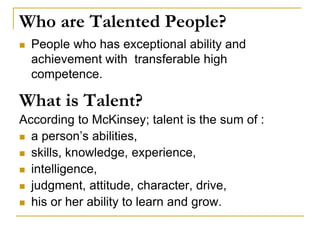
Who are Talented People?
 People who has exceptional ability and
achievement with transferable high
competence.
What is Talent?
According to McKinsey; talent is the sum of :
 a person’s abilities,
 skills, knowledge, experience,
 intelligence,
 judgment, attitude, character, drive,
 his or her ability to learn and grow.
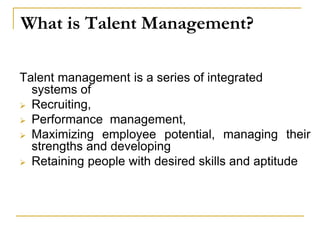
What is Talent Management?
Talent management is a series of integrated
systems of
 Recruiting,
 Performance management,
 Maximizing employee potential, managing their
strengths and developing
 Retaining people with desired skills and aptitude
Talent Management
 TM is identified as the critical success factor in
corporate world
 TM focuses on
 differentiated performance: A, B, C players
influencing company performance and
success
 identifying key positions in the organization
Why Organizations Need Talent Development?
 To develop leaders for tomorrow from within an
organization
 To maximize employee performance as a
unique source of competitive advantage
 To empower employees:
 Cut down high turnover rates
 Reduce the cost of constantly hiring new people
to train
Talent Management Model
 There are different approaches to talent
management in organizations
 A successful TM model has to link
1. TM creed (what types of people are expected
to work in the organization and what type of a
culture is desired to achieve success) with
2. TM strategy and
3. TM system.
should be embedded in HR systems as selection
criteria, competency definitions, performance
and promotion criteria and development
processes.
The Talent Strategy
Describes what type of people the organization will
invest in (select, train, develop, reward)
1) Identify key positions in the organization (not
more than 20 to 30 %)
2) Assess your employees and identify the high
performers (classify according to their current
and future potential)
3) Retain key position backups
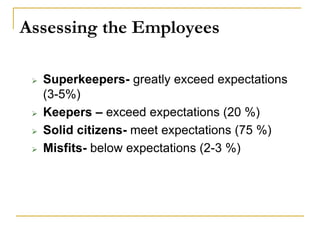
Assessing the Employees
 Superkeepers- greatly exceed expectations
(3-5%)
 Keepers – exceed expectations (20 %)
 Solid citizens- meet expectations (75 %)
 Misfits- below expectations (2-3 %)
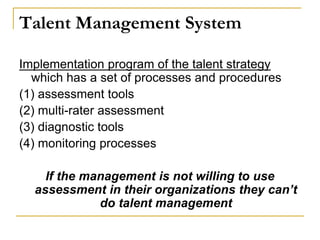
Talent Management System
Implementation program of the talent strategy
which has a set of processes and procedures
(1) assessment tools
(2) multi-rater assessment
(3) diagnostic tools
(4) monitoring processes
If the management is not willing to use
assessment in their organizations they can’t
do talent management
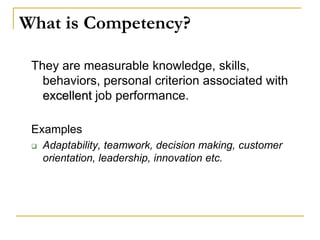
What is Competency?
They are measurable knowledge, skills,
behaviors, personal criterion associated with
excellent job performance.
Examples
 Adaptability, teamwork, decision making, customer
orientation, leadership, innovation etc.
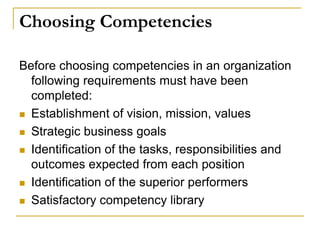
Choosing Competencies
Before choosing competencies in an organization
following requirements must have been
completed:
 Establishment of vision, mission, values
 Strategic business goals
 Identification of the tasks, responsibilities and
outcomes expected from each position
 Identification of the superior performers
 Satisfactory competency library
Why Competencies?
The starting point of the model is the creed
 Sends a consistent message to the workforce about
“what it takes” to be successful in the job
 Helps drive successful performance
 Focuses on the “How” of the job.
 Competency models are outcome driven rather than
activities (Job descriptions focus on activities,
competencies focus on outcomes)
 Integrates HR strategy with business strategy –both
focus on outcomes
Results of one TM system is used as the input
data for the following TM system.
The Competency Model
 The Competency Model identifies usually three
groups of competencies:
 Core competencies for the entire organization to shape the
organizational capabilities and culture required to achieve
the strategic goals
 Leadership competencies for the management teams of
various levels for selection, career planning and
development
 Functional (technical) competencies (specific for each job
family)
Talent Management
TALENT=COMPETENCE+COMMITMENT+CONTRIBUTION
Retention is also essential to gaurantee future
alignment of the talent with the right key
positions
Talent Management Model
 Expectations for the future. Businesses should identify
 Job roles
 Spesific objectives
 Competencies
 Capabilities to meet the expectations
 Work environment
 Managerial support
 Rewards and recognition
 Removing barriers
 Feedback systems needed to
 Focus
 Keep on track
 Develop
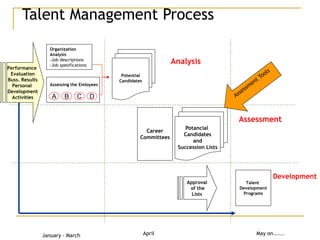
Talent Management Process
Organization
Analysis
-Job descriptions
-Job spesifications
Assessing the Emloyees
A B C D
Potential
Candidates
Performance
Evaluation
Buss. Results
Personal
Development
Activities
Career
Committees
Potancial
Candidates
and
Succession Lists
Approval
of the
Lists
Analysis
Assessment
Development
Talent
Development
Programs
January - March April May on......
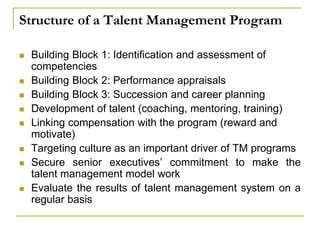
Structure of a Talent Management Program
 Building Block 1: Identification and assessment of
competencies
 Building Block 2: Performance appraisals
 Building Block 3: Succession and career planning
 Development of talent (coaching, mentoring, training)
 Linking compensation with the program (reward and
motivate)
 Targeting culture as an important driver of TM programs
 Secure senior executives’ commitment to make the
talent management model work
 Evaluate the results of talent management system on a
regular basis
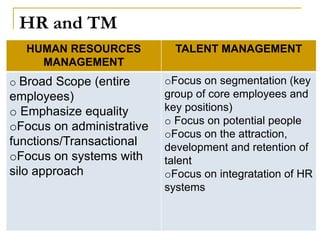
HR and TM
HUMAN RESOURCES
MANAGEMENT
TALENT MANAGEMENT
o Broad Scope (entire
employees)
o Emphasize equality
oFocus on administrative
functions/Transactional
oFocus on systems with
silo approach
oFocus on segmentation (key
group of core employees and
key positions)
o Focus on potential people
oFocus on the attraction,
development and retention of
talent
oFocus on integratation of HR
systems
19

TM-F.ppt

  • 1.
  • 2.
    Who are TalentedPeople?  People who has exceptional ability and achievement with transferable high competence. What is Talent? According to McKinsey; talent is the sum of :  a person’s abilities,  skills, knowledge, experience,  intelligence,  judgment, attitude, character, drive,  his or her ability to learn and grow.
  • 3.
    What is TalentManagement? Talent management is a series of integrated systems of  Recruiting,  Performance management,  Maximizing employee potential, managing their strengths and developing  Retaining people with desired skills and aptitude
  • 4.
    Talent Management  TMis identified as the critical success factor in corporate world  TM focuses on  differentiated performance: A, B, C players influencing company performance and success  identifying key positions in the organization
  • 5.
    Why Organizations NeedTalent Development?  To develop leaders for tomorrow from within an organization  To maximize employee performance as a unique source of competitive advantage  To empower employees:  Cut down high turnover rates  Reduce the cost of constantly hiring new people to train
  • 6.
    Talent Management Model There are different approaches to talent management in organizations  A successful TM model has to link 1. TM creed (what types of people are expected to work in the organization and what type of a culture is desired to achieve success) with 2. TM strategy and 3. TM system. should be embedded in HR systems as selection criteria, competency definitions, performance and promotion criteria and development processes.
  • 7.
    The Talent Strategy Describeswhat type of people the organization will invest in (select, train, develop, reward) 1) Identify key positions in the organization (not more than 20 to 30 %) 2) Assess your employees and identify the high performers (classify according to their current and future potential) 3) Retain key position backups
  • 8.
    Assessing the Employees Superkeepers- greatly exceed expectations (3-5%)  Keepers – exceed expectations (20 %)  Solid citizens- meet expectations (75 %)  Misfits- below expectations (2-3 %)
  • 9.
    Talent Management System Implementationprogram of the talent strategy which has a set of processes and procedures (1) assessment tools (2) multi-rater assessment (3) diagnostic tools (4) monitoring processes If the management is not willing to use assessment in their organizations they can’t do talent management
  • 10.
    What is Competency? Theyare measurable knowledge, skills, behaviors, personal criterion associated with excellent job performance. Examples  Adaptability, teamwork, decision making, customer orientation, leadership, innovation etc.
  • 11.
    Choosing Competencies Before choosingcompetencies in an organization following requirements must have been completed:  Establishment of vision, mission, values  Strategic business goals  Identification of the tasks, responsibilities and outcomes expected from each position  Identification of the superior performers  Satisfactory competency library
  • 12.
    Why Competencies? The startingpoint of the model is the creed  Sends a consistent message to the workforce about “what it takes” to be successful in the job  Helps drive successful performance  Focuses on the “How” of the job.  Competency models are outcome driven rather than activities (Job descriptions focus on activities, competencies focus on outcomes)  Integrates HR strategy with business strategy –both focus on outcomes Results of one TM system is used as the input data for the following TM system.
  • 13.
    The Competency Model The Competency Model identifies usually three groups of competencies:  Core competencies for the entire organization to shape the organizational capabilities and culture required to achieve the strategic goals  Leadership competencies for the management teams of various levels for selection, career planning and development  Functional (technical) competencies (specific for each job family)
  • 14.
    Talent Management TALENT=COMPETENCE+COMMITMENT+CONTRIBUTION Retention isalso essential to gaurantee future alignment of the talent with the right key positions
  • 15.
    Talent Management Model Expectations for the future. Businesses should identify  Job roles  Spesific objectives  Competencies  Capabilities to meet the expectations  Work environment  Managerial support  Rewards and recognition  Removing barriers  Feedback systems needed to  Focus  Keep on track  Develop
  • 16.
    Talent Management Process Organization Analysis -Jobdescriptions -Job spesifications Assessing the Emloyees A B C D Potential Candidates Performance Evaluation Buss. Results Personal Development Activities Career Committees Potancial Candidates and Succession Lists Approval of the Lists Analysis Assessment Development Talent Development Programs January - March April May on......
  • 17.
    Structure of aTalent Management Program  Building Block 1: Identification and assessment of competencies  Building Block 2: Performance appraisals  Building Block 3: Succession and career planning  Development of talent (coaching, mentoring, training)  Linking compensation with the program (reward and motivate)  Targeting culture as an important driver of TM programs  Secure senior executives’ commitment to make the talent management model work  Evaluate the results of talent management system on a regular basis
  • 18.
    HR and TM HUMANRESOURCES MANAGEMENT TALENT MANAGEMENT o Broad Scope (entire employees) o Emphasize equality oFocus on administrative functions/Transactional oFocus on systems with silo approach oFocus on segmentation (key group of core employees and key positions) o Focus on potential people oFocus on the attraction, development and retention of talent oFocus on integratation of HR systems
  • 19.