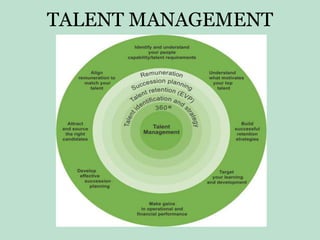
TALENT MANAGEMENT
Consider……....at any one time 59% of employees will be open to working elsewhere
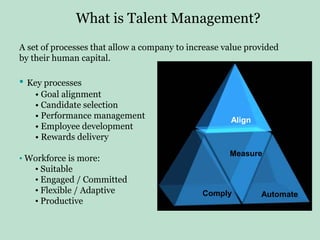
What is Talent Management?A set of processes that allow a company to increase value provided by their human capital.Key processes
 Goal alignment
 Candidate selection
 Performance management
 Employee development
 Rewards delivery
 Workforce is more:
 Suitable
 Engaged / Committed
 Flexible / Adaptive
 ProductiveAlignMeasureComplyAutomate
Characteristics Of Good Talent ManagementOwnership and involvementBusiness objectives permeate every aspect of the system The system is measured in real business terms and results are acted upon Hire the right people. Acclimate new employees Discuss career interests with employees Identify developmental opportunities Identify training opportunities Offer appropriate rewards and recognition Help employees to advance Create a workplace that has meaning and purpose
MANAGING TALENT EFFECTIVELY…Identify key rolesTake an inventory of your talent management skillsMeasure the right thingsSet up a process-wide feedback
The Develop-Deploy-Connect ModelAlignment: Connecting people to work that is motivating.Commitment: Providing coaching and mentoring. Capability: Developing critical skills to ensure success.
AcquiringtalentValue PropostionEducation & DevelopmentTalent Management ProcessBuilding Leadership SupplyRequires an integrated Approach Which Addresses the Following Areas:Assessing   new and      currenttalentDeveloping        talentTransitioning    TalentRetention
TALENT ACQUISTIONCORE CONCEPT Get away from the 'fill in the box' thinking to one that is more pro-active
 And much closer to building the skill sets required to achieve business  success.  Key to success in talent acquisition is the unique way that you are able  to tap into the 'top performers' who are not really looking for another job IMPORTANCEUnderstanding workforce demographics (current and future)
Identifying economic issues impacting organizational sustainability
Identifying organizational and cultural issues impacting talent acquisition
Knowledge of industry trends and emerging issues TALENT ACQUISITION STRATEGIESStrengthen Your Own Direct Reports Establish a talent Standard… sharp difference between poor; average and excellent performance is creating a benchmark for evaluation and promotion.Influence People Decisions Far Down the Organization Drive a Simple, Probing review of Talent Hold Managers Accountable for the strength of their talent poolsPoaching talent
Old MindsetA vague notion that “People are our most important asset”HR is responsible for people managementTwo days succession planningI work with the people I inherit
New MindsetA new conviction that talent leads to better corporate performanceAll managers are accountableTalent managers is a central partI take bold actions to build the talent pool I need
BALANCING INDIVIDUAL AND ORGANIZATIONAL NEEDS
THE CHANGING CAREER PARADIGMSOLD PARADIGMSJob SecurityLongitudinal Career PathsJob/Person FitOrganizational LoyaltyCareer SuccessAcademic DegreePosition/TitleFull-Time EmploymentRetirementSingle Jobs/CareersChange in jobs based on fearPromotion highly tenure basedNEW PARADIGMSEmployability SecurityAlternate Career PathsPerson/Organization FitJob/Task LoyaltyWork/Family BalanceContinuous RelearningCompetencies/DevelopmentContract EmploymentCareer SabbaticalsMultiple Jobs/CareersChange in jobs based on growthPromotion highly performance based
Contributions fromInducements fromthe IndividualtheOrganization•Effort•Pay•Ability•Job security•Loyalty•Benefits•Skills•Career opportunities•Time•Status•Competencies•Promotion opportunitiesTHE PSYCHOLOGICAL CONTRACTThe overall set of expectations held by an individual with respect to what he or she will contribute to the organization and what the organization will provide in return.

Talent Management

  • 1.
  • 2.
    Consider……....at any onetime 59% of employees will be open to working elsewhere
  • 3.
    What is TalentManagement?A set of processes that allow a company to increase value provided by their human capital.Key processes
  • 4.
  • 5.
  • 6.
  • 7.
  • 8.
  • 9.
  • 10.
  • 11.
    Engaged /Committed
  • 12.
    Flexible /Adaptive
  • 13.
  • 14.
    Characteristics Of GoodTalent ManagementOwnership and involvementBusiness objectives permeate every aspect of the system The system is measured in real business terms and results are acted upon Hire the right people. Acclimate new employees Discuss career interests with employees Identify developmental opportunities Identify training opportunities Offer appropriate rewards and recognition Help employees to advance Create a workplace that has meaning and purpose
  • 15.
    MANAGING TALENT EFFECTIVELY…Identifykey rolesTake an inventory of your talent management skillsMeasure the right thingsSet up a process-wide feedback
  • 16.
    The Develop-Deploy-Connect ModelAlignment:Connecting people to work that is motivating.Commitment: Providing coaching and mentoring. Capability: Developing critical skills to ensure success.
  • 17.
    AcquiringtalentValue PropostionEducation &DevelopmentTalent Management ProcessBuilding Leadership SupplyRequires an integrated Approach Which Addresses the Following Areas:Assessing new and currenttalentDeveloping talentTransitioning TalentRetention
  • 18.
    TALENT ACQUISTIONCORE CONCEPTGet away from the 'fill in the box' thinking to one that is more pro-active
  • 19.
    And muchcloser to building the skill sets required to achieve business success. Key to success in talent acquisition is the unique way that you are able to tap into the 'top performers' who are not really looking for another job IMPORTANCEUnderstanding workforce demographics (current and future)
  • 20.
    Identifying economic issuesimpacting organizational sustainability
  • 21.
    Identifying organizational andcultural issues impacting talent acquisition
  • 22.
    Knowledge of industrytrends and emerging issues TALENT ACQUISITION STRATEGIESStrengthen Your Own Direct Reports Establish a talent Standard… sharp difference between poor; average and excellent performance is creating a benchmark for evaluation and promotion.Influence People Decisions Far Down the Organization Drive a Simple, Probing review of Talent Hold Managers Accountable for the strength of their talent poolsPoaching talent
  • 23.
    Old MindsetA vaguenotion that “People are our most important asset”HR is responsible for people managementTwo days succession planningI work with the people I inherit
  • 24.
    New MindsetA newconviction that talent leads to better corporate performanceAll managers are accountableTalent managers is a central partI take bold actions to build the talent pool I need
  • 25.
    BALANCING INDIVIDUAL ANDORGANIZATIONAL NEEDS
  • 26.
    THE CHANGING CAREERPARADIGMSOLD PARADIGMSJob SecurityLongitudinal Career PathsJob/Person FitOrganizational LoyaltyCareer SuccessAcademic DegreePosition/TitleFull-Time EmploymentRetirementSingle Jobs/CareersChange in jobs based on fearPromotion highly tenure basedNEW PARADIGMSEmployability SecurityAlternate Career PathsPerson/Organization FitJob/Task LoyaltyWork/Family BalanceContinuous RelearningCompetencies/DevelopmentContract EmploymentCareer SabbaticalsMultiple Jobs/CareersChange in jobs based on growthPromotion highly performance based
  • 27.
    Contributions fromInducements fromtheIndividualtheOrganization•Effort•Pay•Ability•Job security•Loyalty•Benefits•Skills•Career opportunities•Time•Status•Competencies•Promotion opportunitiesTHE PSYCHOLOGICAL CONTRACTThe overall set of expectations held by an individual with respect to what he or she will contribute to the organization and what the organization will provide in return.