Talent Management A competency based HR program to select, develop and motivate high performing people
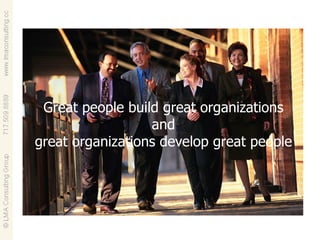
Great people build great organizations and great organizations develop great people
“ The first job of every leader is to match talent to task.” David Keirsey Please Understand Me II “ The right people don’t need to be tightly managed or fired up, they will be self-motivated to produce the best results.” Jim Collins Good to Great
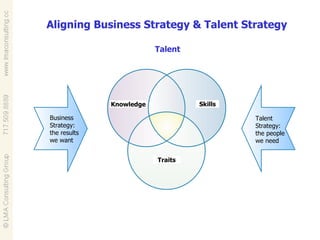
Aligning Business Strategy & Talent Strategy Traits Skills Knowledge Talent Business Strategy: the results we want Talent Strategy: the people we need
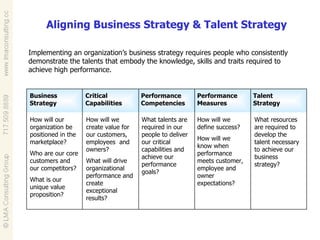
Aligning Business Strategy & Talent Strategy Implementing an organization’s business strategy requires people who consistently demonstrate the talents that embody the knowledge, skills and traits required to achieve high performance.  Business Strategy Talent Strategy How will our organization be positioned in the marketplace? Who are our core customers and our competitors? What is our unique value proposition? How will we create value for our customers, employees  and owners?  What will drive organizational performance and create  exceptional results? What talents are required in our people to deliver our critical capabilities and achieve our performance goals? How will we define success? How will we  know when performance meets customer, employee and owner  expectations? What resources are required to develop the talent necessary to achieve our business strategy? Critical Capabilities Performance Competencies Performance Measures
Knowledge:  Factual information that can be acquired through classwork, reading, talking with others, videos, websites, etc. Knowledge includes procedures, processes, specifications, products, regulations, market information. Skills:  Applied techniques that are acquired experientially. They can be developed through OJT, coaching and practice. Skills include using tools and equipment, negotiating, writing, sales. Traits:  Aptitudes, interests and personality and interaction style. Traits are innate to individuals and must be screened for and selected, typically through an assessment tool. They tend to be consistent for each individual over time. Traits include aspects such as leadership, assertiveness, resilience, creativity, mechanical aptitude, math aptitude. Talent Has Three Dimensions
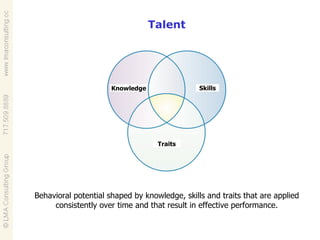
Behavioral potential shaped by knowledge, skills and traits that are applied consistently over time and that result in effective performance. Talent Traits Skills Knowledge
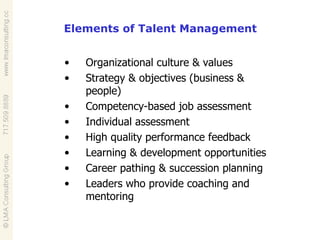
Organizational culture & values Strategy & objectives (business & people) Competency-based job assessment  Individual assessment  High quality performance feedback  Learning & development opportunities  Career pathing & succession planning  Leaders who provide coaching and mentoring Elements of Talent Management
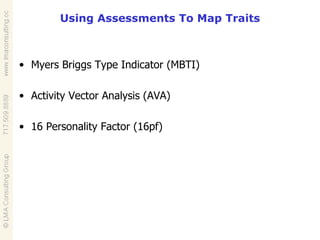
Using Assessments To Map Traits Myers Briggs Type Indicator (MBTI) Activity Vector Analysis (AVA) 16 Personality Factor (16pf)
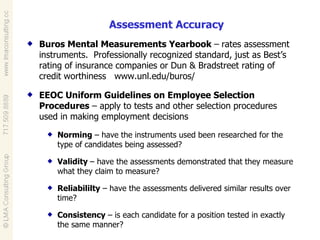
Assessment Accuracy Buros Mental Measurements Yearbook  –   rates assessment instruments.  Professionally recognized standard, just as Best’s rating of insurance companies or Dun & Bradstreet rating of credit worthiness  www.unl.edu/buros/ EEOC Uniform Guidelines on Employee Selection Procedures  – apply to tests and other selection procedures used in making employment decisions Norming  – have the instruments used been researched for the type of candidates being assessed? Validity  – have the assessments demonstrated that they measure what they claim to measure? Reliabililty  – have the assessments delivered similar results over time? Consistency  – is each candidate for a position tested in exactly the same manner?
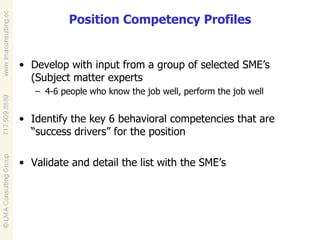
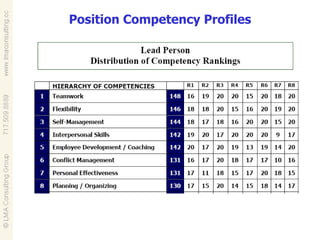
Position Competency Profiles Develop with input from a group of selected SME’s (Subject matter experts 4-6 people who know the job well, perform the job well Identify the key 6 behavioral competencies that are “success drivers” for the position Validate and detail the list with the SME’s
Position Competency Profiles
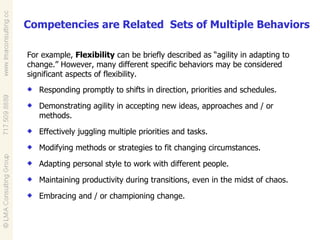
Competencies are Related  Sets of Multiple Behaviors Responding promptly to shifts in direction, priorities and schedules. Demonstrating agility in accepting new ideas, approaches and / or methods. Effectively juggling multiple priorities and tasks. Modifying methods or strategies to fit changing circumstances. Adapting personal style to work with different people. Maintaining productivity during transitions, even in the midst of chaos. Embracing and / or championing change. For example,  Flexibility  can be briefly described as “agility in adapting to change.” However, many different specific behaviors may be considered significant aspects of flexibility.
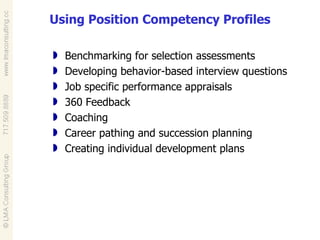
Using Position Competency Profiles Benchmarking for selection assessments Developing behavior-based interview questions Job specific performance appraisals 360 Feedback Coaching Career pathing and succession planning Creating individual development plans
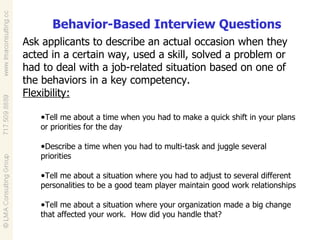
Behavior-Based Interview Questions Ask applicants to describe an actual occasion when they acted in a certain way, used a skill, solved a problem or had to deal with a job-related situation based on one of the behaviors in a key competency.  Flexibility: Tell me about a time when you had to make a quick shift in your plans or priorities for the day Describe a time when you had to multi-task and juggle several priorities Tell me about a situation where you had to adjust to several different personalities to be a good team player maintain good work relationships Tell me about a situation where your organization made a big change that affected your work.  How did you handle that?
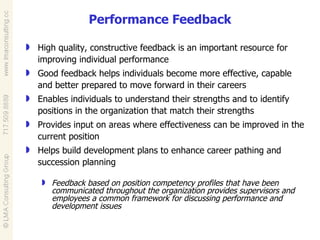
Performance Feedback High quality, constructive feedback is an important resource for improving individual performance Good feedback helps individuals become more effective, capable and better prepared to move forward in their careers Enables individuals to understand their strengths and to identify positions in the organization that match their strengths Provides input on areas where effectiveness can be improved in the current position Helps build development plans to enhance career pathing and succession planning Feedback based on position competency profiles that have been communicated throughout the organization provides supervisors and employees a common framework for discussing performance and development issues
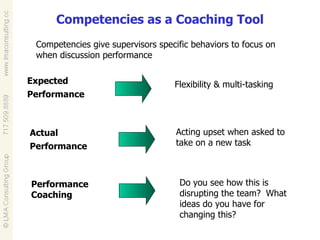
Expected Performance Actual Performance Performance Coaching Flexibility & multi-tasking Acting upset when asked to take on a new task Do you see how this is disrupting the team?   What ideas do you have for   changing this? Competencies as a Coaching Tool Competencies give supervisors specific behaviors to focus on when discussion performance
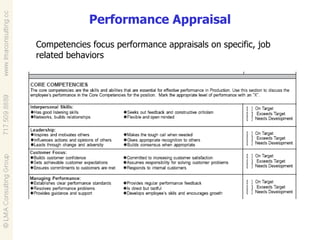
Performance Appraisal Competencies focus performance appraisals on specific, job related behaviors
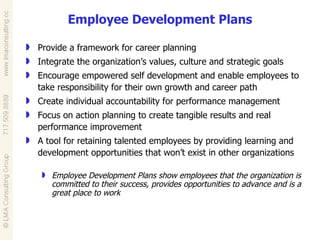
Employee Development Plans Provide a framework for career planning Integrate the organization’s values, culture and strategic goals Encourage empowered self development and enable employees to take responsibility for their own growth and career path Create individual accountability for performance management Focus on action planning to create tangible results and real performance improvement A tool for retaining talented employees by providing learning and development opportunities that won’t exist in other organizations Employee Development Plans show employees that the organization is committed to their success, provides opportunities to advance and is a great place to work
Leadership Role in Talent Management  Supervisors and managers become Talent Managers as well as business process managers Developers of “engaged workforce” that is committed to organizational mission, values, culture and meeting high performance standards Accountable and rewarded for growing talent Talent coaches, mentors, facilitators Resource providers
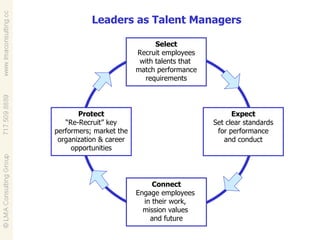
Leaders as Talent Managers Protect “ Re-Recruit” key performers; market the organization & career opportunities Expect Set clear standards for performance and conduct Connect Engage employees  in their work,  mission values  and future Select Recruit employees with talents that  match performance requirements
Strategic Talent Management   A strategic plan for the company’s talent needs. Places the right people with the right skills and abilities in the right positions at the right time. Provides people with a career path and the resources to develop the skills they and the company need to achieve success. Starts with people where they are today and looks to where they need to be as the company moves forward.
Better hiring decisions  Increased productivity  Improved motivation  Higher performance  Greater commitment  More effective teamwork  Clearer communication  Improved customer service & satisfaction  Pay for results  Benefits of Talent Management
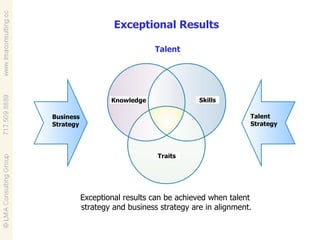
Business Strategy Talent Strategy Exceptional Results Exceptional results can be achieved when talent  strategy and business strategy are in alignment. Traits Skills Knowledge Talent
1848 Charter Lane Lancaster, PA 17601-5896 717.509.8889    Fax 717.509.8879 Toll Free 877.562.2888 www.lmaconsulting.cc

Competency Based HR Programs

  • 1.
    Talent Management Acompetency based HR program to select, develop and motivate high performing people
  • 2.
    Great people buildgreat organizations and great organizations develop great people
  • 3.
    “ The firstjob of every leader is to match talent to task.” David Keirsey Please Understand Me II “ The right people don’t need to be tightly managed or fired up, they will be self-motivated to produce the best results.” Jim Collins Good to Great
  • 4.
    Aligning Business Strategy& Talent Strategy Traits Skills Knowledge Talent Business Strategy: the results we want Talent Strategy: the people we need
  • 5.
    Aligning Business Strategy& Talent Strategy Implementing an organization’s business strategy requires people who consistently demonstrate the talents that embody the knowledge, skills and traits required to achieve high performance. Business Strategy Talent Strategy How will our organization be positioned in the marketplace? Who are our core customers and our competitors? What is our unique value proposition? How will we create value for our customers, employees and owners? What will drive organizational performance and create exceptional results? What talents are required in our people to deliver our critical capabilities and achieve our performance goals? How will we define success? How will we know when performance meets customer, employee and owner expectations? What resources are required to develop the talent necessary to achieve our business strategy? Critical Capabilities Performance Competencies Performance Measures
  • 6.
    Knowledge: Factualinformation that can be acquired through classwork, reading, talking with others, videos, websites, etc. Knowledge includes procedures, processes, specifications, products, regulations, market information. Skills: Applied techniques that are acquired experientially. They can be developed through OJT, coaching and practice. Skills include using tools and equipment, negotiating, writing, sales. Traits: Aptitudes, interests and personality and interaction style. Traits are innate to individuals and must be screened for and selected, typically through an assessment tool. They tend to be consistent for each individual over time. Traits include aspects such as leadership, assertiveness, resilience, creativity, mechanical aptitude, math aptitude. Talent Has Three Dimensions
  • 7.
    Behavioral potential shapedby knowledge, skills and traits that are applied consistently over time and that result in effective performance. Talent Traits Skills Knowledge
  • 8.
    Organizational culture &values Strategy & objectives (business & people) Competency-based job assessment Individual assessment High quality performance feedback Learning & development opportunities Career pathing & succession planning Leaders who provide coaching and mentoring Elements of Talent Management
  • 9.
    Using Assessments ToMap Traits Myers Briggs Type Indicator (MBTI) Activity Vector Analysis (AVA) 16 Personality Factor (16pf)
  • 10.
    Assessment Accuracy BurosMental Measurements Yearbook – rates assessment instruments. Professionally recognized standard, just as Best’s rating of insurance companies or Dun & Bradstreet rating of credit worthiness www.unl.edu/buros/ EEOC Uniform Guidelines on Employee Selection Procedures – apply to tests and other selection procedures used in making employment decisions Norming – have the instruments used been researched for the type of candidates being assessed? Validity – have the assessments demonstrated that they measure what they claim to measure? Reliabililty – have the assessments delivered similar results over time? Consistency – is each candidate for a position tested in exactly the same manner?
  • 11.
    Position Competency ProfilesDevelop with input from a group of selected SME’s (Subject matter experts 4-6 people who know the job well, perform the job well Identify the key 6 behavioral competencies that are “success drivers” for the position Validate and detail the list with the SME’s
  • 12.
  • 13.
    Competencies are Related Sets of Multiple Behaviors Responding promptly to shifts in direction, priorities and schedules. Demonstrating agility in accepting new ideas, approaches and / or methods. Effectively juggling multiple priorities and tasks. Modifying methods or strategies to fit changing circumstances. Adapting personal style to work with different people. Maintaining productivity during transitions, even in the midst of chaos. Embracing and / or championing change. For example, Flexibility can be briefly described as “agility in adapting to change.” However, many different specific behaviors may be considered significant aspects of flexibility.
  • 14.
    Using Position CompetencyProfiles Benchmarking for selection assessments Developing behavior-based interview questions Job specific performance appraisals 360 Feedback Coaching Career pathing and succession planning Creating individual development plans
  • 15.
    Behavior-Based Interview QuestionsAsk applicants to describe an actual occasion when they acted in a certain way, used a skill, solved a problem or had to deal with a job-related situation based on one of the behaviors in a key competency. Flexibility: Tell me about a time when you had to make a quick shift in your plans or priorities for the day Describe a time when you had to multi-task and juggle several priorities Tell me about a situation where you had to adjust to several different personalities to be a good team player maintain good work relationships Tell me about a situation where your organization made a big change that affected your work. How did you handle that?
  • 16.
    Performance Feedback Highquality, constructive feedback is an important resource for improving individual performance Good feedback helps individuals become more effective, capable and better prepared to move forward in their careers Enables individuals to understand their strengths and to identify positions in the organization that match their strengths Provides input on areas where effectiveness can be improved in the current position Helps build development plans to enhance career pathing and succession planning Feedback based on position competency profiles that have been communicated throughout the organization provides supervisors and employees a common framework for discussing performance and development issues
  • 17.
    Expected Performance ActualPerformance Performance Coaching Flexibility & multi-tasking Acting upset when asked to take on a new task Do you see how this is disrupting the team? What ideas do you have for changing this? Competencies as a Coaching Tool Competencies give supervisors specific behaviors to focus on when discussion performance
  • 18.
    Performance Appraisal Competenciesfocus performance appraisals on specific, job related behaviors
  • 19.
    Employee Development PlansProvide a framework for career planning Integrate the organization’s values, culture and strategic goals Encourage empowered self development and enable employees to take responsibility for their own growth and career path Create individual accountability for performance management Focus on action planning to create tangible results and real performance improvement A tool for retaining talented employees by providing learning and development opportunities that won’t exist in other organizations Employee Development Plans show employees that the organization is committed to their success, provides opportunities to advance and is a great place to work
  • 20.
    Leadership Role inTalent Management Supervisors and managers become Talent Managers as well as business process managers Developers of “engaged workforce” that is committed to organizational mission, values, culture and meeting high performance standards Accountable and rewarded for growing talent Talent coaches, mentors, facilitators Resource providers
  • 21.
    Leaders as TalentManagers Protect “ Re-Recruit” key performers; market the organization & career opportunities Expect Set clear standards for performance and conduct Connect Engage employees in their work, mission values and future Select Recruit employees with talents that match performance requirements
  • 22.
    Strategic Talent Management A strategic plan for the company’s talent needs. Places the right people with the right skills and abilities in the right positions at the right time. Provides people with a career path and the resources to develop the skills they and the company need to achieve success. Starts with people where they are today and looks to where they need to be as the company moves forward.
  • 23.
    Better hiring decisions Increased productivity Improved motivation Higher performance Greater commitment More effective teamwork Clearer communication Improved customer service & satisfaction Pay for results Benefits of Talent Management
  • 24.
    Business Strategy TalentStrategy Exceptional Results Exceptional results can be achieved when talent strategy and business strategy are in alignment. Traits Skills Knowledge Talent
  • 25.
    1848 Charter LaneLancaster, PA 17601-5896 717.509.8889  Fax 717.509.8879 Toll Free 877.562.2888 www.lmaconsulting.cc