Talent Acquisition
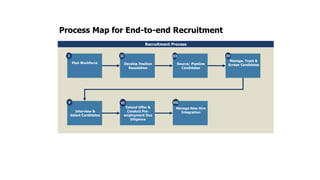
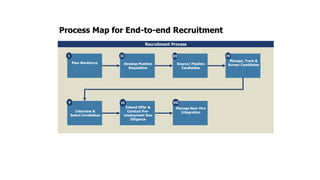
Process Map for End-to-end Recruitment 
Recruitment Process 
I II III IV 
Plan Workforce Develop Position 
Requisition 
Source/ Pipeline 
Candidates 
Manage, Track & 
Screen Candidates 
Interview & 
Select Candidates 
Extend Offer & 
Conduct Pre-employment 
Due 
Diligence 
Manage New Hire 
Integration 
V VI VII
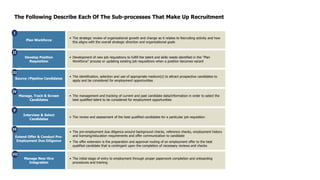
The Following Describe Each Of The Sub-processes That Make Up Recruitment 
Plan Workforce 
• The strategic review of organizational growth and change as it relates to Recruiting activity and how 
this aligns with the overall strategic direction and organizational goals 
Develop Position 
Requisition 
• Development of new job requisitions to fulfill the talent and skills needs identified in the “Plan 
Workforce” process or updating existing job requisitions when a position becomes vacant 
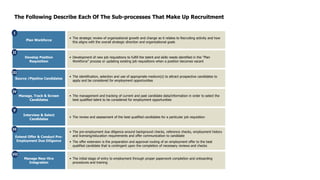
II 
III 
Source /Pipeline Candidates 
• The identification, selection and use of appropriate medium(s) to attract prospective candidates to 
apply and be considered for employment opportunities 
Manage, Track & Screen 
Candidates 
• The management and tracking of current and past candidate data/information in order to select the 
best qualified talent to be considered for employment opportunities 
Interview & Select 
Candidates 
• The review and assessment of the best qualified candidates for a particular job requisition 
IV 
V 
VI 
Extend Offer & Conduct Pre- 
Employment Due Diligence 
• The pre-employment due diligence around background checks, reference checks, employment history 
and licensing/education requirements and offer communication to candidate 
• The offer extension is the preparation and approval routing of an employment offer to the best 
qualified candidate that is contingent upon the completion of necessary reviews and checks 
Manage New Hire 
Integration 
I 
VII 
• The initial stage of entry to employment through proper paperwork completion and onboarding 
procedures and training
Staffing 
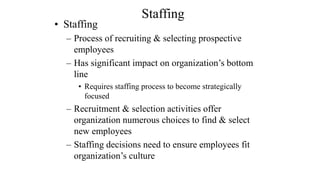
• Staffing 
– Process of recruiting & selecting prospective 
employees 
– Has significant impact on organization’s bottom 
line 
• Requires staffing process to become strategically 
focused 
– Recruitment & selection activities offer 
organization numerous choices to find & select 
new employees 
– Staffing decisions need to ensure employees fit 
organization’s culture
Recruiting 
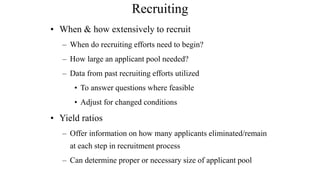
• When & how extensively to recruit 
– When do recruiting efforts need to begin? 
– How large an applicant pool needed? 
– Data from past recruiting efforts utilized 
• To answer questions where feasible 
• Adjust for changed conditions 
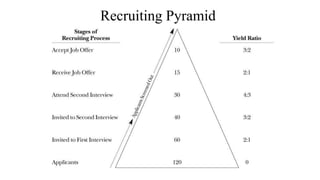
• Yield ratios 
– Offer information on how many applicants eliminated/remain 
at each step in recruitment process 
– Can determine proper or necessary size of applicant pool
Recruiting Pyramid
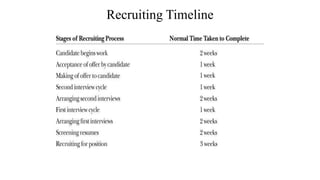
Recruiting Timeline
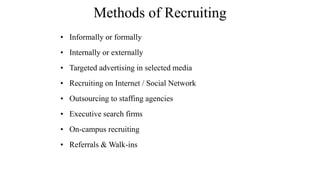
Methods of Recruiting 
• Informally or formally 
• Internally or externally 
• Targeted advertising in selected media 
• Recruiting on Internet / Social Network 
• Outsourcing to staffing agencies 
• Executive search firms 
• On-campus recruiting 
• Referrals & Walk-ins
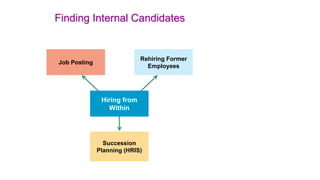
Finding Internal Candidates 
Hiring from 
Within 
Job Posting 
Succession 
Rehiring Former 
Planning (HRIS) 
Employees
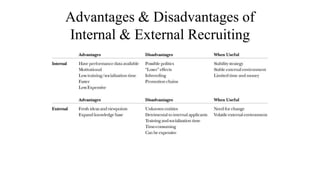
Advantages & Disadvantages of 
Internal & External Recruiting
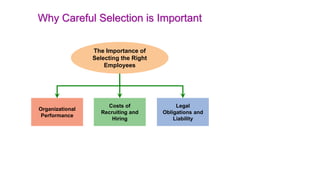
Why Careful Selection is Important 
Organizational 
Performance 
Legal 
Obligations and 
Liability 
The Importance of 
Selecting the Right 
Employees 
Costs of 
Recruiting and 
Hiring
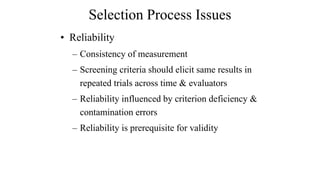
Selection Process Issues 
• Reliability 
– Consistency of measurement 
– Screening criteria should elicit same results in 
repeated trials across time & evaluators 
– Reliability influenced by criterion deficiency & 
contamination errors 
– Reliability is prerequisite for validity
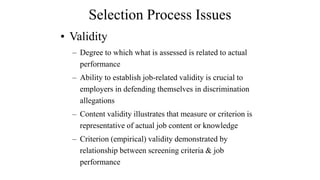
Selection Process Issues 
• Validity 
– Degree to which what is assessed is related to actual 
performance 
– Ability to establish job-related validity is crucial to 
employers in defending themselves in discrimination 
allegations 
– Content validity illustrates that measure or criterion is 
representative of actual job content or knowledge 
– Criterion (empirical) validity demonstrated by 
relationship between screening criteria & job 
performance
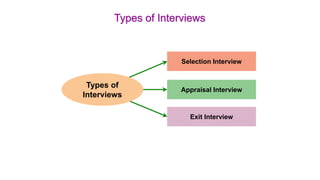
Types of Interviews 
Selection Interview 
Appraisal Interview 
Exit Interview 
Types of 
Interviews
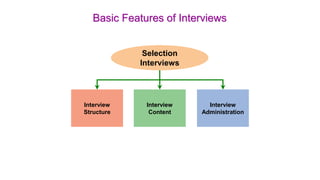
Basic Features of Interviews 
Interview 
Structure 
Interview 
Administration 
Selection 
Interviews 
Interview 
Content
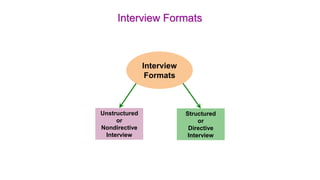
Interview Formats 
Unstructured 
or 
Nondirective 
Interview 
Interview 
Formats 
Structured 
or 
Directive 
Interview
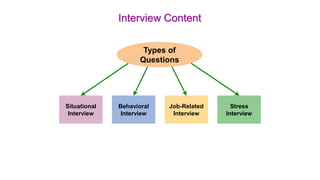
Interview Content 
Situational 
Interview 
Stress 
Interview 
Types of 
Questions 
Behavioral 
Interview 
Job-Related 
Interview
Behavioral Interviewing 
• Used with experienced & inexperienced 
applicants 
• Asks about situations candidate is likely to 
face on job 
• Candidates can present real-life situations 
they were involved in & how they handled 
them
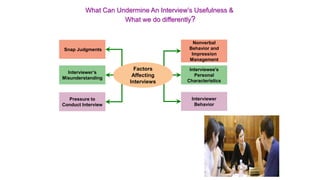
What Can Undermine An Interview’s Usefulness & 
What we do differently? 
Nonverbal 
Behavior and 
Impression 
Management 
Interviewee’s 
Personal 
Characteristics 
Interviewer 
Behavior 
Factors 
Affecting 
Interviews 
Snap Judgments 
Interviewer’s 
Misunderstanding 
Pressure to 
Conduct Interview
Interviewing Process Issues 
• Who should be involved? 
– Prospective supervisors, peers, subordinates 
• Which interview format? 
– Individual or group interviews 
• Common interviewer errors 
– Similarity errors 
– Contrast errors 
– First impression 
– Halo errors 
– Personal biases
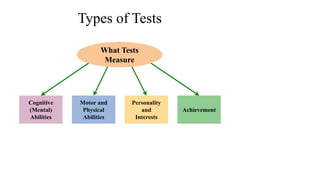
Types of Tests 
Cognitive 
(Mental) 
Abilities 
Achievement 
What Tests 
Measure 
Motor and 
Physical 
Abilities 
Personality 
and 
Interests
Testing 
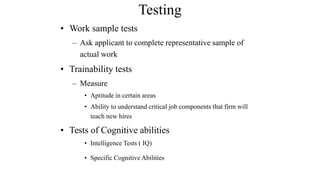
• Work sample tests 
– Ask applicant to complete representative sample of 
actual work 
• Trainability tests 
– Measure 
• Aptitude in certain areas 
• Ability to understand critical job components that firm will 
teach new hires 
• Tests of Cognitive abilities 
• Intelligence Tests ( IQ) 
• Specific Cognitive Abilities
Testing 
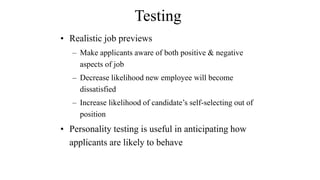
• Realistic job previews 
– Make applicants aware of both positive & negative 
aspects of job 
– Decrease likelihood new employee will become 
dissatisfied 
– Increase likelihood of candidate’s self-selecting out of 
position 
• Personality testing is useful in anticipating how 
applicants are likely to behave
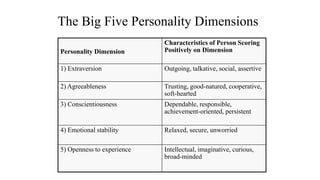
The Big Five Personality Dimensions 
Personality Dimension 
Characteristics of Person Scoring 
Positively on Dimension 
1) Extraversion Outgoing, talkative, social, assertive 
2) Agreeableness Trusting, good-natured, cooperative, 
soft-hearted 
3) Conscientiousness Dependable, responsible, 
achievement-oriented, persistent 
4) Emotional stability Relaxed, secure, unworried 
5) Openness to experience Intellectual, imaginative, curious, 
broad-minded
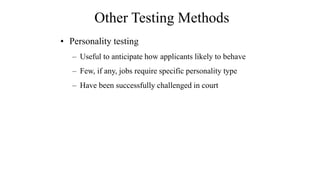
Other Testing Methods 
• Personality testing 
– Useful to anticipate how applicants likely to behave 
– Few, if any, jobs require specific personality type 
– Have been successfully challenged in court
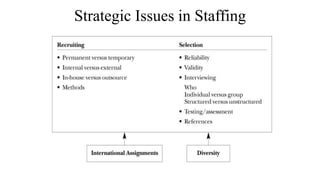
Strategic Issues in Staffing
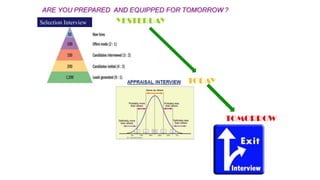
Selection Interview
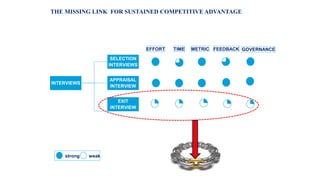
THE MISSING LINK FOR SUSTAINED COMPETITIVE ADVANTAGE 
INTERVIEWS 
SELECTION 
INTERVIEWS 
APPRAISAL 
INTERVIEW 
EXIT 
INTERVIEW 
strong weak 
EFFORT TIME METRIC FEEDBACK GOVERNANCE
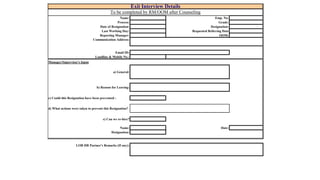
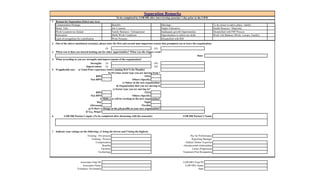
Name: Emp. No: 
Process: Grade: 
Date of Resignation: Designation: 
Last Working Day: Requested Relieving Date 
Reporting Manager: OOM: 
Communication Address: 
Email ID: 
Landline & Mobile No.: 
Manager/Supervisor's Input 
a) General: 
b) Reason for Leaving: 
c) Could this Resignation have been prevented : 
d) What actions were taken to prevent this Resignation? 
e) Can we re-hire? 
Name: Date: 
Designation: 
LOB HR Partner's Remarks (If any): 
Exit Interview Details 
To be completed by RM/OOM after Counseling
1 Reason for Separation (Select any two) 
Separation Remarks 
To be completed by LOB HR after interviewing associate 1 day prior to the LWD 
Compensation Package Benefits Marriage To be closer to native place / family 
Better Title Job Contents Higher Education Health Reasons / Maternity 
Work Location too distant Family Business / Entrepreneur Inadequate growth Opportunities Dissatisfied with P4P Process 
Relocation Shifts/Work Conditions Opportunities to utilize my skills Work Life Balance (Work, Leisure, Family) 
Lack of recognition for contribution Work Pressure Dissatisfied with RM 
2 
Out of the above-mentioned reason(s), please state the first and second most important reason that prompted you to leave the organization: 
(I) (II) 
3 
Date: 
4 
When was it that you started looking out for other opportunities? What was the trigger event? 
What according to you are strengths and improvements of the organization? 
Strengths (I) (II) 
Improvement (I) (II) 
5 
If applicable any: a) Total Prior experience before joining BACS (In Months) 
b) Previous sector type you are moving from ? 
BPO ITES 
Non BPO Others (Specify) 
c) Salary in the new organization 
d) Organization that you are moving to 
e) Sector type you are moving to? 
BPO ITES 
Non BPO Others (Specify) 
f) Shifts you will be working in the new organization? 
Day Night 
Afternoon Flexible 
g) Is there a change in the job profile at your new organization? 
If Yes, What? 
6 
7 
LOB HR Partner's input: (To be completed after discussing with the associate) LOB HR Partner's Name: 
Indicate your ratings on the following: (1 being the lowest and 5 being the highest) 
Training - Pre-process Pay for Performance 
Reporting Manager 
- Subject Matter Expertise 
- Interpersonal relationships 
Career Progression 
Treatment Post Resignation 
Training - Process 
Compensation 
Benefits 
Facilities 
Technology 
Associates Emp ID: LOB HR's Emp ID: 
Associates Name: LOB HR's Name: 
Voluntary/ Involuntary Date:
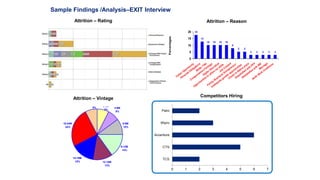
Sample Findings /Analysis–EXIT Interview 
Attrition – Rating Attrition – Reason 
6-9M 
10% 
9-12M 
14% 
12-15M 
13% 
15-18M 
15% 
18-24M 
24% 
3-6M 
8% 
0-3M 
8% 
>24M 
8% 
10 10 10 10 
8 
5 5 
3 3 3 3 3 
18 
13 
20 
15 
10 
5 
0 
Higher Education 
Opportunities to utilize my skills 
Better Title 
Compensation Package 
Career Opportunity 
Personal Obligations 
Job Content 
Closer to Native place 
Dissatisfied with PFP 
Dissatisfied with RM 
Family Business/ Entrepreneur 
Inadequate growth opportunities 
Marriage 
Shift/ Work Conditions 
Percentages 
Competitors Hiring 
Attrition – Vintage 
0 1 2 3 4 5 6 7 
Patni 
Wipro 
Accenture 
CTS 
TCS
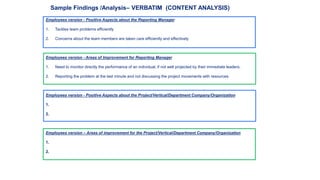
Sample Findings /Analysis– VERBATIM (CONTENT ANALYSIS) 
Employees version - Positive Aspects about the Reporting Manager 
1. Tackles team problems efficiently 
2. Concerns about the team members are taken care efficiently and effectively 
Employees version - Areas of Improvement for Reporting Manager 
1. Need to monitor directly the performance of an individual, if not well projected by their immediate leaders. 
2. Reporting the problem at the last minute and not discussing the project movements with resources 
Employees version - Positive Aspects about the Project/Vertical/Department Company/Organization 
1. 
2. 
Employees version – Areas of improvement for the Project/Vertical/Department Company/Organization 
1. 
2.
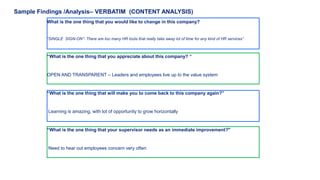
Sample Findings /Analysis– VERBATIM (CONTENT ANALYSIS) 
What is the one thing that you would like to change in this company? 
“SINGLE SIGN-ON”- There are too many HR tools that really take away lot of time for any kind of HR services” 
“What is the one thing that you appreciate about this company? “ 
OPEN AND TRANSPARENT – Leaders and employees live up to the value system 
“What is the one thing that will make you to come back to this company again?” 
Learning is amazing, with lot of opportunity to grow horizontally 
“What is the one thing that your supervisor needs as an immediate improvement?" 
Need to hear out employees concern very often
Process Map for End-to-end Recruitment 
Recruitment Process 
I II III IV 
Plan Workforce Develop Position 
Requisition 
Source/ Pipeline 
Candidates 
Manage, Track & 
Screen Candidates 
Interview & 
Select Candidates 
Extend Offer & 
Conduct Pre-employment 
Due 
Diligence 
Manage New Hire 
Integration 
V VI VII
The Following Describe Each Of The Sub-processes That Make Up Recruitment 
Plan Workforce 
• The strategic review of organizational growth and change as it relates to Recruiting activity and how 
this aligns with the overall strategic direction and organizational goals 
Develop Position 
Requisition 
• Development of new job requisitions to fulfill the talent and skills needs identified in the “Plan 
Workforce” process or updating existing job requisitions when a position becomes vacant 
II 
III 
Source /Pipeline Candidates 
• The identification, selection and use of appropriate medium(s) to attract prospective candidates to 
apply and be considered for employment opportunities 
Manage, Track & Screen 
Candidates 
• The management and tracking of current and past candidate data/information in order to select the 
best qualified talent to be considered for employment opportunities 
Interview & Select 
Candidates 
• The review and assessment of the best qualified candidates for a particular job requisition 
IV 
V 
VI 
Extend Offer & Conduct Pre- 
Employment Due Diligence 
• The pre-employment due diligence around background checks, reference checks, employment history 
and licensing/education requirements and offer communication to candidate 
• The offer extension is the preparation and approval routing of an employment offer to the best 
qualified candidate that is contingent upon the completion of necessary reviews and checks 
Manage New Hire 
Integration 
I 
VII 
• The initial stage of entry to employment through proper paperwork completion and onboarding 
procedures and training
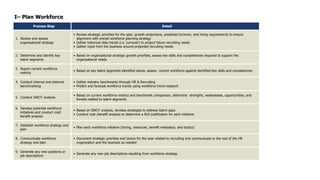
I– Plan Workforce 
Process Step Detail 
1. Review and assess 
organizational strategy 
• Review strategic priorities for the year, growth projections, predicted turnover, and hiring requirements to ensure 
alignment with overall workforce planning strategy 
• Gather historical data trends (i.e. turnover) to project future recruiting needs 
• Gather input from the business around projected recruiting needs 
2. Determine and identify key 
talent segments 
• Based on organizational strategic growth priorities, assess key skills and competencies required to support the 
organizational needs 
3. Report current workforce 
metrics 
• Based on key talent segments identified above, assess current workforce against identified key skills and competencies 
4. Conduct internal and external 
benchmarking 
• Gather industry benchmarks through HR & Recruiting 
• Predict and forecast workforce trends using workforce trend research 
5. Conduct SWOT analysis 
• Based on current workforce metrics and benchmark comparison, determine strengths, weaknesses, opportunities, and 
threats related to talent segments 
6. Develop potential workforce 
initiatives and conduct cost/ 
benefit analysis 
• Based on SWOT analysis, develop strategies to address talent gaps 
• Conduct cost /benefit analysis to determine a ROI justification for each initiative 
7. Establish workforce strategy and 
plan 
• Plan each workforce initiative (timing, resources, benefit realization, and tactics) 
8. Communicate workforce 
strategy and plan 
• Document strategic priorities and tactics for the year related to recruiting and communicate to the rest of the HR 
organization and the business as needed 
9. Generate any new positions or 
job descriptions 
• Generate any new job descriptions resulting from workforce strategy
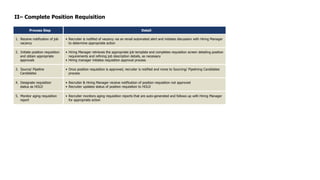
II– Complete Position Requisition 
Process Step Detail 
1. Receive notification of job 
vacancy 
• Recruiter is notified of vacancy via an email automated alert and initiates discussion with Hiring Manager 
to determine appropriate action 
2. Initiate position requisition 
and obtain appropriate 
approvals 
• Hiring Manager retrieves the appropriate job template and completes requisition screen detailing position 
requirements and refining job description details, as necessary 
• Hiring manager initiates requisition approval process 
3. Source/ Pipeline 
Candidates 
• Once position requisition is approved, recruiter is notified and move to Sourcing/ Pipelining Candidates 
process 
4. Designate requisition 
status as HOLD 
• Recruiter & Hiring Manager receive notification of position requisition not approved 
• Recruiter updates status of position requisition to HOLD 
5. Monitor aging requisition 
report 
• Recruiter monitors aging requisition reports that are auto-generated and follows up with Hiring Manager 
for appropriate action
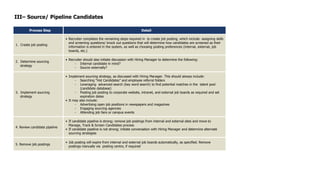
III– Source/ Pipeline Candidates 
Process Step Detail 
1. Create job posting 
• Recruiter completes the remaining steps required in to create job posting, which include: assigning skills 
and screening questions/ knock out questions that will determine how candidates are screened as their 
information is entered in the system, as well as choosing posting preferences (internal, external, job 
boards, etc.) 
2. Determine sourcing 
strategy 
• Recruiter should also initiate discussion with Hiring Manager to determine the following: 
- Internal candidate in mind? 
- Source externally? 
3. Implement sourcing 
strategy 
• Implement sourcing strategy, as discussed with Hiring Manager. This should always include: 
- Searching “Hot Candidates” and employee referral folders 
- Leveraging advanced search (key word search) to find potential matches in the talent pool 
(candidate database) 
- Posting job posting to corporate website, intranet, and external job boards as required and set 
expiration dates 
• It may also include: 
- Advertising open job positions in newspapers and magazines 
- Engaging sourcing agencies 
- Attending job fairs or campus events 
4. Review candidate pipeline 
• If candidate pipeline is strong; remove job postings from internal and external sites and move to 
Manage, Track & Screen Candidates process 
• If candidate pipeline is not strong; initiate conversation with Hiring Manager and determine alternate 
sourcing strategies 
5. Remove job postings 
• Job posting will expire from internal and external job boards automatically, as specified. Remove 
postings manually via posting centre, if required
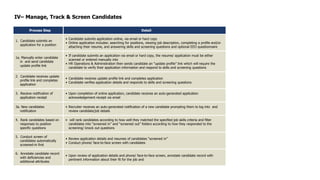
IV– Manage, Track & Screen Candidates 
Process Step Detail 
1. Candidate submits an 
application for a position 
• Candidate submits application online, via email or hard copy 
• Online application includes: searching for positions, viewing job description, completing a profile and/or 
attaching their resume, and answering skills and screening questions and optional EEO questionnaire 
1a. Manually enter candidate 
in and send candidate 
update profile link 
• If candidate submits an application via email or hard copy, the resume/ application must be either 
scanned or entered manually into 
• HR Operations & Administration then sends candidate an “update profile” link which will require the 
candidate to verify their application information and respond to skills and screening questions 
2. Candidate receives update 
profile link and completes 
application 
• Candidate receives update profile link and completes application 
• Candidate verifies application details and responds to skills and screening questions 
3. Receive notification of 
application receipt 
• Upon completion of online application, candidate receives an auto-generated application 
acknowledgement receipt via email 
3a. New candidates 
notification 
• Recruiter receives an auto-generated notification of a new candidate prompting them to log into and 
review candidate/job details 
4. Rank candidates based on 
responses to position 
specific questions 
• will rank candidates according to how well they matched the specified job skills criteria and filter 
candidates into “screened in” and “screened out” folders according to how they responded to the 
screening/ knock out questions 
5. Conduct screen of 
candidates automatically 
screened-in first 
• Review application details and resumes of candidates “screened in” 
• Conduct phone/ face-to-face screen with candidates 
6. Annotate candidate record 
with deficiencies and 
additional attributes 
• Upon review of application details and phone/ face-to-face screen, annotate candidate record with 
pertinent information about their fit for the job and
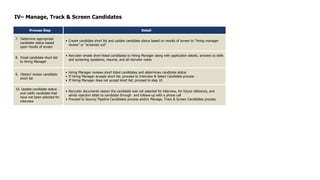
IV– Manage, Track & Screen Candidates 
Process Step Detail 
7. Determine appropriate 
candidate status based 
upon results of screen 
• Create candidate short list and update candidate status based on results of screen to “hiring manager 
review” or “screened out” 
8. Email candidate short-list 
to Hiring Manager 
• Recruiter emails short-listed candidates to Hiring Manager along with application details, answers to skills 
and screening questions, resume, and all recruiter notes 
9. Obtain/ review candidate 
short list 
• Hiring Manager reviews short listed candidates and determines candidate status 
• If Hiring Manager accepts short list; proceed to Interview & Select Candidate process 
• If Hiring Manager does not accept short list; proceed to step 10 
10. Update candidate status 
and notify candidate that 
have not been selected for 
interview 
• Recruiter documents reason the candidate was not selected for interview, for future reference, and 
sends rejection letter to candidate through and follows-up with a phone call 
• Proceed to Source/ Pipeline Candidates process and/or Manage, Track & Screen Candidates process
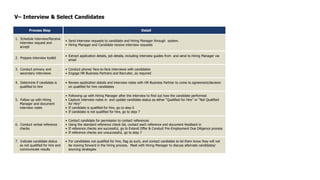
V– Interview & Select Candidates 
Process Step Detail 
1. Schedule interview/Receive 
interview request and 
accept 
• Send interview requests to candidate and Hiring Manager through system. 
• Hiring Manager and Candidate receive interview requests 
2. Prepare interview toolkit 
• Extract application details, job details, including interview guides from and send to Hiring Manager via 
email 
3. Conduct primary and 
secondary interviews 
• Conduct phone/ face-to-face interviews with candidates 
• Engage HR Business Partners and Recruiter, as required 
4. Determine if candidate is 
qualified to hire 
• Review application details and interview notes with HR Business Partner to come to agreement/decision 
on qualified for hire candidates 
5. Follow up with Hiring 
Manager and document 
interview notes 
• Following up with Hiring Manager after the interview to find out how the candidate performed 
• Capture interview notes in and update candidate status as either “Qualified for Hire” or “Not Qualified 
for Hire” 
• If candidate is qualified for hire, go to step 6 
• If candidate is not qualified for hire, go to step 7 
6. Conduct verbal reference 
checks 
• Contact candidate for permission to contact references 
• Using the standard reference check list, contact each reference and document feedback in 
• If reference checks are successful, go to Extend Offer & Conduct Pre-Employment Due Diligence process 
• If reference checks are unsuccessful, go to step 7 
7. Indicate candidate status 
as not qualified for hire and 
communicate results 
• For candidates not qualified for hire, flag as such, and contact candidate to let them know they will not 
be moving forward in the hiring process. Meet with Hiring Manager to discuss alternate candidates/ 
sourcing strategies
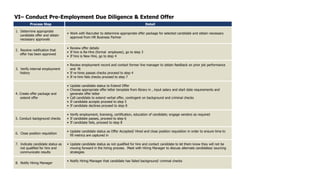
VI– Conduct Pre-Employment Due Diligence & Extend Offer 
Process Step Detail 
1. Determine appropriate 
candidate offer and obtain 
necessary approvals 
• Work with Recruiter to determine appropriate offer package for selected candidate and obtain necessary 
approval from HR Business Partner 
2. Receive notification that 
offer has been approved 
• Review offer details 
• If hire is Re-Hire (formal employee), go to step 3 
• If hire is New Hire, go to step 4 
3. Verify internal employment 
history 
• Review employment record and contact former line manager to obtain feedback on prior job performance 
and fit 
• If re-hires passes checks proceed to step 4 
• If re-hire fails checks proceed to step 7 
4. Create offer package and 
extend offer 
• Update candidate status to Extend Offer 
• Choose appropriate offer letter template from library in , input salary and start date requirements and 
generate offer letter 
• Call candidate to extend verbal offer, contingent on background and criminal checks 
• If candidate accepts proceed to step 5 
• If candidate declines proceed to step 8 
5. Conduct background checks 
• Verify employment, licensing, certification, education of candidate; engage vendors as required 
• If candidate passes, proceed to step 6 
• If candidate fails, proceed to step 8 
6. Close position requisition 
• Update candidate status as Offer Accepted/ Hired and close position requisition in order to ensure time to 
fill metrics are captured in 
7. Indicate candidate status as 
not qualified for hire and 
communicate results 
• Update candidate status as not qualified for hire and contact candidate to let them know they will not be 
moving forward in the hiring process. Meet with Hiring Manager to discuss alternate candidates/ sourcing 
strategies 
8. Notify Hiring Manager 
• Notify Hiring Manager that candidate has failed background/ criminal checks
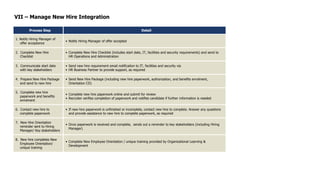
VII – Manage New Hire Integration 
Process Step Detail 
1. Notify Hiring Manager of 
offer acceptance 
• Notify Hiring Manager of offer accepted 
2. Complete New Hire 
Checklist 
• Complete New Hire Checklist (includes start date, IT, facilities and security requirements) and send to 
HR Operations and Administration 
3. Communicate start date 
with key stakeholders 
• Send new hire requirement email notification to IT, facilities and security via 
• HR Business Partner to provide support, as required 
4. Prepare New Hire Package 
and send to new hire 
• Send New Hire Package (including new hire paperwork, authorization, and benefits enrolment, 
Orientation CD) 
5. Complete new hire 
paperwork and benefits 
enrolment 
• Complete new hire paperwork online and submit for review 
• Recruiter verifies completion of paperwork and notifies candidate if further information is needed 
6. Contact new hire to 
complete paperwork 
• If new hire paperwork is unfinished or incomplete, contact new hire to complete. Answer any questions 
and provide assistance to new hire to complete paperwork, as required 
7. New Hire Orientation 
reminder sent to Hiring 
Manager/ Key stakeholders 
• Once paperwork is received and complete, sends out a reminder to key stakeholders (including Hiring 
Manager) 
8. New hire completes New 
Employee Orientation/ 
unique training 
• Complete New Employee Orientation / unique training provided by Organizational Learning & 
Development

Talent acquisition

  • 1.
  • 2.
    Process Map forEnd-to-end Recruitment Recruitment Process I II III IV Plan Workforce Develop Position Requisition Source/ Pipeline Candidates Manage, Track & Screen Candidates Interview & Select Candidates Extend Offer & Conduct Pre-employment Due Diligence Manage New Hire Integration V VI VII
  • 3.
    The Following DescribeEach Of The Sub-processes That Make Up Recruitment Plan Workforce • The strategic review of organizational growth and change as it relates to Recruiting activity and how this aligns with the overall strategic direction and organizational goals Develop Position Requisition • Development of new job requisitions to fulfill the talent and skills needs identified in the “Plan Workforce” process or updating existing job requisitions when a position becomes vacant II III Source /Pipeline Candidates • The identification, selection and use of appropriate medium(s) to attract prospective candidates to apply and be considered for employment opportunities Manage, Track & Screen Candidates • The management and tracking of current and past candidate data/information in order to select the best qualified talent to be considered for employment opportunities Interview & Select Candidates • The review and assessment of the best qualified candidates for a particular job requisition IV V VI Extend Offer & Conduct Pre- Employment Due Diligence • The pre-employment due diligence around background checks, reference checks, employment history and licensing/education requirements and offer communication to candidate • The offer extension is the preparation and approval routing of an employment offer to the best qualified candidate that is contingent upon the completion of necessary reviews and checks Manage New Hire Integration I VII • The initial stage of entry to employment through proper paperwork completion and onboarding procedures and training
  • 4.
    Staffing • Staffing – Process of recruiting & selecting prospective employees – Has significant impact on organization’s bottom line • Requires staffing process to become strategically focused – Recruitment & selection activities offer organization numerous choices to find & select new employees – Staffing decisions need to ensure employees fit organization’s culture
  • 5.
    Recruiting • When& how extensively to recruit – When do recruiting efforts need to begin? – How large an applicant pool needed? – Data from past recruiting efforts utilized • To answer questions where feasible • Adjust for changed conditions • Yield ratios – Offer information on how many applicants eliminated/remain at each step in recruitment process – Can determine proper or necessary size of applicant pool
  • 6.
  • 7.
  • 8.
    Methods of Recruiting • Informally or formally • Internally or externally • Targeted advertising in selected media • Recruiting on Internet / Social Network • Outsourcing to staffing agencies • Executive search firms • On-campus recruiting • Referrals & Walk-ins
  • 9.
    Finding Internal Candidates Hiring from Within Job Posting Succession Rehiring Former Planning (HRIS) Employees
  • 10.
    Advantages & Disadvantagesof Internal & External Recruiting
  • 11.
    Why Careful Selectionis Important Organizational Performance Legal Obligations and Liability The Importance of Selecting the Right Employees Costs of Recruiting and Hiring
  • 12.
    Selection Process Issues • Reliability – Consistency of measurement – Screening criteria should elicit same results in repeated trials across time & evaluators – Reliability influenced by criterion deficiency & contamination errors – Reliability is prerequisite for validity
  • 13.
    Selection Process Issues • Validity – Degree to which what is assessed is related to actual performance – Ability to establish job-related validity is crucial to employers in defending themselves in discrimination allegations – Content validity illustrates that measure or criterion is representative of actual job content or knowledge – Criterion (empirical) validity demonstrated by relationship between screening criteria & job performance
  • 14.
    Types of Interviews Selection Interview Appraisal Interview Exit Interview Types of Interviews
  • 15.
    Basic Features ofInterviews Interview Structure Interview Administration Selection Interviews Interview Content
  • 16.
    Interview Formats Unstructured or Nondirective Interview Interview Formats Structured or Directive Interview
  • 17.
    Interview Content Situational Interview Stress Interview Types of Questions Behavioral Interview Job-Related Interview
  • 18.
    Behavioral Interviewing •Used with experienced & inexperienced applicants • Asks about situations candidate is likely to face on job • Candidates can present real-life situations they were involved in & how they handled them
  • 19.
    What Can UndermineAn Interview’s Usefulness & What we do differently? Nonverbal Behavior and Impression Management Interviewee’s Personal Characteristics Interviewer Behavior Factors Affecting Interviews Snap Judgments Interviewer’s Misunderstanding Pressure to Conduct Interview
  • 20.
    Interviewing Process Issues • Who should be involved? – Prospective supervisors, peers, subordinates • Which interview format? – Individual or group interviews • Common interviewer errors – Similarity errors – Contrast errors – First impression – Halo errors – Personal biases
  • 21.
    Types of Tests Cognitive (Mental) Abilities Achievement What Tests Measure Motor and Physical Abilities Personality and Interests
  • 22.
    Testing • Worksample tests – Ask applicant to complete representative sample of actual work • Trainability tests – Measure • Aptitude in certain areas • Ability to understand critical job components that firm will teach new hires • Tests of Cognitive abilities • Intelligence Tests ( IQ) • Specific Cognitive Abilities
  • 23.
    Testing • Realisticjob previews – Make applicants aware of both positive & negative aspects of job – Decrease likelihood new employee will become dissatisfied – Increase likelihood of candidate’s self-selecting out of position • Personality testing is useful in anticipating how applicants are likely to behave
  • 24.
    The Big FivePersonality Dimensions Personality Dimension Characteristics of Person Scoring Positively on Dimension 1) Extraversion Outgoing, talkative, social, assertive 2) Agreeableness Trusting, good-natured, cooperative, soft-hearted 3) Conscientiousness Dependable, responsible, achievement-oriented, persistent 4) Emotional stability Relaxed, secure, unworried 5) Openness to experience Intellectual, imaginative, curious, broad-minded
  • 25.
    Other Testing Methods • Personality testing – Useful to anticipate how applicants likely to behave – Few, if any, jobs require specific personality type – Have been successfully challenged in court
  • 26.
  • 27.
  • 28.
    THE MISSING LINKFOR SUSTAINED COMPETITIVE ADVANTAGE INTERVIEWS SELECTION INTERVIEWS APPRAISAL INTERVIEW EXIT INTERVIEW strong weak EFFORT TIME METRIC FEEDBACK GOVERNANCE
  • 29.
    Name: Emp. No: Process: Grade: Date of Resignation: Designation: Last Working Day: Requested Relieving Date Reporting Manager: OOM: Communication Address: Email ID: Landline & Mobile No.: Manager/Supervisor's Input a) General: b) Reason for Leaving: c) Could this Resignation have been prevented : d) What actions were taken to prevent this Resignation? e) Can we re-hire? Name: Date: Designation: LOB HR Partner's Remarks (If any): Exit Interview Details To be completed by RM/OOM after Counseling
  • 30.
    1 Reason forSeparation (Select any two) Separation Remarks To be completed by LOB HR after interviewing associate 1 day prior to the LWD Compensation Package Benefits Marriage To be closer to native place / family Better Title Job Contents Higher Education Health Reasons / Maternity Work Location too distant Family Business / Entrepreneur Inadequate growth Opportunities Dissatisfied with P4P Process Relocation Shifts/Work Conditions Opportunities to utilize my skills Work Life Balance (Work, Leisure, Family) Lack of recognition for contribution Work Pressure Dissatisfied with RM 2 Out of the above-mentioned reason(s), please state the first and second most important reason that prompted you to leave the organization: (I) (II) 3 Date: 4 When was it that you started looking out for other opportunities? What was the trigger event? What according to you are strengths and improvements of the organization? Strengths (I) (II) Improvement (I) (II) 5 If applicable any: a) Total Prior experience before joining BACS (In Months) b) Previous sector type you are moving from ? BPO ITES Non BPO Others (Specify) c) Salary in the new organization d) Organization that you are moving to e) Sector type you are moving to? BPO ITES Non BPO Others (Specify) f) Shifts you will be working in the new organization? Day Night Afternoon Flexible g) Is there a change in the job profile at your new organization? If Yes, What? 6 7 LOB HR Partner's input: (To be completed after discussing with the associate) LOB HR Partner's Name: Indicate your ratings on the following: (1 being the lowest and 5 being the highest) Training - Pre-process Pay for Performance Reporting Manager - Subject Matter Expertise - Interpersonal relationships Career Progression Treatment Post Resignation Training - Process Compensation Benefits Facilities Technology Associates Emp ID: LOB HR's Emp ID: Associates Name: LOB HR's Name: Voluntary/ Involuntary Date:
  • 31.
    Sample Findings /Analysis–EXITInterview Attrition – Rating Attrition – Reason 6-9M 10% 9-12M 14% 12-15M 13% 15-18M 15% 18-24M 24% 3-6M 8% 0-3M 8% >24M 8% 10 10 10 10 8 5 5 3 3 3 3 3 18 13 20 15 10 5 0 Higher Education Opportunities to utilize my skills Better Title Compensation Package Career Opportunity Personal Obligations Job Content Closer to Native place Dissatisfied with PFP Dissatisfied with RM Family Business/ Entrepreneur Inadequate growth opportunities Marriage Shift/ Work Conditions Percentages Competitors Hiring Attrition – Vintage 0 1 2 3 4 5 6 7 Patni Wipro Accenture CTS TCS
  • 33.
    Sample Findings /Analysis–VERBATIM (CONTENT ANALYSIS) Employees version - Positive Aspects about the Reporting Manager 1. Tackles team problems efficiently 2. Concerns about the team members are taken care efficiently and effectively Employees version - Areas of Improvement for Reporting Manager 1. Need to monitor directly the performance of an individual, if not well projected by their immediate leaders. 2. Reporting the problem at the last minute and not discussing the project movements with resources Employees version - Positive Aspects about the Project/Vertical/Department Company/Organization 1. 2. Employees version – Areas of improvement for the Project/Vertical/Department Company/Organization 1. 2.
  • 34.
    Sample Findings /Analysis–VERBATIM (CONTENT ANALYSIS) What is the one thing that you would like to change in this company? “SINGLE SIGN-ON”- There are too many HR tools that really take away lot of time for any kind of HR services” “What is the one thing that you appreciate about this company? “ OPEN AND TRANSPARENT – Leaders and employees live up to the value system “What is the one thing that will make you to come back to this company again?” Learning is amazing, with lot of opportunity to grow horizontally “What is the one thing that your supervisor needs as an immediate improvement?" Need to hear out employees concern very often
  • 35.
    Process Map forEnd-to-end Recruitment Recruitment Process I II III IV Plan Workforce Develop Position Requisition Source/ Pipeline Candidates Manage, Track & Screen Candidates Interview & Select Candidates Extend Offer & Conduct Pre-employment Due Diligence Manage New Hire Integration V VI VII
  • 36.
    The Following DescribeEach Of The Sub-processes That Make Up Recruitment Plan Workforce • The strategic review of organizational growth and change as it relates to Recruiting activity and how this aligns with the overall strategic direction and organizational goals Develop Position Requisition • Development of new job requisitions to fulfill the talent and skills needs identified in the “Plan Workforce” process or updating existing job requisitions when a position becomes vacant II III Source /Pipeline Candidates • The identification, selection and use of appropriate medium(s) to attract prospective candidates to apply and be considered for employment opportunities Manage, Track & Screen Candidates • The management and tracking of current and past candidate data/information in order to select the best qualified talent to be considered for employment opportunities Interview & Select Candidates • The review and assessment of the best qualified candidates for a particular job requisition IV V VI Extend Offer & Conduct Pre- Employment Due Diligence • The pre-employment due diligence around background checks, reference checks, employment history and licensing/education requirements and offer communication to candidate • The offer extension is the preparation and approval routing of an employment offer to the best qualified candidate that is contingent upon the completion of necessary reviews and checks Manage New Hire Integration I VII • The initial stage of entry to employment through proper paperwork completion and onboarding procedures and training
  • 37.
    I– Plan Workforce Process Step Detail 1. Review and assess organizational strategy • Review strategic priorities for the year, growth projections, predicted turnover, and hiring requirements to ensure alignment with overall workforce planning strategy • Gather historical data trends (i.e. turnover) to project future recruiting needs • Gather input from the business around projected recruiting needs 2. Determine and identify key talent segments • Based on organizational strategic growth priorities, assess key skills and competencies required to support the organizational needs 3. Report current workforce metrics • Based on key talent segments identified above, assess current workforce against identified key skills and competencies 4. Conduct internal and external benchmarking • Gather industry benchmarks through HR & Recruiting • Predict and forecast workforce trends using workforce trend research 5. Conduct SWOT analysis • Based on current workforce metrics and benchmark comparison, determine strengths, weaknesses, opportunities, and threats related to talent segments 6. Develop potential workforce initiatives and conduct cost/ benefit analysis • Based on SWOT analysis, develop strategies to address talent gaps • Conduct cost /benefit analysis to determine a ROI justification for each initiative 7. Establish workforce strategy and plan • Plan each workforce initiative (timing, resources, benefit realization, and tactics) 8. Communicate workforce strategy and plan • Document strategic priorities and tactics for the year related to recruiting and communicate to the rest of the HR organization and the business as needed 9. Generate any new positions or job descriptions • Generate any new job descriptions resulting from workforce strategy
  • 38.
    II– Complete PositionRequisition Process Step Detail 1. Receive notification of job vacancy • Recruiter is notified of vacancy via an email automated alert and initiates discussion with Hiring Manager to determine appropriate action 2. Initiate position requisition and obtain appropriate approvals • Hiring Manager retrieves the appropriate job template and completes requisition screen detailing position requirements and refining job description details, as necessary • Hiring manager initiates requisition approval process 3. Source/ Pipeline Candidates • Once position requisition is approved, recruiter is notified and move to Sourcing/ Pipelining Candidates process 4. Designate requisition status as HOLD • Recruiter & Hiring Manager receive notification of position requisition not approved • Recruiter updates status of position requisition to HOLD 5. Monitor aging requisition report • Recruiter monitors aging requisition reports that are auto-generated and follows up with Hiring Manager for appropriate action
  • 39.
    III– Source/ PipelineCandidates Process Step Detail 1. Create job posting • Recruiter completes the remaining steps required in to create job posting, which include: assigning skills and screening questions/ knock out questions that will determine how candidates are screened as their information is entered in the system, as well as choosing posting preferences (internal, external, job boards, etc.) 2. Determine sourcing strategy • Recruiter should also initiate discussion with Hiring Manager to determine the following: - Internal candidate in mind? - Source externally? 3. Implement sourcing strategy • Implement sourcing strategy, as discussed with Hiring Manager. This should always include: - Searching “Hot Candidates” and employee referral folders - Leveraging advanced search (key word search) to find potential matches in the talent pool (candidate database) - Posting job posting to corporate website, intranet, and external job boards as required and set expiration dates • It may also include: - Advertising open job positions in newspapers and magazines - Engaging sourcing agencies - Attending job fairs or campus events 4. Review candidate pipeline • If candidate pipeline is strong; remove job postings from internal and external sites and move to Manage, Track & Screen Candidates process • If candidate pipeline is not strong; initiate conversation with Hiring Manager and determine alternate sourcing strategies 5. Remove job postings • Job posting will expire from internal and external job boards automatically, as specified. Remove postings manually via posting centre, if required
  • 40.
    IV– Manage, Track& Screen Candidates Process Step Detail 1. Candidate submits an application for a position • Candidate submits application online, via email or hard copy • Online application includes: searching for positions, viewing job description, completing a profile and/or attaching their resume, and answering skills and screening questions and optional EEO questionnaire 1a. Manually enter candidate in and send candidate update profile link • If candidate submits an application via email or hard copy, the resume/ application must be either scanned or entered manually into • HR Operations & Administration then sends candidate an “update profile” link which will require the candidate to verify their application information and respond to skills and screening questions 2. Candidate receives update profile link and completes application • Candidate receives update profile link and completes application • Candidate verifies application details and responds to skills and screening questions 3. Receive notification of application receipt • Upon completion of online application, candidate receives an auto-generated application acknowledgement receipt via email 3a. New candidates notification • Recruiter receives an auto-generated notification of a new candidate prompting them to log into and review candidate/job details 4. Rank candidates based on responses to position specific questions • will rank candidates according to how well they matched the specified job skills criteria and filter candidates into “screened in” and “screened out” folders according to how they responded to the screening/ knock out questions 5. Conduct screen of candidates automatically screened-in first • Review application details and resumes of candidates “screened in” • Conduct phone/ face-to-face screen with candidates 6. Annotate candidate record with deficiencies and additional attributes • Upon review of application details and phone/ face-to-face screen, annotate candidate record with pertinent information about their fit for the job and
  • 41.
    IV– Manage, Track& Screen Candidates Process Step Detail 7. Determine appropriate candidate status based upon results of screen • Create candidate short list and update candidate status based on results of screen to “hiring manager review” or “screened out” 8. Email candidate short-list to Hiring Manager • Recruiter emails short-listed candidates to Hiring Manager along with application details, answers to skills and screening questions, resume, and all recruiter notes 9. Obtain/ review candidate short list • Hiring Manager reviews short listed candidates and determines candidate status • If Hiring Manager accepts short list; proceed to Interview & Select Candidate process • If Hiring Manager does not accept short list; proceed to step 10 10. Update candidate status and notify candidate that have not been selected for interview • Recruiter documents reason the candidate was not selected for interview, for future reference, and sends rejection letter to candidate through and follows-up with a phone call • Proceed to Source/ Pipeline Candidates process and/or Manage, Track & Screen Candidates process
  • 42.
    V– Interview &Select Candidates Process Step Detail 1. Schedule interview/Receive interview request and accept • Send interview requests to candidate and Hiring Manager through system. • Hiring Manager and Candidate receive interview requests 2. Prepare interview toolkit • Extract application details, job details, including interview guides from and send to Hiring Manager via email 3. Conduct primary and secondary interviews • Conduct phone/ face-to-face interviews with candidates • Engage HR Business Partners and Recruiter, as required 4. Determine if candidate is qualified to hire • Review application details and interview notes with HR Business Partner to come to agreement/decision on qualified for hire candidates 5. Follow up with Hiring Manager and document interview notes • Following up with Hiring Manager after the interview to find out how the candidate performed • Capture interview notes in and update candidate status as either “Qualified for Hire” or “Not Qualified for Hire” • If candidate is qualified for hire, go to step 6 • If candidate is not qualified for hire, go to step 7 6. Conduct verbal reference checks • Contact candidate for permission to contact references • Using the standard reference check list, contact each reference and document feedback in • If reference checks are successful, go to Extend Offer & Conduct Pre-Employment Due Diligence process • If reference checks are unsuccessful, go to step 7 7. Indicate candidate status as not qualified for hire and communicate results • For candidates not qualified for hire, flag as such, and contact candidate to let them know they will not be moving forward in the hiring process. Meet with Hiring Manager to discuss alternate candidates/ sourcing strategies
  • 43.
    VI– Conduct Pre-EmploymentDue Diligence & Extend Offer Process Step Detail 1. Determine appropriate candidate offer and obtain necessary approvals • Work with Recruiter to determine appropriate offer package for selected candidate and obtain necessary approval from HR Business Partner 2. Receive notification that offer has been approved • Review offer details • If hire is Re-Hire (formal employee), go to step 3 • If hire is New Hire, go to step 4 3. Verify internal employment history • Review employment record and contact former line manager to obtain feedback on prior job performance and fit • If re-hires passes checks proceed to step 4 • If re-hire fails checks proceed to step 7 4. Create offer package and extend offer • Update candidate status to Extend Offer • Choose appropriate offer letter template from library in , input salary and start date requirements and generate offer letter • Call candidate to extend verbal offer, contingent on background and criminal checks • If candidate accepts proceed to step 5 • If candidate declines proceed to step 8 5. Conduct background checks • Verify employment, licensing, certification, education of candidate; engage vendors as required • If candidate passes, proceed to step 6 • If candidate fails, proceed to step 8 6. Close position requisition • Update candidate status as Offer Accepted/ Hired and close position requisition in order to ensure time to fill metrics are captured in 7. Indicate candidate status as not qualified for hire and communicate results • Update candidate status as not qualified for hire and contact candidate to let them know they will not be moving forward in the hiring process. Meet with Hiring Manager to discuss alternate candidates/ sourcing strategies 8. Notify Hiring Manager • Notify Hiring Manager that candidate has failed background/ criminal checks
  • 44.
    VII – ManageNew Hire Integration Process Step Detail 1. Notify Hiring Manager of offer acceptance • Notify Hiring Manager of offer accepted 2. Complete New Hire Checklist • Complete New Hire Checklist (includes start date, IT, facilities and security requirements) and send to HR Operations and Administration 3. Communicate start date with key stakeholders • Send new hire requirement email notification to IT, facilities and security via • HR Business Partner to provide support, as required 4. Prepare New Hire Package and send to new hire • Send New Hire Package (including new hire paperwork, authorization, and benefits enrolment, Orientation CD) 5. Complete new hire paperwork and benefits enrolment • Complete new hire paperwork online and submit for review • Recruiter verifies completion of paperwork and notifies candidate if further information is needed 6. Contact new hire to complete paperwork • If new hire paperwork is unfinished or incomplete, contact new hire to complete. Answer any questions and provide assistance to new hire to complete paperwork, as required 7. New Hire Orientation reminder sent to Hiring Manager/ Key stakeholders • Once paperwork is received and complete, sends out a reminder to key stakeholders (including Hiring Manager) 8. New hire completes New Employee Orientation/ unique training • Complete New Employee Orientation / unique training provided by Organizational Learning & Development