Talent Management
Ankit Garg (2012MB51)
Ankit Kumar Chaurasia(2012MB10)
Ankit Sachan(2012MB36)
Ankita Bharat (2012MB45)
Talent management refers to the anticipation of
required human capital the organization needs at
the time then setting a plan to meet those needs.
Talent Management, as the name itself suggests is
managing the ability, competency and power of

employees within an organization.
Everything that is done to recruit, retain, develop,
reward and make people perform is part of Talent
Management
Benefits of Talent Management
• Right Person in the right Job
• Retaining the top talent
• Better Hiring
• Understanding Employees Better
• Better professional development decisions
Talent Management Process
•
•
•
•
•
•
•
•
•
•
•
•
•

Understanding the Requirement
Sourcing the Talent
Attracting the Talent
Recruiting the Talent
Selecting the Talent
Training and Development
Retention
Promotion
Competency Mapping
Performance Appraisal
Career Planning
Succession Planning
Exit
Talent Management process is very complex
and is therefore, very difficult to handle. The
sole purpose of the whole process is to place
the right person at the right place at the right
time. The main issue of concern is to establish
a right fit between the job and the individual.
Talent management is now looked upon as a critical HR
activity; the discipline is evolving every day. some
trends in the same are as below..

•
•
•
•
•
•

Talent War
Technology and Talent Management:
Promoting Talent Internally
Population Worries Globally
Talent Management to rescue HR
Increase in Employer of Choice Initiatives
Example
• Deloitte developed a global methodology:
Deploy – Develop – Connect model enables
companies to design a strategy and policies of
talent management in a way that skilled
employees are actively integrated and thus
retained in the company.
The QUAD Model
• The Real Business Benefits could be attained through effective
Talent Management.
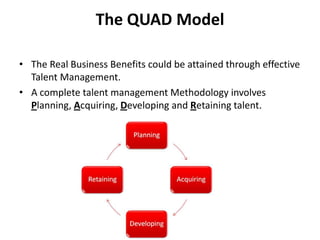
• A complete talent management Methodology involves
Planning, Acquiring, Developing and Retaining talent.
• Plan talent to involve identifying, defining, and
setting criteria for required capabilities, as well as
auditing current talent levels.
• Acquire talent utilizing a wide range of strategies
to attract talent.
• Develop talent to involve providing opportunities
for career development and training, managing
employees' performance, coaching and mentoring.
• Retain talent, through long-term incentives, a
flexible and positive work environment,
opportunities for advancement and good
remuneration
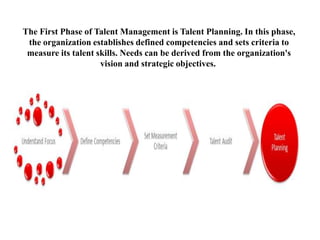
The First Phase of Talent Management is Talent Planning. In this phase,
the organization establishes defined competencies and sets criteria to
measure its talent skills. Needs can be derived from the organization's
vision and strategic objectives.
• Talent Focus:
Once you know what your organization needs, you can start
thinking about what type of talent potential to focus on.
• Competency Definition:
Competencies are lasting individual attributes that cause or predict
high levels of performance. Defining competencies is a process of
defining the specific, usable talents that your employees need in
order to meet the organization's objectives and strategic goals.
• Measurement Criteria:
To evaluate, measure, and develop competencies, you need to
establish particular criteria for each identified competency. You
need objective criteria to measure competencies effectively.
• Talent Audit:
An audit may include different types of activities designed to
evaluate the level of current competence against talent indicators
you have defined. Different assessment methods include
psychometric tests and questionnaires, in-depth interviews, case
studies, and analysis of most recent performance reviews.
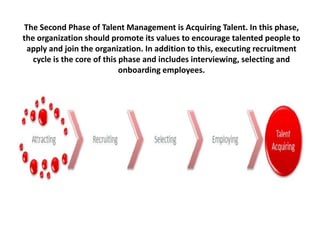
The Second Phase of Talent Management is Acquiring Talent. In this phase,
the organization should promote its values to encourage talented people to
apply and join the organization. In addition to this, executing recruitment
cycle is the core of this phase and includes interviewing, selecting and
onboarding employees.
• Attracting: This is about inspiring people to want to
work for your organization so that they apply when
positions become vacant.
• Recruiting: A recruiting brand reflects the core values
of the organization and communicates the advantages
of working for the organization.
• Selecting: This includes multiple steps such as
interviews, tests, and background checks.
• Employing: This is the process of bringing a person into
the organization, or it could mean promoting a person
within the organization to a new position. During this
stage, you negotiate a reimbursement package and
starting date, and you provide the employee with a
positive introduction – sometimes called onboarding –
to the company.
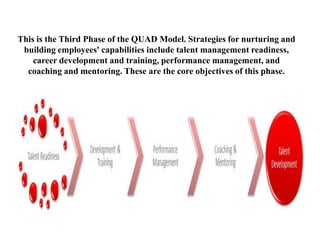
This is the Third Phase of the QUAD Model. Strategies for nurturing and
building employees' capabilities include talent management readiness,
career development and training, performance management, and
coaching and mentoring. These are the core objectives of this phase.
•

•

•

•
•

Talent Readiness Training:
This is a defined Training Program targeting managers to equip with the skills and competencies
needed to implement Talent Management. Such competencies will help the organization attract,
identify and develop Talents.
Career Development & Training:
Varied training programs are needed to improve people's performance and skills. You need to
tailor specific programs to help personnel adjust to new technology and upgrade task-specific
techniques, and to prepare employees for future work.
Performance Management:
Performance management encompasses setting goals, giving performance reviews, and
providing feedback. A key component of performance management is giving performance
appraisals.
Although pay increases or bonuses are important to employees, praise can go a long way toward
making employees feel valued. To be effective, rewards and recognition programs should align
with what is motivating to employees.
Coaching & Mentoring:
Coaching and mentoring develop talent by encouraging people to excel at their work and to learn
on the job. The one-on-one reflective nature of these techniques provides a supportive and
intimate quality that can engage people on a more emotional level.
Mentoring is carried out by an individual with proven success in the area that the person who's
mentored wants to learn about. The main role of a mentor is as advice giver. A coach works with
a client to achieve specific, identifiable goals. The coach and the client are held accountable to the
organization. A coach asks provocative questions to expand the individual's awareness and desire
to change.
Talent Retention
The longer you keep talented people in your organization, the
greater the return on your investment. The fourth phase of
the QUAD Model is to define several strategies that can help
retain talent:
•

Competitive pay and long-term incentives – Pay should be
competitive to prevent people from leaving the organization to
earn more elsewhere. Long-term incentives such as stock options
or vacation days or other benefits increasing over time can
encourage people to couple their careers and personal goals with
a long-term commitment to your organization.
• Career Planning – To retain up-and-coming talented people, an
organization has to provide them with genuine opportunities for
advancement.
• Flexible working arrangements – When working arrangements are
inflexible and fixed, the options available to people are
circumscribed – forcing them to choose between staying with or
leaving an organization.
• Talent Culture: Employees need to derive satisfaction from their
work, feel respected, and be physically comfortable. Managers
need to monitor these levels of satisfaction so they can forestall
problems before people leave an organization. Positive work
environment is a key factor to retain talent
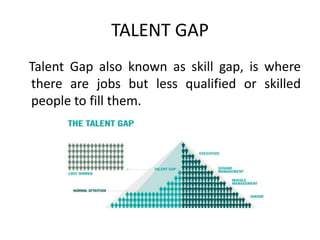
TALENT GAP
Talent Gap also known as skill gap, is where
there are jobs but less qualified or skilled
people to fill them.
Measuring Talent Management by
Building the Employee Gap Analysis
Select the right candidate with the desired level of
proficiency, identify the skills gap of the candidate
to the position, mitigate the risks of the skills gap,
and upon hiring the candidate, develop a
continuous professional development plan so they
succeed in the position and so the organization
can benefit from the employee’s continuous
alignment with the needs of the position and the
goals of the organization
Here are the basics of how the
Employee Gap Analysis works:
• What are the KSA’s needed for the position?
• Identify areas of proficiency needed and include
weighted multiple choice questions in the
application process.
• Once the candidate has demonstrated they have
the required minimum level of proficiency, then
they move on to the interview.
• Upon being hired, their responses to the
application questions turn into their Professional
Development Plan.
• Skill gaps are recognized and the new hire is
provided learning opportunities by the
organization such as training and classes to
improve their proficiency in their role.
• Their proficiency level is reassessed at least every
90 days to ensure it is increasing. If their
proficiency is not increasing – or it is decreasing –
managers can easily, and objectively, have a
conversation with the employee about their
development.
• As the employee changes positions, their PDP will
update as well with the needs of the position.
Talent Acquisition Crisis: Bridging the
Talent Gap

•
•
•
•

Talent gap is an increasingly important issue for
organizations to tackle. The four strategies below will
help organizations tackle talent acquisition
challenges.
Persuade Retirees with Flexible Work Arrangements.
Proactive Retraining and Education Strategy.
Train your Business Leaders to be Talent Managers.
Get Involved with Local Schools
Reference
• www.linkedin.com/skills/skill/Talent_Manageme
nt
• http://www.managementstudyguide.com/talentmanagement-process
• http://www.iquadme.com/talent-managementsolutions/Acquiring-Talents
• http://hiring.monster.com/hr/hr-bestpractices/recruiting-hiring-advice/employeesourcing-strategies/closing-the-talent-gap.aspx

Talent management

  • 1.
    Talent Management Ankit Garg(2012MB51) Ankit Kumar Chaurasia(2012MB10) Ankit Sachan(2012MB36) Ankita Bharat (2012MB45)
  • 2.
    Talent management refersto the anticipation of required human capital the organization needs at the time then setting a plan to meet those needs. Talent Management, as the name itself suggests is managing the ability, competency and power of employees within an organization. Everything that is done to recruit, retain, develop, reward and make people perform is part of Talent Management
  • 3.
    Benefits of TalentManagement • Right Person in the right Job • Retaining the top talent • Better Hiring • Understanding Employees Better • Better professional development decisions
  • 4.
    Talent Management Process • • • • • • • • • • • • • Understandingthe Requirement Sourcing the Talent Attracting the Talent Recruiting the Talent Selecting the Talent Training and Development Retention Promotion Competency Mapping Performance Appraisal Career Planning Succession Planning Exit
  • 5.
    Talent Management processis very complex and is therefore, very difficult to handle. The sole purpose of the whole process is to place the right person at the right place at the right time. The main issue of concern is to establish a right fit between the job and the individual.
  • 6.
    Talent management isnow looked upon as a critical HR activity; the discipline is evolving every day. some trends in the same are as below.. • • • • • • Talent War Technology and Talent Management: Promoting Talent Internally Population Worries Globally Talent Management to rescue HR Increase in Employer of Choice Initiatives
  • 7.
    Example • Deloitte developeda global methodology: Deploy – Develop – Connect model enables companies to design a strategy and policies of talent management in a way that skilled employees are actively integrated and thus retained in the company.
  • 8.
    The QUAD Model •The Real Business Benefits could be attained through effective Talent Management. • A complete talent management Methodology involves Planning, Acquiring, Developing and Retaining talent.
  • 9.
    • Plan talentto involve identifying, defining, and setting criteria for required capabilities, as well as auditing current talent levels. • Acquire talent utilizing a wide range of strategies to attract talent. • Develop talent to involve providing opportunities for career development and training, managing employees' performance, coaching and mentoring. • Retain talent, through long-term incentives, a flexible and positive work environment, opportunities for advancement and good remuneration
  • 10.
    The First Phaseof Talent Management is Talent Planning. In this phase, the organization establishes defined competencies and sets criteria to measure its talent skills. Needs can be derived from the organization's vision and strategic objectives.
  • 11.
    • Talent Focus: Onceyou know what your organization needs, you can start thinking about what type of talent potential to focus on. • Competency Definition: Competencies are lasting individual attributes that cause or predict high levels of performance. Defining competencies is a process of defining the specific, usable talents that your employees need in order to meet the organization's objectives and strategic goals. • Measurement Criteria: To evaluate, measure, and develop competencies, you need to establish particular criteria for each identified competency. You need objective criteria to measure competencies effectively. • Talent Audit: An audit may include different types of activities designed to evaluate the level of current competence against talent indicators you have defined. Different assessment methods include psychometric tests and questionnaires, in-depth interviews, case studies, and analysis of most recent performance reviews.
  • 12.
    The Second Phaseof Talent Management is Acquiring Talent. In this phase, the organization should promote its values to encourage talented people to apply and join the organization. In addition to this, executing recruitment cycle is the core of this phase and includes interviewing, selecting and onboarding employees.
  • 13.
    • Attracting: Thisis about inspiring people to want to work for your organization so that they apply when positions become vacant. • Recruiting: A recruiting brand reflects the core values of the organization and communicates the advantages of working for the organization. • Selecting: This includes multiple steps such as interviews, tests, and background checks. • Employing: This is the process of bringing a person into the organization, or it could mean promoting a person within the organization to a new position. During this stage, you negotiate a reimbursement package and starting date, and you provide the employee with a positive introduction – sometimes called onboarding – to the company.
  • 14.
    This is theThird Phase of the QUAD Model. Strategies for nurturing and building employees' capabilities include talent management readiness, career development and training, performance management, and coaching and mentoring. These are the core objectives of this phase.
  • 15.
    • • • • • Talent Readiness Training: Thisis a defined Training Program targeting managers to equip with the skills and competencies needed to implement Talent Management. Such competencies will help the organization attract, identify and develop Talents. Career Development & Training: Varied training programs are needed to improve people's performance and skills. You need to tailor specific programs to help personnel adjust to new technology and upgrade task-specific techniques, and to prepare employees for future work. Performance Management: Performance management encompasses setting goals, giving performance reviews, and providing feedback. A key component of performance management is giving performance appraisals. Although pay increases or bonuses are important to employees, praise can go a long way toward making employees feel valued. To be effective, rewards and recognition programs should align with what is motivating to employees. Coaching & Mentoring: Coaching and mentoring develop talent by encouraging people to excel at their work and to learn on the job. The one-on-one reflective nature of these techniques provides a supportive and intimate quality that can engage people on a more emotional level. Mentoring is carried out by an individual with proven success in the area that the person who's mentored wants to learn about. The main role of a mentor is as advice giver. A coach works with a client to achieve specific, identifiable goals. The coach and the client are held accountable to the organization. A coach asks provocative questions to expand the individual's awareness and desire to change.
  • 16.
    Talent Retention The longeryou keep talented people in your organization, the greater the return on your investment. The fourth phase of the QUAD Model is to define several strategies that can help retain talent:
  • 17.
    • Competitive pay andlong-term incentives – Pay should be competitive to prevent people from leaving the organization to earn more elsewhere. Long-term incentives such as stock options or vacation days or other benefits increasing over time can encourage people to couple their careers and personal goals with a long-term commitment to your organization. • Career Planning – To retain up-and-coming talented people, an organization has to provide them with genuine opportunities for advancement. • Flexible working arrangements – When working arrangements are inflexible and fixed, the options available to people are circumscribed – forcing them to choose between staying with or leaving an organization. • Talent Culture: Employees need to derive satisfaction from their work, feel respected, and be physically comfortable. Managers need to monitor these levels of satisfaction so they can forestall problems before people leave an organization. Positive work environment is a key factor to retain talent
  • 18.
    TALENT GAP Talent Gapalso known as skill gap, is where there are jobs but less qualified or skilled people to fill them.
  • 19.
    Measuring Talent Managementby Building the Employee Gap Analysis Select the right candidate with the desired level of proficiency, identify the skills gap of the candidate to the position, mitigate the risks of the skills gap, and upon hiring the candidate, develop a continuous professional development plan so they succeed in the position and so the organization can benefit from the employee’s continuous alignment with the needs of the position and the goals of the organization
  • 20.
    Here are thebasics of how the Employee Gap Analysis works: • What are the KSA’s needed for the position? • Identify areas of proficiency needed and include weighted multiple choice questions in the application process. • Once the candidate has demonstrated they have the required minimum level of proficiency, then they move on to the interview. • Upon being hired, their responses to the application questions turn into their Professional Development Plan.
  • 21.
    • Skill gapsare recognized and the new hire is provided learning opportunities by the organization such as training and classes to improve their proficiency in their role. • Their proficiency level is reassessed at least every 90 days to ensure it is increasing. If their proficiency is not increasing – or it is decreasing – managers can easily, and objectively, have a conversation with the employee about their development. • As the employee changes positions, their PDP will update as well with the needs of the position.
  • 22.
    Talent Acquisition Crisis:Bridging the Talent Gap • • • • Talent gap is an increasingly important issue for organizations to tackle. The four strategies below will help organizations tackle talent acquisition challenges. Persuade Retirees with Flexible Work Arrangements. Proactive Retraining and Education Strategy. Train your Business Leaders to be Talent Managers. Get Involved with Local Schools
  • 23.
    Reference • www.linkedin.com/skills/skill/Talent_Manageme nt • http://www.managementstudyguide.com/talentmanagement-process •http://www.iquadme.com/talent-managementsolutions/Acquiring-Talents • http://hiring.monster.com/hr/hr-bestpractices/recruiting-hiring-advice/employeesourcing-strategies/closing-the-talent-gap.aspx