Work
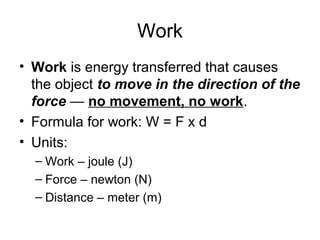
• Work is energy transferred that causes
the object to move in the direction of the
force — no movement, no work.
• Formula for work: W = F x d
• Units:
– Work – joule (J)
– Force – newton (N)
– Distance – meter (m)
Power
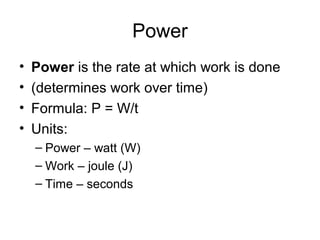
• Power is the rate at which work is done
• (determines work over time)
• Formula: P = W/t
• Units:
– Power – watt (W)
– Work – joule (J)
– Time – seconds
Machines
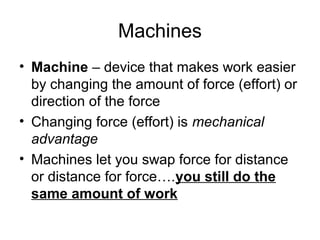
• Machine – device that makes work easier
by changing the amount of force (effort) or
direction of the force
• Changing force (effort) is mechanical
advantage
• Machines let you swap force for distance
or distance for force….you still do the
same amount of work
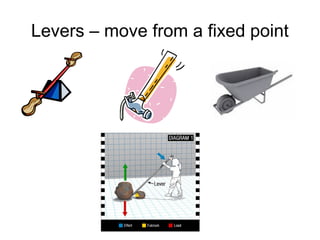
Levers – move from a fixed point
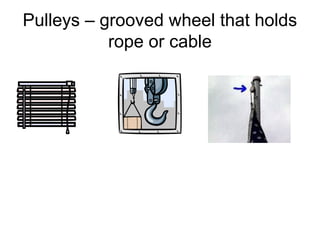
Pulleys – grooved wheel that holds
rope or cable
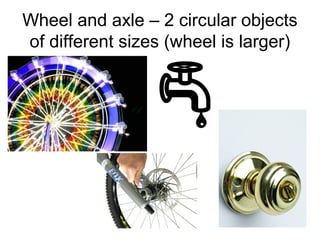
Wheel and axle – 2 circular objects
of different sizes (wheel is larger)
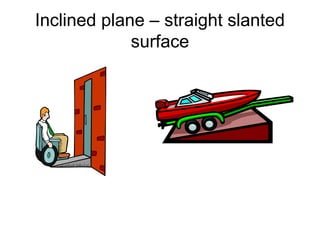
Inclined plane – straight slanted
surface
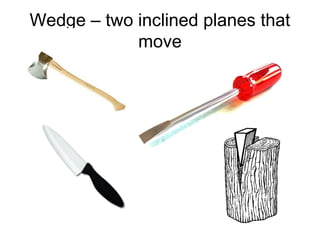
Wedge – two inclined planes that
move
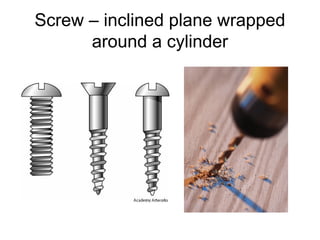
Screw – inclined plane wrapped
around a cylinder
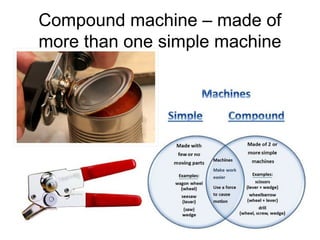
Compound machine – made of
more than one simple machine
• Mechanical advantage – number of times
a machine multiples force
• Work output – work done by the
machine; product of output force and the
distance of the force applied
• Work input – work done on a machine;
product of the input force and the distance
of the force applied
• Mechanical efficiency – ratio of output to
input of energy or power (divide output by input)
• Due to friction, work put into a machine is
always greater the than the work output by
the machine.

Work, power and machines with pitucres

  • 1.
    Work • Work isenergy transferred that causes the object to move in the direction of the force — no movement, no work. • Formula for work: W = F x d • Units: – Work – joule (J) – Force – newton (N) – Distance – meter (m)
  • 2.
    Power • Power isthe rate at which work is done • (determines work over time) • Formula: P = W/t • Units: – Power – watt (W) – Work – joule (J) – Time – seconds
  • 3.
    Machines • Machine –device that makes work easier by changing the amount of force (effort) or direction of the force • Changing force (effort) is mechanical advantage • Machines let you swap force for distance or distance for force….you still do the same amount of work
  • 4.
    Levers – movefrom a fixed point
  • 5.
    Pulleys – groovedwheel that holds rope or cable
  • 6.
    Wheel and axle– 2 circular objects of different sizes (wheel is larger)
  • 7.
    Inclined plane –straight slanted surface
  • 8.
    Wedge – twoinclined planes that move
  • 9.
    Screw – inclinedplane wrapped around a cylinder
  • 10.
    Compound machine –made of more than one simple machine
  • 11.
    • Mechanical advantage– number of times a machine multiples force • Work output – work done by the machine; product of output force and the distance of the force applied • Work input – work done on a machine; product of the input force and the distance of the force applied • Mechanical efficiency – ratio of output to input of energy or power (divide output by input)
  • 12.
    • Due tofriction, work put into a machine is always greater the than the work output by the machine.