Work, Power, and Simple
          Machines
 Work

 Power

 Machines

 Simple   and Compound Machines
Work
 Work  is defined as a force acting
  through a distance.
 Work=Force x Distance

 W=Fd=Newtons x meters=N-
  m=Joule
 A Joule (J) is an amount of work or
  energy that is equivalent to applying
  a 1 Newton force to an object for a
  distance of 1 meter.
 Energy is the ability to do work.
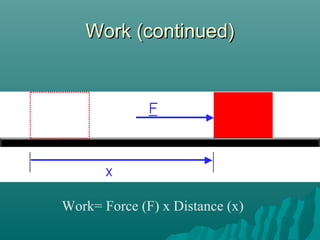
Work (continued)


Work= Force (F) x Distance (x)
Power
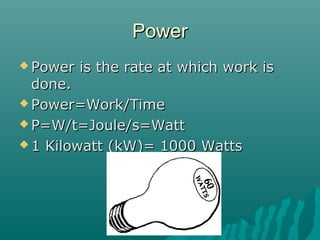
 Power   is the rate at which work is
  done.
 Power=Work/Time

 P=W/t=Joule/s=Watt

 1 Kilowatt (kW)= 1000 Watts
Machines
A  machine is a device that makes
  work easier.
 Work input is the work that is put
  into the machine (the input distance
  times the input or effort force).
 Work output is the work that a
  machine does (the output distance
  times the output or resistant force).
Machines (continued)
 Machines  make work easier by
  changing the input force or distance
  or by changing the direction of input
  force.
 Work is conserved.

 Theoretically, the work put into a
  machine must equal the work that
  comes out of a machine.
 In practice this never happens due to
  energy being lost to friction.
Machines (continued)
A  comparison of input work to output
  work is called efficiency.
 The efficiency of a machine is equal
  to work output/work input.
 Due to friction, no machine is 100%
  efficient.
 Machines with the smallest amount
  of friction are the most efficient.
Machines (continued)
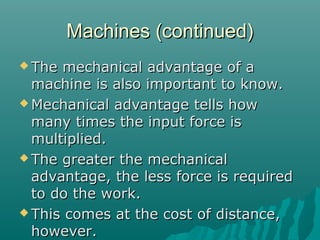
 The mechanical advantage of a
  machine is also important to know.
 Mechanical advantage tells how
  many times the input force is
  multiplied.
 The greater the mechanical
  advantage, the less force is required
  to do the work.
 This comes at the cost of distance,
  however.
Simple Machines
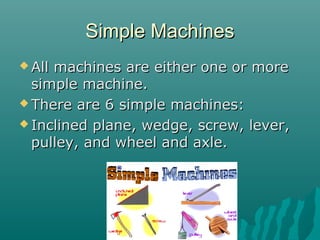
 Allmachines are either one or more
  simple machine.
 There are 6 simple machines:

 Inclined plane, wedge, screw, lever,
  pulley, and wheel and axle.
Simple Machines (continued)
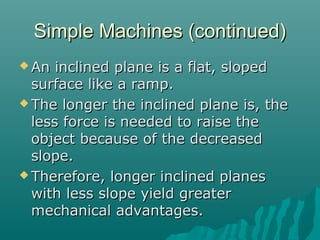
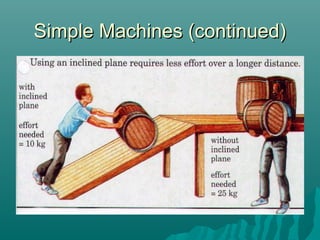
 An  inclined plane is a flat, sloped
  surface like a ramp.
 The longer the inclined plane is, the
  less force is needed to raise the
  object because of the decreased
  slope.
 Therefore, longer inclined planes
  with less slope yield greater
  mechanical advantages.
Simple Machines (continued)
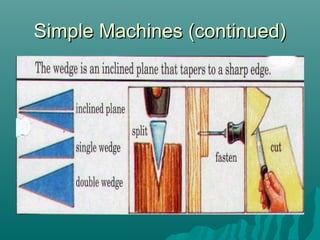
A  wedge is a moving inclined plane.
 Many wedges are made from two
  inclined planes stuck together like an
  ax.
 The longer and thinner the wedge,
  the greater its mechanical
  advantage.
Simple Machines (continued)
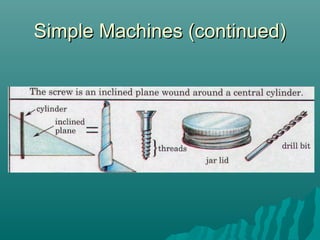
A  screw is an inclined plane wrapped
  around a central bar to form a spiral.
 A screw gets its mechanical
  advantage from the length of the
  inclined plane wrapped around it.
 The closer together the threads on a
  screw, the greater its mechanical
  advantage.
Simple Machines (continued)
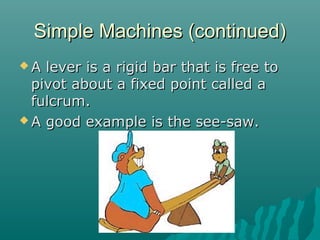
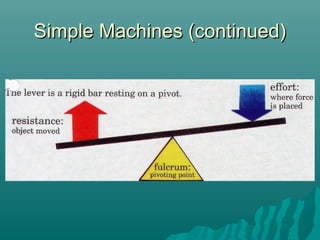
A  lever is a rigid bar that is free to
  pivot about a fixed point called a
  fulcrum.
 A good example is the see-saw.
Simple Machines (continued)
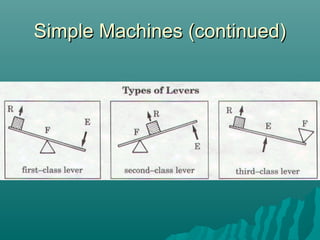
 There   are three classes of levers.
 A first class lever has a fulcrum in
  the middle.
 A second class lever has the
  resistance in the middle.
 A third class lever has the effort in
  the middle.
 Just remember FRE.
Simple Machines (continued)
 Notice  that different classes of levers
  change the direction of the input
  force.
 This can sometimes make work
  easier.
 The mechanical advantage of a lever
  is generated by changing the length
  of the force or effort arm relative to
  the resistant arm of the lever.
Simple Machines (continued)
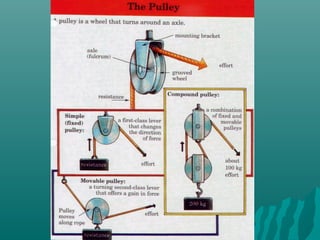
A  pulley is a rope, belt, or chain
  wrapped around a wheel.
 A fixed pulley can change the
  direction of input force.
 Pulleys can be combined in systems.
 The mechanical advantage of a
  moveable pulley system is equal to
  the number of lifting lines.
Simple Machines (continued)
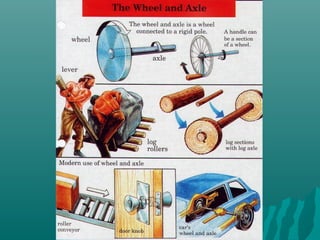
A  wheel and axle is a simple machine
  made from two circular objects of
  different sizes.
 The wheel is the larger of the two.

 The mechanical advantage of a
  wheel is generated by the difference
  in the radii.
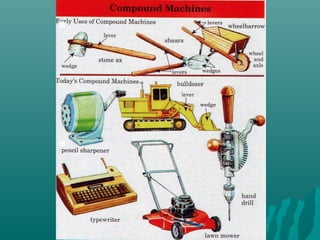
Compound Machines
A compound machine is a
 combination of two or more simple
 machines.
Mfe chapter 4 notes

Mfe chapter 4 notes

  • 1.
    Work, Power, andSimple Machines  Work  Power  Machines  Simple and Compound Machines
  • 2.
    Work  Work is defined as a force acting through a distance.  Work=Force x Distance  W=Fd=Newtons x meters=N- m=Joule  A Joule (J) is an amount of work or energy that is equivalent to applying a 1 Newton force to an object for a distance of 1 meter.  Energy is the ability to do work.
  • 3.
    Work (continued) Work= Force(F) x Distance (x)
  • 4.
    Power  Power is the rate at which work is done.  Power=Work/Time  P=W/t=Joule/s=Watt  1 Kilowatt (kW)= 1000 Watts
  • 5.
    Machines A machineis a device that makes work easier.  Work input is the work that is put into the machine (the input distance times the input or effort force).  Work output is the work that a machine does (the output distance times the output or resistant force).
  • 6.
    Machines (continued)  Machines make work easier by changing the input force or distance or by changing the direction of input force.  Work is conserved.  Theoretically, the work put into a machine must equal the work that comes out of a machine.  In practice this never happens due to energy being lost to friction.
  • 7.
    Machines (continued) A comparison of input work to output work is called efficiency.  The efficiency of a machine is equal to work output/work input.  Due to friction, no machine is 100% efficient.  Machines with the smallest amount of friction are the most efficient.
  • 8.
    Machines (continued)  Themechanical advantage of a machine is also important to know.  Mechanical advantage tells how many times the input force is multiplied.  The greater the mechanical advantage, the less force is required to do the work.  This comes at the cost of distance, however.
  • 9.
    Simple Machines  Allmachinesare either one or more simple machine.  There are 6 simple machines:  Inclined plane, wedge, screw, lever, pulley, and wheel and axle.
  • 10.
    Simple Machines (continued) An inclined plane is a flat, sloped surface like a ramp.  The longer the inclined plane is, the less force is needed to raise the object because of the decreased slope.  Therefore, longer inclined planes with less slope yield greater mechanical advantages.
  • 11.
  • 12.
    Simple Machines (continued) A wedge is a moving inclined plane.  Many wedges are made from two inclined planes stuck together like an ax.  The longer and thinner the wedge, the greater its mechanical advantage.
  • 13.
  • 14.
    Simple Machines (continued) A screw is an inclined plane wrapped around a central bar to form a spiral.  A screw gets its mechanical advantage from the length of the inclined plane wrapped around it.  The closer together the threads on a screw, the greater its mechanical advantage.
  • 15.
  • 16.
    Simple Machines (continued) A lever is a rigid bar that is free to pivot about a fixed point called a fulcrum.  A good example is the see-saw.
  • 17.
  • 18.
    Simple Machines (continued) There are three classes of levers.  A first class lever has a fulcrum in the middle.  A second class lever has the resistance in the middle.  A third class lever has the effort in the middle.  Just remember FRE.
  • 19.
  • 20.
    Simple Machines (continued) Notice that different classes of levers change the direction of the input force.  This can sometimes make work easier.  The mechanical advantage of a lever is generated by changing the length of the force or effort arm relative to the resistant arm of the lever.
  • 21.
    Simple Machines (continued) A pulley is a rope, belt, or chain wrapped around a wheel.  A fixed pulley can change the direction of input force.  Pulleys can be combined in systems.  The mechanical advantage of a moveable pulley system is equal to the number of lifting lines.
  • 23.
    Simple Machines (continued) A wheel and axle is a simple machine made from two circular objects of different sizes.  The wheel is the larger of the two.  The mechanical advantage of a wheel is generated by the difference in the radii.
  • 25.
    Compound Machines A compoundmachine is a combination of two or more simple machines.