8 th  Grade Chapter 3 Lesson 5 Pgs. 122-128 For Student Use Only
Solids at Work Moving Matter: WORK- the movement of an object by force WORK= Force x Distance Measured in Foot-pounds Work in In Metric System: One newton-meter (force x distance) is one  Joule Joule is named after James Prescott Joule Joule- metric unit of work and energy
Solids at Work Rate of Work: Time= important for mechanical work Power= Work/Time Work=W/T Work is directly related to power- greater work is the same time equals more power
Solids at Work Rate of Work: James Watt developed horsepower Horsepower: the ability to lift (move) 550 Lbs, 1 foot in 1 sec.  3 Horsepower meant that it can do the work of three horses in one second Average car= 150 hp Race car= 500 hp
Solids at Work Simple Machines: Helped muscle do work Machines- devices for doing work Multiply muscle power Working Devices: Complex mechanical devices- turn potential energy into kinetic energy- use some simple machines
Solids at Work Simple Machines: Simple Machines: Basic force multiplying machines Use many simple machines still today Jack to raise a car Manual can opener Simple Machines help in three ways: Multiplying the force Changing the direction of force applied Multiplying the speed pr distance to force
Solids at Work Mastering Machines: Effort: force we apply to a machine Resistance: the force the machine helps us overcome (load we are trying to move) Mechanical Advantage= Resistance/Effort
Solids at Work Working Law: Work input= work put into a machine Work output= work received from a machine Work output= distance in x force in = distance out x force out Law of Work: The work put into a machine is equal to the work received from the machine Effort force x effort distance = resistance force x resistance distance
Solids at Work Frictional Effects: Some effort force goes to overcome friction Because of friction: Work input is always greater than work output Energy is conserved because some energy is lost as heat, sound, etc. Work input= work output + work used to overcome friction
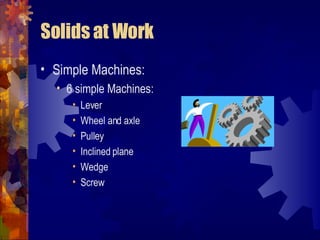
Solids at Work Simple Machines: 6 simple Machines: Lever Wheel and axle Pulley Inclined plane Wedge Screw
Solids at Work Simple Machines Lever: One of the most useful and versitile It can multiply force or speed with or without changing the direction of the effort Consists of rigid bar and fulcrum (pivot point) Bar is divided into effort arm and resistance arm
Solids at Work Simple Machines Lever Parts:  Effort arm (where effort is applied) and Resistance arm (where object is moved) Types of Levers: First class lever-  reverses the direction of the effort Second class lever-  fulcrum is at end and effort is applied at other end- effort force does not change direction Third class lever-  fulcrum at end and resistance at the other end- force is applied in between- change speed and distance

8th Grade Chapter 3 Lesson 5

  • 1.
    8 th Grade Chapter 3 Lesson 5 Pgs. 122-128 For Student Use Only
  • 2.
    Solids at WorkMoving Matter: WORK- the movement of an object by force WORK= Force x Distance Measured in Foot-pounds Work in In Metric System: One newton-meter (force x distance) is one Joule Joule is named after James Prescott Joule Joule- metric unit of work and energy
  • 3.
    Solids at WorkRate of Work: Time= important for mechanical work Power= Work/Time Work=W/T Work is directly related to power- greater work is the same time equals more power
  • 4.
    Solids at WorkRate of Work: James Watt developed horsepower Horsepower: the ability to lift (move) 550 Lbs, 1 foot in 1 sec. 3 Horsepower meant that it can do the work of three horses in one second Average car= 150 hp Race car= 500 hp
  • 5.
    Solids at WorkSimple Machines: Helped muscle do work Machines- devices for doing work Multiply muscle power Working Devices: Complex mechanical devices- turn potential energy into kinetic energy- use some simple machines
  • 6.
    Solids at WorkSimple Machines: Simple Machines: Basic force multiplying machines Use many simple machines still today Jack to raise a car Manual can opener Simple Machines help in three ways: Multiplying the force Changing the direction of force applied Multiplying the speed pr distance to force
  • 7.
    Solids at WorkMastering Machines: Effort: force we apply to a machine Resistance: the force the machine helps us overcome (load we are trying to move) Mechanical Advantage= Resistance/Effort
  • 8.
    Solids at WorkWorking Law: Work input= work put into a machine Work output= work received from a machine Work output= distance in x force in = distance out x force out Law of Work: The work put into a machine is equal to the work received from the machine Effort force x effort distance = resistance force x resistance distance
  • 9.
    Solids at WorkFrictional Effects: Some effort force goes to overcome friction Because of friction: Work input is always greater than work output Energy is conserved because some energy is lost as heat, sound, etc. Work input= work output + work used to overcome friction
  • 10.
    Solids at WorkSimple Machines: 6 simple Machines: Lever Wheel and axle Pulley Inclined plane Wedge Screw
  • 11.
    Solids at WorkSimple Machines Lever: One of the most useful and versitile It can multiply force or speed with or without changing the direction of the effort Consists of rigid bar and fulcrum (pivot point) Bar is divided into effort arm and resistance arm
  • 12.
    Solids at WorkSimple Machines Lever Parts: Effort arm (where effort is applied) and Resistance arm (where object is moved) Types of Levers: First class lever- reverses the direction of the effort Second class lever- fulcrum is at end and effort is applied at other end- effort force does not change direction Third class lever- fulcrum at end and resistance at the other end- force is applied in between- change speed and distance