Simple Machines   May 9, 2008
Objectives Explain how a machine makes work easier Calculate mechanical advantage Describe an ideal machine  Explain why machines are not 100% efficient
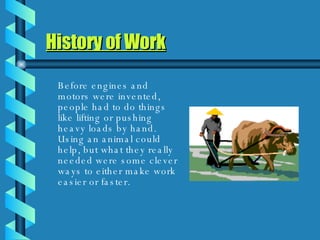
History of Work Before engines and motors were invented, people had to do things like lifting or pushing heavy loads by hand. Using an animal could help, but what they really needed were some clever ways to either make work easier or faster.
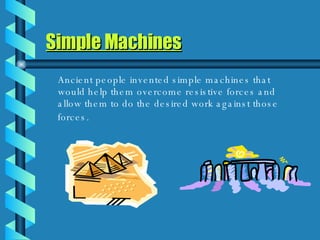
Simple Machines Ancient people invented simple machines that would help them overcome resistive forces and allow them to do the desired work against those forces.
Machines make work easier by changing the size and/or the direction of the force In order for work to be done: A force must be exerted There must be movement in direction of the force The two most common resistive forces are friction and gravity Machines
Machines make work easier  by changing  the amount of  force  you exert the  distance  over which you exert your force the  direction  over which you exert your force
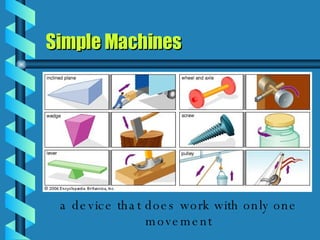
Simple Machines a device that does work with only one movement
Types of Simple Machines inclined plane wedge  lever wheel & axle screw pulley These make work  easier !
when using a machine to do work Effort (Input) Force (F E )  – This is the force you apply to the machine Resistance (Output) Force (F R )  – This is the force that the machine applies 2 general forces involved
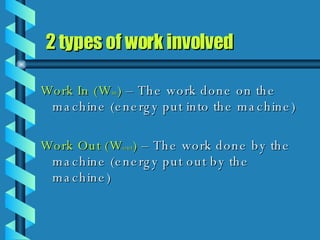
Work In (W in )  – The work done on the machine (energy put into the machine) Work Out (W out )  – The work done by the machine (energy put out by the machine) 2 types of work involved
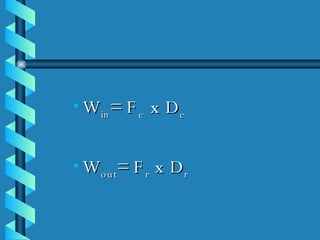
W in = F e  x D e W out = F r  x D r
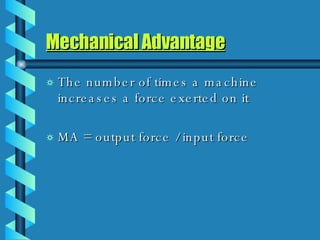
Mechanical Advantage The number of times a machine increases a force exerted on it MA = output force / input force
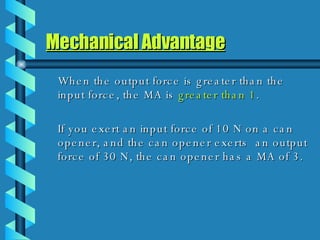
Mechanical Advantage When the output force is greater than the input force, the MA is  greater   than 1 . If you exert an input force of 10 N on a can opener, and the can opener exerts  an output force of 30 N, the can opener has a MA of 3.
Mechanical Advantage For a machine that increases distance, the output force is less than the input force. So the MA is  less   than 1 . If you exert an input force of 20 N and the machine’s output force is 10 N, the MA is 0.5 The machine only exerts half of your force but it is exerted over a loner distance.
Mechanical Advantage If only the direction changes, the input force will be the same as the output force. The MA will  always be 1 .
Efficiency Compares the output work to the input work. Efficiency =  W out   x 100%   W in The higher the percent, the more efficient the machine.
one in which there is no friction, no energy is lost so work in and work out would be equal W in =W out F e  x D e  = F r  x D r In reality, work out will always be less than work in because energy is lost through friction Ideal machine

Simple Machines2008

  • 1.
    Simple Machines May 9, 2008
  • 2.
    Objectives Explain howa machine makes work easier Calculate mechanical advantage Describe an ideal machine Explain why machines are not 100% efficient
  • 3.
    History of WorkBefore engines and motors were invented, people had to do things like lifting or pushing heavy loads by hand. Using an animal could help, but what they really needed were some clever ways to either make work easier or faster.
  • 4.
    Simple Machines Ancientpeople invented simple machines that would help them overcome resistive forces and allow them to do the desired work against those forces.
  • 5.
    Machines make workeasier by changing the size and/or the direction of the force In order for work to be done: A force must be exerted There must be movement in direction of the force The two most common resistive forces are friction and gravity Machines
  • 6.
    Machines make workeasier by changing the amount of force you exert the distance over which you exert your force the direction over which you exert your force
  • 7.
    Simple Machines adevice that does work with only one movement
  • 8.
    Types of SimpleMachines inclined plane wedge lever wheel & axle screw pulley These make work easier !
  • 9.
    when using amachine to do work Effort (Input) Force (F E ) – This is the force you apply to the machine Resistance (Output) Force (F R ) – This is the force that the machine applies 2 general forces involved
  • 10.
    Work In (Win ) – The work done on the machine (energy put into the machine) Work Out (W out ) – The work done by the machine (energy put out by the machine) 2 types of work involved
  • 11.
    W in =F e x D e W out = F r x D r
  • 12.
    Mechanical Advantage Thenumber of times a machine increases a force exerted on it MA = output force / input force
  • 13.
    Mechanical Advantage Whenthe output force is greater than the input force, the MA is greater than 1 . If you exert an input force of 10 N on a can opener, and the can opener exerts an output force of 30 N, the can opener has a MA of 3.
  • 14.
    Mechanical Advantage Fora machine that increases distance, the output force is less than the input force. So the MA is less than 1 . If you exert an input force of 20 N and the machine’s output force is 10 N, the MA is 0.5 The machine only exerts half of your force but it is exerted over a loner distance.
  • 15.
    Mechanical Advantage Ifonly the direction changes, the input force will be the same as the output force. The MA will always be 1 .
  • 16.
    Efficiency Compares theoutput work to the input work. Efficiency = W out x 100% W in The higher the percent, the more efficient the machine.
  • 17.
    one in whichthere is no friction, no energy is lost so work in and work out would be equal W in =W out F e x D e = F r x D r In reality, work out will always be less than work in because energy is lost through friction Ideal machine