Work, Power,
& Machines
Hold a book out in front
of you…your arms are
getting tired…is this
work?
What is work ?
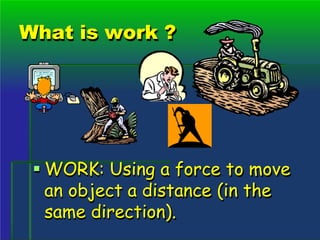
 WORK: Using a force to move
an object a distance (in the
same direction).
Calculating Work
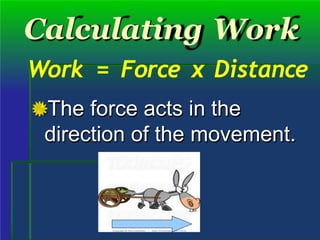
Work = Force x Distance
The force acts in the
direction of the movement.
No Distance…No Work
No work is done when you stand
in place holding an object.
Example: Hold a 5N pan of chocolate
brownies, waiting for your friend to open
the door. You have not moved the pan.
W = F x D
work = 5N x 0m = 0
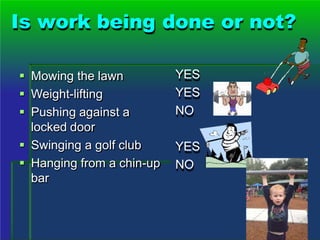
Is work being done or not?
 Mowing the lawn
 Weight-lifting
 Pushing against a
locked door
 Swinging a golf club
 Hanging from a chin-up
bar
YES
YES
NO
YES
NO
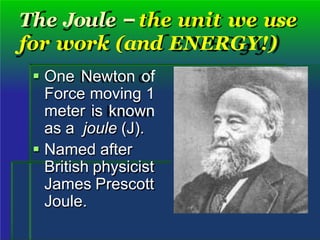
The Joule –the unit we use
for work (and ENERGY!)
 One Newton of
Force moving 1
meter is known
as a joule (J).
 Named after
British physicist
James Prescott
Joule.
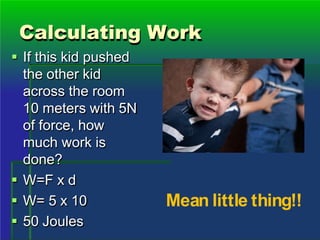
Calculating Work
 If this kid pushed
the other kid
across the room
10 meters with 5N
of force, how
much work is
done?
 W=F x d
 W= 5 x 10
 50 Joules
Mean little thing!!
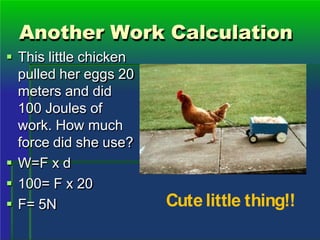
Another Work Calculation
 This little chicken
pulled her eggs 20
meters and did
100 Joules of
work. How much
force did she use?
 W=F x d
 100= F x 20
 F= 5N Cute little thing!!
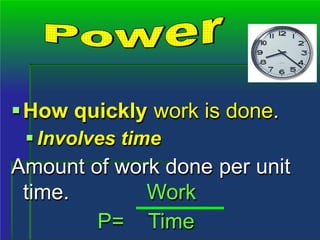
How quickly work is done.
Involves time
Amount of work done per unit
time. Work
P= Time
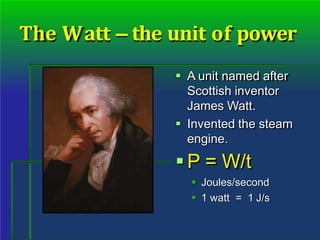
The Watt – the unit of power
 A unit named after
Scottish inventor
James Watt.
 Invented the steam
engine.
P = W/t
 Joules/second
 1 watt = 1 J/s
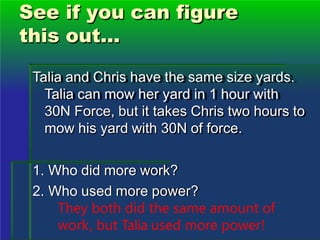
See if you can figure
this out...
Talia and Chris have the same size yards.
Talia can mow her yard in 1 hour with
30N Force, but it takes Chris two hours to
mow his yard with 30N of force.
1. Who did more work?
2. Who used more power?
They both did the same amount of
work, but Talia used more power!
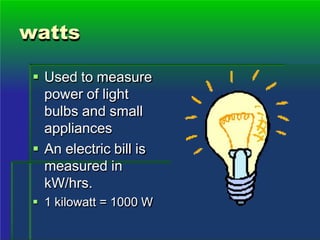
watts
 Used to measure
power of light
bulbs and small
appliances
 An electric bill is
measured in
kW/hrs.
 1 kilowatt = 1000 W
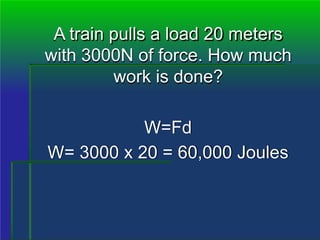
A train pulls a load 20 meters
with 3000N of force. How much
work is done?
W=Fd
W= 3000 x 20 = 60,000 Joules
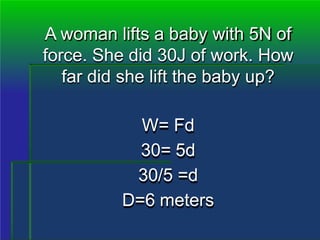
A woman lifts a baby with 5N of
force. She did 30J of work. How
far did she lift the baby up?
W= Fd
30= 5d
30/5 =d
D=6 meters
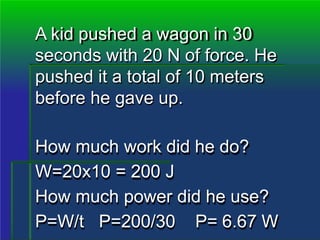
A kid pushed a wagon in 30
seconds with 20 N of force. He
pushed it a total of 10 meters
before he gave up.
How much work did he do?
W=20x10 = 200 J
How much power did he use?
P=W/t P=200/30 P= 6.67 W
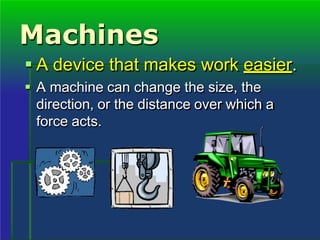
Machines
 A device that makes work easier.
 A machine can change the size, the
direction, or the distance over which a
force acts.
Forces involved:
Input Force
FI
Force
applied to
a machine
Output Force
FO
Force
applied by
a machine
Two forces, thus two
types of work
 Work Input
 work done on a
machine
=Input force x the
distance through
which that force acts
(input distance)
Work Output
Work done by a
machine
=Output force x the
distance through
which the resistance
moves (output
distance)
Can you get more work
out than you put in?
Work output can never be greater than
work input.
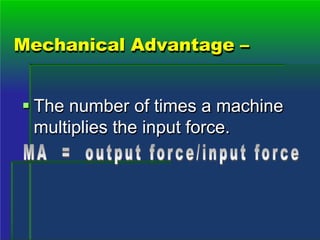
Mechanical Advantage –
 The number of times a machine
multiplies the input force.
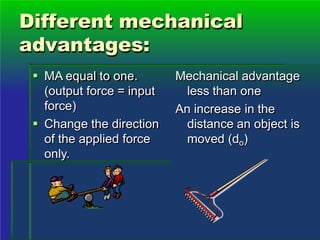
Different mechanical
advantages:
 MA equal to one.
(output force = input
force)
 Change the direction
of the applied force
only.
Mechanical advantage
less than one
An increase in the
distance an object is
moved (do)
Efficiency
 Efficiency can never be greater than 100
%. Why?
 Some work is always needed to
overcome friction.
 A percentage comparison of work output
to work input.
 work output (WO) / work input (WI)
1 . T H E L E V E R
 A bar that is free to pivot, or move about
a fixed point when an input force is
applied.
 Fulcrum = the pivot point of a lever.
 There are three classes of levers based
on the positioning of the effort force,
resistance force, and fulcrum.
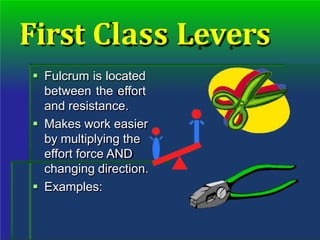
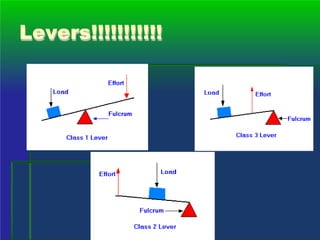
First Class Levers
 Fulcrum is located
between the effort
and resistance.
 Makes work easier
by multiplying the
effort force AND
changing direction.
 Examples:
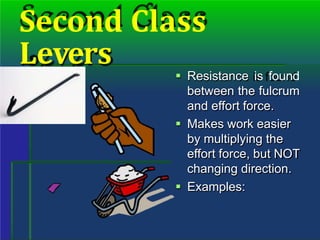
Second Class
Levers
 Resistance is found
between the fulcrum
and effort force.
 Makes work easier
by multiplying the
effort force, but NOT
changing direction.
 Examples:
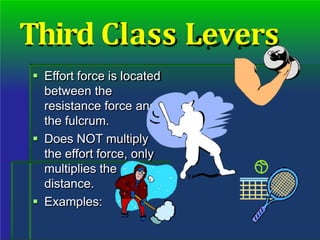
Third Class Levers
 Effort force is located
between the
resistance force and
the fulcrum.
 Does NOT multiply
the effort force, only
multiplies the
distance.
 Examples:
Levers!!!!!!!!!!!
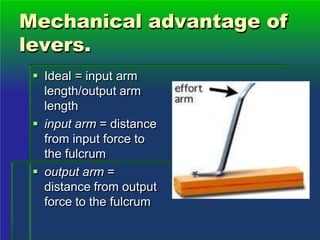
Mechanical advantage of
levers.
 Ideal = input arm
length/output arm
length
 input arm = distance
from input force to
the fulcrum
 output arm =
distance from output
force to the fulcrum
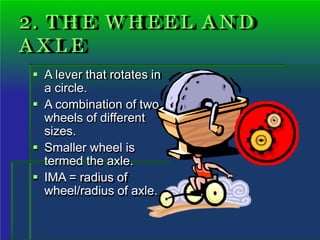
2. T H E W H E E L A N D
A X L E
 A lever that rotates in
a circle.
 A combination of two
wheels of different
sizes.
 Smaller wheel is
termed the axle.
 IMA = radius of
wheel/radius of axle.
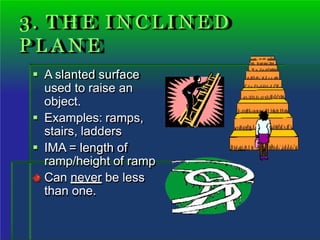
3. T H E I N C L I N E D
P L A N E
 A slanted surface
used to raise an
object.
 Examples: ramps,
stairs, ladders
 IMA = length of
ramp/height of ramp
Can never be less
than one.
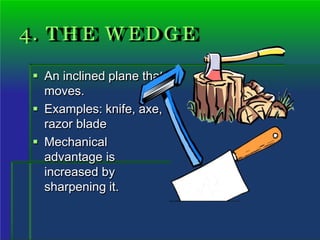
4. T H E W E D G E
 An inclined plane that
moves.
 Examples: knife, axe,
razor blade
 Mechanical
advantage is
increased by
sharpening it.
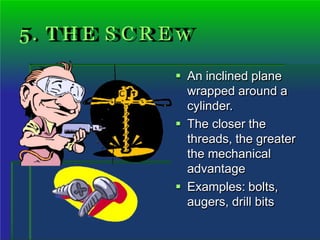
5. T H E S C R E w
 An inclined plane
wrapped around a
cylinder.
 The closer the
threads, the greater
the mechanical
advantage
 Examples: bolts,
augers, drill bits
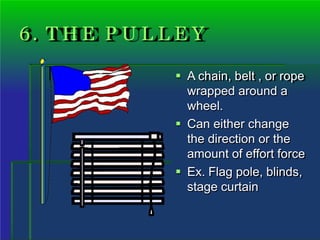
6. T H E P U L L E Y
 A chain, belt , or rope
wrapped around a
wheel.
 Can either change
the direction or the
amount of effort force
 Ex. Flag pole, blinds,
stage curtain
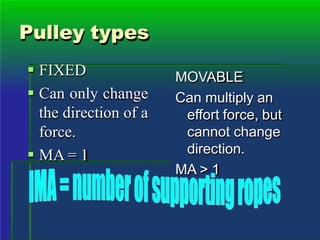
Pulley types
 FIXED
 Can only change
the direction of a
force.
 MA = 1
MOVABLE
Can multiply an
effort force, but
cannot change
direction.
MA > 1
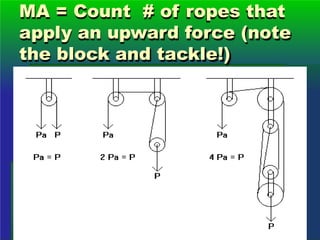
MA = Count # of ropes that
apply an upward force (note
the block and tackle!)
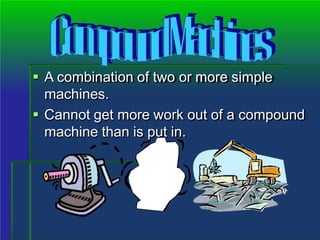
 A combination of two or more simple
machines.
 Cannot get more work out of a compound
machine than is put in.

work and simplvbvfv cbfdvc bfve machines.pptx

  • 1.
  • 2.
    Hold a bookout in front of you…your arms are getting tired…is this work?
  • 3.
    What is work?  WORK: Using a force to move an object a distance (in the same direction).
  • 4.
    Calculating Work Work =Force x Distance The force acts in the direction of the movement.
  • 5.
    No Distance…No Work Nowork is done when you stand in place holding an object. Example: Hold a 5N pan of chocolate brownies, waiting for your friend to open the door. You have not moved the pan. W = F x D work = 5N x 0m = 0
  • 6.
    Is work beingdone or not?  Mowing the lawn  Weight-lifting  Pushing against a locked door  Swinging a golf club  Hanging from a chin-up bar YES YES NO YES NO
  • 7.
    The Joule –theunit we use for work (and ENERGY!)  One Newton of Force moving 1 meter is known as a joule (J).  Named after British physicist James Prescott Joule.
  • 8.
    Calculating Work  Ifthis kid pushed the other kid across the room 10 meters with 5N of force, how much work is done?  W=F x d  W= 5 x 10  50 Joules Mean little thing!!
  • 9.
    Another Work Calculation This little chicken pulled her eggs 20 meters and did 100 Joules of work. How much force did she use?  W=F x d  100= F x 20  F= 5N Cute little thing!!
  • 10.
    How quickly workis done. Involves time Amount of work done per unit time. Work P= Time
  • 11.
    The Watt –the unit of power  A unit named after Scottish inventor James Watt.  Invented the steam engine. P = W/t  Joules/second  1 watt = 1 J/s
  • 12.
    See if youcan figure this out... Talia and Chris have the same size yards. Talia can mow her yard in 1 hour with 30N Force, but it takes Chris two hours to mow his yard with 30N of force. 1. Who did more work? 2. Who used more power? They both did the same amount of work, but Talia used more power!
  • 13.
    watts  Used tomeasure power of light bulbs and small appliances  An electric bill is measured in kW/hrs.  1 kilowatt = 1000 W
  • 14.
    A train pullsa load 20 meters with 3000N of force. How much work is done? W=Fd W= 3000 x 20 = 60,000 Joules
  • 15.
    A woman liftsa baby with 5N of force. She did 30J of work. How far did she lift the baby up? W= Fd 30= 5d 30/5 =d D=6 meters
  • 16.
    A kid pusheda wagon in 30 seconds with 20 N of force. He pushed it a total of 10 meters before he gave up. How much work did he do? W=20x10 = 200 J How much power did he use? P=W/t P=200/30 P= 6.67 W
  • 17.
    Machines  A devicethat makes work easier.  A machine can change the size, the direction, or the distance over which a force acts.
  • 18.
    Forces involved: Input Force FI Force appliedto a machine Output Force FO Force applied by a machine
  • 19.
    Two forces, thustwo types of work  Work Input  work done on a machine =Input force x the distance through which that force acts (input distance) Work Output Work done by a machine =Output force x the distance through which the resistance moves (output distance)
  • 20.
    Can you getmore work out than you put in? Work output can never be greater than work input.
  • 21.
    Mechanical Advantage – The number of times a machine multiplies the input force.
  • 22.
    Different mechanical advantages:  MAequal to one. (output force = input force)  Change the direction of the applied force only. Mechanical advantage less than one An increase in the distance an object is moved (do)
  • 23.
    Efficiency  Efficiency cannever be greater than 100 %. Why?  Some work is always needed to overcome friction.  A percentage comparison of work output to work input.  work output (WO) / work input (WI)
  • 24.
    1 . TH E L E V E R  A bar that is free to pivot, or move about a fixed point when an input force is applied.  Fulcrum = the pivot point of a lever.  There are three classes of levers based on the positioning of the effort force, resistance force, and fulcrum.
  • 25.
    First Class Levers Fulcrum is located between the effort and resistance.  Makes work easier by multiplying the effort force AND changing direction.  Examples:
  • 26.
    Second Class Levers  Resistanceis found between the fulcrum and effort force.  Makes work easier by multiplying the effort force, but NOT changing direction.  Examples:
  • 27.
    Third Class Levers Effort force is located between the resistance force and the fulcrum.  Does NOT multiply the effort force, only multiplies the distance.  Examples:
  • 28.
  • 29.
    Mechanical advantage of levers. Ideal = input arm length/output arm length  input arm = distance from input force to the fulcrum  output arm = distance from output force to the fulcrum
  • 30.
    2. T HE W H E E L A N D A X L E  A lever that rotates in a circle.  A combination of two wheels of different sizes.  Smaller wheel is termed the axle.  IMA = radius of wheel/radius of axle.
  • 31.
    3. T HE I N C L I N E D P L A N E  A slanted surface used to raise an object.  Examples: ramps, stairs, ladders  IMA = length of ramp/height of ramp Can never be less than one.
  • 32.
    4. T HE W E D G E  An inclined plane that moves.  Examples: knife, axe, razor blade  Mechanical advantage is increased by sharpening it.
  • 33.
    5. T HE S C R E w  An inclined plane wrapped around a cylinder.  The closer the threads, the greater the mechanical advantage  Examples: bolts, augers, drill bits
  • 34.
    6. T HE P U L L E Y  A chain, belt , or rope wrapped around a wheel.  Can either change the direction or the amount of effort force  Ex. Flag pole, blinds, stage curtain
  • 35.
    Pulley types  FIXED Can only change the direction of a force.  MA = 1 MOVABLE Can multiply an effort force, but cannot change direction. MA > 1
  • 36.
    MA = Count# of ropes that apply an upward force (note the block and tackle!)
  • 37.
     A combinationof two or more simple machines.  Cannot get more work out of a compound machine than is put in.