Vocabulary
 Machine: any device that makes doing
work easier
 Mechanical advantage: the # of times a
machine multiplies the input force;
 MA= output force/ input force
 Efficiency: the percentage of the input
work done on a machine that the machine
can return in output work;
 E=output work/input work ● 100
Vocabulary
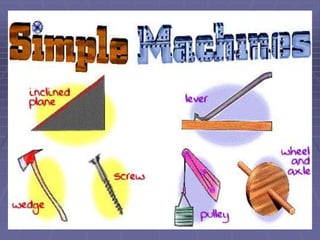
 Simple machine: one of the basic
machines that makes doing work easier
1. lever
2. Inclined plane
3. Wheel and axle
4. Pulley
5. Wedge
6. Screw
Vocabulary
 Compound Machine: a machine that is made up
of two or more simple machines
 Nanotechnology: the science and technology of
building electronic circuits and devices from
single atoms and molecules
 Robot: a machine that works automatically or by
remote control
 Fulcrum: a fixed point around which a lever
rotates
Lever
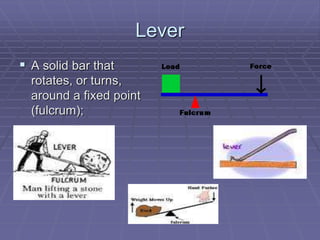
 A solid bar that
rotates, or turns,
around a fixed point
(fulcrum);
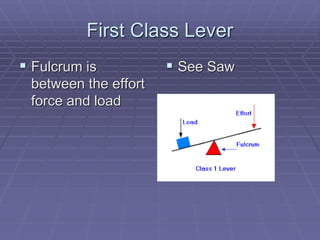
First Class Lever
 Fulcrum is
between the effort
force and load
 See Saw
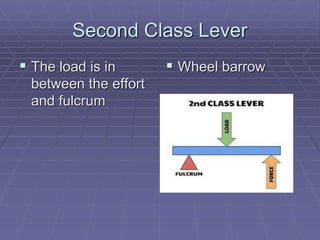
Second Class Lever
 The load is in
between the effort
and fulcrum
 Wheel barrow
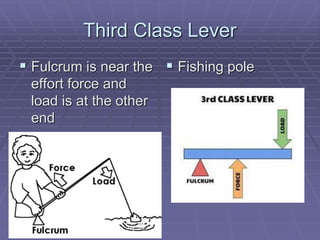
Third Class Lever
 Fulcrum is near the
effort force and
load is at the other
end
 Fishing pole
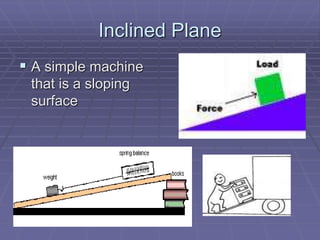
Inclined Plane
 A simple machine
that is a sloping
surface
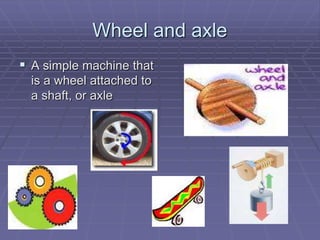
Wheel and axle
 A simple machine that
is a wheel attached to
a shaft, or axle
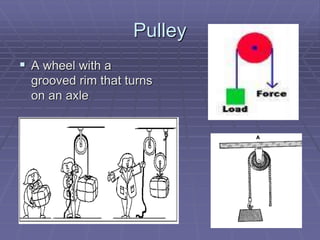
Pulley
 A wheel with a
grooved rim that turns
on an axle
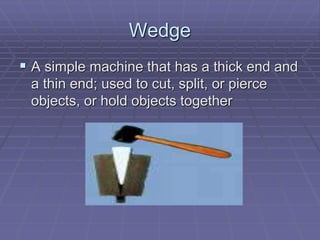
Wedge
 A simple machine that has a thick end and
a thin end; used to cut, split, or pierce
objects, or hold objects together
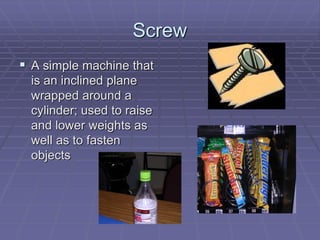
Screw
 A simple machine that
is an inclined plane
wrapped around a
cylinder; used to raise
and lower weights as
well as to fasten
objects
Machines help people do work
1. Machines change the way a force is
applied
a. If a machine decreases the amount of
force needed to do the work, the
distance over which that force must be
applied increases.
b. A machine can change the direction of
an applied force
 Input force (effort): the force exerted on a
machine.
 Output force: the force exerted on an
object by a machine
 The number of times the machine
multiplies the input force is the machine’s
mechanical advantage
2. Work transfers energy
a. A machine increases the potential or
kinetic energy of an object by doing work on
it.
b. For a certain amount of work, if distance
increases, force decreases.
3. Output work is always less than input
work
a. Efficiency
(output work/input work ● 100)
b. No real machine is 100 % efficient.
c. Machines lose energy due to friction
d. Machines lose energy due to air
resistance (car design, helmet design,
airplane design)
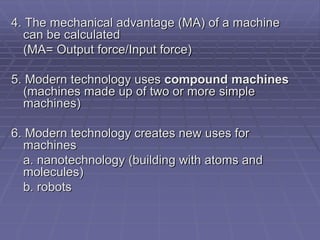
4. The mechanical advantage (MA) of a machine
can be calculated
(MA= Output force/Input force)
5. Modern technology uses compound machines
(machines made up of two or more simple
machines)
6. Modern technology creates new uses for
machines
a. nanotechnology (building with atoms and
molecules)
b. robots
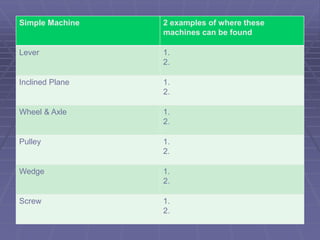
Simple Machine 2 examples of where these
machines can be found
Lever 1.
2.
Inclined Plane 1.
2.
Wheel & Axle 1.
2.
Pulley 1.
2.
Wedge 1.
2.
Screw 1.
2.

Simple Machines.ppt

  • 2.
    Vocabulary  Machine: anydevice that makes doing work easier  Mechanical advantage: the # of times a machine multiplies the input force;  MA= output force/ input force  Efficiency: the percentage of the input work done on a machine that the machine can return in output work;  E=output work/input work ● 100
  • 3.
    Vocabulary  Simple machine:one of the basic machines that makes doing work easier 1. lever 2. Inclined plane 3. Wheel and axle 4. Pulley 5. Wedge 6. Screw
  • 4.
    Vocabulary  Compound Machine:a machine that is made up of two or more simple machines  Nanotechnology: the science and technology of building electronic circuits and devices from single atoms and molecules  Robot: a machine that works automatically or by remote control  Fulcrum: a fixed point around which a lever rotates
  • 5.
    Lever  A solidbar that rotates, or turns, around a fixed point (fulcrum);
  • 6.
    First Class Lever Fulcrum is between the effort force and load  See Saw
  • 7.
    Second Class Lever The load is in between the effort and fulcrum  Wheel barrow
  • 8.
    Third Class Lever Fulcrum is near the effort force and load is at the other end  Fishing pole
  • 9.
    Inclined Plane  Asimple machine that is a sloping surface
  • 10.
    Wheel and axle A simple machine that is a wheel attached to a shaft, or axle
  • 11.
    Pulley  A wheelwith a grooved rim that turns on an axle
  • 12.
    Wedge  A simplemachine that has a thick end and a thin end; used to cut, split, or pierce objects, or hold objects together
  • 13.
    Screw  A simplemachine that is an inclined plane wrapped around a cylinder; used to raise and lower weights as well as to fasten objects
  • 14.
    Machines help peopledo work 1. Machines change the way a force is applied a. If a machine decreases the amount of force needed to do the work, the distance over which that force must be applied increases. b. A machine can change the direction of an applied force
  • 15.
     Input force(effort): the force exerted on a machine.  Output force: the force exerted on an object by a machine  The number of times the machine multiplies the input force is the machine’s mechanical advantage
  • 16.
    2. Work transfersenergy a. A machine increases the potential or kinetic energy of an object by doing work on it. b. For a certain amount of work, if distance increases, force decreases.
  • 17.
    3. Output workis always less than input work a. Efficiency (output work/input work ● 100) b. No real machine is 100 % efficient. c. Machines lose energy due to friction d. Machines lose energy due to air resistance (car design, helmet design, airplane design)
  • 18.
    4. The mechanicaladvantage (MA) of a machine can be calculated (MA= Output force/Input force) 5. Modern technology uses compound machines (machines made up of two or more simple machines) 6. Modern technology creates new uses for machines a. nanotechnology (building with atoms and molecules) b. robots
  • 19.
    Simple Machine 2examples of where these machines can be found Lever 1. 2. Inclined Plane 1. 2. Wheel & Axle 1. 2. Pulley 1. 2. Wedge 1. 2. Screw 1. 2.