Atomic Theory
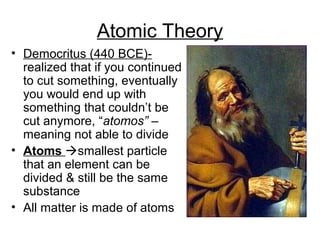
• Democritus (440 BCE)-
realized that if you continued
to cut something, eventually
you would end up with
something that couldn’t be
cut anymore, “atomos” –
meaning not able to divide
• Atoms smallest particle
that an element can be
divided & still be the same
substance
• All matter is made of atoms
John Dalton (1803)
• realized that atoms combine
in very specific proportions
(ratios) based on mass
• all substances are made of
atoms and they cannot be
created, divided or destroyed
(made of a single substance)
• All atoms of the same
element are exactly alike and
different from other elements,
(unique)
• Atoms join with other atoms
to form new substance
J. J. Thomson (1897)
• discovered that there were
small particles inside the
atom, meaning that atoms
can be divided into smaller
substances
• Electrons – negatively
charged particles attracted to
positively charged particles
• Plum pudding model –
electrons are mixed
throughout the atom, soft
blobs of matter
Ernest Rutherford (1909)
• Discovered that an
atom contains a
nucleus with
positively charged
particles and that the
electrons must be
“floating” around the
nucleus
• Most of an atom is
empty space
Niels Bohr (1913)
• Proposed that electron
moved around the
nucleus in energy levels
(shells), but no electrons
between the energy level
(think ladder)
• Electrons can jump from
one level to another
• Travel in a definite path
Modern Atomic Theory
• Erwin Shrodinger &
Werner Heisenberg
• Electrons have no
predictable pattern
and move in a region
where electrons are
likely to be found
called the electron
cloud
Atoms
• All atoms have a nucleus
– protons (+),
– neutrons (no charge)
– electrons (-)
• Same number of protons and electrons an
atom has no charge
• More protons (+) than electrons (-) the atom
has a positive ion form (more positives than negatives)
• More electrons (-) than protons (+) a negative
ion is formed (more negatives than positives)
• 117 different elements that are unique and
all things known to exist come from a
combination of these elements in specific
mass ratios
• Simplest atom is made of one proton, and
1 electron – hydrogen (has no neutrons)
• All additional element will have protons,
neutrons and electrons
• The atomic number of an element is
determined by the number of protons,
– 1 is hydrogen, 6 is carbon, hydrogen has 1
proton, carbon has 6 protons (you cannot
change the number of protons)
• To find neutrons take the mass number
(rounded) and subtract the protons.
Isotopes
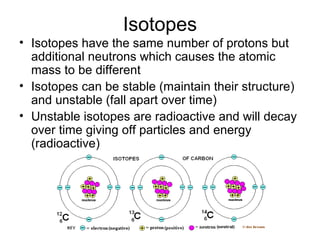
• Isotopes have the same number of protons but
additional neutrons which causes the atomic
mass to be different
• Isotopes can be stable (maintain their structure)
and unstable (fall apart over time)
• Unstable isotopes are radioactive and will decay
over time giving off particles and energy
(radioactive)
• Mass number
determines the
isotope, the number
of protons and
neutrons added
together
• Most elements have
isotopes
• All isotopes of an
element have the
exact properties of
the element
Forces in
atoms
• Gravitational force –
pulls objects toward
each other—depends on
mass and distances
between the objects—
very small force in
atoms
• Electromagnetic force
–– proton (+) and
electrons (-) have strong
attraction which keeps
the electrons in motion
around the nucleus of
• Strong force – force
which keeps protons
from flying apart due
to close distance
between protons and
neutrons
• Weak force – relevant
to radioactive atoms-
allows neutrons to
change into proton
and electron

Atomic theory

  • 2.
    Atomic Theory • Democritus(440 BCE)- realized that if you continued to cut something, eventually you would end up with something that couldn’t be cut anymore, “atomos” – meaning not able to divide • Atoms smallest particle that an element can be divided & still be the same substance • All matter is made of atoms
  • 4.
    John Dalton (1803) •realized that atoms combine in very specific proportions (ratios) based on mass • all substances are made of atoms and they cannot be created, divided or destroyed (made of a single substance) • All atoms of the same element are exactly alike and different from other elements, (unique) • Atoms join with other atoms to form new substance
  • 6.
    J. J. Thomson(1897) • discovered that there were small particles inside the atom, meaning that atoms can be divided into smaller substances • Electrons – negatively charged particles attracted to positively charged particles • Plum pudding model – electrons are mixed throughout the atom, soft blobs of matter
  • 8.
    Ernest Rutherford (1909) •Discovered that an atom contains a nucleus with positively charged particles and that the electrons must be “floating” around the nucleus • Most of an atom is empty space
  • 11.
    Niels Bohr (1913) •Proposed that electron moved around the nucleus in energy levels (shells), but no electrons between the energy level (think ladder) • Electrons can jump from one level to another • Travel in a definite path
  • 13.
    Modern Atomic Theory •Erwin Shrodinger & Werner Heisenberg • Electrons have no predictable pattern and move in a region where electrons are likely to be found called the electron cloud
  • 16.
    Atoms • All atomshave a nucleus – protons (+), – neutrons (no charge) – electrons (-) • Same number of protons and electrons an atom has no charge • More protons (+) than electrons (-) the atom has a positive ion form (more positives than negatives) • More electrons (-) than protons (+) a negative ion is formed (more negatives than positives)
  • 17.
    • 117 differentelements that are unique and all things known to exist come from a combination of these elements in specific mass ratios • Simplest atom is made of one proton, and 1 electron – hydrogen (has no neutrons)
  • 18.
    • All additionalelement will have protons, neutrons and electrons • The atomic number of an element is determined by the number of protons, – 1 is hydrogen, 6 is carbon, hydrogen has 1 proton, carbon has 6 protons (you cannot change the number of protons) • To find neutrons take the mass number (rounded) and subtract the protons.
  • 19.
    Isotopes • Isotopes havethe same number of protons but additional neutrons which causes the atomic mass to be different • Isotopes can be stable (maintain their structure) and unstable (fall apart over time) • Unstable isotopes are radioactive and will decay over time giving off particles and energy (radioactive)
  • 20.
    • Mass number determinesthe isotope, the number of protons and neutrons added together • Most elements have isotopes • All isotopes of an element have the exact properties of the element
  • 21.
    Forces in atoms • Gravitationalforce – pulls objects toward each other—depends on mass and distances between the objects— very small force in atoms • Electromagnetic force –– proton (+) and electrons (-) have strong attraction which keeps the electrons in motion around the nucleus of
  • 22.
    • Strong force– force which keeps protons from flying apart due to close distance between protons and neutrons • Weak force – relevant to radioactive atoms- allows neutrons to change into proton and electron