WIND POWER-EXISTING &
RECENT TRENDS
Electrical Engineering Department
INDIRA GANDHI INSTITUTE OF TECHNOLOGY
Sarang-759146, Dhenkanal, Orissa
1
9/4/2011 1
OUTLINE
1.INTRODUCTION
2.NATURE OF WIND
3.WIND TURBINE & CLASSIFICATION
4.WIND DATA, SPEED & ENERGY
5.CAPACITY FACTOR & PENETRATION
6.TURBINE PRODUCING ELECTRICITY
7.FLYING POWER STATION
8.AIRBORNE WIND TURBINE
9.KITEGEN
10.SMALL SCALE WIND POWER
11.ADVANTAGES & DISADVANTAGES
12.CONCLUSION
9/4/2011 2
INTRODUCTION
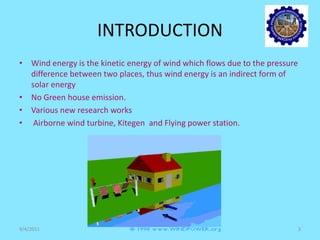
• Wind energy is the kinetic energy of wind which flows due to the pressure
difference between two places, thus wind energy is an indirect form of
solar energy
• No Green house emission.
• Various new research works
• Airborne wind turbine, Kitegen and Flying power station.
9/4/2011 3
NATURE OF WIND
Winds are caused because of two factors:
• The absorption of solar energy on the earth`s and in the atmosphere
• The rotation of earth about its own axis and its motion around the sun
Because of these two factors, alternate heating and cooling cycles occur,
differences in pressure are created, and the air is caused to move.
Most of the energy stored in these wind movements can be found at high
altitudes where continuous wind speeds of over 160 km/h (100 mph) occur.
Eventually, the wind energy is converted through friction into diffuse heat
throughout the Earth's surface and the atmospheric pressure are created, and the
air is caused to move.
9/4/2011 4
WIND TURBINE
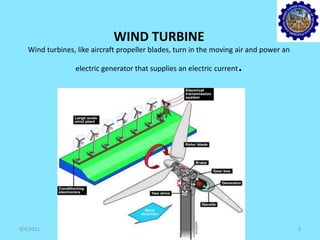
Wind turbines, like aircraft propeller blades, turn in the moving air and power an
electric generator that supplies an electric current.
9/4/2011 5
WIND TURBINE’S CLASSIFICATION
Wind turbines are classified into:
 Horizontal Axis wind turbine
 Vertical Axis wind turbine
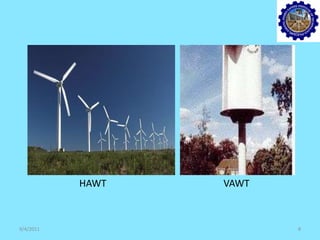
HAWT: In horizontal axis turbine, the rotor axis is horizontal and can be adjusted so
that it is parallel to the direction of the wind stream. It is of 2 types based on the
types of rotor used:
1.Multiblade type: The multi-blade rotor consists of a number of curved sheet metal
blades which increase in width going outwards from the centre
2.Propeller type: : The propeller rotor consists of only two or three blades made from
glass fibre reinforced plastic. The blades have aerofoil sections with a high
thickness-to-chord ratio and yield a high lift relative to the drag.
9/4/2011 6
VAWT: In the vertical axis wind turbine, the rotor axis is vertical and fixed,
and is perpendicular to both the surface of the earth and the wind stream.
Based on the type of rotor used, it is of two type:
1. Savinous type: The savinous rotor consists essentially of a hollow cylinder
(approximately elliptical in shape) sliced in half, the halves being fixed to
a vertical axis with a gap in between to make an S-shape.
2. Darrieus type: The darrieus rotor is shaped somewhat like an egg beater.
It consists of two or three blades having an aerofoil cross section. Along
the length, the blades are curved into a shape called a troposkein.
9/4/2011 7
HAWT VAWT
9/4/2011 8
WIND DATA &WIND SPEED NEEDED
Wind data:
 Vector quantity
 Anemometers
Wind speed needed:
 Minimum 16 kmph
 Wind speed increases with height & in
offshore regions.
 Rotate between 10 to 50 rpm.
9/4/2011 9
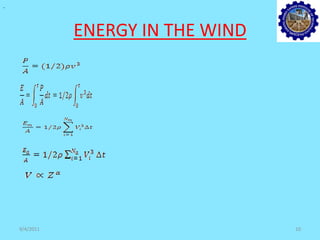
ENERGY IN THE WIND
-
9/4/2011 10
CAPACITY FACTOR
• The ratio of actual productivity in a year to this theoretical
maximum is called the capacity factor.
• Typical capacity factors are 20–40%.
PENETRATION
• Wind energy "penetration" refers to the fraction of energy
produced by wind compared with the total available
generation capacity.
9/4/2011 11
HOW WIND TURBINE PRODUCES
ELECTRICITY
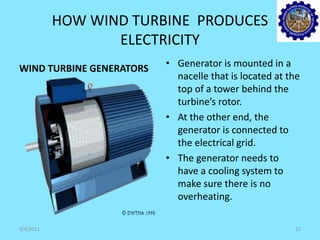
WIND TURBINE GENERATORS • Generator is mounted in a
nacelle that is located at the
top of a tower behind the
turbine’s rotor.
• At the other end, the
generator is connected to
the electrical grid.
• The generator needs to
have a cooling system to
make sure there is no
overheating.
9/4/2011 12
SMALL GENERATORS:
 Require less force to turn than a larger ones, but give much
lower power output.
 Less efficient
i.e.. If you fit a large wind turbine rotor with a small generator it
will be producing electricity during many hours of the year,
but it will capture only a small part of the energy content of
the wind at high wind speeds.
LARGE GENERATORS:
 Very efficient at high wind speeds, but unable to turn at low
wind speeds.
9/4/2011 13
FLYING POWER STATION
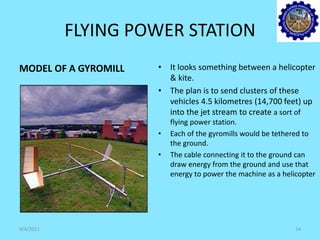
MODEL OF A GYROMILL • It looks something between a helicopter
& kite.
• The plan is to send clusters of these
vehicles 4.5 kilometres (14,700 feet) up
into the jet stream to create a sort of
flying power station.
• Each of the gyromills would be tethered to
the ground.
• The cable connecting it to the ground can
draw energy from the ground and use that
energy to power the machine as a helicopter
9/4/2011 14
Contd.
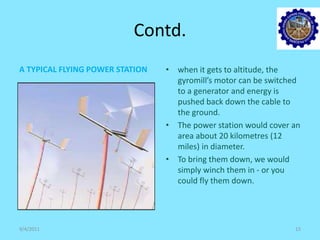
A TYPICAL FLYING POWER STATION • when it gets to altitude, the
gyromill’s motor can be switched
to a generator and energy is
pushed back down the cable to
the ground.
• The power station would cover an
area about 20 kilometres (12
miles) in diameter.
• To bring them down, we would
simply winch them in - or you
could fly them down.
9/4/2011 15
AIRBORNE WIND TURBINE
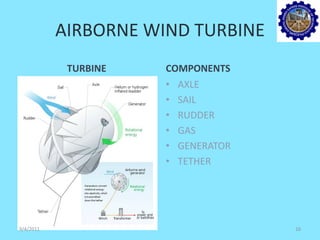
TURBINE COMPONENTS
• AXLE
• SAIL
• RUDDER
• GAS
• GENERATOR
• TETHER
9/4/2011 16
MARS
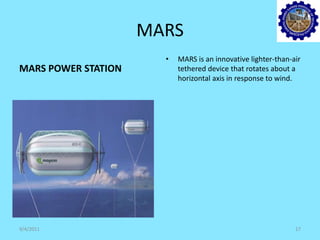
MARS POWER STATION
• MARS is an innovative lighter-than-air
tethered device that rotates about a
horizontal axis in response to wind.
9/4/2011 17
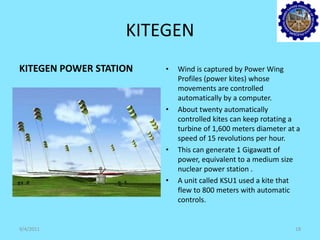
KITEGEN
KITEGEN POWER STATION • Wind is captured by Power Wing
Profiles (power kites) whose
movements are controlled
automatically by a computer.
• About twenty automatically
controlled kites can keep rotating a
turbine of 1,600 meters diameter at a
speed of 15 revolutions per hour.
• This can generate 1 Gigawatt of
power, equivalent to a medium size
nuclear power station .
• A unit called KSU1 used a kite that
flew to 800 meters with automatic
controls.
9/4/2011 18
SMALL SCALE WIND POWER
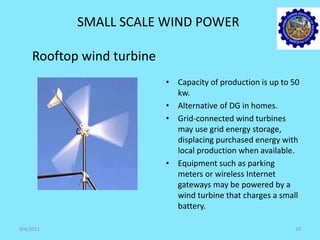
Rooftop wind turbine
• Capacity of production is up to 50
kw.
• Alternative of DG in homes.
• Grid-connected wind turbines
may use grid energy storage,
displacing purchased energy with
local production when available.
• Equipment such as parking
meters or wireless Internet
gateways may be powered by a
wind turbine that charges a small
battery.
9/4/2011 19
ADVANTAGES DISADVANTAGES
• Very inexpensive and
not very hard to
implement.
• Environmental effects
of wind power are
relatively minor.
• No fuel charges.
• Most wind catching
systems are very small.
• Present widely used
designs of wind power
are not very efficient .
• Wind power system
causes visual pollution .
• Wind power cannot be
used everywhere.
• Deadly for birds
9/4/2011 20
CONCLUSION
Various new techniques that are covered here are great future prospects for
our power requirement fulfillment. Wind power is renewable & does not
cause pollution. Efficient techniques of wind power utilization can solve
our energy crisis of the future.
9/4/2011 21
REFERENCES
9/4/2011 22
• “SOLAR ENERGY”, PRINCIPLES OF THERMAL COLLECTION & STORAGE (2nd
edition) by S.P.SUKHAMTE.
• “ALTERNATIVE ENERGY SOURCES III”, PART A: WIND
ENERGY/STORAGE/PRODUCTION by T.NEZAL VEZIROGLU.
• HANNELE HOLTTINEN, et al (Sept 2006) “DESIGN & OPERATION OF POWER
SYSTEMS WITH LARGE AMOUNTS OF WIND POWER” IEA WIND SUMMARY
PAPER.
• DAVID COHN “WINDMILLS IN THE SKY”.
• KITEGEN PROJECT, CANALE, M. FAGIANO, L. MILANESE, M. IPPOLITO.
• TOMORROWS WORLD (BBC NEWS), WORLD ENERGY COUNCIL, PROFF.
BRYAN ROBERTS.

Wind power existing & recent trends

  • 1.
    WIND POWER-EXISTING & RECENTTRENDS Electrical Engineering Department INDIRA GANDHI INSTITUTE OF TECHNOLOGY Sarang-759146, Dhenkanal, Orissa 1 9/4/2011 1
  • 2.
    OUTLINE 1.INTRODUCTION 2.NATURE OF WIND 3.WINDTURBINE & CLASSIFICATION 4.WIND DATA, SPEED & ENERGY 5.CAPACITY FACTOR & PENETRATION 6.TURBINE PRODUCING ELECTRICITY 7.FLYING POWER STATION 8.AIRBORNE WIND TURBINE 9.KITEGEN 10.SMALL SCALE WIND POWER 11.ADVANTAGES & DISADVANTAGES 12.CONCLUSION 9/4/2011 2
  • 3.
    INTRODUCTION • Wind energyis the kinetic energy of wind which flows due to the pressure difference between two places, thus wind energy is an indirect form of solar energy • No Green house emission. • Various new research works • Airborne wind turbine, Kitegen and Flying power station. 9/4/2011 3
  • 4.
    NATURE OF WIND Windsare caused because of two factors: • The absorption of solar energy on the earth`s and in the atmosphere • The rotation of earth about its own axis and its motion around the sun Because of these two factors, alternate heating and cooling cycles occur, differences in pressure are created, and the air is caused to move. Most of the energy stored in these wind movements can be found at high altitudes where continuous wind speeds of over 160 km/h (100 mph) occur. Eventually, the wind energy is converted through friction into diffuse heat throughout the Earth's surface and the atmospheric pressure are created, and the air is caused to move. 9/4/2011 4
  • 5.
    WIND TURBINE Wind turbines,like aircraft propeller blades, turn in the moving air and power an electric generator that supplies an electric current. 9/4/2011 5
  • 6.
    WIND TURBINE’S CLASSIFICATION Windturbines are classified into:  Horizontal Axis wind turbine  Vertical Axis wind turbine HAWT: In horizontal axis turbine, the rotor axis is horizontal and can be adjusted so that it is parallel to the direction of the wind stream. It is of 2 types based on the types of rotor used: 1.Multiblade type: The multi-blade rotor consists of a number of curved sheet metal blades which increase in width going outwards from the centre 2.Propeller type: : The propeller rotor consists of only two or three blades made from glass fibre reinforced plastic. The blades have aerofoil sections with a high thickness-to-chord ratio and yield a high lift relative to the drag. 9/4/2011 6
  • 7.
    VAWT: In thevertical axis wind turbine, the rotor axis is vertical and fixed, and is perpendicular to both the surface of the earth and the wind stream. Based on the type of rotor used, it is of two type: 1. Savinous type: The savinous rotor consists essentially of a hollow cylinder (approximately elliptical in shape) sliced in half, the halves being fixed to a vertical axis with a gap in between to make an S-shape. 2. Darrieus type: The darrieus rotor is shaped somewhat like an egg beater. It consists of two or three blades having an aerofoil cross section. Along the length, the blades are curved into a shape called a troposkein. 9/4/2011 7
  • 8.
  • 9.
    WIND DATA &WINDSPEED NEEDED Wind data:  Vector quantity  Anemometers Wind speed needed:  Minimum 16 kmph  Wind speed increases with height & in offshore regions.  Rotate between 10 to 50 rpm. 9/4/2011 9
  • 10.
    ENERGY IN THEWIND - 9/4/2011 10
  • 11.
    CAPACITY FACTOR • Theratio of actual productivity in a year to this theoretical maximum is called the capacity factor. • Typical capacity factors are 20–40%. PENETRATION • Wind energy "penetration" refers to the fraction of energy produced by wind compared with the total available generation capacity. 9/4/2011 11
  • 12.
    HOW WIND TURBINEPRODUCES ELECTRICITY WIND TURBINE GENERATORS • Generator is mounted in a nacelle that is located at the top of a tower behind the turbine’s rotor. • At the other end, the generator is connected to the electrical grid. • The generator needs to have a cooling system to make sure there is no overheating. 9/4/2011 12
  • 13.
    SMALL GENERATORS:  Requireless force to turn than a larger ones, but give much lower power output.  Less efficient i.e.. If you fit a large wind turbine rotor with a small generator it will be producing electricity during many hours of the year, but it will capture only a small part of the energy content of the wind at high wind speeds. LARGE GENERATORS:  Very efficient at high wind speeds, but unable to turn at low wind speeds. 9/4/2011 13
  • 14.
    FLYING POWER STATION MODELOF A GYROMILL • It looks something between a helicopter & kite. • The plan is to send clusters of these vehicles 4.5 kilometres (14,700 feet) up into the jet stream to create a sort of flying power station. • Each of the gyromills would be tethered to the ground. • The cable connecting it to the ground can draw energy from the ground and use that energy to power the machine as a helicopter 9/4/2011 14
  • 15.
    Contd. A TYPICAL FLYINGPOWER STATION • when it gets to altitude, the gyromill’s motor can be switched to a generator and energy is pushed back down the cable to the ground. • The power station would cover an area about 20 kilometres (12 miles) in diameter. • To bring them down, we would simply winch them in - or you could fly them down. 9/4/2011 15
  • 16.
    AIRBORNE WIND TURBINE TURBINECOMPONENTS • AXLE • SAIL • RUDDER • GAS • GENERATOR • TETHER 9/4/2011 16
  • 17.
    MARS MARS POWER STATION •MARS is an innovative lighter-than-air tethered device that rotates about a horizontal axis in response to wind. 9/4/2011 17
  • 18.
    KITEGEN KITEGEN POWER STATION• Wind is captured by Power Wing Profiles (power kites) whose movements are controlled automatically by a computer. • About twenty automatically controlled kites can keep rotating a turbine of 1,600 meters diameter at a speed of 15 revolutions per hour. • This can generate 1 Gigawatt of power, equivalent to a medium size nuclear power station . • A unit called KSU1 used a kite that flew to 800 meters with automatic controls. 9/4/2011 18
  • 19.
    SMALL SCALE WINDPOWER Rooftop wind turbine • Capacity of production is up to 50 kw. • Alternative of DG in homes. • Grid-connected wind turbines may use grid energy storage, displacing purchased energy with local production when available. • Equipment such as parking meters or wireless Internet gateways may be powered by a wind turbine that charges a small battery. 9/4/2011 19
  • 20.
    ADVANTAGES DISADVANTAGES • Veryinexpensive and not very hard to implement. • Environmental effects of wind power are relatively minor. • No fuel charges. • Most wind catching systems are very small. • Present widely used designs of wind power are not very efficient . • Wind power system causes visual pollution . • Wind power cannot be used everywhere. • Deadly for birds 9/4/2011 20
  • 21.
    CONCLUSION Various new techniquesthat are covered here are great future prospects for our power requirement fulfillment. Wind power is renewable & does not cause pollution. Efficient techniques of wind power utilization can solve our energy crisis of the future. 9/4/2011 21
  • 22.
    REFERENCES 9/4/2011 22 • “SOLARENERGY”, PRINCIPLES OF THERMAL COLLECTION & STORAGE (2nd edition) by S.P.SUKHAMTE. • “ALTERNATIVE ENERGY SOURCES III”, PART A: WIND ENERGY/STORAGE/PRODUCTION by T.NEZAL VEZIROGLU. • HANNELE HOLTTINEN, et al (Sept 2006) “DESIGN & OPERATION OF POWER SYSTEMS WITH LARGE AMOUNTS OF WIND POWER” IEA WIND SUMMARY PAPER. • DAVID COHN “WINDMILLS IN THE SKY”. • KITEGEN PROJECT, CANALE, M. FAGIANO, L. MILANESE, M. IPPOLITO. • TOMORROWS WORLD (BBC NEWS), WORLD ENERGY COUNCIL, PROFF. BRYAN ROBERTS.