Northern India Engineering College
MTDC SYSTEM
Prashant Kumar (15715604911)
Department of E.E.E
Contents of MTDC SYSTEM
Abstract
and
Introduction
Types of
MTDC
Systems
Applications,
Typical
problems,
Advantages
&
Disadvantages
Future
Aspects
&
Conclusion
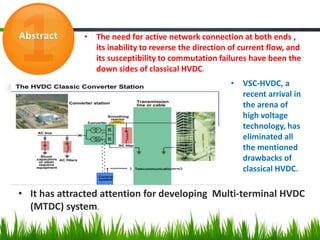
Abstract • The need for active network connection at both ends ,
its inability to reverse the direction of current flow, and
its susceptibility to commutation failures have been the
down sides of classical HVDC.
• VSC-HVDC, a
recent arrival in
the arena of
high voltage
technology, has
eliminated all
the mentioned
drawbacks of
classical HVDC.
• It has attracted attention for developing Multi-terminal HVDC
(MTDC) system.
MULTI-TERMINAL
HVDC SYSTEMS
Introduction
• A multi-terminal DC (MTDC) system
has more than two converter stations,
some of them operating as rectifiers
and others as inverters.
• The simplest way of building a MTDC
system from an existing two terminal
system is to introduce tap-pings.
Parallel operation of converters and bi
poles can also be viewed as multi-
terminal operation
• MTDC is a DC
equivalent of AC
grid which will
have DC
transmission
network
connecting more
than two AC/DC
converter
stations.
• The task of extending two terminal systems to
multi-terminal systems is not trivial. The
complexities of control and protection
increases.
• The use of HVDC breakers is generally required
in the MTDC systems.
• With recent advances in the emerging
technology of VSC-HVDC transmission, the
application of MTDC systems is becoming more
attractive than before.
Introduction
MULTI-TERMINAL HVDC SYSTEMS
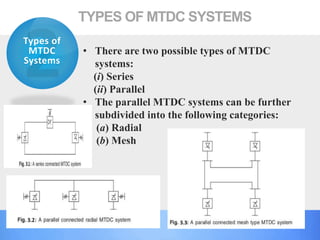
• There are two possible types of MTDC
systems:
(i) Series
(ii) Parallel
• The parallel MTDC systems can be further
subdivided into the following categories:
(a) Radial
(b) Mesh
TYPES OF MTDC SYSTEMS
Types of
MTDC
Systems
Comparison
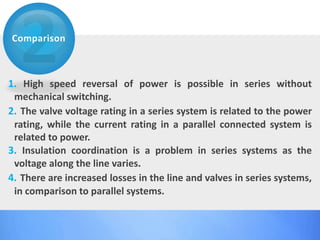
1. High speed reversal of power is possible in series without
mechanical switching.
2. The valve voltage rating in a series system is related to the power
rating, while the current rating in a parallel connected system is
related to power.
3. Insulation coordination is a problem in series systems as the
voltage along the line varies.
4. There are increased losses in the line and valves in series systems,
in comparison to parallel systems.
Potential
Applications
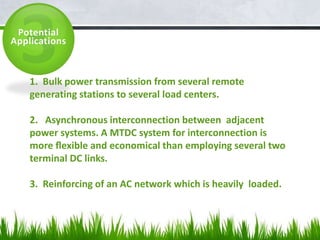
1. Bulk power transmission from several remote
generating stations to several load centers.
2. Asynchronous interconnection between adjacent
power systems. A MTDC system for interconnection is
more flexible and economical than employing several two
terminal DC links.
3. Reinforcing of an AC network which is heavily loaded.
Typical
Problems
Some of the typical problems that have been considered for study
are as follows:
1. Operation of small inverter taps connected to weak AC systems.
2. Integration of existing HVDC converter stations in MTDC systems
without major modifications in control.
3. Evaluation of communication, reactive power and filtering
requirements.
4. Power and reactive power modulation strategies in MTDC systems.
(1) The power reversal in a converter is achieved by current
reversal which is easily arranged by control action without
using mechanical switches.
(2) There is no problem of commutation failures.
(3) It can even supply passive loads.
(4) The use of Pulse Width Modulation (PWM) eliminates
low frequency harmonics and simple AC filters can be
supplied.
Advantages
- There is no need for reactive power compensation of VSC.
Actually, a VSC can supply reactive power and can help in
the control of the AC voltage.
- High speed reversal of power is possible.
- Overall efficiency of the system increases.
- Economical & environmental advantages are also there.
Advantages
1. Large smoothing reactor may be required to help in the
recovery of a small inverter from AC faults.
2. The speed of recovery of the entire MTDC system depends
upon the recovery of the small tap.
3. It is necessary to consider the effect of mode shifts and
develop additional protection sequences, particularly for faults
in DC line.
4. Multi-terminal systems are difficult to realize using line
commutated converters.
Disadvantages
FUTURE ASPECTS
1. Power distribution on vehicles.
2. Backbone of micro-grid.
3. Offshore wind integration
4. Super-grid: massive integration & transmission of
renewable energy.
5.AC islanding: splitting AC system into smaller
segments.
• Although the concept of MTDC systems has been
discussed for a long time, the implementation has
been very limited.
• The complexities in control and protection have
deterred many utilities from experimenting with
MTDC system operation.
• Introduction of MTDC systems requires extensive R
& D activities to solve the problems associated with
MTDC systems.
• It is anticipated that emerging technology of VSC-
HVDC transmission can help solve many of the
problems and encourage utilities to introduce MTDC
systems.
Conclusion
THANK YOU

MTDC SYSTEMS

  • 1.
    Northern India EngineeringCollege MTDC SYSTEM Prashant Kumar (15715604911) Department of E.E.E
  • 2.
    Contents of MTDCSYSTEM Abstract and Introduction Types of MTDC Systems Applications, Typical problems, Advantages & Disadvantages Future Aspects & Conclusion
  • 3.
    Abstract • Theneed for active network connection at both ends , its inability to reverse the direction of current flow, and its susceptibility to commutation failures have been the down sides of classical HVDC. • VSC-HVDC, a recent arrival in the arena of high voltage technology, has eliminated all the mentioned drawbacks of classical HVDC. • It has attracted attention for developing Multi-terminal HVDC (MTDC) system.
  • 4.
    MULTI-TERMINAL HVDC SYSTEMS Introduction • Amulti-terminal DC (MTDC) system has more than two converter stations, some of them operating as rectifiers and others as inverters. • The simplest way of building a MTDC system from an existing two terminal system is to introduce tap-pings. Parallel operation of converters and bi poles can also be viewed as multi- terminal operation • MTDC is a DC equivalent of AC grid which will have DC transmission network connecting more than two AC/DC converter stations.
  • 5.
    • The taskof extending two terminal systems to multi-terminal systems is not trivial. The complexities of control and protection increases. • The use of HVDC breakers is generally required in the MTDC systems. • With recent advances in the emerging technology of VSC-HVDC transmission, the application of MTDC systems is becoming more attractive than before. Introduction MULTI-TERMINAL HVDC SYSTEMS
  • 6.
    • There aretwo possible types of MTDC systems: (i) Series (ii) Parallel • The parallel MTDC systems can be further subdivided into the following categories: (a) Radial (b) Mesh TYPES OF MTDC SYSTEMS Types of MTDC Systems
  • 7.
    Comparison 1. High speedreversal of power is possible in series without mechanical switching. 2. The valve voltage rating in a series system is related to the power rating, while the current rating in a parallel connected system is related to power. 3. Insulation coordination is a problem in series systems as the voltage along the line varies. 4. There are increased losses in the line and valves in series systems, in comparison to parallel systems.
  • 8.
    Potential Applications 1. Bulk powertransmission from several remote generating stations to several load centers. 2. Asynchronous interconnection between adjacent power systems. A MTDC system for interconnection is more flexible and economical than employing several two terminal DC links. 3. Reinforcing of an AC network which is heavily loaded.
  • 9.
    Typical Problems Some of thetypical problems that have been considered for study are as follows: 1. Operation of small inverter taps connected to weak AC systems. 2. Integration of existing HVDC converter stations in MTDC systems without major modifications in control. 3. Evaluation of communication, reactive power and filtering requirements. 4. Power and reactive power modulation strategies in MTDC systems.
  • 10.
    (1) The powerreversal in a converter is achieved by current reversal which is easily arranged by control action without using mechanical switches. (2) There is no problem of commutation failures. (3) It can even supply passive loads. (4) The use of Pulse Width Modulation (PWM) eliminates low frequency harmonics and simple AC filters can be supplied. Advantages
  • 11.
    - There isno need for reactive power compensation of VSC. Actually, a VSC can supply reactive power and can help in the control of the AC voltage. - High speed reversal of power is possible. - Overall efficiency of the system increases. - Economical & environmental advantages are also there. Advantages
  • 12.
    1. Large smoothingreactor may be required to help in the recovery of a small inverter from AC faults. 2. The speed of recovery of the entire MTDC system depends upon the recovery of the small tap. 3. It is necessary to consider the effect of mode shifts and develop additional protection sequences, particularly for faults in DC line. 4. Multi-terminal systems are difficult to realize using line commutated converters. Disadvantages
  • 13.
    FUTURE ASPECTS 1. Powerdistribution on vehicles. 2. Backbone of micro-grid. 3. Offshore wind integration 4. Super-grid: massive integration & transmission of renewable energy. 5.AC islanding: splitting AC system into smaller segments.
  • 14.
    • Although theconcept of MTDC systems has been discussed for a long time, the implementation has been very limited. • The complexities in control and protection have deterred many utilities from experimenting with MTDC system operation. • Introduction of MTDC systems requires extensive R & D activities to solve the problems associated with MTDC systems. • It is anticipated that emerging technology of VSC- HVDC transmission can help solve many of the problems and encourage utilities to introduce MTDC systems. Conclusion
  • 15.