Variable Voltage And Variable
Frequency Drives
9/21/2015 1Dept. Of Electrical Engg.
Contents
9/21/2015 2
Dept. Of Electrical Engg.
• Introduction
• Operating principle
• Example
• VVVFD system description
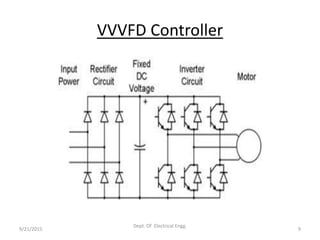
• VVVFD controller
• VVVFD Operation
• Conclusion
Introduction
1. A variable voltage and variable frequency drive (VVVFD) is
a system for controlling the rotational speed of an
alternating current (AC) electric motor by controlling the
frequency of the electrical power supplied to the motor.
2. A variable frequency drive is a specific type of adjustable-
speed drive.
3. Variable-frequency drives are also known as adjustable-
frequency drives (AFD), variable-speed drives (VSD), AC
drives or inverter drives
9/21/2015 3
Dept. Of Electrical Engg.
Speed Control
Following methods are employed for speed
control of Induction motors:-
1. Pole changing
2. Stator voltage control
3. Supply frequency control
4. Rotor resistance control
9/21/2015 4
Dept. Of Electrical Engg.
Operating Principle
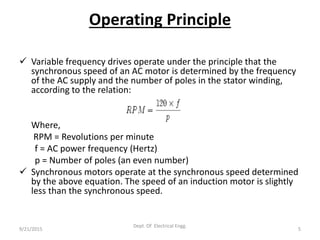
 Variable frequency drives operate under the principle that the
synchronous speed of an AC motor is determined by the frequency
of the AC supply and the number of poles in the stator winding,
according to the relation:
Where,
RPM = Revolutions per minute
f = AC power frequency (Hertz)
p = Number of poles (an even number)
 Synchronous motors operate at the synchronous speed determined
by the above equation. The speed of an induction motor is slightly
less than the synchronous speed.
9/21/2015 5
Dept. Of Electrical Engg.
Contd…
 Voltage induced in stator is proportional to the product of
supply frequencies and flux.
 Any reduction in supply frequencies without change in
terminal voltage causes an increase air gap flux.
 The increase in flux will saturate the motor.
 Therefore the variable frequency control below the rated
frequency is generally carried out at rated air-gap flux by
varying the terminal voltage with frequency so as to maintain
(V/F) ratio constant at rated value.
9/21/2015 6
Dept. Of Electrical Engg.
The variable frequency control provides a
good running and transient performance
because of following features:-
– Speed control and braking operations are available
from zero to above base speed operations.
– During transient the operation can be carried out
at the max. torque while reduced current giving
good dynamic response.
– Drop in speed from no lad to full load is small.
9/21/2015 7
Dept. Of Electrical Engg.
9/21/2015 8
Dept. Of Electrical Engg.
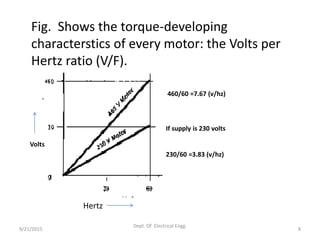
Fig. Shows the torque-developing
characterstics of every motor: the Volts per
Hertz ratio (V/F).
Hertz
460/60 =7.67 (v/hz)
If supply is 230 volts
230/60 =3.83 (v/hz)
Volts
VVVFD Controller
9/21/2015 9
Dept. Of Electrical Engg.
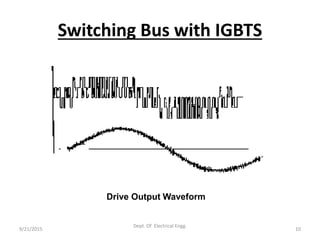
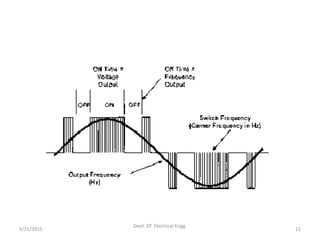
Switching Bus with IGBTS
9/21/2015 10
Dept. Of Electrical Engg.
Drive Output Waveform
9/21/2015 11
Dept. Of Electrical Engg.
VVVFD Operation
• When a VVVFD starts a motor, it initially applies a
low frequency and voltage to the motor.
• The starting frequency is typically 2 Hz or less.
• Starting at such a low frequency avoids the high
inrush current.
• When a VVVFD starts, the applied frequency and
voltage are increased at a controlled rate to
accelerate the load without drawing excessive
current.
9/21/2015 12
Dept. Of Electrical Engg.
Conclusion
Due to many advantages offered by ac drives
like automatic control, closed loop control,
economical cost etc. ac motors are being
replaced in fields which where totally
capitalized by dc motors like traction, some
industrial applications etc.
9/21/2015 13
Dept. Of Electrical Engg.
References
1.Clayton,A.E,The performance and design of direct current
machines.
2.Chillikin,M.,Electric drives,Mir Publisher,Moscow.
3.Pillai,S.K,A first course on electrical drives,Wiley Eastern
Ltd.,1982.
4.Bedford,B.D and R.G. Hoft,Principle of inverter circuit,John
Wiley and sons, New York,1964.
5.Subrahmanyam,Vedam,Thyristor control of electrical
drives,Tata McGraw-Hill Publishing,New Delhi 1988.
9/21/2015
Dept. Of Electrical Engg.
14

Variabe voltage and variable frequency drives

  • 1.
    Variable Voltage AndVariable Frequency Drives 9/21/2015 1Dept. Of Electrical Engg.
  • 2.
    Contents 9/21/2015 2 Dept. OfElectrical Engg. • Introduction • Operating principle • Example • VVVFD system description • VVVFD controller • VVVFD Operation • Conclusion
  • 3.
    Introduction 1. A variablevoltage and variable frequency drive (VVVFD) is a system for controlling the rotational speed of an alternating current (AC) electric motor by controlling the frequency of the electrical power supplied to the motor. 2. A variable frequency drive is a specific type of adjustable- speed drive. 3. Variable-frequency drives are also known as adjustable- frequency drives (AFD), variable-speed drives (VSD), AC drives or inverter drives 9/21/2015 3 Dept. Of Electrical Engg.
  • 4.
    Speed Control Following methodsare employed for speed control of Induction motors:- 1. Pole changing 2. Stator voltage control 3. Supply frequency control 4. Rotor resistance control 9/21/2015 4 Dept. Of Electrical Engg.
  • 5.
    Operating Principle  Variablefrequency drives operate under the principle that the synchronous speed of an AC motor is determined by the frequency of the AC supply and the number of poles in the stator winding, according to the relation: Where, RPM = Revolutions per minute f = AC power frequency (Hertz) p = Number of poles (an even number)  Synchronous motors operate at the synchronous speed determined by the above equation. The speed of an induction motor is slightly less than the synchronous speed. 9/21/2015 5 Dept. Of Electrical Engg.
  • 6.
    Contd…  Voltage inducedin stator is proportional to the product of supply frequencies and flux.  Any reduction in supply frequencies without change in terminal voltage causes an increase air gap flux.  The increase in flux will saturate the motor.  Therefore the variable frequency control below the rated frequency is generally carried out at rated air-gap flux by varying the terminal voltage with frequency so as to maintain (V/F) ratio constant at rated value. 9/21/2015 6 Dept. Of Electrical Engg.
  • 7.
    The variable frequencycontrol provides a good running and transient performance because of following features:- – Speed control and braking operations are available from zero to above base speed operations. – During transient the operation can be carried out at the max. torque while reduced current giving good dynamic response. – Drop in speed from no lad to full load is small. 9/21/2015 7 Dept. Of Electrical Engg.
  • 8.
    9/21/2015 8 Dept. OfElectrical Engg. Fig. Shows the torque-developing characterstics of every motor: the Volts per Hertz ratio (V/F). Hertz 460/60 =7.67 (v/hz) If supply is 230 volts 230/60 =3.83 (v/hz) Volts
  • 9.
  • 10.
    Switching Bus withIGBTS 9/21/2015 10 Dept. Of Electrical Engg. Drive Output Waveform
  • 11.
    9/21/2015 11 Dept. OfElectrical Engg.
  • 12.
    VVVFD Operation • Whena VVVFD starts a motor, it initially applies a low frequency and voltage to the motor. • The starting frequency is typically 2 Hz or less. • Starting at such a low frequency avoids the high inrush current. • When a VVVFD starts, the applied frequency and voltage are increased at a controlled rate to accelerate the load without drawing excessive current. 9/21/2015 12 Dept. Of Electrical Engg.
  • 13.
    Conclusion Due to manyadvantages offered by ac drives like automatic control, closed loop control, economical cost etc. ac motors are being replaced in fields which where totally capitalized by dc motors like traction, some industrial applications etc. 9/21/2015 13 Dept. Of Electrical Engg.
  • 14.
    References 1.Clayton,A.E,The performance anddesign of direct current machines. 2.Chillikin,M.,Electric drives,Mir Publisher,Moscow. 3.Pillai,S.K,A first course on electrical drives,Wiley Eastern Ltd.,1982. 4.Bedford,B.D and R.G. Hoft,Principle of inverter circuit,John Wiley and sons, New York,1964. 5.Subrahmanyam,Vedam,Thyristor control of electrical drives,Tata McGraw-Hill Publishing,New Delhi 1988. 9/21/2015 Dept. Of Electrical Engg. 14