CH 410
Summer 2009
Joe Musgrave and Ted Walker
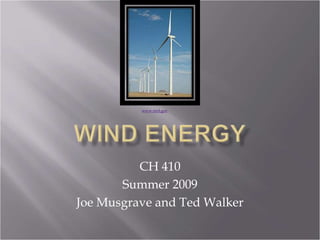
www.nrel.gov
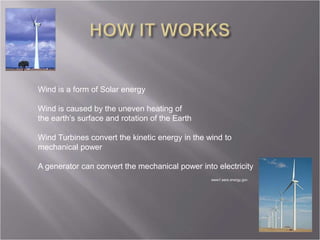
Wind is a form of Solar energy
Wind is caused by the uneven heating of
the earth’s surface and rotation of the Earth
Wind Turbines convert the kinetic energy in the wind to
mechanical power
A generator can convert the mechanical power into electricity
www1.eere.energy.gov
How it works cont.
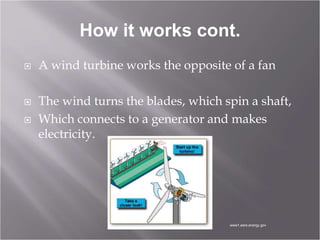
 A wind turbine works the opposite of a fan
 The wind turns the blades, which spin a shaft,
 Which connects to a generator and makes
electricity.
www1.eere.energy.gov
The Parts
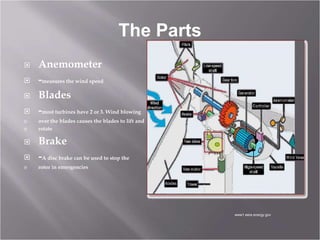
 Anemometer
 -measures the wind speed
 Blades
 -most turbines have 2 or 3. Wind blowing
 over the blades causes the blades to lift and
 rotate
 Brake
 -A disc brake can be used to stop the
 rotor in emergencies
www1.eere.energy.gov
The Parts
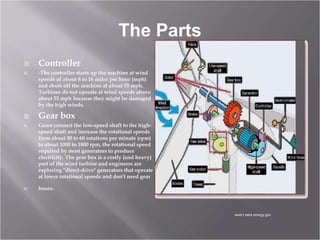
 Controller
 -The controller starts up the machine at wind
speeds of about 8 to 16 miles per hour (mph)
and shuts off the machine at about 55 mph.
Turbines do not operate at wind speeds above
about 55 mph because they might be damaged
by the high winds.
 Gear box
 Gears connect the low-speed shaft to the high-
speed shaft and increase the rotational speeds
from about 30 to 60 rotations per minute (rpm)
to about 1000 to 1800 rpm, the rotational speed
required by most generators to produce
electricity. The gear box is a costly (and heavy)
part of the wind turbine and engineers are
exploring "direct-drive" generators that operate
at lower rotational speeds and don't need gear
 boxes.
www1.eere.energy.gov
The Parts
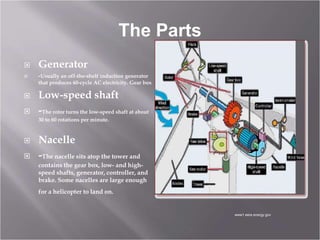
 Generator
 -Usually an off-the-shelf induction generator
that produces 60-cycle AC electricity. Gear box
 Low-speed shaft
 -The rotor turns the low-speed shaft at about
30 to 60 rotations per minute.
 Nacelle
 -The nacelle sits atop the tower and
contains the gear box, low- and high-
speed shafts, generator, controller, and
brake. Some nacelles are large enough
for a helicopter to land on.
www1.eere.energy.gov
The Parts
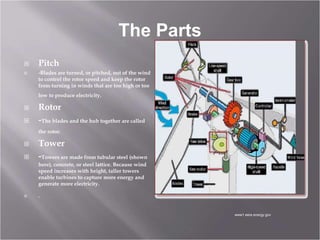
 Pitch
 -Blades are turned, or pitched, out of the wind
to control the rotor speed and keep the rotor
from turning in winds that are too high or too
low to produce electricity.
 Rotor
 -The blades and the hub together are called
the rotor.
 Tower
 -Towers are made from tubular steel (shown
here), concrete, or steel lattice. Because wind
speed increases with height, taller towers
enable turbines to capture more energy and
generate more electricity.
 .
www1.eere.energy.gov
The Parts
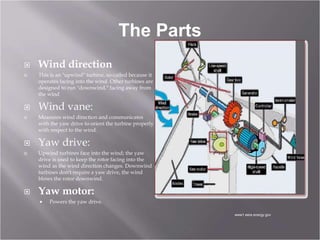
 Wind direction
 This is an "upwind" turbine, so-called because it
operates facing into the wind. Other turbines are
designed to run "downwind," facing away from
the wind
 Wind vane:
 Measures wind direction and communicates
with the yaw drive to orient the turbine properly
with respect to the wind.
 Yaw drive:
 Upwind turbines face into the wind; the yaw
drive is used to keep the rotor facing into the
wind as the wind direction changes. Downwind
turbines don't require a yaw drive, the wind
blows the rotor downwind.
 Yaw motor:
 Powers the yaw drive.
www1.eere.energy.gov
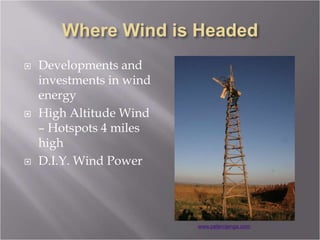
 Developments and
investments in wind
energy
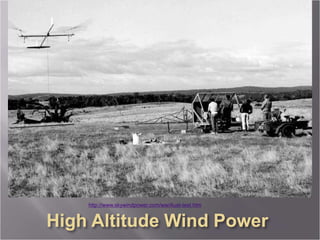
 High Altitude Wind
– Hotspots 4 miles
high
 D.I.Y. Wind Power
www.peternjenga.com
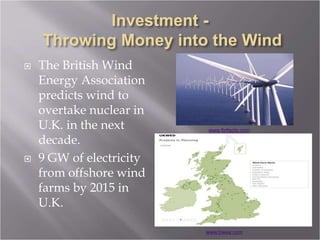
 The British Wind
Energy Association
predicts wind to
overtake nuclear in
U.K. in the next
decade.
 9 GW of electricity
from offshore wind
farms by 2015 in
U.K.
www.finfacts.com
www.bwea.com
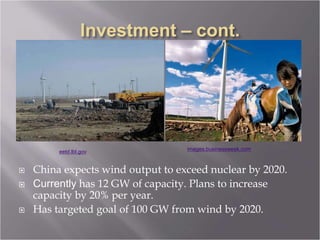
 China expects wind output to exceed nuclear by 2020.
 Currently has 12 GW of capacity. Plans to increase
capacity by 20% per year.
 Has targeted goal of 100 GW from wind by 2020.
eetd.lbl.gov
images.businessweek.com
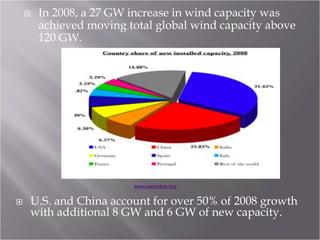
 In 2008, a 27 GW increase in wind capacity was
achieved moving total global wind capacity above
120 GW.
 U.S. and China account for over 50% of 2008 growth
with additional 8 GW and 6 GW of new capacity.
www.wwindea.org
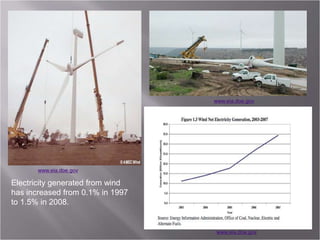
Electricity generated from wind
has increased from 0.1% in 1997
to 1.5% in 2008.
www.eia.doe.gov
www.eia.doe.gov
www.eia.doe.gov
http://www.skywindpower.com/ww/Aust-test.htm
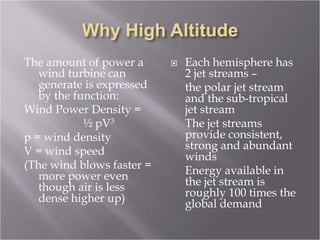
The amount of power a
wind turbine can
generate is expressed
by the function:
Wind Power Density =
½ pV3
p = wind density
V = wind speed
(The wind blows faster =
more power even
though air is less
dense higher up)
 Each hemisphere has
2 jet streams –
the polar jet stream
and the sub-tropical
jet stream
The jet streams
provide consistent,
strong and abundant
winds
Energy available in
the jet stream is
roughly 100 times the
global demand
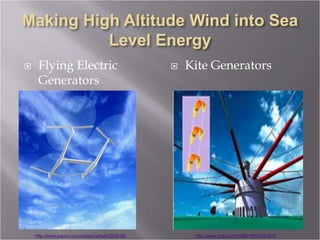
 Flying Electric
Generators
 Kite Generators
http://www.popsci.com/scitech/article/2009-06/ http://www.mdpi.com/1996-1073/2/2/307/
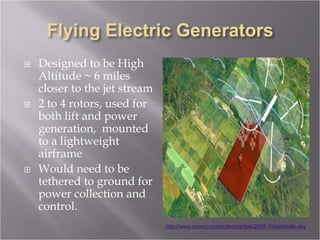
 Designed to be High
Altitude ~ 6 miles
closer to the jet stream
 2 to 4 rotors, used for
both lift and power
generation, mounted
to a lightweight
airframe
 Would need to be
tethered to ground for
power collection and
control.
http://www.popsci.com/scitech/article/2005-11/windmills-sky
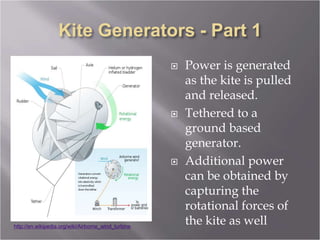
 Power is generated
as the kite is pulled
and released.
 Tethered to a
ground based
generator.
 Additional power
can be obtained by
capturing the
rotational forces of
the kite as well
http://en.wikipedia.org/wiki/Airborne_wind_turbine
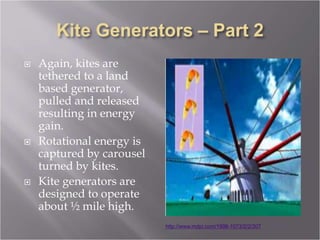
 Again, kites are
tethered to a land
based generator,
pulled and released
resulting in energy
gain.
 Rotational energy is
captured by carousel
turned by kites.
 Kite generators are
designed to operate
about ½ mile high.
http://www.mdpi.com/1996-1073/2/2/307
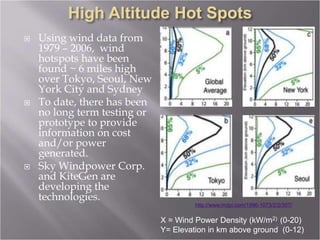
 Using wind data from
1979 – 2006, wind
hotspots have been
found ~ 6 miles high
over Tokyo, Seoul, New
York City and Sydney
 To date, there has been
no long term testing or
prototype to provide
information on cost
and/or power
generated.
 Sky Windpower Corp.
and KiteGen are
developing the
technologies.
X = Wind Power Density (kW/m2) (0-20)
Y= Elevation in km above ground (0-12)
http://www.mdpi.com/1996-1073/2/2/307/
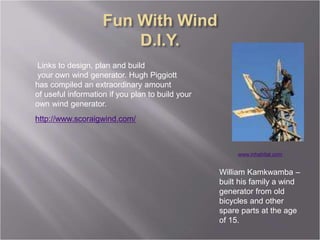
William Kamkwamba –
built his family a wind
generator from old
bicycles and other
spare parts at the age
of 15.
http://www.scoraigwind.com/
Links to design, plan and build
your own wind generator. Hugh Piggiott
has compiled an extraordinary amount
of useful information if you plan to build your
own wind generator.
www.inhabitat.com

Wind energy ppt

  • 1.
    CH 410 Summer 2009 JoeMusgrave and Ted Walker www.nrel.gov
  • 2.
    Wind is aform of Solar energy Wind is caused by the uneven heating of the earth’s surface and rotation of the Earth Wind Turbines convert the kinetic energy in the wind to mechanical power A generator can convert the mechanical power into electricity www1.eere.energy.gov
  • 3.
    How it workscont.  A wind turbine works the opposite of a fan  The wind turns the blades, which spin a shaft,  Which connects to a generator and makes electricity. www1.eere.energy.gov
  • 4.
    The Parts  Anemometer -measures the wind speed  Blades  -most turbines have 2 or 3. Wind blowing  over the blades causes the blades to lift and  rotate  Brake  -A disc brake can be used to stop the  rotor in emergencies www1.eere.energy.gov
  • 5.
    The Parts  Controller -The controller starts up the machine at wind speeds of about 8 to 16 miles per hour (mph) and shuts off the machine at about 55 mph. Turbines do not operate at wind speeds above about 55 mph because they might be damaged by the high winds.  Gear box  Gears connect the low-speed shaft to the high- speed shaft and increase the rotational speeds from about 30 to 60 rotations per minute (rpm) to about 1000 to 1800 rpm, the rotational speed required by most generators to produce electricity. The gear box is a costly (and heavy) part of the wind turbine and engineers are exploring "direct-drive" generators that operate at lower rotational speeds and don't need gear  boxes. www1.eere.energy.gov
  • 6.
    The Parts  Generator -Usually an off-the-shelf induction generator that produces 60-cycle AC electricity. Gear box  Low-speed shaft  -The rotor turns the low-speed shaft at about 30 to 60 rotations per minute.  Nacelle  -The nacelle sits atop the tower and contains the gear box, low- and high- speed shafts, generator, controller, and brake. Some nacelles are large enough for a helicopter to land on. www1.eere.energy.gov
  • 7.
    The Parts  Pitch -Blades are turned, or pitched, out of the wind to control the rotor speed and keep the rotor from turning in winds that are too high or too low to produce electricity.  Rotor  -The blades and the hub together are called the rotor.  Tower  -Towers are made from tubular steel (shown here), concrete, or steel lattice. Because wind speed increases with height, taller towers enable turbines to capture more energy and generate more electricity.  . www1.eere.energy.gov
  • 8.
    The Parts  Winddirection  This is an "upwind" turbine, so-called because it operates facing into the wind. Other turbines are designed to run "downwind," facing away from the wind  Wind vane:  Measures wind direction and communicates with the yaw drive to orient the turbine properly with respect to the wind.  Yaw drive:  Upwind turbines face into the wind; the yaw drive is used to keep the rotor facing into the wind as the wind direction changes. Downwind turbines don't require a yaw drive, the wind blows the rotor downwind.  Yaw motor:  Powers the yaw drive. www1.eere.energy.gov
  • 9.
     Developments and investmentsin wind energy  High Altitude Wind – Hotspots 4 miles high  D.I.Y. Wind Power www.peternjenga.com
  • 10.
     The BritishWind Energy Association predicts wind to overtake nuclear in U.K. in the next decade.  9 GW of electricity from offshore wind farms by 2015 in U.K. www.finfacts.com www.bwea.com
  • 11.
     China expectswind output to exceed nuclear by 2020.  Currently has 12 GW of capacity. Plans to increase capacity by 20% per year.  Has targeted goal of 100 GW from wind by 2020. eetd.lbl.gov images.businessweek.com
  • 12.
     In 2008,a 27 GW increase in wind capacity was achieved moving total global wind capacity above 120 GW.  U.S. and China account for over 50% of 2008 growth with additional 8 GW and 6 GW of new capacity. www.wwindea.org
  • 13.
    Electricity generated fromwind has increased from 0.1% in 1997 to 1.5% in 2008. www.eia.doe.gov www.eia.doe.gov www.eia.doe.gov
  • 14.
  • 15.
    The amount ofpower a wind turbine can generate is expressed by the function: Wind Power Density = ½ pV3 p = wind density V = wind speed (The wind blows faster = more power even though air is less dense higher up)  Each hemisphere has 2 jet streams – the polar jet stream and the sub-tropical jet stream The jet streams provide consistent, strong and abundant winds Energy available in the jet stream is roughly 100 times the global demand
  • 16.
     Flying Electric Generators Kite Generators http://www.popsci.com/scitech/article/2009-06/ http://www.mdpi.com/1996-1073/2/2/307/
  • 17.
     Designed tobe High Altitude ~ 6 miles closer to the jet stream  2 to 4 rotors, used for both lift and power generation, mounted to a lightweight airframe  Would need to be tethered to ground for power collection and control. http://www.popsci.com/scitech/article/2005-11/windmills-sky
  • 18.
     Power isgenerated as the kite is pulled and released.  Tethered to a ground based generator.  Additional power can be obtained by capturing the rotational forces of the kite as well http://en.wikipedia.org/wiki/Airborne_wind_turbine
  • 19.
     Again, kitesare tethered to a land based generator, pulled and released resulting in energy gain.  Rotational energy is captured by carousel turned by kites.  Kite generators are designed to operate about ½ mile high. http://www.mdpi.com/1996-1073/2/2/307
  • 20.
     Using winddata from 1979 – 2006, wind hotspots have been found ~ 6 miles high over Tokyo, Seoul, New York City and Sydney  To date, there has been no long term testing or prototype to provide information on cost and/or power generated.  Sky Windpower Corp. and KiteGen are developing the technologies. X = Wind Power Density (kW/m2) (0-20) Y= Elevation in km above ground (0-12) http://www.mdpi.com/1996-1073/2/2/307/
  • 21.
    William Kamkwamba – builthis family a wind generator from old bicycles and other spare parts at the age of 15. http://www.scoraigwind.com/ Links to design, plan and build your own wind generator. Hugh Piggiott has compiled an extraordinary amount of useful information if you plan to build your own wind generator. www.inhabitat.com

Editor's Notes

  • #2 Picture www.nrel.gov