Presented by:
Bibhu Prasad Ganthia
1407105060 (PED)
 Motivation
 Overview
 Schematic block diagram
 PV System
 DC-DC Converter (Boost)
 MPPT(P&O)
 Results
 Conclusion
 Future Work
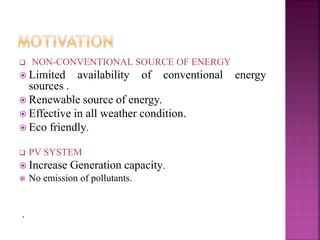
 NON-CONVENTIONAL SOURCE OF ENERGY
 Limited availability of conventional energy
sources .
 Renewable source of energy.
 Effective in all weather condition.
 Eco friendly.
 PV SYSTEM
 Increase Generation capacity.
 No emission of pollutants.
.
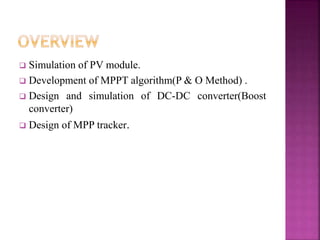
 Simulation of PV module.
 Development of MPPT algorithm(P & O Method) .
 Design and simulation of DC-DC converter(Boost
converter)
 Design of MPP tracker.
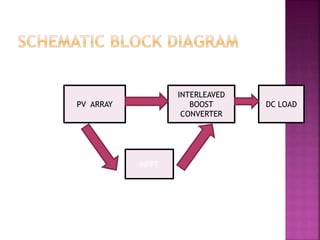
PV ARRAY
INTERLEAVED
BOOST
CONVERTER
MPPT
DC LOAD
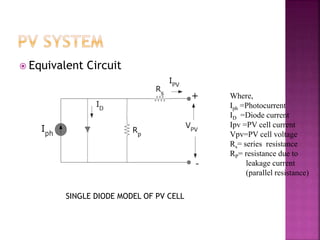
 Equivalent Circuit
SINGLE DIODE MODEL OF PV CELL
Where,
Iph =Photocurrent
ID =Diode current
Ipv =PV cell current
Vpv=PV cell voltage
Rs= series resistance
RP= resistance due to
leakage current
(parallel resistance)
𝐼 𝑃𝑉= Iph-Is[exp(q(Vpv+IpvRs)/KTcA)-1]-(Vpv+IpvRs)/Rp
Iph=[Isc+Ki(Tc-TRef)]ß/1000
Is(t)=Is(Tc-TRef)3exp[qEg(1/Tref-1/Tc)/KA]
 Where,
Is=Reverse saturation current
q= charge of electrone
K=Boltzmann constant
A= Ideality factor
Tc=
Tref=
ß= irradiance
Eg=band gap energy
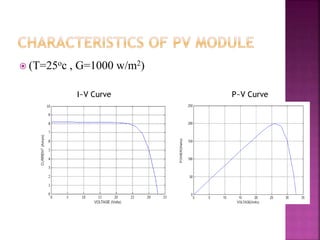
 (T=25oc , G=1000 w/m2)
I~V Curve P~V Curve
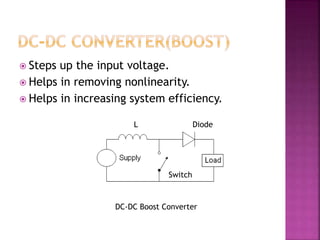
 Steps up the input voltage.
 Helps in removing nonlinearity.
 Helps in increasing system efficiency.
DC-DC Boost Converter
L Diode
Switch
 Charging Mode:
The switch is closed and the inductor is charged by the
source through the switch. The charging current is
exponential in nature but for simplicity is assumed to be
linearly varying.
The diode restricts the flow of current from the source to
the load and the demand of the load is met by the
discharging of the capacitor.
 Discharging Mode:
The switch is open and the diode is forward biased . The
inductor now discharges and together with the source
charges the capacitor and meets the load demands.
 The efficiency of solar energy is very low. Thus we need
some techniques to extract the maximum power from these
arrays, to ensure that power converter circuits operate at the
maximum power point of the solar array.
 The basic principle of MPPT is to extract the maximum
available power from PV module by making them operate at
most efficient voltage(MPP).
 The main objective of all these MPPT algorithms is to
achieve fast and accurate tracking performance and
minimize oscillations due to varying weather conditions.
A lot of MPPT algorithms have been developed by
researchers all over the world. They are:
 perturbation and observation method
 incremental conductance method
 Hill climbing method.
P&O method is the most frequently used algorithm
to track the maximum power because of its simple
structure and fewer required parameters.
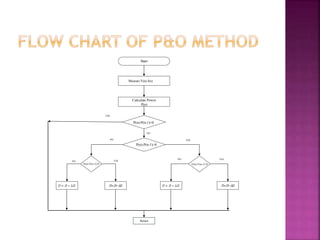
Start
Measure V(n) I(n)
Calculate Power
P(n)
P(n)-P(n-1)=0
P(n)-P(n-1)>0
V(n)-V(n-1)<0 V(n)-V(n-1)>0
YESNO
YES
YES
NO
NO
NO YES
Return
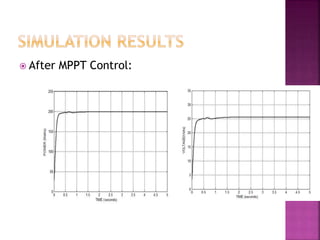
 After MPPT Control:
 Interleaved boost converter has been studied
and the waveforms have been verified.
 One close loop inverter will be designed for
the grid synchronization.
 WEI WEN YIM-SHU LEE, Senior Member, IEEE,MARTIN
HOI LAM CHOW, Member, IEEE ,DAVID KI-WAI CHENG,”
Interleaved Boost Converter with Zero Diode Reverse-
Recovery Loss”.
 Wong, P. L., and Lee, F. C. (2000),”Interleaving to
reduce reverse-recovery loss in power factor
correction circuits.”
 Jovanovi´c, M. M. (1997), “A technique for reducing
rectifier reverse-recovery-related losses in high-
voltage, high-power boost converters.”
In Proceedings of IEEE APEC’97 Annual Meeting,
Vol. 2, Feb. 1997.
 Tseng, C. J., and Chen, C. L. (1998), “Passive lossless
snubber for dc/dc converters. In Proceedings of IEEE
APEC’98 Annual Meeting, Vol. 2,Feb. 1998

INTERLEAVED BOOST CONVERTER FOR PV APPLICATION

  • 1.
    Presented by: Bibhu PrasadGanthia 1407105060 (PED)
  • 2.
     Motivation  Overview Schematic block diagram  PV System  DC-DC Converter (Boost)  MPPT(P&O)  Results  Conclusion  Future Work
  • 3.
     NON-CONVENTIONAL SOURCEOF ENERGY  Limited availability of conventional energy sources .  Renewable source of energy.  Effective in all weather condition.  Eco friendly.  PV SYSTEM  Increase Generation capacity.  No emission of pollutants. .
  • 4.
     Simulation ofPV module.  Development of MPPT algorithm(P & O Method) .  Design and simulation of DC-DC converter(Boost converter)  Design of MPP tracker.
  • 5.
  • 6.
     Equivalent Circuit SINGLEDIODE MODEL OF PV CELL Where, Iph =Photocurrent ID =Diode current Ipv =PV cell current Vpv=PV cell voltage Rs= series resistance RP= resistance due to leakage current (parallel resistance)
  • 7.
    𝐼 𝑃𝑉= Iph-Is[exp(q(Vpv+IpvRs)/KTcA)-1]-(Vpv+IpvRs)/Rp Iph=[Isc+Ki(Tc-TRef)]ß/1000 Is(t)=Is(Tc-TRef)3exp[qEg(1/Tref-1/Tc)/KA] Where, Is=Reverse saturation current q= charge of electrone K=Boltzmann constant A= Ideality factor Tc= Tref= ß= irradiance Eg=band gap energy
  • 8.
     (T=25oc ,G=1000 w/m2) I~V Curve P~V Curve
  • 9.
     Steps upthe input voltage.  Helps in removing nonlinearity.  Helps in increasing system efficiency. DC-DC Boost Converter L Diode Switch
  • 10.
     Charging Mode: Theswitch is closed and the inductor is charged by the source through the switch. The charging current is exponential in nature but for simplicity is assumed to be linearly varying. The diode restricts the flow of current from the source to the load and the demand of the load is met by the discharging of the capacitor.  Discharging Mode: The switch is open and the diode is forward biased . The inductor now discharges and together with the source charges the capacitor and meets the load demands.
  • 11.
     The efficiencyof solar energy is very low. Thus we need some techniques to extract the maximum power from these arrays, to ensure that power converter circuits operate at the maximum power point of the solar array.  The basic principle of MPPT is to extract the maximum available power from PV module by making them operate at most efficient voltage(MPP).  The main objective of all these MPPT algorithms is to achieve fast and accurate tracking performance and minimize oscillations due to varying weather conditions.
  • 12.
    A lot ofMPPT algorithms have been developed by researchers all over the world. They are:  perturbation and observation method  incremental conductance method  Hill climbing method. P&O method is the most frequently used algorithm to track the maximum power because of its simple structure and fewer required parameters.
  • 13.
    Start Measure V(n) I(n) CalculatePower P(n) P(n)-P(n-1)=0 P(n)-P(n-1)>0 V(n)-V(n-1)<0 V(n)-V(n-1)>0 YESNO YES YES NO NO NO YES Return
  • 14.
  • 15.
     Interleaved boostconverter has been studied and the waveforms have been verified.  One close loop inverter will be designed for the grid synchronization.
  • 16.
     WEI WENYIM-SHU LEE, Senior Member, IEEE,MARTIN HOI LAM CHOW, Member, IEEE ,DAVID KI-WAI CHENG,” Interleaved Boost Converter with Zero Diode Reverse- Recovery Loss”.  Wong, P. L., and Lee, F. C. (2000),”Interleaving to reduce reverse-recovery loss in power factor correction circuits.”  Jovanovi´c, M. M. (1997), “A technique for reducing rectifier reverse-recovery-related losses in high- voltage, high-power boost converters.” In Proceedings of IEEE APEC’97 Annual Meeting, Vol. 2, Feb. 1997.  Tseng, C. J., and Chen, C. L. (1998), “Passive lossless snubber for dc/dc converters. In Proceedings of IEEE APEC’98 Annual Meeting, Vol. 2,Feb. 1998