This document describes a student project to design and build a vertical axis wind turbine (VAWT). It provides background on wind energy and different types of wind turbines. It then details the design and construction process for the VAWT, including conceptual designs, fabrication of blades and supports, and testing specifications. The summary concludes that VAWTs provide an efficient and low-cost way to harness wind power for small-scale energy production.
In this document
Powered by AI
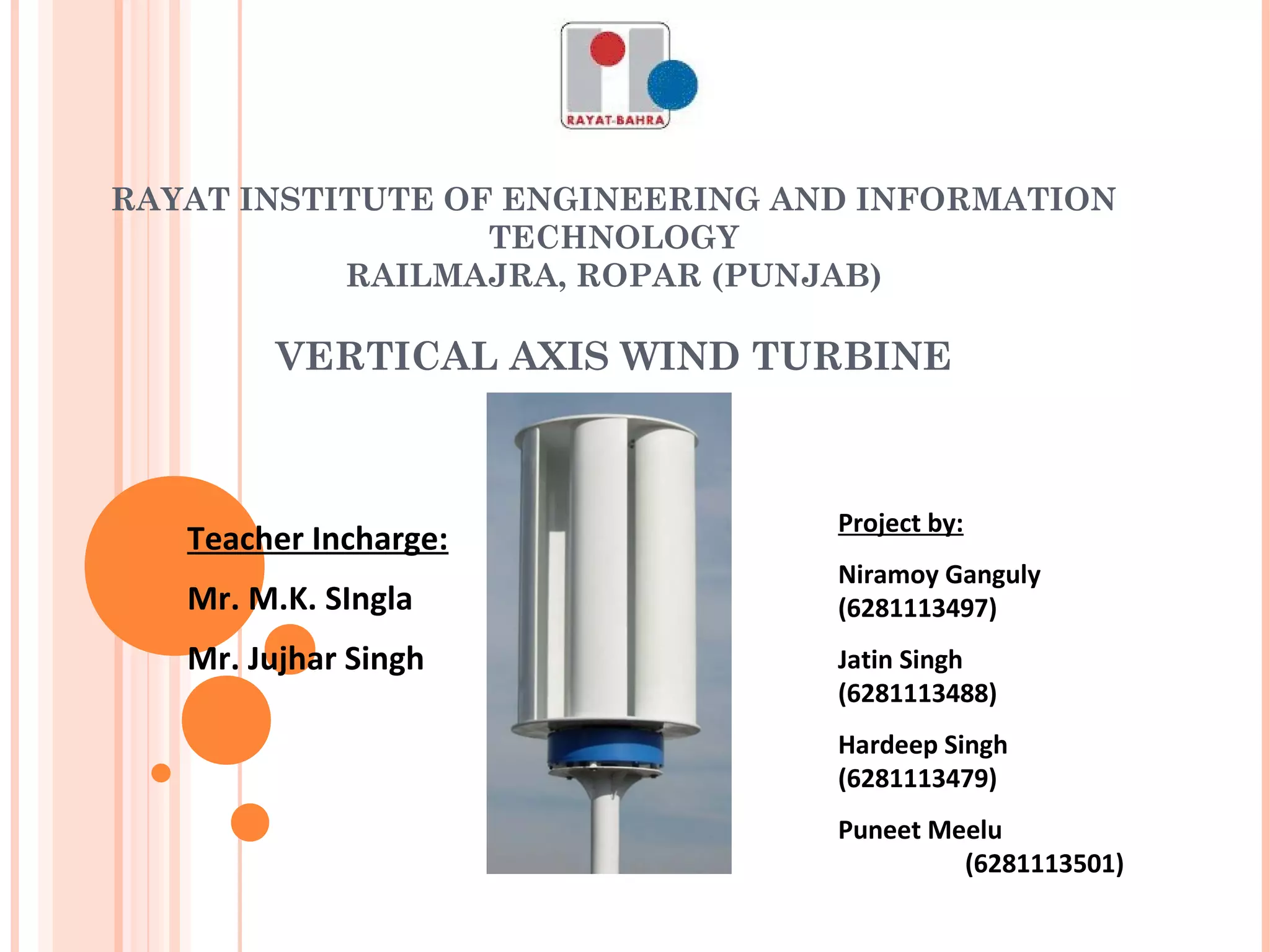
Introduction to the project on Vertical Axis Wind Turbine by students and teachers from Rayat Institute.
Wind energy is derived from solar energy causing atmospheric air pressure changes, resulting in wind.
Description of wind turbines converting kinetic energy to mechanical energy or electricity, including types.
Introduction to horizontal axis wind turbines (HAWT) and their operational characteristics.
Overview of vertical-axis wind turbines (VAWT) and their types: Darrieus, Giromill, and Savonius.
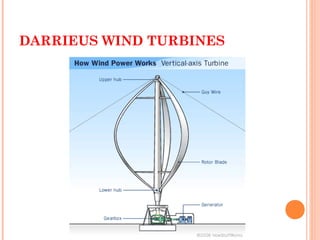
Detailed view of Darrieus wind turbines, including operation and design.
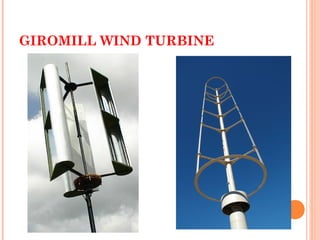
Detailed view of Giromill wind turbines, emphasizing its straight blades design.
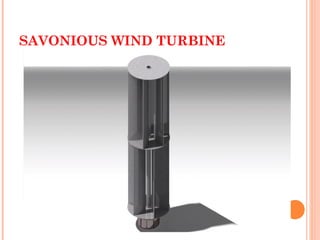
Detailed view of Savonius wind turbines, focusing on its scoop-based design.
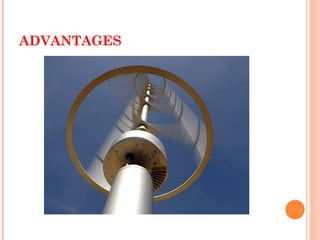
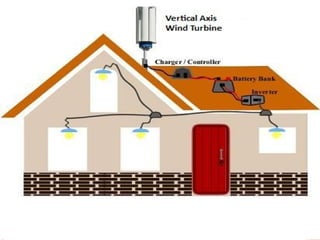
An overview of the advantages offered by VAWTs including maintenance ease and lower costs.
Additional benefits of VAWTs, including noise reduction and space efficiency.
Cost and efficiency comparison between solar power and wind power for energy generation.
Overview of the phases involved in the construction of vertical axis wind turbines.
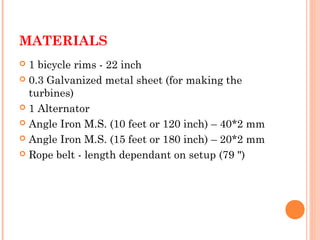
List of materials required for constructing the vertical axis wind turbine.
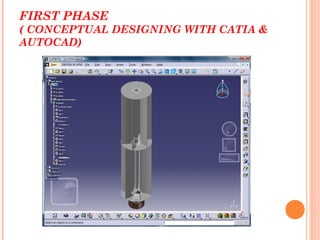
Conceptual design phase of VAWT using CATIA and AUTOCAD.
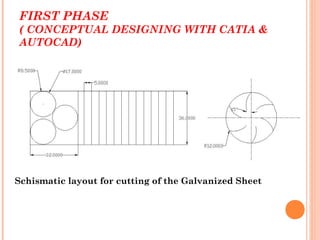
Schismatic layout for cutting the galvanized sheet in the design process.
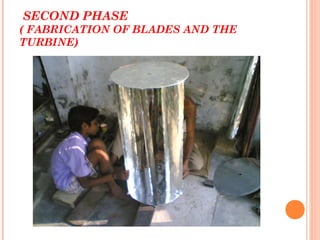
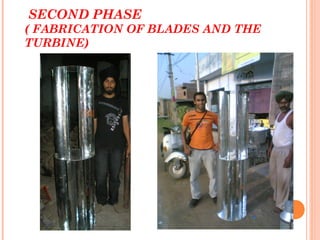
Fabrication phase of the blades and the turbine.
Continued details on the fabrication of blades and turbine structure.
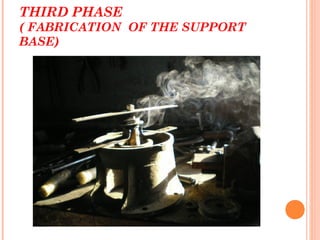
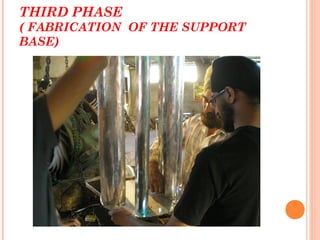
Fabrication of the support base for the turbine.
Further elaboration on the fabrication processes involved in creating the turbine support.
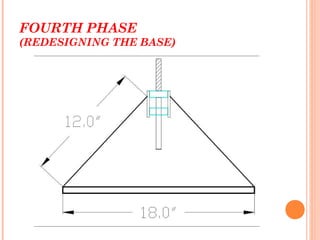
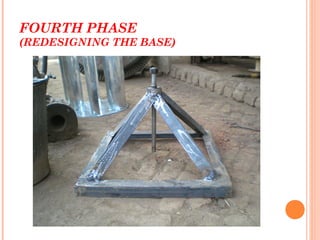
Focus on the redesigning phase of the turbine base.
Continued work on the turbine's base redesign.
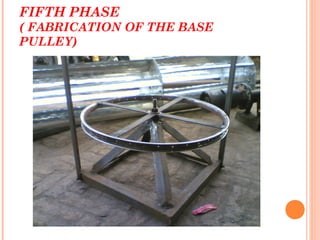
Description of the fabrication of the base pulley used in the turbine.
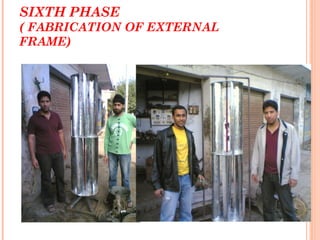
Overview of the fabrication of the external frame for the wind turbine.
Specifications for energy production based on turbine rotor size and wind speed.
Details on the charge rate of the VAWT battery based on wind conditions.
Discusses practical applications, costs, and efficiency challenges of VAWTs.
Recommended regions for effective installation and operation of vertical axis wind turbines.
Concludes VAWT project viability for household and industrial applications with future energy potential.
Summary of the VAWT model designed to generate electricity efficiently from wind.
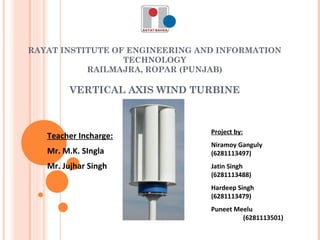
RAYAT INSTITUTE OFENGINEERING AND INFORMATION
TECHNOLOGY
RAILMAJRA, ROPAR (PUNJAB)
VERTICAL AXIS WIND TURBINE
Project by:
Niramoy Ganguly
(6281113497)
Jatin Singh
(6281113488)
Hardeep Singh
(6281113479)
Puneet Meelu
(6281113501)
Teacher Incharge:
Mr. M.K. SIngla
Mr. Jujhar Singh
3.
WIND ENERGY
Windenergy is a converted form of solar energy.
The sun's radiation heats different parts of the
earth at different rates-most notably during the
day and night, but also when different surfaces
(for example, water and land) absorb or reflect at
different rates.
This in turn causes portions of the atmosphere to
warm differently.
Hot air rises, reducing the atmospheric pressure
at the earth's surface, and cooler air is drawn in
to replace it.
The result is wind.
4.
WIND TURBINES
• Windturbines are a rotating machine that will spin
and convert kinetic energy from the rotation in the
wind into mechanical energy or electricity to use to
power your house or anything else.
• There are various type of wind turbines these days.
• If they power machines directly such as a well pump
then they are considered wind mills.
• If the energy produced is instead converted to
electricity then the source is considered a wind
turbine or wind generator.
• Wind Turbines have subcategories like
Horizontal Wind Turbines
Vertical Axis Wind Turbines
5.
HORIZONTAL AXIS WIND
TURBINE
HAWT have the main rotor shaft and electrical
generator at the top of a tower
must be pointed into the wind.
Small turbines are pointed by a simple wind
vane, while large turbines generally use a wind
sensor coupled with a servo motor.
6.
VERTICAL-AXIS WIND TURBINES
Vertical-axis wind turbines (VAWT) use rotors
that run vertically.
Three well-known types of VAWTs are the
1. Darrieus Wind Turbine - a model that collects
wind in cups dragging a turbine around,
and that looks much like a 'giant
eggbeater
2. Giromill Wind Turbine - a subtype of
Darrieus turbine with straight, as opposed
to curved, blades.
3. Savonius Wind Turbine - a dragtype devise
consisting of two or three scoops causing a turbine to
spin,
ADVANTAGES
You mayplace the generator, gearbox etc. on the
ground, and you may not need a tower for the
machine.
You do not need a yaw mechanism to turn the rotor
against the wind.
A VAWT can be located nearer the ground, making it
easier to maintain the moving parts.
VAWTs can operate with winds from all directions
VAWTs have lower wind startup speeds than HAWTs.
VAWTs may be built at locations where taller
structures are prohibited.
12.
ADVANTAGES
VAWTs maybe built at locations where taller
structures are prohibited.
VAWTs situated close to the ground can take
advantage of locations where hilltops,
ridgelines, and passes funnel the wind and
increase wind velocity.
VAWTs may have a lower noise signature.
The installation cost is far lesser as
compared to so both HAWT and Solar Power
systems.
Since the system is vertically standing up,
the occupied surface area is smaller
compared to HAWT and much smaller than
Solar Power panels.
14.
DIFFERENCE BETWEEN
SOLAR POWERAND WIND POWER
Solar Power Wind Power
For the average domestic system, costs
can be around Rs 3,60,000- Rs
5,40,000 per kW installed
Systems up to 1kW will cost around
Rs 1,08,000
A larger area is required for the same
amount of power generation
A smaller area is needed for the same
amount of power generation
Requires a whole day of clear skies for
the system to work efficiently
Not affected by the type of day as it
operates in low wind speeds
Solar-based power currently costs over
Rs 15 per KWh
Wind-based power costs around
Rs 3 – 4 per KWh
MATERIALS
1 bicyclerims - 22 inch
0.3 Galvanized metal sheet (for making the
turbines)
1 Alternator
Angle Iron M.S. (10 feet or 120 inch) – 40*2 mm
Angle Iron M.S. (15 feet or 180 inch) – 20*2 mm
Rope belt - length dependant on setup (79 ")
ENERGY PRODUCTION
SPECIFICATIONS
Rotor size:42.5 mm D x 170 mm L.
Operational Voltage 12V DC (connected to battery)
Power Rating.
10 mph (4.5 m /s) = 0.75 A x 12V = 8 Watts
20 mph (9.0 m /s) = 3.0 A x 12V = 36 Watts
30 mph (13.5 m /s) = 5 A x 12V = 60 Watts
28.
ENERGY PRODUCTION
SPECIFICATIONS
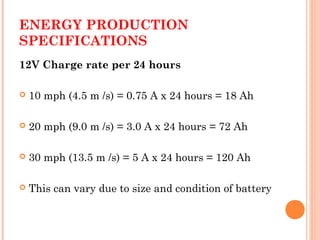
12V Chargerate per 24 hours
10 mph (4.5 m /s) = 0.75 A x 24 hours = 18 Ah
20 mph (9.0 m /s) = 3.0 A x 24 hours = 72 Ah
30 mph (13.5 m /s) = 5 A x 24 hours = 120 Ah
This can vary due to size and condition of battery
29.
PRACTICAL CONSIDERATIONS
Consideringthe input involved in the making of
VAWT, it can be easily constructed and put to
use at home.
As we have seen the cost involved in its making,
it proves to be cheaper than tapping any other
non-conventional source of energy, hence proving
it to be the future of power generation.
The only trouble in its successful application
across the globe is ‘Constant Wind Velocity’.
So practically speaking, this turbine would
efficiently in those areas which have constant
wind flow, be it at any velocity. Intermittent
wind flow will reduce its efficiency.
30.
CHIEF AREAS WHEREITS
INSTALLATION AND WORKING
WOULD BE EFFICIENT
Coastal Areas
Deserts
Open Fields
Farms
Hilly Areas
Polar Regions
High stories buildings in cities, etc.
As these regions have constant wind velocity
almost all throughout the year, so this turbine
would work efficiently.
31.
CONCLUSION
The project“Vertical Axis Wind Turbine” is easy to
implement in normal house hold and industrial
application.
From the project it can be concluded that wind
turbines have a large base of applications in power
production.
Wind power is an untapped resource and it can easily
suffice our power needs in the coming future
As we already concluded that power production using
wind energy costs much cheaper at Rs. 5 per KWh as
compared to solar energy ( above Rs. 15 per KWh).
So wind energy can be easily regarded as a cheap and
efficient energy source of the future
32.
CONCLUSION
Here wehave developed a mode which is capable
of producing enough mechanical power required
to generate electricity using an alternator.
This is just the miniature version of turbines
which are used for heavy power generation.
Our project aims at introducing the new concept
of tapping this wind energy in an easy efficient
and unconventional way