Wind Energy
    NIRAV DARANIYA
WIND ENERGY
   How Wind Power Is Generated
   Wind Turbines
   Wind Turbine Types
   Turbine Components
   Turbine Configurations
   Wind Turbine Size and Power Ratings
   Wind Energy Resources in the United States
   Advantages and Disadvantages
.


 Wind    Energy is an indirect form of
    solar energy which can be used
    continuously unlike solar energy

 Wind   energy classified in two types
            1.- Planetary winds
            2.- Local winds.
.
       Planetary winds are cause due
    to greater heating of earth’s
    surface near the equator as
    compared to solar heating near
    the south & north poles.
       Local winds are caused due to
    differential heating of land &
    water in coastal areas these are
    also caused due to uneven
    heating     in hills & mountain
    along the slopes.
.


   Wind is a form of solar energy. Winds are
    caused by the uneven heating of the
    atmosphere by the sun, the irregularities
    of the earth's surface, and rotation of the
    earth. Wind flow patterns are modified by
    the earth's terrain, bodies of water, and
    vegetative cover. This wind flow, or
    motion energy, when "harvested" by
    modern wind turbines, can be used to
    generate electricity.
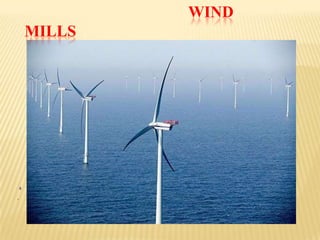
WIND
        MILLS


    .
.
HOW WIND POWER IS
GENERATED
 Theterms "wind energy" or "wind
 power" describe the process by
 which the wind is used to generate
 mechanical power or electricity.
 Wind turbines convert the kinetic
 energy in the wind into mechanical
 power.
.


     This  mechanical power can be
     used for specific tasks (such as
     grinding grain or pumping water)
     or a generator can convert this
     mechanical power into electricity
     to                         power
     homes, businesses, schools, and
     the like.
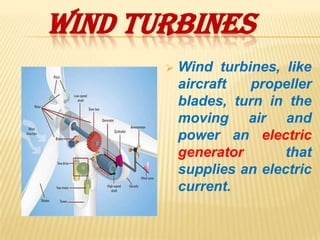
WIND TURBINES
          Wind turbines, like
           aircraft  propeller
           blades, turn in the
           moving air and
           power an electric
           generator       that
           supplies an electric
           current.
.


     Simply stated, a wind turbine is the
     opposite of a fan. Instead of using
     electricity to make wind, like a
     fan, wind turbines use wind to
     make electricity. The wind turns
     the    blades,    which     spin    a
     shaft, which connects to a
     generator and makes electricity.
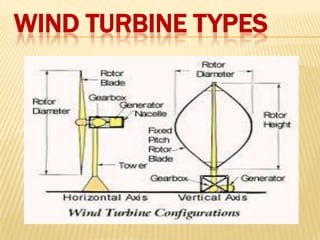
WIND TURBINE TYPES
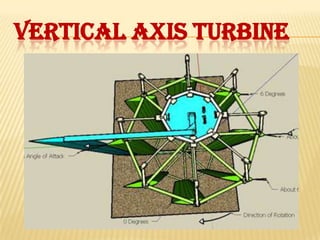
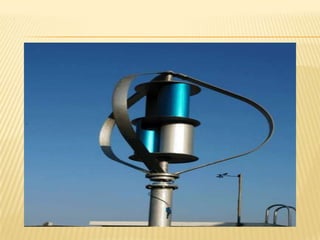
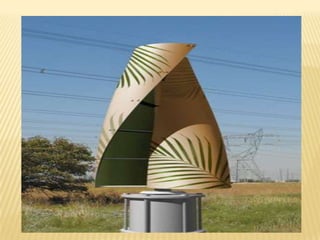
VERTICAL AXIS TURBINE
.
.


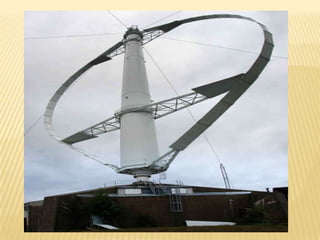
          Modern wind turbines fall into
        two basic groups; the horizontal-
        axis variety, like the traditional
        farm windmills used for pumping
        water,   and     the    vertical-axis
        design, like the eggbeater-style
        Darrieus model, named after its
        French    inventor.    Most     large
        modern      wind     turbines     are
        horizontal-axis turbines.
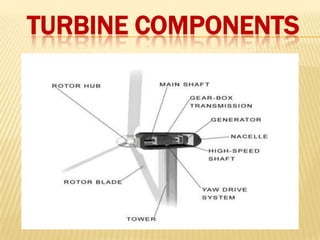
TURBINE COMPONENTS
.


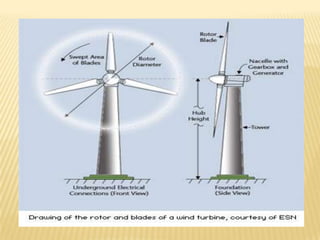
     blade  or rotor, which converts the
      energy in the wind to rotational
      shaft energy;
     a drive train, usually including a
      gearbox and a generator; a tower
      that supports the rotor and drive
      train
     other      equipment,      including
      controls, electrical cables, ground
      support        equipment,        and
      interconnection equipment.
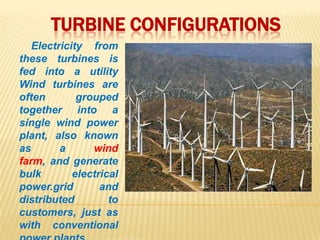
TURBINE CONFIGURATIONS
   Electricity from
these turbines is
fed into a utility
Wind turbines are
often        grouped
together into a
single wind power
plant, also known
as       a      wind
farm, and generate
bulk        electrical
power.grid        and
distributed         to
customers, just as
with conventional
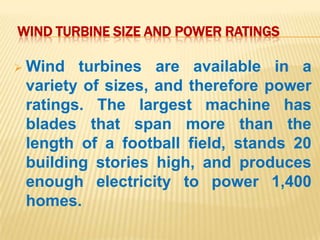
WIND TURBINE SIZE AND POWER RATINGS

 Wind  turbines are available in a
 variety of sizes, and therefore power
 ratings. The largest machine has
 blades that span more than the
 length of a football field, stands 20
 building stories high, and produces
 enough electricity to power 1,400
 homes.
.


          A small home-sized wind
        machine has rotors between 8 and
        25 feet in diameter and stands
        upwards of 30 feet and can supply
        the power needs of an all-electric
        home or small business. Utility-
        scale turbines range in size from
        50 to 750 kilowatts. Single small
        turbines, below 50 kilowatts, are
        used                           for
        homes,        telecommunications
.


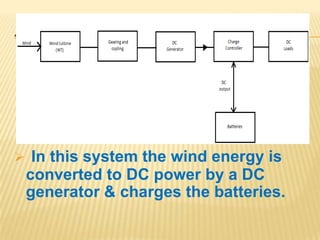
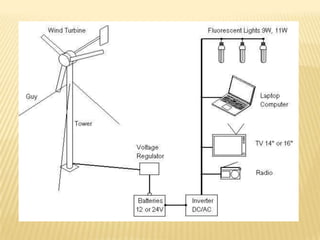
 In this system the wind energy is
    converted to DC power by a DC
    generator & charges the batteries.
.


 Power    is supplied to DC loads or by
    the batteries. The charge controller is
    used       for     controlling     the
    charge/discharge of batteries. The
    systems can be used as standalone
    system for charging the batteries or
    for power supply in remote areas.
TOTAL WIND POWER
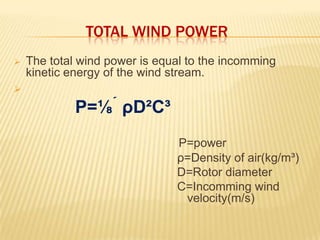
   The total wind power is equal to the incomming
    kinetic energy of the wind stream.


             P=⅛  ρD²C³
                               P=power
                               ρ=Density of air(kg/m³)
                               D=Rotor diameter
                               C=Incomming wind
                                velocity(m/s)
.


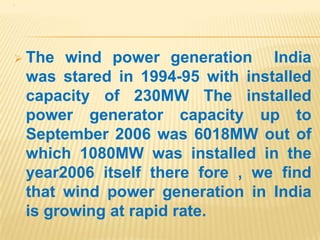
 The     wind power generation India
    was stared in 1994-95 with installed
    capacity of 230MW The installed
    power generator capacity up to
    September 2006 was 6018MW out of
    which 1080MW was installed in the
    year2006 itself there fore , we find
    that wind power generation in India
    is growing at rapid rate.
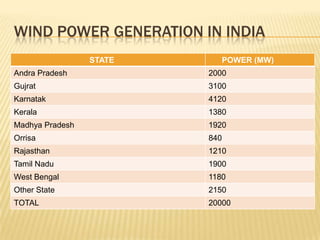
WIND POWER GENERATION IN INDIA
                 STATE      POWER (MW)
Andra Pradesh            2000
Gujrat                   3100
Karnatak                 4120
Kerala                   1380
Madhya Pradesh           1920
Orrisa                   840
Rajasthan                1210
Tamil Nadu               1900
West Bengal              1180
Other State              2150
TOTAL                    20000
ADVANTAGES AND DISADVANTAGES OF WIND-
GENERATED ELECTRICITY
A   Renewable Non-Polluting
    Resource :
       Wind energy is a free, renewable
    resource, so no matter how much is used
    today, there will still be the same supply
    in the future. Wind energy is also a source
    of clean, non-polluting, electricity. Unlike
    conventional power plants, wind plants
    emit no air pollutants or greenhouse
    gases
.


     According to the U.S. Department
     of Energy, in 1990, California's
     wind power plants offset the
     emission of more than 2.5 billion
     pounds of carbon dioxide, and 15
     million pounds of other pollutants
     that would have otherwise been
     produced. It would take a forest of
     90 million to 175 million trees to
     provide the same air quality.
COST ISSUES

 Even though the cost of wind power
 has decreased dramatically in the
 past 10 years, the technology
 requires a higher initial investment
 than     fossil-fueled     generators.
 Roughly 80% of the cost is the
 machinery, with the balance being
 site preparation and installation.
.


     Ifwind generating systems are
      compared with fossil-fueled
      systems on a "life-cycle" cost
      basis (counting fuel and operating
      expenses for the life of the
      generator), however, wind costs
      are much more competitive with
      other generating technologies
      because there is no fuel to
      purchase and minimal operating
ENVIRONMENTAL CONCERNS

   Although wind power plants have
    relatively  little  impact     on    the
    environment compared to fossil fuel
    power plants, there is some concern
    over the noise produced by the rotor
    blades, aesthetic (visual) impacts, and
    birds and bats having been killed
    (avian/bat mortality) by flying into the
    rotors. Most of these problems have
    been resolved or greatly reduced
    through technological development or
SUPPLY AND TRANSPORT ISSUES :

 The major challenge to using wind
 as a source of power is that it is
 intermittent and does not always
 blow when electricity is needed.
 Wind cannot be stored (although
 wind-generated electricity can be
 stored, if batteries are used), and
 not all winds can be harnessed to
 meet the timing of electricity
 demands.
.


 Further,    good wind sites are often
    located in remote locations far
    from areas of electric power
    demand (such as cities). Finally,
    wind resource development may
    compete with other uses for the
    land, and those alternative uses
    may be more highly valued than
    electricity generation. However,
    wind turbines can be located on
.
Wind energy basics
Wind energy basics
Wind energy basics

Wind energy basics

  • 1.
    Wind Energy NIRAV DARANIYA
  • 2.
    WIND ENERGY  How Wind Power Is Generated  Wind Turbines  Wind Turbine Types  Turbine Components  Turbine Configurations  Wind Turbine Size and Power Ratings  Wind Energy Resources in the United States  Advantages and Disadvantages
  • 3.
    .  Wind Energy is an indirect form of solar energy which can be used continuously unlike solar energy  Wind energy classified in two types 1.- Planetary winds  2.- Local winds.
  • 4.
    . Planetary winds are cause due to greater heating of earth’s surface near the equator as compared to solar heating near the south & north poles. Local winds are caused due to differential heating of land & water in coastal areas these are also caused due to uneven heating in hills & mountain along the slopes.
  • 5.
    .  Wind is a form of solar energy. Winds are caused by the uneven heating of the atmosphere by the sun, the irregularities of the earth's surface, and rotation of the earth. Wind flow patterns are modified by the earth's terrain, bodies of water, and vegetative cover. This wind flow, or motion energy, when "harvested" by modern wind turbines, can be used to generate electricity.
  • 6.
    WIND MILLS . .
  • 7.
    HOW WIND POWERIS GENERATED  Theterms "wind energy" or "wind power" describe the process by which the wind is used to generate mechanical power or electricity. Wind turbines convert the kinetic energy in the wind into mechanical power.
  • 8.
    .  This mechanical power can be used for specific tasks (such as grinding grain or pumping water) or a generator can convert this mechanical power into electricity to power homes, businesses, schools, and the like.
  • 9.
    WIND TURBINES  Wind turbines, like aircraft propeller blades, turn in the moving air and power an electric generator that supplies an electric current.
  • 10.
    .  Simply stated, a wind turbine is the opposite of a fan. Instead of using electricity to make wind, like a fan, wind turbines use wind to make electricity. The wind turns the blades, which spin a shaft, which connects to a generator and makes electricity.
  • 11.
  • 12.
  • 13.
    .  Modern wind turbines fall into two basic groups; the horizontal- axis variety, like the traditional farm windmills used for pumping water, and the vertical-axis design, like the eggbeater-style Darrieus model, named after its French inventor. Most large modern wind turbines are horizontal-axis turbines.
  • 14.
  • 15.
    .  blade or rotor, which converts the energy in the wind to rotational shaft energy;  a drive train, usually including a gearbox and a generator; a tower that supports the rotor and drive train  other equipment, including controls, electrical cables, ground support equipment, and interconnection equipment.
  • 17.
    TURBINE CONFIGURATIONS Electricity from these turbines is fed into a utility Wind turbines are often grouped together into a single wind power plant, also known as a wind farm, and generate bulk electrical power.grid and distributed to customers, just as with conventional
  • 18.
    WIND TURBINE SIZEAND POWER RATINGS  Wind turbines are available in a variety of sizes, and therefore power ratings. The largest machine has blades that span more than the length of a football field, stands 20 building stories high, and produces enough electricity to power 1,400 homes.
  • 19.
    .  A small home-sized wind machine has rotors between 8 and 25 feet in diameter and stands upwards of 30 feet and can supply the power needs of an all-electric home or small business. Utility- scale turbines range in size from 50 to 750 kilowatts. Single small turbines, below 50 kilowatts, are used for homes, telecommunications
  • 20.
    .  In thissystem the wind energy is converted to DC power by a DC generator & charges the batteries.
  • 21.
    .  Power is supplied to DC loads or by the batteries. The charge controller is used for controlling the charge/discharge of batteries. The systems can be used as standalone system for charging the batteries or for power supply in remote areas.
  • 22.
    TOTAL WIND POWER  The total wind power is equal to the incomming kinetic energy of the wind stream.  P=⅛  ρD²C³ P=power ρ=Density of air(kg/m³) D=Rotor diameter C=Incomming wind velocity(m/s)
  • 23.
    .  The wind power generation India was stared in 1994-95 with installed capacity of 230MW The installed power generator capacity up to September 2006 was 6018MW out of which 1080MW was installed in the year2006 itself there fore , we find that wind power generation in India is growing at rapid rate.
  • 24.
    WIND POWER GENERATIONIN INDIA STATE POWER (MW) Andra Pradesh 2000 Gujrat 3100 Karnatak 4120 Kerala 1380 Madhya Pradesh 1920 Orrisa 840 Rajasthan 1210 Tamil Nadu 1900 West Bengal 1180 Other State 2150 TOTAL 20000
  • 26.
    ADVANTAGES AND DISADVANTAGESOF WIND- GENERATED ELECTRICITY A Renewable Non-Polluting Resource :  Wind energy is a free, renewable resource, so no matter how much is used today, there will still be the same supply in the future. Wind energy is also a source of clean, non-polluting, electricity. Unlike conventional power plants, wind plants emit no air pollutants or greenhouse gases
  • 27.
    .  According to the U.S. Department of Energy, in 1990, California's wind power plants offset the emission of more than 2.5 billion pounds of carbon dioxide, and 15 million pounds of other pollutants that would have otherwise been produced. It would take a forest of 90 million to 175 million trees to provide the same air quality.
  • 28.
    COST ISSUES  Eventhough the cost of wind power has decreased dramatically in the past 10 years, the technology requires a higher initial investment than fossil-fueled generators. Roughly 80% of the cost is the machinery, with the balance being site preparation and installation.
  • 29.
    .  Ifwind generating systems are compared with fossil-fueled systems on a "life-cycle" cost basis (counting fuel and operating expenses for the life of the generator), however, wind costs are much more competitive with other generating technologies because there is no fuel to purchase and minimal operating
  • 30.
    ENVIRONMENTAL CONCERNS  Although wind power plants have relatively little impact on the environment compared to fossil fuel power plants, there is some concern over the noise produced by the rotor blades, aesthetic (visual) impacts, and birds and bats having been killed (avian/bat mortality) by flying into the rotors. Most of these problems have been resolved or greatly reduced through technological development or
  • 31.
    SUPPLY AND TRANSPORTISSUES :  The major challenge to using wind as a source of power is that it is intermittent and does not always blow when electricity is needed. Wind cannot be stored (although wind-generated electricity can be stored, if batteries are used), and not all winds can be harnessed to meet the timing of electricity demands.
  • 32.
    .  Further, good wind sites are often located in remote locations far from areas of electric power demand (such as cities). Finally, wind resource development may compete with other uses for the land, and those alternative uses may be more highly valued than electricity generation. However, wind turbines can be located on
  • 33.