MOHAMMED SHAHARZAD M.K
SHANID.P
SINJNA V.S
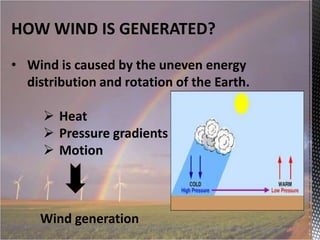
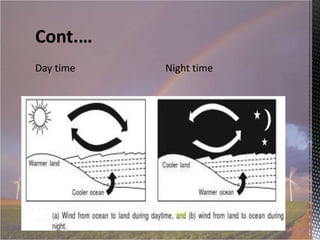
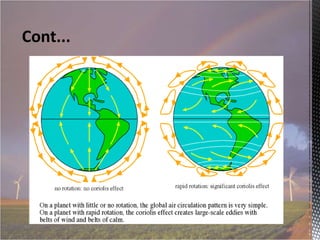
HOW WIND IS GENERATED?
• Wind is caused by the uneven energy
distribution and rotation of the Earth.
 Heat
 Pressure gradients
 Motion

Wind generation
 Then in China wind mills were used to raise water for
irrigation and sea water for production of salt.
 In 1854 Daniel Halladay in US introduced a wind pump
and used for irrigation and industrial applications.
 In 1880 P. La’cour used wind mill as a source of
electricity.
 In 1929 French engineer Darreius built an aero
generator.
 In 1974 NASA constructed and operated a wind
generator of 100kW capacity.
 In 1987 US firms generated a 2.5MW generator
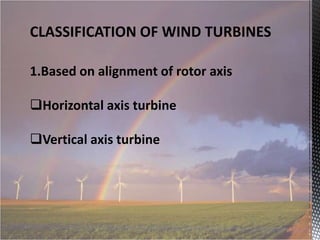
CLASSIFICATION OF WIND TURBINES
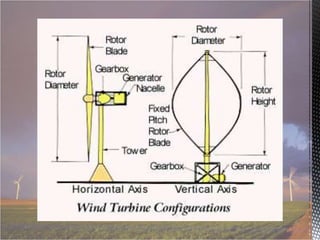
1.Based on alignment of rotor axis
Horizontal axis turbine
Vertical axis turbine
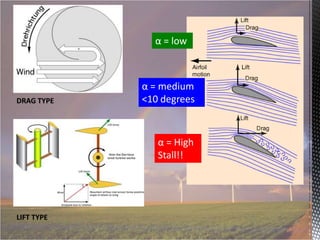
2.Based on the force utilised
 Lift type wind turbine

 Drag type wind turbine
• Forces are transmitted from a moving fluid to
an object in the flow stream
Lift = the force component perpendicular to the
original flow direction
Drag = the force component in line with the original
flow direction
α = low

DRAG TYPE

α = medium
<10 degrees

α = High
Stall!!

LIFT TYPE
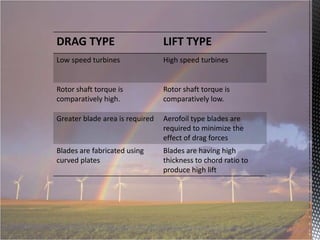
DRAG TYPE

LIFT TYPE

Low speed turbines

High speed turbines

Rotor shaft torque is
comparatively high.

Rotor shaft torque is
comparatively low.

Greater blade area is required

Aerofoil type blades are
required to minimize the
effect of drag forces

Blades are fabricated using
curved plates

Blades are having high
thickness to chord ratio to
produce high lift
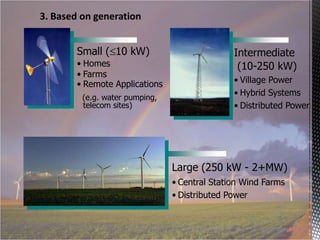
3. Based on generation
Small ( 10 kW)
• Homes
• Farms
• Remote Applications
(e.g. water pumping,
telecom sites)

Intermediate
(10-250 kW)
• Village Power
• Hybrid Systems
• Distributed Power

Large (250 kW - 2+MW)
• Central Station Wind Farms
• Distributed Power
KidWi
nd
Projec
t |
www.
kidwi
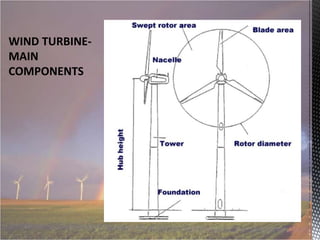
WIND TURBINEMAIN
COMPONENTS
DIFFERENT TYPES OF ROTORS
Multiblade Type
Propeller Type
Savonious Type
Darrieus type
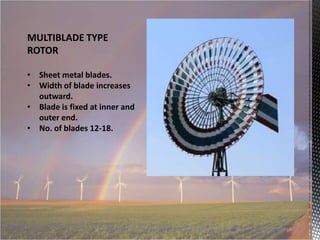
MULTIBLADE TYPE
ROTOR
• Sheet metal blades.
• Width of blade increases
outward.
• Blade is fixed at inner and
outer end.
• No. of blades 12-18.
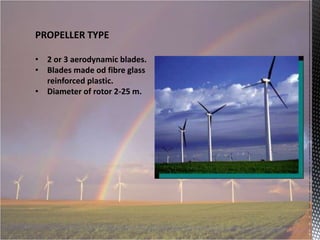
PROPELLER TYPE
• 2 or 3 aerodynamic blades.
• Blades made od fibre glass
reinforced plastic.
• Diameter of rotor 2-25 m.
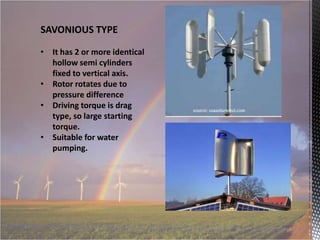
SAVONIOUS TYPE
• It has 2 or more identical
hollow semi cylinders
fixed to vertical axis.
• Rotor rotates due to
pressure difference
• Driving torque is drag
type, so large starting
torque.
• Suitable for water
pumping.
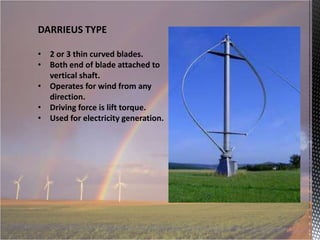
DARRIEUS TYPE
• 2 or 3 thin curved blades.
• Both end of blade attached to
vertical shaft.
• Operates for wind from any
direction.
• Driving force is lift torque.
• Used for electricity generation.
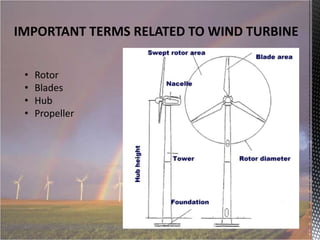
IMPORTANT TERMS RELATED TO WIND TURBINE
•
•
•
•

Rotor
Blades
Hub
Propeller
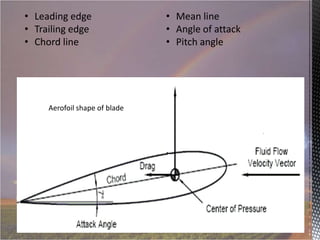
• Leading edge
• Trailing edge
• Chord line

Aerofoil shape of blade

• Mean line
• Angle of attack
• Pitch angle
WIND ENERGY EXTRACTION
 Extract energy from wind stream by converting the
KE of wind to rotational motion required to operate
an electric generator.
 On interaction of free wind on turbine rotor, the wind
transfers part of energy into rotor and speed of wind
reduces.
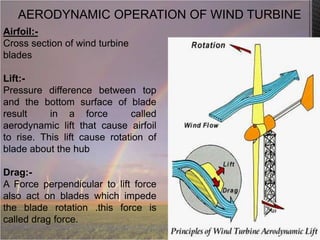
AERODYNAMIC OPERATION OF WIND TURBINE
Airfoil:Cross section of wind turbine
blades
Lift:Pressure difference between top
and the bottom surface of blade
result
in a force
called
aerodynamic lift that cause airfoil
to rise. This lift cause rotation of
blade about the hub
Drag:A Force perpendicular to lift force
also act on blades which impede
the blade rotation .this force is
called drag force.
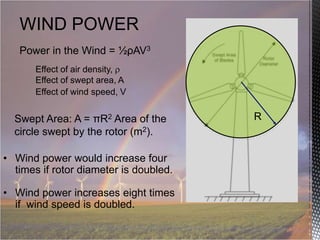
WIND POWER
Power in the Wind = ½ρAV3
Effect of air density,
Effect of swept area, A
Effect of wind speed, V

Swept Area: A = πR2 Area of the
circle swept by the rotor (m2).
• Wind power would increase four
times if rotor diameter is doubled.
• Wind power increases eight times
if wind speed is doubled.

R
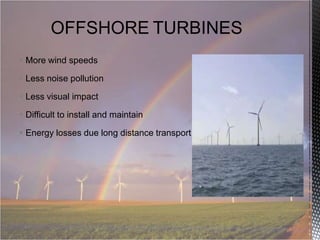
 More wind speeds
 Less noise pollution
 Less visual impact
 Difficult to install and maintain
 Energy losses due long distance transport
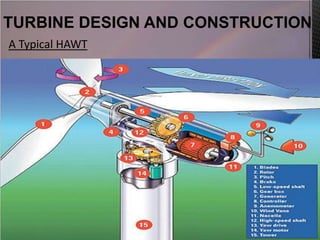
TURBINE DESIGN AND CONSTRUCTION
Blades:
Important part that extract wind Energy
Light weight and good strength
Fabricated with aircraft industry technique.
Made of Fiberglass reinforced polyester
Structured for creating optimum lift.
Rotor:
Combination of blade and hub assembly
Pitch control of blades:
A system where the pitch angle of blade changes according
to the wind speed for efficient operation
Brakes:
Aerodynamic and Mechanical braking are used for over
speed protection , speed control , power control and
emergency stop.
Low speed shaft:
shaft connected directly to rotor to the gear.
Gear box:
 Mechanical power generated by rotor blade is
transmitted to the generator through two stage gear box
 Provided for increasing shaft speed.
Generator:
 Used for converting mechanical power to electric
power.
 Commonly used generators are PMSG,SEIG,DFIG.
Controller:
 Microprocessor based controller monitor wind speed ,
direction of wind , power output and take proper yaw ,
pitch rotations.
Anemometer & wind wane:
 Used for wind speed and direction monitoring.
Nacelle:
 Housing of generator, the gear box, yawing
mechanism,etc.
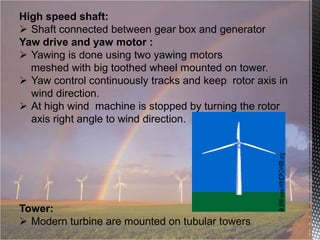
High speed shaft:
 Shaft connected between gear box and generator
Yaw drive and yaw motor :
 Yawing is done using two yawing motors
meshed with big toothed wheel mounted on tower.
 Yaw control continuously tracks and keep rotor axis in
wind direction.
 At high wind machine is stopped by turning the rotor
axis right angle to wind direction.

Tower:
 Modern turbine are mounted on tubular towers
MODES OF WIND POWER
GENERATION
1) Standalone mode
2) Backup mode like wind diesel

3) Grid connected mode
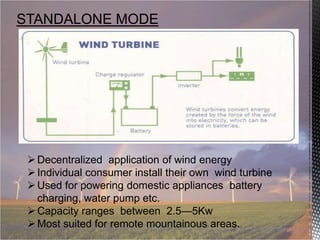
STANDALONE MODE

 Decentralized application of wind energy
 Individual consumer install their own wind turbine
 Used for powering domestic appliances battery
charging, water pump etc.
 Capacity ranges between 2.5—5Kw
 Most suited for remote mountainous areas.
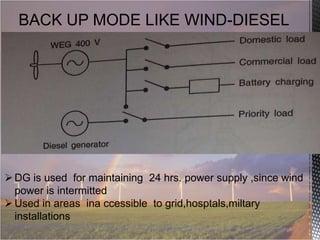
BACK UP MODE LIKE WIND-DIESEL

 DG is used for maintaining 24 hrs. power supply ,since wind
power is intermitted
 Used in areas ina ccessible to grid,hosptals,miltary
installations
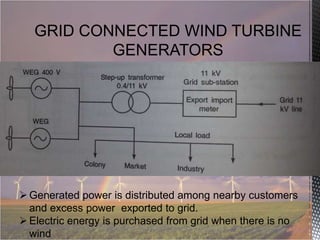
GRID CONNECTED WIND TURBINE
GENERATORS

 Generated power is distributed among nearby customers
and excess power exported to grid.
 Electric energy is purchased from grid when there is no
wind
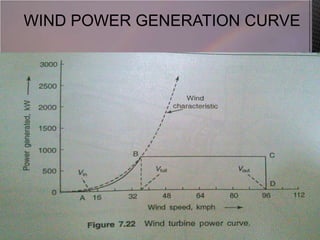
Cut in Speed: It is the wind speed(14m/s)
at which the turbine output begins.
Rated Speed: It is the Speed at which the
turbine is designed to generate rated
power
Cut out Speed: When the speed reaches
upper limit (25m/s) the turbine stops to
generate power


Renewable source of energy



Free of fuel cost



Supply power to remote areas



Public opinion is in favor of wind power generation
rather than nuclear generation



Cost effective



Economically competitive with other modes of
generation



Reliable and has been used for ages
 Low energy density.
 Available at selected graphical location.
 Wind speed being variable , wind energy is irregular.
 Wind turbine design is complex.
 Requires storage batteries which contribute
environmental pollution.
 Capital intensive.
REFERENCES
1. Renewable Energy Sources And Emerging
Technologies,
D.P Kothari,K.C
Singal,Rakesh Ranjan
2. .
3. www.renewableenergyworld.com.
THANK YOU

Wind energy and constructional features

  • 1.
  • 2.
    HOW WIND ISGENERATED? • Wind is caused by the uneven energy distribution and rotation of the Earth.  Heat  Pressure gradients  Motion Wind generation
  • 5.
     Then inChina wind mills were used to raise water for irrigation and sea water for production of salt.  In 1854 Daniel Halladay in US introduced a wind pump and used for irrigation and industrial applications.  In 1880 P. La’cour used wind mill as a source of electricity.  In 1929 French engineer Darreius built an aero generator.  In 1974 NASA constructed and operated a wind generator of 100kW capacity.  In 1987 US firms generated a 2.5MW generator
  • 6.
    CLASSIFICATION OF WINDTURBINES 1.Based on alignment of rotor axis Horizontal axis turbine Vertical axis turbine
  • 8.
    2.Based on theforce utilised  Lift type wind turbine  Drag type wind turbine • Forces are transmitted from a moving fluid to an object in the flow stream Lift = the force component perpendicular to the original flow direction Drag = the force component in line with the original flow direction
  • 9.
    α = low DRAGTYPE α = medium <10 degrees α = High Stall!! LIFT TYPE
  • 10.
    DRAG TYPE LIFT TYPE Lowspeed turbines High speed turbines Rotor shaft torque is comparatively high. Rotor shaft torque is comparatively low. Greater blade area is required Aerofoil type blades are required to minimize the effect of drag forces Blades are fabricated using curved plates Blades are having high thickness to chord ratio to produce high lift
  • 11.
    3. Based ongeneration Small ( 10 kW) • Homes • Farms • Remote Applications (e.g. water pumping, telecom sites) Intermediate (10-250 kW) • Village Power • Hybrid Systems • Distributed Power Large (250 kW - 2+MW) • Central Station Wind Farms • Distributed Power KidWi nd Projec t | www. kidwi
  • 12.
  • 13.
    DIFFERENT TYPES OFROTORS Multiblade Type Propeller Type Savonious Type Darrieus type
  • 14.
    MULTIBLADE TYPE ROTOR • Sheetmetal blades. • Width of blade increases outward. • Blade is fixed at inner and outer end. • No. of blades 12-18.
  • 15.
    PROPELLER TYPE • 2or 3 aerodynamic blades. • Blades made od fibre glass reinforced plastic. • Diameter of rotor 2-25 m.
  • 16.
    SAVONIOUS TYPE • Ithas 2 or more identical hollow semi cylinders fixed to vertical axis. • Rotor rotates due to pressure difference • Driving torque is drag type, so large starting torque. • Suitable for water pumping.
  • 17.
    DARRIEUS TYPE • 2or 3 thin curved blades. • Both end of blade attached to vertical shaft. • Operates for wind from any direction. • Driving force is lift torque. • Used for electricity generation.
  • 18.
    IMPORTANT TERMS RELATEDTO WIND TURBINE • • • • Rotor Blades Hub Propeller
  • 19.
    • Leading edge •Trailing edge • Chord line Aerofoil shape of blade • Mean line • Angle of attack • Pitch angle
  • 20.
    WIND ENERGY EXTRACTION Extract energy from wind stream by converting the KE of wind to rotational motion required to operate an electric generator.  On interaction of free wind on turbine rotor, the wind transfers part of energy into rotor and speed of wind reduces.
  • 21.
    AERODYNAMIC OPERATION OFWIND TURBINE Airfoil:Cross section of wind turbine blades Lift:Pressure difference between top and the bottom surface of blade result in a force called aerodynamic lift that cause airfoil to rise. This lift cause rotation of blade about the hub Drag:A Force perpendicular to lift force also act on blades which impede the blade rotation .this force is called drag force.
  • 22.
    WIND POWER Power inthe Wind = ½ρAV3 Effect of air density, Effect of swept area, A Effect of wind speed, V Swept Area: A = πR2 Area of the circle swept by the rotor (m2). • Wind power would increase four times if rotor diameter is doubled. • Wind power increases eight times if wind speed is doubled. R
  • 23.
     More windspeeds  Less noise pollution  Less visual impact  Difficult to install and maintain  Energy losses due long distance transport
  • 24.
    TURBINE DESIGN ANDCONSTRUCTION
  • 25.
    Blades: Important part thatextract wind Energy Light weight and good strength Fabricated with aircraft industry technique. Made of Fiberglass reinforced polyester Structured for creating optimum lift. Rotor: Combination of blade and hub assembly Pitch control of blades: A system where the pitch angle of blade changes according to the wind speed for efficient operation Brakes: Aerodynamic and Mechanical braking are used for over speed protection , speed control , power control and emergency stop. Low speed shaft: shaft connected directly to rotor to the gear.
  • 26.
    Gear box:  Mechanicalpower generated by rotor blade is transmitted to the generator through two stage gear box  Provided for increasing shaft speed. Generator:  Used for converting mechanical power to electric power.  Commonly used generators are PMSG,SEIG,DFIG. Controller:  Microprocessor based controller monitor wind speed , direction of wind , power output and take proper yaw , pitch rotations. Anemometer & wind wane:  Used for wind speed and direction monitoring. Nacelle:  Housing of generator, the gear box, yawing mechanism,etc.
  • 27.
    High speed shaft: Shaft connected between gear box and generator Yaw drive and yaw motor :  Yawing is done using two yawing motors meshed with big toothed wheel mounted on tower.  Yaw control continuously tracks and keep rotor axis in wind direction.  At high wind machine is stopped by turning the rotor axis right angle to wind direction. Tower:  Modern turbine are mounted on tubular towers
  • 28.
    MODES OF WINDPOWER GENERATION 1) Standalone mode 2) Backup mode like wind diesel 3) Grid connected mode
  • 29.
    STANDALONE MODE  Decentralizedapplication of wind energy  Individual consumer install their own wind turbine  Used for powering domestic appliances battery charging, water pump etc.  Capacity ranges between 2.5—5Kw  Most suited for remote mountainous areas.
  • 30.
    BACK UP MODELIKE WIND-DIESEL  DG is used for maintaining 24 hrs. power supply ,since wind power is intermitted  Used in areas ina ccessible to grid,hosptals,miltary installations
  • 31.
    GRID CONNECTED WINDTURBINE GENERATORS  Generated power is distributed among nearby customers and excess power exported to grid.  Electric energy is purchased from grid when there is no wind
  • 33.
    Cut in Speed:It is the wind speed(14m/s) at which the turbine output begins. Rated Speed: It is the Speed at which the turbine is designed to generate rated power Cut out Speed: When the speed reaches upper limit (25m/s) the turbine stops to generate power
  • 38.
     Renewable source ofenergy  Free of fuel cost  Supply power to remote areas  Public opinion is in favor of wind power generation rather than nuclear generation  Cost effective  Economically competitive with other modes of generation  Reliable and has been used for ages
  • 40.
     Low energydensity.  Available at selected graphical location.  Wind speed being variable , wind energy is irregular.  Wind turbine design is complex.  Requires storage batteries which contribute environmental pollution.  Capital intensive.
  • 41.
    REFERENCES 1. Renewable EnergySources And Emerging Technologies, D.P Kothari,K.C Singal,Rakesh Ranjan 2. . 3. www.renewableenergyworld.com.
  • 42.