



TACHYARRYTHMIAS
DR.JAKEER HUSSAIN
MD, DNB, IDCCM
BASICS
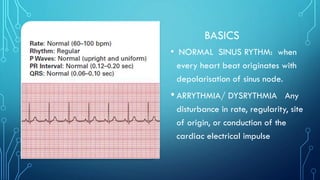
• NORMAL SINUS RYTHM: when
every heart beat originates with
depolarisation of sinus node.
• ARRYTHMIA/ DYSRYTHMIA Any
disturbance in rate, regularity, site
of origin, or conduction of the
cardiac electrical impulse
PRECIPITATING FACTORS FOR ARRYTHMIAS
• HYPOXIA : myocardium deprived of O2 – irritable myocardium. Pulm disorders, copd,
• embolus.
• ISCHEMIA & IRRITABILITY: ANGINA, MYOCARDIAL INFARCTIONS, MYOCARDITIS( Viral
SYMPATHETIC STIMULATION : enhanced sympathetic tone ( hyperthyroid, nervousness, exercise)
• DRUGS : Many drugs cause arrhythmias…
• ELECTROLYTE IMBALANCE: K, Ca , Mg.
• STRECTH : Hypertrophy & enlargement of ATRIA & VENTRICLES
• ( VALVULAR HEART Ds, CARDIOMYOPATHY, CHF)
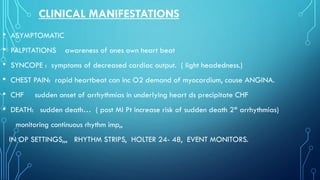
CLINICAL MANIFESTATIONS
• ASYMPTOMATIC
• PALPITATIONS awareness of ones own heart beat
• SYNCOPE : symptoms of decreased cardiac output. ( light headedness.)
• CHEST PAIN: rapid heartbeat can inc O2 demand of myocardium, cause ANGINA.
• CHF sudden onset of arrhythmias in underlying heart ds precipitate CHF
• DEATH: sudden death… ( post MI Pt increase risk of sudden death 2* arrhythmias)
monitoring continuous rhythm imp,,
IN OP SETTINGS,,, RHYTHM STRIPS, HOLTER 24- 48, EVENT MONITORS.
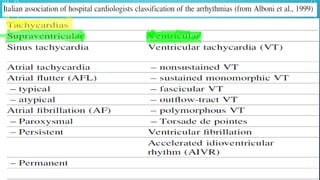
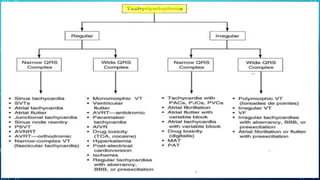
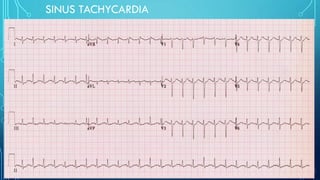
SINUS TACHYCARDIA
CAUSES
• FeverPain
• ● Anxiety
• ● Pheochromocytoma
• ● Hyperthyroidism
• ● Decompensated heart failure
• ● Chronic pulmonary disease
• Exposure to stimulants (nicotine, caffeine,
amphetamines), anticholinergic drugs, beta
blocker
• withdrawal, or illicit drugs
• ● Abrupt withdrawal of medications such as
beta blockers
• ● Volume depletion
• ● Hypotension and shock
• ● Sepsis
• ● Anemia
• ● Hypoxia
• ● Pulmonary embolism
• ● Acute coronary ischemia and myocardial
infarction
• BETA BLOCKERS — For patients with symptomatic inappropriate sinus tachycardia, we
suggest a trial of beta blockade, rather than non-dihydropyridine CCB, as the initial medical
therapy. start long-acting metoprolol 25 to 50 mg daily.
• IVABRADINE — For patients with persistently symptomatic inappropriate sinus tachycardia,
ivabradine (5 mg to 7.5 mg twice daily) with or without a beta adrenergic receptor blocker
• 2015 ACC/AHA/HRS guideline for the treatment of supraventricular tachycardia both support
the use of ivabradine for inappropriate sinus tachycardia
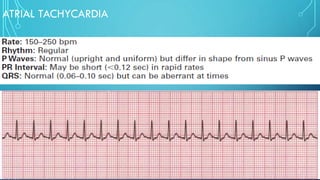
ATRIAL TACHYCARDIA
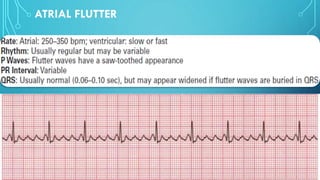
ATRIAL FLUTTER
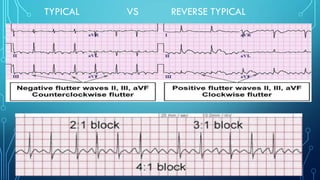
TYPICAL VS REVERSE TYPICAL
RX
• radiofrequency ablation (RFA). In all available studies, catheter ablation is
superior to rate-control and rhythm-control strategies with antiarrhythmic
drugs.
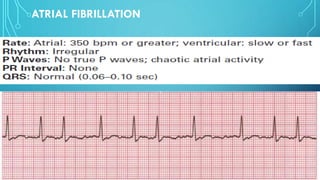
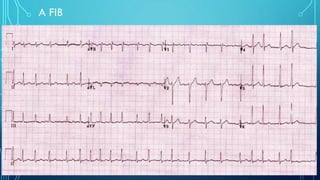
ATRIAL FIBRILLATION
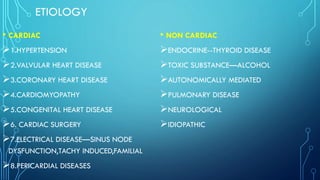
ETIOLOGY
• CARDIAC
➢1.HYPERTENSION
➢2.VALVULAR HEART DISEASE
➢3.CORONARY HEART DISEASE
➢4.CARDIOMYOPATHY
➢5.CONGENITAL HEART DISEASE
➢6. CARDIAC SURGERY
➢7.ELECTRICAL DISEASE—SINUS NODE
DYSFUNCTION,TACHY INDUCED,FAMILIAL
➢8.PERICARDIAL DISEASES
• NON CARDIAC
➢ENDOCRINE--THYROID DISEASE
➢TOXIC SUBSTANCE—ALCOHOL
➢AUTONOMICALLY MEDIATED
➢PULMONARY DISEASE
➢NEUROLOGICAL
➢IDIOPATHIC
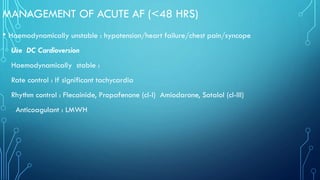
MANAGEMENT OF ACUTE AF (<48 HRS)
• Haemodynamically unstable : hypotension/heart failure/chest pain/syncope
Use DC Cardioversion
Haemodynamically stable :
Rate control : If significant tachycardia
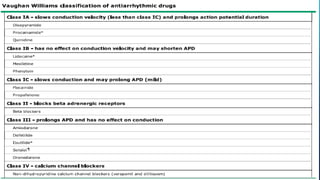
Rhythm control : Flecainide, Propafenone (cl-I) Amiodarone, Sotalol (cl-III)
Anticoagulant : LMWH
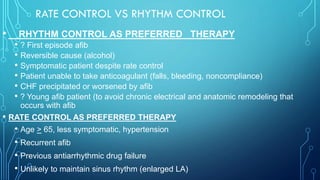
RATE CONTROL VS RHYTHM CONTROL
• RHYTHM CONTROL AS PREFERRED THERAPY
• ? First episode afib
• Reversible cause (alcohol)
• Symptomatic patient despite rate control
• Patient unable to take anticoagulant (falls, bleeding, noncompliance)
• CHF precipitated or worsened by afib
• ? Young afib patient (to avoid chronic electrical and anatomic remodeling that
occurs with afib
• RATE CONTROL AS PREFERRED THERAPY
• Age > 65, less symptomatic, hypertension
• Recurrent afib
• Previous antiarrhythmic drug failure
• Unlikely to maintain sinus rhythm (enlarged LA)
AMIODARONE
•Large volume of distribution
& long half life
•Contraindications
•Sinus bradycardia
•Heart block
•Adverse effects
•Short term : Skin
reactions,Brady, hypotension,
•Long term :
• Pulmonary fibrosis, alveolitis,
pneumonitis
• Liver dysfunction..monitor LFT
• Hypo or Hyperthyroidism (check
TFT before starting)
• Peripheral neuropathy, myopathy,
Cerebellar dysfunction.
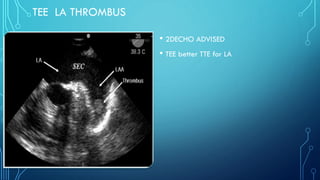
TEE LA THROMBUS
• 2DECHO ADVISED
• TEE better TTE for LA
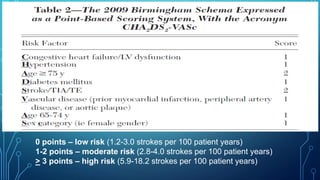
0 points – low risk (1.2-3.0 strokes per 100 patient years)
1-2 points – moderate risk (2.8-4.0 strokes per 100 patient years)
> 3 points – high risk (5.9-18.2 strokes per 100 patient years)
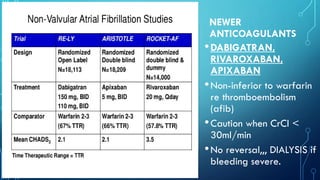
NEWER
ANTICOAGULANTS
•DABIGATRAN,
RIVAROXABAN,
APIXABAN
•Non-inferior to warfarin
re thromboembolism
(afib)
•Caution when CrCl <
30ml/min
•No reversal,,, DIALYSIS if
bleeding severe.
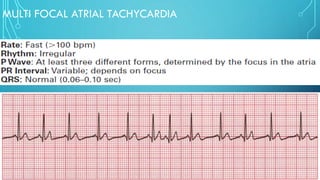
MULTI FOCAL ATRIAL TACHYCARDIA
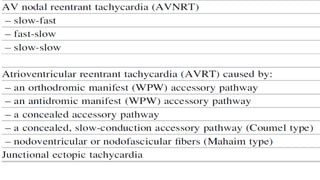
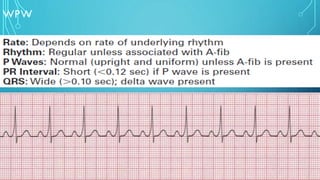
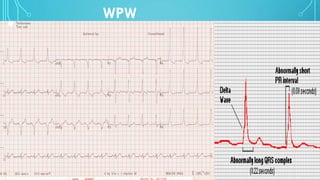
WPW
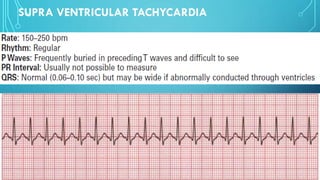
SUPRA VENTRICULAR TACHYCARDIA
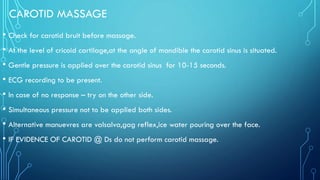
CAROTID MASSAGE
• Check for carotid bruit before massage.
• At the level of cricoid cartilage,at the angle of mandible the carotid sinus is situated.
• Gentle pressure is applied over the carotid sinus for 10-15 seconds.
• ECG recording to be present.
• In case of no response – try on the other side.
• Simultaneous pressure not to be applied both sides.
• Alternative manuevres are valsalva,gag reflex,ice water pouring over the face.
• IF EVIDENCE OF CAROTID @ Ds do not perform carotid massage.
• If SVT is suspected to be AVNode dependent – drug of choice is adenosine and CCBs verapamil
and diltiazem.
• But digoxin,BBs,CCBs better control of ventricular response in atrial tachycardias
• Class I agents to be combined with AV nodal blocking drugs – to eliminate 1:1 conduction of
atrial to ventricles.
• Pre-excitation syndromes seen on ECG when patient in sinus rhythm (WPW changes). These are
lost when AVRT is established
• Short PR, delta wave, widened QRS
• Anatomical re-entrant pathway (Bundle of Kent). Circus movement between the AV node and
accessory pathway.
• May be triggered by PAC or PVC
• Circus movement may by orthodromic or antidromic
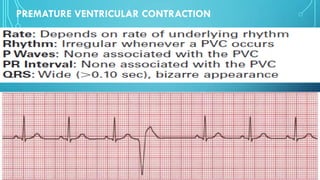
PREMATURE VENTRICULAR CONTRACTION
PREMATURE VENTRICULAR CONTRACTION (PVC)
• The ectopic beat is not preceded by a p-wave
• Irregular rhythm due to ectopic beat
• Rate will be determined by the underlying rhythm
• QRS is wide and may be bizarre in appearance
• Caused by a irritable focus within the ventricle which fires prematurely
• Must identify an underlying rhythm
PREMATURE VENTRICULAR CONTRACTION (PVC)
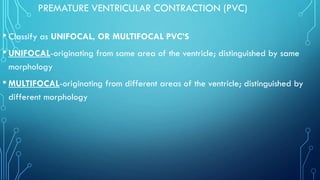
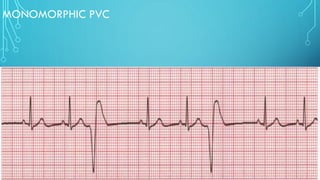
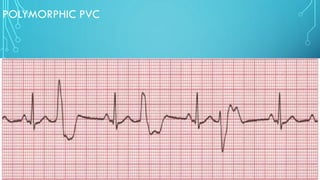
• Classify as UNIFOCAL, OR MULTIFOCAL PVC’S
• UNIFOCAL-originating from same area of the ventricle; distinguished by same
morphology
• MULTIFOCAL-originating from different areas of the ventricle; distinguished by
different morphology
MONOMORPHIC PVC
POLYMORPHIC PVC
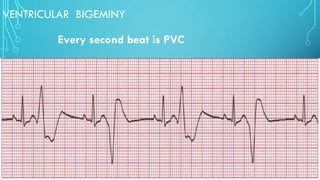
VENTRICULAR BIGEMINY
Every second beat is PVC
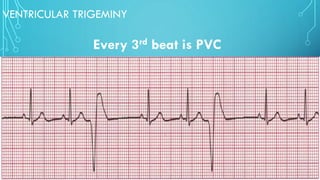
VENTRICULAR TRIGEMINY
Every 3rd beat is PVC
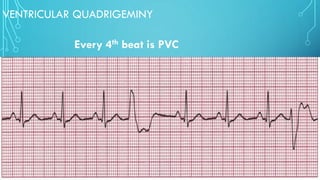
VENTRICULAR QUADRIGEMINY
Every 4th beat is PVC
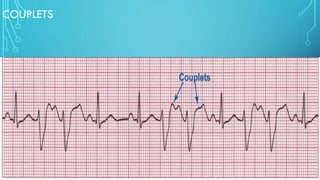
COUPLETS
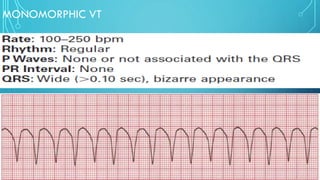
MONOMORPHIC VT
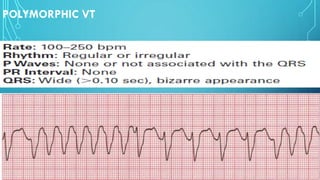
POLYMORPHIC VT
IMPLANTABLE CARDIOVERTER-DEFIBRILLATOR (ICD)
•ICD therapy compared with conventional AAD associated with mortality
reduction of 23-55% depending on risk group.
•Current ICD options:
• Single chamber
• Dual chamber
• Biventricular cardiac resynchronization
• Multilevel shock discharge for VT or VF
Complications:
Inappropriate shock discharge
Defibrillator storm
Infections
Exacerbation of HF
LONG QT SYNDROME
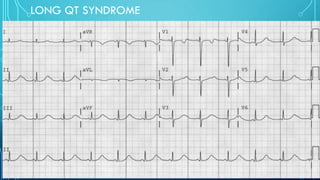
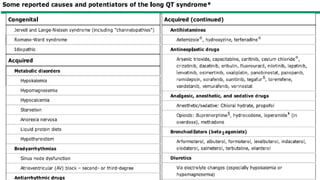
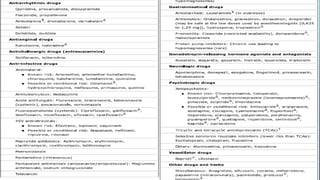
• Long QT syndrome (LQTS) is a rare congenital and inherited or acquired heart condition in
which delayed repolarization of the heart following a heartbeat increases the risk of episodes
of torsades de pointes (TdP, a form of irregular heartbeat that originates from the ventricles)
• QTc is prolonged if > 440ms in men or
• > 460ms in women.
• QTc > 500 is associated with increased risk of torsades de pointes.
• a normal QT is less than half the preceding RRinterval.
LONG QT SYNDROME
TREATMENT
• Beta-adrenergic blocking agents are the drugs of choice to treat long QT syndrome and include
the following medications:
• Propranolol, Nadolol, Metoprolol, Atenolol
• SURGICAL OPTION
• Surgical intervention in patients with long QT syndrome may include the following procedures:
• Implantation of cardioverter-defibrillators
• Placement of a pacemaker
• Left cervicothoracic stellectomy
• FAMILY HISTORY,, AVOID EXERCISES, AVOID DRUGS
TORSADES DE POINTES
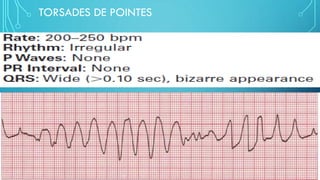
• Torsades de pointes is a specific form of polymorphic VT in patients with a
long QT interval. It is characterized by rapid, irregular QRS complexes,
• which appear to be twisting around the ECG baseline.
• This arrhythmia may cease spontaneously or degenerate into ventricular
fibrillation.
TORSADES DE POINTES
RX
MAGNESIUM
decreasing the influx of calcium, thus lowering the amplitude of EADs.
Magnesium can be given at 1-2 g IV initially in 30-60 seconds, which then can be
repeated in 5-15 minutes.
• Because of the danger of hypermagnesemia (depression of neuromuscular function), the
patient requires close monitoring.
LONG-TERM TREATMENT
• Beta-adrenergic antagonists at maximally tolerated doses are used as a first-line long-
term therapy in congenital long QT syndrome. Propranolol is used most extensively
• Implantable cardioverter-defibrillators (ICDs) are useful in instances when torsade
recurs despite treatment with beta-blockers, pacing, and possibly left thoracic
sympathectomy.
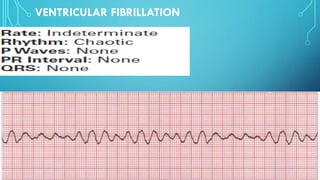
VENTRICULAR FIBRILLATION
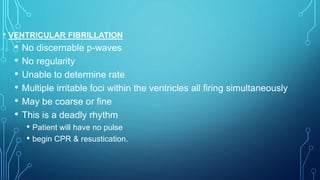
• VENTRICULAR FIBRILLATION
• No discernable p-waves
• No regularity
• Unable to determine rate
• Multiple irritable foci within the ventricles all firing simultaneously
• May be coarse or fine
• This is a deadly rhythm
• Patient will have no pulse
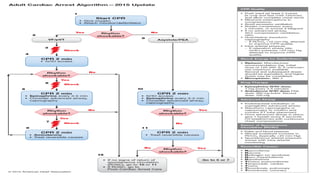
• begin CPR & resustication.
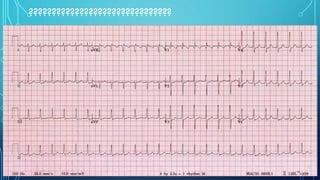
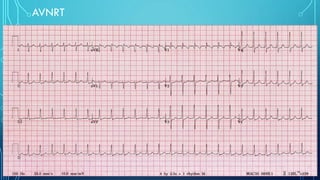
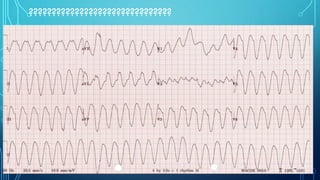
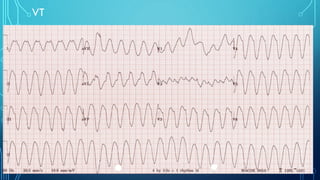
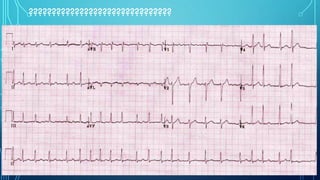
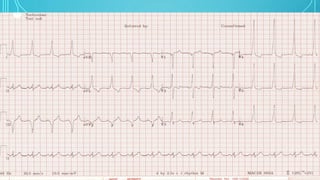
QUIZ…..
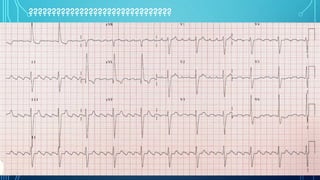
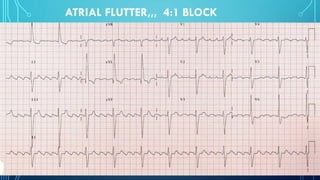
???????????????????????????????
ATRIAL FLUTTER,,, 4:1 BLOCK
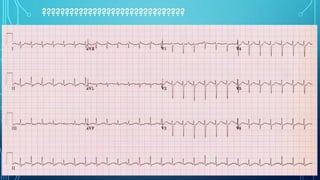
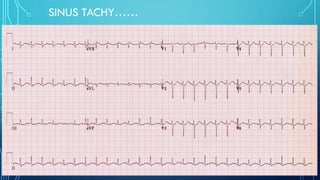
???????????????????????????????
SINUS TACHY……
???????????????????????????????
AVNRT
???????????????????????????????
VT
???????????????????????????????
A FIB
WPW
THANK YOU….
Seminar is defined as process in which
one spoils his sleep for one night ,,,
in an effort to make others sleep …….

TACHY ARRYTHMIAS

  • 1.
  • 2.
    BASICS • NORMAL SINUSRYTHM: when every heart beat originates with depolarisation of sinus node. • ARRYTHMIA/ DYSRYTHMIA Any disturbance in rate, regularity, site of origin, or conduction of the cardiac electrical impulse
  • 4.
    PRECIPITATING FACTORS FORARRYTHMIAS • HYPOXIA : myocardium deprived of O2 – irritable myocardium. Pulm disorders, copd, • embolus. • ISCHEMIA & IRRITABILITY: ANGINA, MYOCARDIAL INFARCTIONS, MYOCARDITIS( Viral SYMPATHETIC STIMULATION : enhanced sympathetic tone ( hyperthyroid, nervousness, exercise) • DRUGS : Many drugs cause arrhythmias… • ELECTROLYTE IMBALANCE: K, Ca , Mg. • STRECTH : Hypertrophy & enlargement of ATRIA & VENTRICLES • ( VALVULAR HEART Ds, CARDIOMYOPATHY, CHF)
  • 5.
    CLINICAL MANIFESTATIONS • ASYMPTOMATIC •PALPITATIONS awareness of ones own heart beat • SYNCOPE : symptoms of decreased cardiac output. ( light headedness.) • CHEST PAIN: rapid heartbeat can inc O2 demand of myocardium, cause ANGINA. • CHF sudden onset of arrhythmias in underlying heart ds precipitate CHF • DEATH: sudden death… ( post MI Pt increase risk of sudden death 2* arrhythmias) monitoring continuous rhythm imp,, IN OP SETTINGS,,, RHYTHM STRIPS, HOLTER 24- 48, EVENT MONITORS.
  • 9.
  • 10.
    CAUSES • FeverPain • ●Anxiety • ● Pheochromocytoma • ● Hyperthyroidism • ● Decompensated heart failure • ● Chronic pulmonary disease • Exposure to stimulants (nicotine, caffeine, amphetamines), anticholinergic drugs, beta blocker • withdrawal, or illicit drugs • ● Abrupt withdrawal of medications such as beta blockers • ● Volume depletion • ● Hypotension and shock • ● Sepsis • ● Anemia • ● Hypoxia • ● Pulmonary embolism • ● Acute coronary ischemia and myocardial infarction
  • 11.
    • BETA BLOCKERS— For patients with symptomatic inappropriate sinus tachycardia, we suggest a trial of beta blockade, rather than non-dihydropyridine CCB, as the initial medical therapy. start long-acting metoprolol 25 to 50 mg daily. • IVABRADINE — For patients with persistently symptomatic inappropriate sinus tachycardia, ivabradine (5 mg to 7.5 mg twice daily) with or without a beta adrenergic receptor blocker • 2015 ACC/AHA/HRS guideline for the treatment of supraventricular tachycardia both support the use of ivabradine for inappropriate sinus tachycardia
  • 12.
  • 14.
  • 15.
  • 16.
    RX • radiofrequency ablation(RFA). In all available studies, catheter ablation is superior to rate-control and rhythm-control strategies with antiarrhythmic drugs.
  • 17.
  • 18.
    ETIOLOGY • CARDIAC ➢1.HYPERTENSION ➢2.VALVULAR HEARTDISEASE ➢3.CORONARY HEART DISEASE ➢4.CARDIOMYOPATHY ➢5.CONGENITAL HEART DISEASE ➢6. CARDIAC SURGERY ➢7.ELECTRICAL DISEASE—SINUS NODE DYSFUNCTION,TACHY INDUCED,FAMILIAL ➢8.PERICARDIAL DISEASES • NON CARDIAC ➢ENDOCRINE--THYROID DISEASE ➢TOXIC SUBSTANCE—ALCOHOL ➢AUTONOMICALLY MEDIATED ➢PULMONARY DISEASE ➢NEUROLOGICAL ➢IDIOPATHIC
  • 19.
    MANAGEMENT OF ACUTEAF (<48 HRS) • Haemodynamically unstable : hypotension/heart failure/chest pain/syncope Use DC Cardioversion Haemodynamically stable : Rate control : If significant tachycardia Rhythm control : Flecainide, Propafenone (cl-I) Amiodarone, Sotalol (cl-III) Anticoagulant : LMWH
  • 21.
    RATE CONTROL VSRHYTHM CONTROL • RHYTHM CONTROL AS PREFERRED THERAPY • ? First episode afib • Reversible cause (alcohol) • Symptomatic patient despite rate control • Patient unable to take anticoagulant (falls, bleeding, noncompliance) • CHF precipitated or worsened by afib • ? Young afib patient (to avoid chronic electrical and anatomic remodeling that occurs with afib • RATE CONTROL AS PREFERRED THERAPY • Age > 65, less symptomatic, hypertension • Recurrent afib • Previous antiarrhythmic drug failure • Unlikely to maintain sinus rhythm (enlarged LA)
  • 22.
    AMIODARONE •Large volume ofdistribution & long half life •Contraindications •Sinus bradycardia •Heart block •Adverse effects •Short term : Skin reactions,Brady, hypotension, •Long term : • Pulmonary fibrosis, alveolitis, pneumonitis • Liver dysfunction..monitor LFT • Hypo or Hyperthyroidism (check TFT before starting) • Peripheral neuropathy, myopathy, Cerebellar dysfunction.
  • 23.
    TEE LA THROMBUS •2DECHO ADVISED • TEE better TTE for LA
  • 24.
    0 points –low risk (1.2-3.0 strokes per 100 patient years) 1-2 points – moderate risk (2.8-4.0 strokes per 100 patient years) > 3 points – high risk (5.9-18.2 strokes per 100 patient years)
  • 25.
    NEWER ANTICOAGULANTS •DABIGATRAN, RIVAROXABAN, APIXABAN •Non-inferior to warfarin rethromboembolism (afib) •Caution when CrCl < 30ml/min •No reversal,,, DIALYSIS if bleeding severe.
  • 26.
    MULTI FOCAL ATRIALTACHYCARDIA
  • 27.
  • 28.
  • 29.
    CAROTID MASSAGE • Checkfor carotid bruit before massage. • At the level of cricoid cartilage,at the angle of mandible the carotid sinus is situated. • Gentle pressure is applied over the carotid sinus for 10-15 seconds. • ECG recording to be present. • In case of no response – try on the other side. • Simultaneous pressure not to be applied both sides. • Alternative manuevres are valsalva,gag reflex,ice water pouring over the face. • IF EVIDENCE OF CAROTID @ Ds do not perform carotid massage.
  • 30.
    • If SVTis suspected to be AVNode dependent – drug of choice is adenosine and CCBs verapamil and diltiazem. • But digoxin,BBs,CCBs better control of ventricular response in atrial tachycardias • Class I agents to be combined with AV nodal blocking drugs – to eliminate 1:1 conduction of atrial to ventricles.
  • 31.
    • Pre-excitation syndromesseen on ECG when patient in sinus rhythm (WPW changes). These are lost when AVRT is established • Short PR, delta wave, widened QRS • Anatomical re-entrant pathway (Bundle of Kent). Circus movement between the AV node and accessory pathway. • May be triggered by PAC or PVC • Circus movement may by orthodromic or antidromic
  • 32.
  • 33.
    PREMATURE VENTRICULAR CONTRACTION(PVC) • The ectopic beat is not preceded by a p-wave • Irregular rhythm due to ectopic beat • Rate will be determined by the underlying rhythm • QRS is wide and may be bizarre in appearance • Caused by a irritable focus within the ventricle which fires prematurely • Must identify an underlying rhythm
  • 34.
    PREMATURE VENTRICULAR CONTRACTION(PVC) • Classify as UNIFOCAL, OR MULTIFOCAL PVC’S • UNIFOCAL-originating from same area of the ventricle; distinguished by same morphology • MULTIFOCAL-originating from different areas of the ventricle; distinguished by different morphology
  • 35.
  • 36.
  • 37.
  • 38.
  • 39.
  • 40.
  • 41.
  • 42.
  • 45.
    IMPLANTABLE CARDIOVERTER-DEFIBRILLATOR (ICD) •ICDtherapy compared with conventional AAD associated with mortality reduction of 23-55% depending on risk group. •Current ICD options: • Single chamber • Dual chamber • Biventricular cardiac resynchronization • Multilevel shock discharge for VT or VF Complications: Inappropriate shock discharge Defibrillator storm Infections Exacerbation of HF
  • 46.
    LONG QT SYNDROME •Long QT syndrome (LQTS) is a rare congenital and inherited or acquired heart condition in which delayed repolarization of the heart following a heartbeat increases the risk of episodes of torsades de pointes (TdP, a form of irregular heartbeat that originates from the ventricles) • QTc is prolonged if > 440ms in men or • > 460ms in women. • QTc > 500 is associated with increased risk of torsades de pointes. • a normal QT is less than half the preceding RRinterval.
  • 47.
  • 50.
    TREATMENT • Beta-adrenergic blockingagents are the drugs of choice to treat long QT syndrome and include the following medications: • Propranolol, Nadolol, Metoprolol, Atenolol • SURGICAL OPTION • Surgical intervention in patients with long QT syndrome may include the following procedures: • Implantation of cardioverter-defibrillators • Placement of a pacemaker • Left cervicothoracic stellectomy • FAMILY HISTORY,, AVOID EXERCISES, AVOID DRUGS
  • 51.
    TORSADES DE POINTES •Torsades de pointes is a specific form of polymorphic VT in patients with a long QT interval. It is characterized by rapid, irregular QRS complexes, • which appear to be twisting around the ECG baseline. • This arrhythmia may cease spontaneously or degenerate into ventricular fibrillation.
  • 52.
  • 53.
    RX MAGNESIUM decreasing the influxof calcium, thus lowering the amplitude of EADs. Magnesium can be given at 1-2 g IV initially in 30-60 seconds, which then can be repeated in 5-15 minutes. • Because of the danger of hypermagnesemia (depression of neuromuscular function), the patient requires close monitoring. LONG-TERM TREATMENT • Beta-adrenergic antagonists at maximally tolerated doses are used as a first-line long- term therapy in congenital long QT syndrome. Propranolol is used most extensively • Implantable cardioverter-defibrillators (ICDs) are useful in instances when torsade recurs despite treatment with beta-blockers, pacing, and possibly left thoracic sympathectomy.
  • 54.
  • 55.
    • VENTRICULAR FIBRILLATION •No discernable p-waves • No regularity • Unable to determine rate • Multiple irritable foci within the ventricles all firing simultaneously • May be coarse or fine • This is a deadly rhythm • Patient will have no pulse • begin CPR & resustication.
  • 58.
  • 59.
  • 60.
  • 61.
  • 62.
  • 63.
  • 64.
  • 65.
  • 66.
  • 67.
  • 68.
  • 70.
  • 72.
    THANK YOU…. Seminar isdefined as process in which one spoils his sleep for one night ,,, in an effort to make others sleep …….