ACUTE RESPIRATORY FAILURE


Ihab B Abdalrahman, MBBS, MD, ABIM, SSBB
Ihab Tarawa
Consultant of Acute Care Medicine, Soba University Hospital


                                                      10/2/2012   1
BASIC RESPIRATORY
    PHYSIOLOGY


           Ihab Tarawa   10/2/2012   2
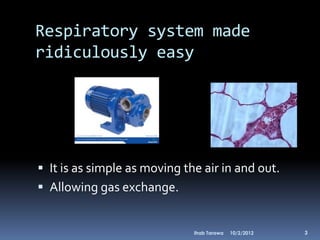
Respiratory system made
ridiculously easy


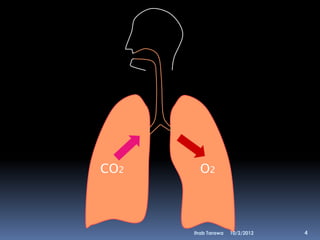
 It is as simple as moving the air in and out.
 Allowing gas exchange.

                              Ihab Tarawa   10/2/2012   3
CO2     O2


      Ihab Tarawa   10/2/2012   4
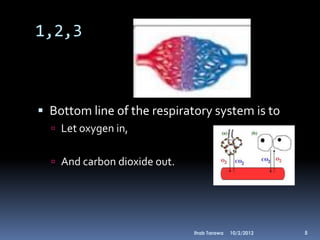
1,2,3


 Bottom line of the respiratory system is to
   Let oxygen in,


   And carbon dioxide out.


                              Ihab Tarawa   10/2/2012   5
Definitions

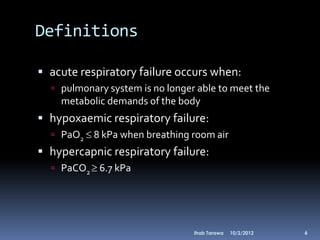
 acute respiratory failure occurs when:
   pulmonary system is no longer able to meet the
    metabolic demands of the body
 hypoxaemic respiratory failure:
   PaO2  8 kPa when breathing room air
 hypercapnic respiratory failure:
   PaCO2  6.7 kPa


                                 Ihab Tarawa   10/2/2012   6
Oxygen in
Depends on
  Ventilation
  PAO2
  Perfusion
  Ventilation-perfusion matching
  Diffusing capacity


                             Ihab Tarawa   10/2/2012   7
PAO2

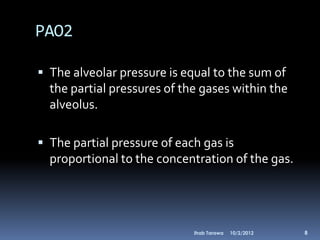
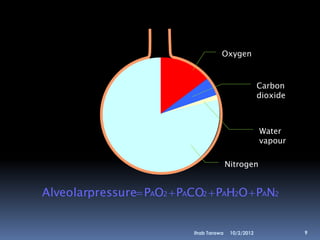
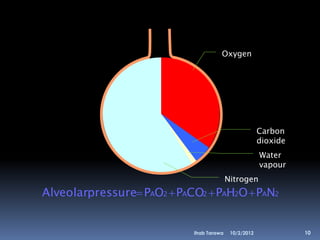
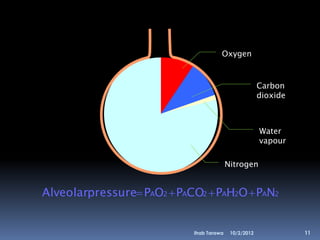
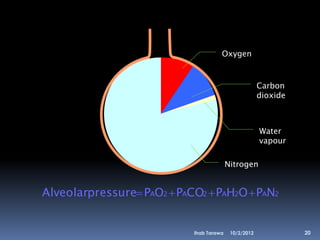
 The alveolar pressure is equal to the sum of
  the partial pressures of the gases within the
  alveolus.

 The partial pressure of each gas is
  proportional to the concentration of the gas.


                             Ihab Tarawa   10/2/2012   8
Oxygen


                                                       Carbon
                                                       dioxide


                                                       Water
                                                       vapour

                                          Nitrogen


Alveolarpressure PAO2  PACO2  PAH2O  PAN2


                            Ihab Tarawa    10/2/2012             9
Oxygen


                                                       Carbon
                                                       dioxide
                                                       Water
                                                       vapour
                                          Nitrogen
Alveolarpressure PAO2  PACO2  PAH2O  PAN2


                            Ihab Tarawa    10/2/2012             10
Oxygen


                                                       Carbon
                                                       dioxide


                                                       Water
                                                       vapour

                                          Nitrogen


Alveolarpressure PAO2  PACO2  PAH2O  PAN2


                            Ihab Tarawa    10/2/2012             11
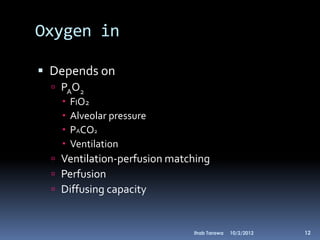
Oxygen in

 Depends on
   PAO2
     FIO2
     Alveolar pressure
     PACO2
     Ventilation
   Ventilation-perfusion matching
   Perfusion
   Diffusing capacity


                              Ihab Tarawa   10/2/2012   12
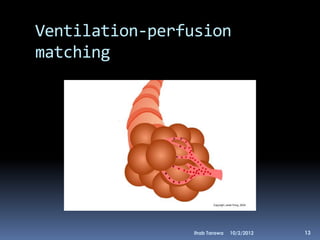
Ventilation-perfusion
matching


                Ihab Tarawa   10/2/2012   13
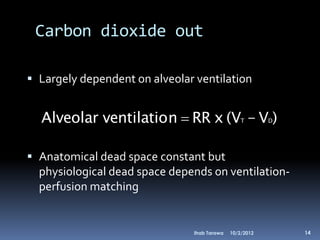
Carbon dioxide out

 Largely dependent on alveolar ventilation


  Alveolar ventilation  RR x (V - V )           T       D


 Anatomical dead space constant but
  physiological dead space depends on ventilation-
  perfusion matching


                               Ihab Tarawa   10/2/2012       14
Carbon dioxide out

 Respiratory rate
 Tidal volume
 Ventilation-perfusion matching


                           Ihab Tarawa   10/2/2012   15
PATHOPHYSIOLOGY


          Ihab Tarawa   10/2/2012   16
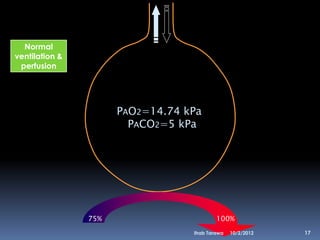
Normal
ventilation &
 perfusion


                      PAO2=14.74 kPa
                        PACO2=5 kPa


                75%                       100%
                                  Ihab Tarawa   10/2/2012   17
Pathophysiology

 Low inspired Po2
   Although, in theory, acute respiratory failure may
    result from a low inspired PO2 this is rarely a
    problem in Intensive Care except in locations at
    high altitude.


                                Ihab Tarawa   10/2/2012   18
Pathophysiology

 Low inspired oxygen concentration
 Hypoventilation


                          Ihab Tarawa   10/2/2012   19
Oxygen


                                                       Carbon
                                                       dioxide


                                                       Water
                                                       vapour

                                          Nitrogen


Alveolarpressure PAO2  PACO2  PAH2O  PAN2


                            Ihab Tarawa    10/2/2012             20
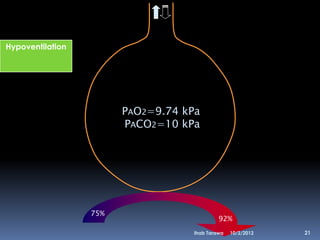
Hypoventilation


                        PAO2=9.74 kPa
                        PACO2=10 kPa


                  75%
                                            92%
                                   Ihab Tarawa   10/2/2012   21
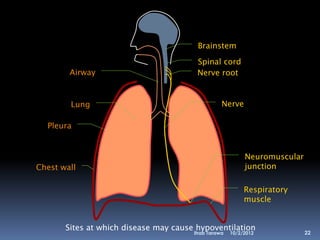
Brainstem

                                        Spinal cord
        Airway                          Nerve root


        Lung                                     Nerve

  Pleura


                                                          Neuromuscular
Chest wall                                                junction

                                                          Respiratory
                                                          muscle


       Sites at which disease may cause hypoventilation
                                       Ihab Tarawa   10/2/2012            22
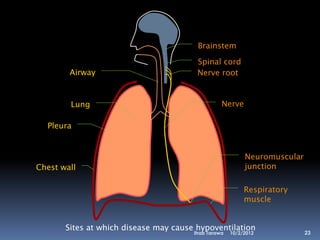
Brainstem

                                        Spinal cord
        Airway                          Nerve root


        Lung                                     Nerve

  Pleura


                                                          Neuromuscular
Chest wall                                                junction

                                                          Respiratory
                                                          muscle


       Sites at which disease may cause hypoventilation
                                       Ihab Tarawa   10/2/2012            23
Pathophysiology

 Low inspired oxygen concentration
 Hypoventilation
 Shunting
 Dead space ventilation
 Diffusion abnormality


                           Ihab Tarawa   10/2/2012   24
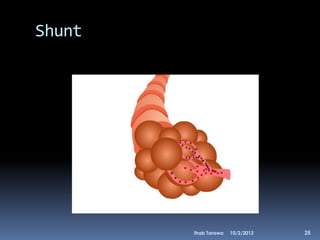
Shunt


        Ihab Tarawa   10/2/2012   25
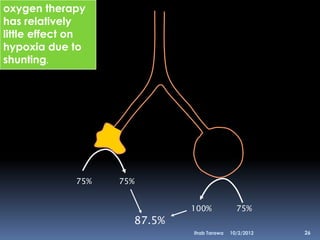
oxygen therapy
has relatively
little effect on
hypoxia due to
shunting.


              75%   75%


                              100%            75%
                      87.5%
                              Ihab Tarawa   10/2/2012   26
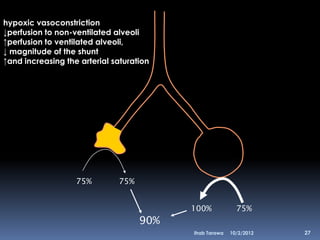
hypoxic vasoconstriction
↓perfusion to non-ventilated alveoli
↑perfusion to ventilated alveoli,
↓ magnitude of the shunt
↑and increasing the arterial saturation


                   75%        75%


                                          100%            75%
                                    90%
                                          Ihab Tarawa   10/2/2012   27
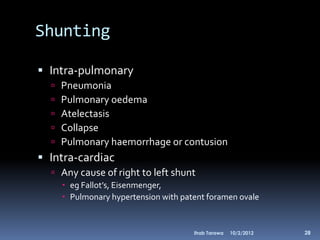
Shunting

 Intra-pulmonary
     Pneumonia
     Pulmonary oedema
     Atelectasis
     Collapse
     Pulmonary haemorrhage or contusion
 Intra-cardiac
   Any cause of right to left shunt
       eg Fallot’s, Eisenmenger,
       Pulmonary hypertension with patent foramen ovale


                                       Ihab Tarawa   10/2/2012   28
Pathophysiology

 Low inspired oxygen concentration
 Hypoventilation
 Shunting
 Dead space ventilation
 Diffusion abnormality


                           Ihab Tarawa   10/2/2012   29
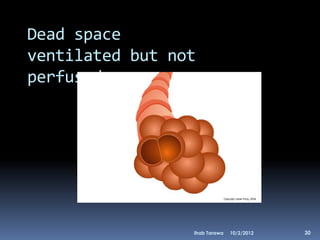
Dead space
ventilated but not
perfused


                 Ihab Tarawa   10/2/2012   30
Pathophysiology

 Low inspired oxygen concentration
 Hypoventilation
 Shunting
 Dead space ventilation
 Diffusion abnormality


                           Ihab Tarawa   10/2/2012   31
Ihab Tarawa   10/2/2012   32
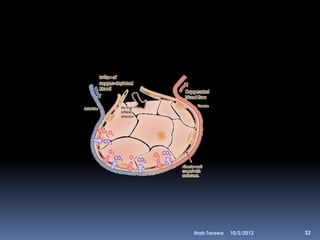
Diffusion abnormalities.

 These can result from a failure of diffusion
  across the alveolar membrane
 or a reduction in the number of alveoli
  resulting in a reduction in the alveolar surface
  area.
 Causes include ARDS and fibrotic lung
  disease


                              Ihab Tarawa   10/2/2012   33
RESPIRATORY MONITORING


              Ihab Tarawa   10/2/2012   34
Clinical

 Respiratory compensation
 Sympathetic stimulation
 Tissue hypoxia
 Haemoglobin desaturation


                            Ihab Tarawa   10/2/2012   35
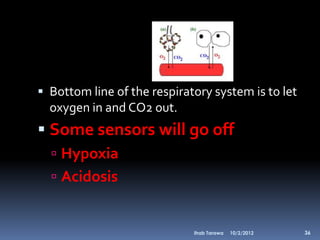
 Bottom line of the respiratory system is to let
  oxygen in and CO2 out.
 Some sensors will go off
   Hypoxia
   Acidosis


                             Ihab Tarawa   10/2/2012   36
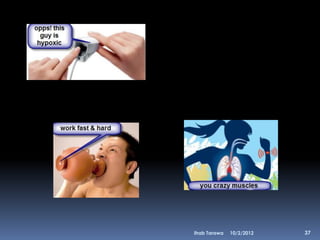
Ihab Tarawa   10/2/2012   37
Clinical

 Respiratory compensation
     Tachypnoea
     Accessory muscles
     Recession
     Nasal flaring


                          Ihab Tarawa   10/2/2012   38
Clinical

 Sympathetic stimulation


                            Ihab Tarawa   10/2/2012   39
Clinical

 Sympathetic stimulation
   HR
   BP (early)
   sweating


                            Ihab Tarawa   10/2/2012   40
Point of making a difference

 Coming for help
 Or coming with a coffin


                            Ihab Tarawa   10/2/2012   41
Clinical

 Tissue hypoxia
   Altered mental state
   HR and BP (late)


                           Ihab Tarawa   10/2/2012   42
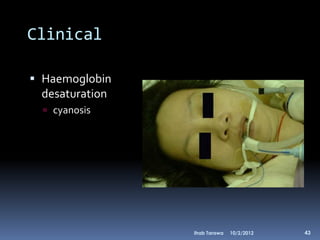
Clinical

 Haemoglobin
  desaturation
   cyanosis


                 Ihab Tarawa   10/2/2012   43
If we wait for the
patient to become
cyanosed


                 Ihab Tarawa   10/2/2012   44
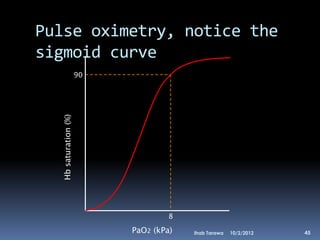
Pulse oximetry, notice the
sigmoid curve
                      90
  Hb saturation (%)


                                    8

                           PaO2 (kPa)   Ihab Tarawa   10/2/2012   45
 The oxygen content of blood is mainly
  dependent on:
   the haemoglobin saturation,
   with the a very small contribution from dissolved
    oxygen.


                                Ihab Tarawa   10/2/2012   46
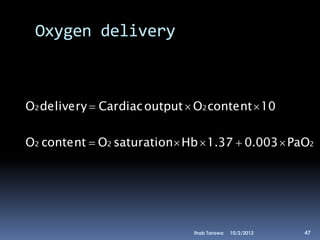
Oxygen delivery


O2 delivery  Cardiac output  O2 content  10

O2 content  O2 saturation Hb  1.37  0.003  PaO2


                              Ihab Tarawa   10/2/2012   47
Monitoring


             Ihab Tarawa   10/2/2012   48
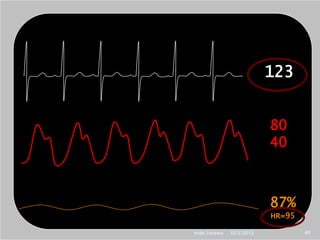
123


                          80
                          40


                          87%
                          HR=95

Ihab Tarawa   10/2/2012           49
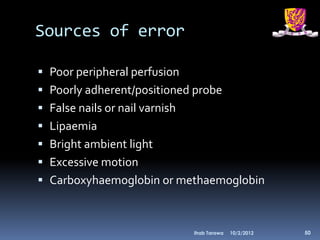
Sources of error

 Poor peripheral perfusion
 Poorly adherent/positioned probe
 False nails or nail varnish
 Lipaemia
 Bright ambient light
 Excessive motion
 Carboxyhaemoglobin or methaemoglobin


                                Ihab Tarawa   10/2/2012   50
Thing to remember


Saturation is not a
 measure of
 ventilation
                Ihab Tarawa   10/2/2012   51
Summary

 worry if
        RR > 30/min (or < 8/min)
        unable to speak 1/2 sentence without pausing
        agitated, confused or comatose
        cyanosed or SpO2 < 90%
        deteriorating despite therapy
 remember
      normal SpO2 does not mean severe ventilatory problems are not
       present


                                            Ihab Tarawa   10/2/2012    52
TREATMENT


       Ihab Tarawa   10/2/2012   53
Treatment

 Treat the cause
 Supportive treatment
   Oxygen therapy
   CPAP
   Mechanical ventilation


                             Ihab Tarawa   10/2/2012   54
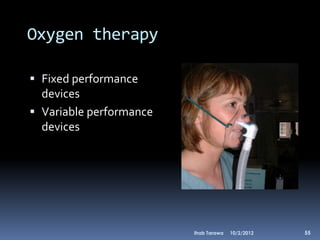
Oxygen therapy

 Fixed performance
  devices
 Variable performance
  devices


                         Ihab Tarawa   10/2/2012   55
 Nasal canula
 Simpler mask
 Other


                 Ihab Tarawa   10/2/2012   56
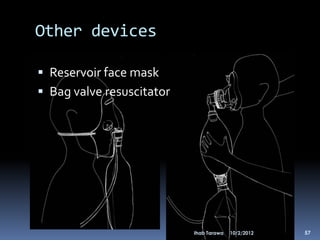
Other devices

 Reservoir face mask
 Bag valve resuscitator


                           Ihab Tarawa   10/2/2012   57
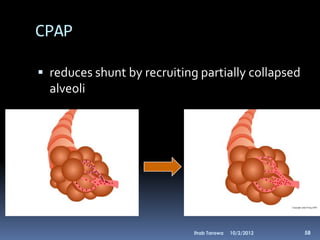
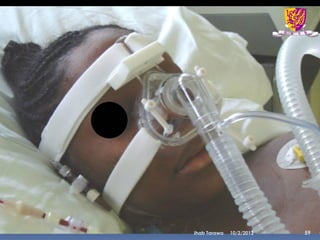
CPAP

 reduces shunt by recruiting partially collapsed
  alveoli


                             Ihab Tarawa   10/2/2012   58
Ihab Tarawa   10/2/2012   59
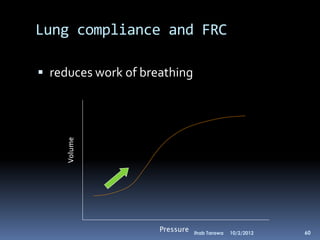
Lung compliance and FRC

 reduces work of breathing
    Volume


                     Pressure   Ihab Tarawa   10/2/2012   60
Mechanical ventilation

 Decision to ventilate
   Complex
   Multifactorial
   No simple rules


                          Ihab Tarawa   10/2/2012   61
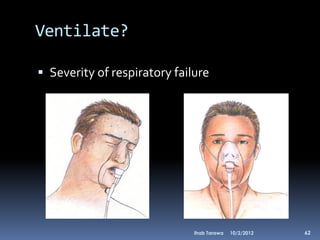
Ventilate?

 Severity of respiratory failure


                              Ihab Tarawa   10/2/2012   62
Ventilate?

 Severity of respiratory failure
 Cardiopulmonary reserve


                              Ihab Tarawa   10/2/2012   63
Ventilate?

 Severity of respiratory failure
 Cardiopulmonary reserve
 Adequacy of compensation
   Ventilatory requirement


                              Ihab Tarawa   10/2/2012   64
Ventilate?

 Severity of respiratory failure
 Cardiopulmonary reserve
 Adequacy of compensation
   Ventilatory requirement
 Expected speed of response
   Underlying disease
   Treatment already given


                              Ihab Tarawa   10/2/2012   65
Ventilate?

 Severity of respiratory failure
 Cardiopulmonary reserve
 Adequacy of compensation
   Ventilatory requirement
 Expected speed of response
   Underlying disease
   Treatment already given
 Risks of mechanical ventilation


                              Ihab Tarawa   10/2/2012   66
Ventilate?

 Severity of respiratory failure
 Cardiopulmonary reserve
 Adequacy of compensation
   Ventilatory requirement
 Expected speed of response
   Underlying disease
   Treatment already given
 Risks of mechanical ventilation
 Non-respiratory indication for intubation

                                Ihab Tarawa   10/2/2012   67
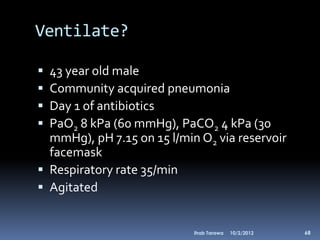
Ventilate?

 43 year old male
 Community acquired pneumonia
 Day 1 of antibiotics
 PaO2 8 kPa (60 mmHg), PaCO2 4 kPa (30
  mmHg), pH 7.15 on 15 l/min O2 via reservoir
  facemask
 Respiratory rate 35/min
 Agitated


                            Ihab Tarawa   10/2/2012   68
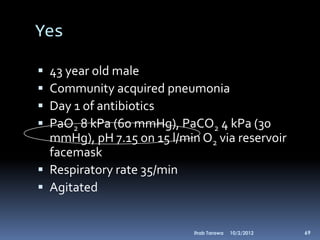
Yes

 43 year old male
 Community acquired pneumonia
 Day 1 of antibiotics
 PaO2 8 kPa (60 mmHg), PaCO2 4 kPa (30
  mmHg), pH 7.15 on 15 l/min O2 via reservoir
  facemask
 Respiratory rate 35/min
 Agitated


                            Ihab Tarawa   10/2/2012   69
Yes

 43 year old male
 Community acquired pneumonia
 Day 1 of antibiotics
 PaO2 8 kPa (60 mmHg), PaCO2 4 kPa (30
  mmHg), pH 7.15 on 15 l/min O2 via reservoir
  facemask                           O2
              O2
 Respiratory rate 35/min
 Agitated


                            Ihab Tarawa   10/2/2012   70
Yes

 43 year old male
 Community acquired pneumonia
 Day 1 of antibiotics
 PaO2 8 kPa (60 mmHg), PaCO2 4 kPa (30
  mmHg), pH 7.15 on 15 l/min O2 via reservoir
  facemask
 Respiratory rate 35/min
 Agitated


                            Ihab Tarawa   10/2/2012   71
Yes

 43 year old male
 Community acquired pneumonia
 Day 1 of antibiotics
 PaO2 8 kPa (60 mmHg), PaCO2 4 kPa (30
  mmHg), pH 7.15 on 15 l/min O2 via reservoir
  facemask
 Respiratory rate 35/min
 Agitated


                            Ihab Tarawa   10/2/2012   72
Yes

 43 year old male
 Community acquired pneumonia
 Day 1 of antibiotics
 PaO2 8 kPa (60 mmHg), PaCO2 4 kPa (30
  mmHg), pH 7.15 on 15 l/min O2 via reservoir
  facemask
 Respiratory rate 35/min
 Agitated


                            Ihab Tarawa   10/2/2012   73
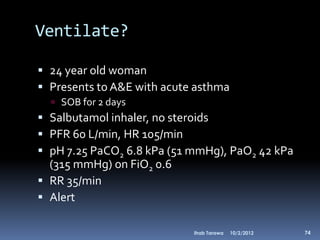
Ventilate?

 24 year old woman
 Presents to A&E with acute asthma
   SOB for 2 days
 Salbutamol inhaler, no steroids
 PFR 60 L/min, HR 105/min
 pH 7.25 PaCO2 6.8 kPa (51 mmHg), PaO2 42 kPa
  (315 mmHg) on FiO2 0.6
 RR 35/min
 Alert

                            Ihab Tarawa   10/2/2012   74
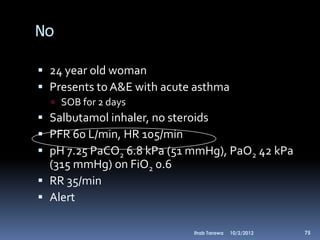
No

 24 year old woman
 Presents to A&E with acute asthma
   SOB for 2 days
 Salbutamol inhaler, no steroids
 PFR 60 L/min, HR 105/min
 pH 7.25 PaCO2 6.8 kPa (51 mmHg), PaO2 42 kPa
  (315 mmHg) on FiO2 0.6
 RR 35/min
 Alert

                            Ihab Tarawa   10/2/2012   75
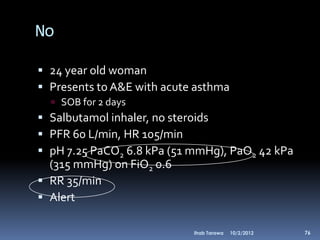
No

 24 year old woman
 Presents to A&E with acute asthma
   SOB for 2 days
 Salbutamol inhaler, no steroids
 PFR 60 L/min, HR 105/min
 pH 7.25 PaCO2 6.8 kPa (51 mmHg), PaO2 42 kPa
  (315 mmHg) on FiO2 0.6
 RR 35/min
 Alert

                            Ihab Tarawa   10/2/2012   76
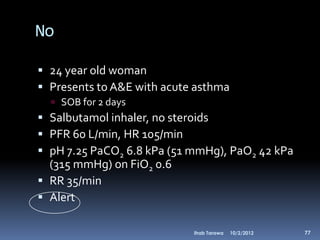
No

 24 year old woman
 Presents to A&E with acute asthma
   SOB for 2 days
 Salbutamol inhaler, no steroids
 PFR 60 L/min, HR 105/min
 pH 7.25 PaCO2 6.8 kPa (51 mmHg), PaO2 42 kPa
  (315 mmHg) on FiO2 0.6
 RR 35/min
 Alert

                            Ihab Tarawa   10/2/2012   77
No

 24 year old woman
 Presents to A&E with acute asthma
   SOB for 2 days
 Salbutamol inhaler, no steroids
 PFR 60 L/min, HR 105/min
 pH 7.25 PaCO2 6.8 kPa (51 mmHg), PaO2 42 kPa
  (315 mmHg) on FiO2 0.6
 RR 35/min
 Alert

                            Ihab Tarawa   10/2/2012   78
No

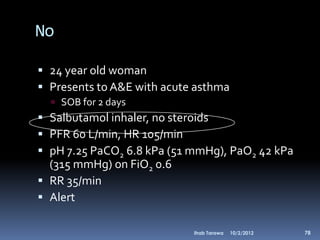
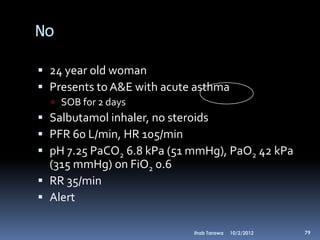
 24 year old woman
 Presents to A&E with acute asthma
   SOB for 2 days
 Salbutamol inhaler, no steroids
 PFR 60 L/min, HR 105/min
 pH 7.25 PaCO2 6.8 kPa (51 mmHg), PaO2 42 kPa
  (315 mmHg) on FiO2 0.6
 RR 35/min
 Alert

                            Ihab Tarawa   10/2/2012   79
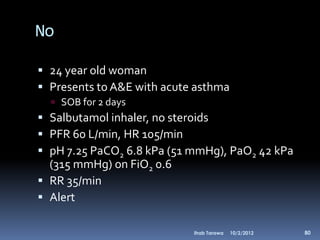
No

 24 year old woman
 Presents to A&E with acute asthma
   SOB for 2 days
 Salbutamol inhaler, no steroids
 PFR 60 L/min, HR 105/min
 pH 7.25 PaCO2 6.8 kPa (51 mmHg), PaO2 42 kPa
  (315 mmHg) on FiO2 0.6
 RR 35/min
 Alert

                            Ihab Tarawa   10/2/2012   80
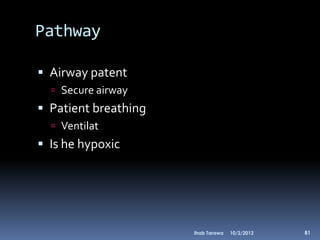
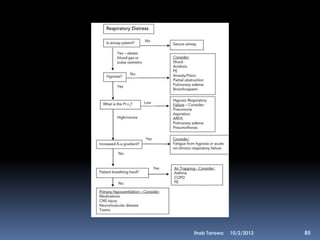
Pathway

 Airway patent
   Secure airway
 Patient breathing
   Ventilat
 Is he hypoxic


                      Ihab Tarawa   10/2/2012   81
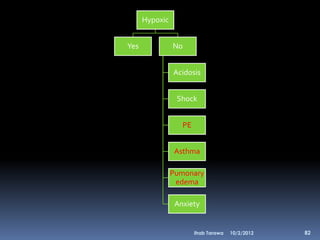
Hypoxic


Yes             No


                Acidosis


                 Shock


                   PE


                Asthma

                Pumonary
                 edema

                 Anxiety


                        Ihab Tarawa   10/2/2012   82
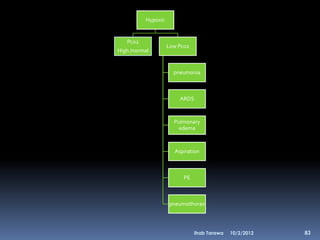
Hypoxic


   Pco2
                    Low Pco2
High /normal


                      pneumonia


                        ARDS


                      Pulmonary
                        edema


                      Aspiration


                          PE


                     pneumothorax


                               Ihab Tarawa   10/2/2012   83
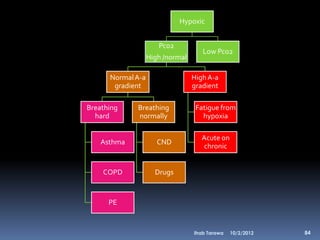
Hypoxic


                      Pco2
                                     Low Pco2
                   High /normal

      Normal A-a                  High A-a
       gradient                   gradient

Breathing    Breathing             Fatigue from
  hard       normally                hypoxia

                                     Acute on
    Asthma            CND
                                     chronic


    COPD             Drugs


      PE


                                  Ihab Tarawa   10/2/2012   84
Ihab Tarawa   10/2/2012   85
QUESTIONS?


       Ihab Tarawa   10/2/2012   86

Acute respiratory failure

  • 1.
    ACUTE RESPIRATORY FAILURE IhabB Abdalrahman, MBBS, MD, ABIM, SSBB Ihab Tarawa Consultant of Acute Care Medicine, Soba University Hospital 10/2/2012 1
  • 2.
    BASIC RESPIRATORY PHYSIOLOGY Ihab Tarawa 10/2/2012 2
  • 3.
    Respiratory system made ridiculouslyeasy  It is as simple as moving the air in and out.  Allowing gas exchange. Ihab Tarawa 10/2/2012 3
  • 4.
    CO2 O2 Ihab Tarawa 10/2/2012 4
  • 5.
    1,2,3  Bottom lineof the respiratory system is to  Let oxygen in,  And carbon dioxide out. Ihab Tarawa 10/2/2012 5
  • 6.
    Definitions  acute respiratoryfailure occurs when:  pulmonary system is no longer able to meet the metabolic demands of the body  hypoxaemic respiratory failure:  PaO2  8 kPa when breathing room air  hypercapnic respiratory failure:  PaCO2  6.7 kPa Ihab Tarawa 10/2/2012 6
  • 7.
    Oxygen in Depends on  Ventilation  PAO2  Perfusion  Ventilation-perfusion matching  Diffusing capacity Ihab Tarawa 10/2/2012 7
  • 8.
    PAO2  The alveolarpressure is equal to the sum of the partial pressures of the gases within the alveolus.  The partial pressure of each gas is proportional to the concentration of the gas. Ihab Tarawa 10/2/2012 8
  • 9.
    Oxygen Carbon dioxide Water vapour Nitrogen Alveolarpressure PAO2  PACO2  PAH2O  PAN2 Ihab Tarawa 10/2/2012 9
  • 10.
    Oxygen Carbon dioxide Water vapour Nitrogen Alveolarpressure PAO2  PACO2  PAH2O  PAN2 Ihab Tarawa 10/2/2012 10
  • 11.
    Oxygen Carbon dioxide Water vapour Nitrogen Alveolarpressure PAO2  PACO2  PAH2O  PAN2 Ihab Tarawa 10/2/2012 11
  • 12.
    Oxygen in  Dependson  PAO2  FIO2  Alveolar pressure  PACO2  Ventilation  Ventilation-perfusion matching  Perfusion  Diffusing capacity Ihab Tarawa 10/2/2012 12
  • 13.
    Ventilation-perfusion matching Ihab Tarawa 10/2/2012 13
  • 14.
    Carbon dioxide out Largely dependent on alveolar ventilation Alveolar ventilation  RR x (V - V ) T D  Anatomical dead space constant but physiological dead space depends on ventilation- perfusion matching Ihab Tarawa 10/2/2012 14
  • 15.
    Carbon dioxide out Respiratory rate  Tidal volume  Ventilation-perfusion matching Ihab Tarawa 10/2/2012 15
  • 16.
    PATHOPHYSIOLOGY Ihab Tarawa 10/2/2012 16
  • 17.
    Normal ventilation & perfusion PAO2=14.74 kPa PACO2=5 kPa 75% 100% Ihab Tarawa 10/2/2012 17
  • 18.
    Pathophysiology  Low inspiredPo2  Although, in theory, acute respiratory failure may result from a low inspired PO2 this is rarely a problem in Intensive Care except in locations at high altitude. Ihab Tarawa 10/2/2012 18
  • 19.
    Pathophysiology  Low inspiredoxygen concentration  Hypoventilation Ihab Tarawa 10/2/2012 19
  • 20.
    Oxygen Carbon dioxide Water vapour Nitrogen Alveolarpressure PAO2  PACO2  PAH2O  PAN2 Ihab Tarawa 10/2/2012 20
  • 21.
    Hypoventilation PAO2=9.74 kPa PACO2=10 kPa 75% 92% Ihab Tarawa 10/2/2012 21
  • 22.
    Brainstem Spinal cord Airway Nerve root Lung Nerve Pleura Neuromuscular Chest wall junction Respiratory muscle Sites at which disease may cause hypoventilation Ihab Tarawa 10/2/2012 22
  • 23.
    Brainstem Spinal cord Airway Nerve root Lung Nerve Pleura Neuromuscular Chest wall junction Respiratory muscle Sites at which disease may cause hypoventilation Ihab Tarawa 10/2/2012 23
  • 24.
    Pathophysiology  Low inspiredoxygen concentration  Hypoventilation  Shunting  Dead space ventilation  Diffusion abnormality Ihab Tarawa 10/2/2012 24
  • 25.
    Shunt Ihab Tarawa 10/2/2012 25
  • 26.
    oxygen therapy has relatively littleeffect on hypoxia due to shunting. 75% 75% 100% 75% 87.5% Ihab Tarawa 10/2/2012 26
  • 27.
    hypoxic vasoconstriction ↓perfusion tonon-ventilated alveoli ↑perfusion to ventilated alveoli, ↓ magnitude of the shunt ↑and increasing the arterial saturation 75% 75% 100% 75% 90% Ihab Tarawa 10/2/2012 27
  • 28.
    Shunting  Intra-pulmonary  Pneumonia  Pulmonary oedema  Atelectasis  Collapse  Pulmonary haemorrhage or contusion  Intra-cardiac  Any cause of right to left shunt  eg Fallot’s, Eisenmenger,  Pulmonary hypertension with patent foramen ovale Ihab Tarawa 10/2/2012 28
  • 29.
    Pathophysiology  Low inspiredoxygen concentration  Hypoventilation  Shunting  Dead space ventilation  Diffusion abnormality Ihab Tarawa 10/2/2012 29
  • 30.
    Dead space ventilated butnot perfused Ihab Tarawa 10/2/2012 30
  • 31.
    Pathophysiology  Low inspiredoxygen concentration  Hypoventilation  Shunting  Dead space ventilation  Diffusion abnormality Ihab Tarawa 10/2/2012 31
  • 32.
    Ihab Tarawa 10/2/2012 32
  • 33.
    Diffusion abnormalities.  Thesecan result from a failure of diffusion across the alveolar membrane  or a reduction in the number of alveoli resulting in a reduction in the alveolar surface area.  Causes include ARDS and fibrotic lung disease Ihab Tarawa 10/2/2012 33
  • 34.
    RESPIRATORY MONITORING Ihab Tarawa 10/2/2012 34
  • 35.
    Clinical  Respiratory compensation Sympathetic stimulation  Tissue hypoxia  Haemoglobin desaturation Ihab Tarawa 10/2/2012 35
  • 36.
     Bottom lineof the respiratory system is to let oxygen in and CO2 out.  Some sensors will go off  Hypoxia  Acidosis Ihab Tarawa 10/2/2012 36
  • 37.
    Ihab Tarawa 10/2/2012 37
  • 38.
    Clinical  Respiratory compensation  Tachypnoea  Accessory muscles  Recession  Nasal flaring Ihab Tarawa 10/2/2012 38
  • 39.
    Clinical  Sympathetic stimulation Ihab Tarawa 10/2/2012 39
  • 40.
    Clinical  Sympathetic stimulation  HR  BP (early)  sweating Ihab Tarawa 10/2/2012 40
  • 41.
    Point of makinga difference  Coming for help  Or coming with a coffin Ihab Tarawa 10/2/2012 41
  • 42.
    Clinical  Tissue hypoxia  Altered mental state  HR and BP (late) Ihab Tarawa 10/2/2012 42
  • 43.
    Clinical  Haemoglobin desaturation  cyanosis Ihab Tarawa 10/2/2012 43
  • 44.
    If we waitfor the patient to become cyanosed Ihab Tarawa 10/2/2012 44
  • 45.
    Pulse oximetry, noticethe sigmoid curve 90 Hb saturation (%) 8 PaO2 (kPa) Ihab Tarawa 10/2/2012 45
  • 46.
     The oxygencontent of blood is mainly dependent on:  the haemoglobin saturation,  with the a very small contribution from dissolved oxygen. Ihab Tarawa 10/2/2012 46
  • 47.
    Oxygen delivery O2 delivery Cardiac output  O2 content  10 O2 content  O2 saturation Hb  1.37  0.003  PaO2 Ihab Tarawa 10/2/2012 47
  • 48.
    Monitoring Ihab Tarawa 10/2/2012 48
  • 49.
    123 80 40 87% HR=95 Ihab Tarawa 10/2/2012 49
  • 50.
    Sources of error Poor peripheral perfusion  Poorly adherent/positioned probe  False nails or nail varnish  Lipaemia  Bright ambient light  Excessive motion  Carboxyhaemoglobin or methaemoglobin Ihab Tarawa 10/2/2012 50
  • 51.
    Thing to remember Saturationis not a measure of ventilation Ihab Tarawa 10/2/2012 51
  • 52.
    Summary  worry if  RR > 30/min (or < 8/min)  unable to speak 1/2 sentence without pausing  agitated, confused or comatose  cyanosed or SpO2 < 90%  deteriorating despite therapy  remember  normal SpO2 does not mean severe ventilatory problems are not present Ihab Tarawa 10/2/2012 52
  • 53.
    TREATMENT Ihab Tarawa 10/2/2012 53
  • 54.
    Treatment  Treat thecause  Supportive treatment  Oxygen therapy  CPAP  Mechanical ventilation Ihab Tarawa 10/2/2012 54
  • 55.
    Oxygen therapy  Fixedperformance devices  Variable performance devices Ihab Tarawa 10/2/2012 55
  • 56.
     Nasal canula Simpler mask  Other Ihab Tarawa 10/2/2012 56
  • 57.
    Other devices  Reservoirface mask  Bag valve resuscitator Ihab Tarawa 10/2/2012 57
  • 58.
    CPAP  reduces shuntby recruiting partially collapsed alveoli Ihab Tarawa 10/2/2012 58
  • 59.
    Ihab Tarawa 10/2/2012 59
  • 60.
    Lung compliance andFRC  reduces work of breathing Volume Pressure Ihab Tarawa 10/2/2012 60
  • 61.
    Mechanical ventilation  Decisionto ventilate  Complex  Multifactorial  No simple rules Ihab Tarawa 10/2/2012 61
  • 62.
    Ventilate?  Severity ofrespiratory failure Ihab Tarawa 10/2/2012 62
  • 63.
    Ventilate?  Severity ofrespiratory failure  Cardiopulmonary reserve Ihab Tarawa 10/2/2012 63
  • 64.
    Ventilate?  Severity ofrespiratory failure  Cardiopulmonary reserve  Adequacy of compensation  Ventilatory requirement Ihab Tarawa 10/2/2012 64
  • 65.
    Ventilate?  Severity ofrespiratory failure  Cardiopulmonary reserve  Adequacy of compensation  Ventilatory requirement  Expected speed of response  Underlying disease  Treatment already given Ihab Tarawa 10/2/2012 65
  • 66.
    Ventilate?  Severity ofrespiratory failure  Cardiopulmonary reserve  Adequacy of compensation  Ventilatory requirement  Expected speed of response  Underlying disease  Treatment already given  Risks of mechanical ventilation Ihab Tarawa 10/2/2012 66
  • 67.
    Ventilate?  Severity ofrespiratory failure  Cardiopulmonary reserve  Adequacy of compensation  Ventilatory requirement  Expected speed of response  Underlying disease  Treatment already given  Risks of mechanical ventilation  Non-respiratory indication for intubation Ihab Tarawa 10/2/2012 67
  • 68.
    Ventilate?  43 yearold male  Community acquired pneumonia  Day 1 of antibiotics  PaO2 8 kPa (60 mmHg), PaCO2 4 kPa (30 mmHg), pH 7.15 on 15 l/min O2 via reservoir facemask  Respiratory rate 35/min  Agitated Ihab Tarawa 10/2/2012 68
  • 69.
    Yes  43 yearold male  Community acquired pneumonia  Day 1 of antibiotics  PaO2 8 kPa (60 mmHg), PaCO2 4 kPa (30 mmHg), pH 7.15 on 15 l/min O2 via reservoir facemask  Respiratory rate 35/min  Agitated Ihab Tarawa 10/2/2012 69
  • 70.
    Yes  43 yearold male  Community acquired pneumonia  Day 1 of antibiotics  PaO2 8 kPa (60 mmHg), PaCO2 4 kPa (30 mmHg), pH 7.15 on 15 l/min O2 via reservoir facemask O2 O2  Respiratory rate 35/min  Agitated Ihab Tarawa 10/2/2012 70
  • 71.
    Yes  43 yearold male  Community acquired pneumonia  Day 1 of antibiotics  PaO2 8 kPa (60 mmHg), PaCO2 4 kPa (30 mmHg), pH 7.15 on 15 l/min O2 via reservoir facemask  Respiratory rate 35/min  Agitated Ihab Tarawa 10/2/2012 71
  • 72.
    Yes  43 yearold male  Community acquired pneumonia  Day 1 of antibiotics  PaO2 8 kPa (60 mmHg), PaCO2 4 kPa (30 mmHg), pH 7.15 on 15 l/min O2 via reservoir facemask  Respiratory rate 35/min  Agitated Ihab Tarawa 10/2/2012 72
  • 73.
    Yes  43 yearold male  Community acquired pneumonia  Day 1 of antibiotics  PaO2 8 kPa (60 mmHg), PaCO2 4 kPa (30 mmHg), pH 7.15 on 15 l/min O2 via reservoir facemask  Respiratory rate 35/min  Agitated Ihab Tarawa 10/2/2012 73
  • 74.
    Ventilate?  24 yearold woman  Presents to A&E with acute asthma  SOB for 2 days  Salbutamol inhaler, no steroids  PFR 60 L/min, HR 105/min  pH 7.25 PaCO2 6.8 kPa (51 mmHg), PaO2 42 kPa (315 mmHg) on FiO2 0.6  RR 35/min  Alert Ihab Tarawa 10/2/2012 74
  • 75.
    No  24 yearold woman  Presents to A&E with acute asthma  SOB for 2 days  Salbutamol inhaler, no steroids  PFR 60 L/min, HR 105/min  pH 7.25 PaCO2 6.8 kPa (51 mmHg), PaO2 42 kPa (315 mmHg) on FiO2 0.6  RR 35/min  Alert Ihab Tarawa 10/2/2012 75
  • 76.
    No  24 yearold woman  Presents to A&E with acute asthma  SOB for 2 days  Salbutamol inhaler, no steroids  PFR 60 L/min, HR 105/min  pH 7.25 PaCO2 6.8 kPa (51 mmHg), PaO2 42 kPa (315 mmHg) on FiO2 0.6  RR 35/min  Alert Ihab Tarawa 10/2/2012 76
  • 77.
    No  24 yearold woman  Presents to A&E with acute asthma  SOB for 2 days  Salbutamol inhaler, no steroids  PFR 60 L/min, HR 105/min  pH 7.25 PaCO2 6.8 kPa (51 mmHg), PaO2 42 kPa (315 mmHg) on FiO2 0.6  RR 35/min  Alert Ihab Tarawa 10/2/2012 77
  • 78.
    No  24 yearold woman  Presents to A&E with acute asthma  SOB for 2 days  Salbutamol inhaler, no steroids  PFR 60 L/min, HR 105/min  pH 7.25 PaCO2 6.8 kPa (51 mmHg), PaO2 42 kPa (315 mmHg) on FiO2 0.6  RR 35/min  Alert Ihab Tarawa 10/2/2012 78
  • 79.
    No  24 yearold woman  Presents to A&E with acute asthma  SOB for 2 days  Salbutamol inhaler, no steroids  PFR 60 L/min, HR 105/min  pH 7.25 PaCO2 6.8 kPa (51 mmHg), PaO2 42 kPa (315 mmHg) on FiO2 0.6  RR 35/min  Alert Ihab Tarawa 10/2/2012 79
  • 80.
    No  24 yearold woman  Presents to A&E with acute asthma  SOB for 2 days  Salbutamol inhaler, no steroids  PFR 60 L/min, HR 105/min  pH 7.25 PaCO2 6.8 kPa (51 mmHg), PaO2 42 kPa (315 mmHg) on FiO2 0.6  RR 35/min  Alert Ihab Tarawa 10/2/2012 80
  • 81.
    Pathway  Airway patent  Secure airway  Patient breathing  Ventilat  Is he hypoxic Ihab Tarawa 10/2/2012 81
  • 82.
    Hypoxic Yes No Acidosis Shock PE Asthma Pumonary edema Anxiety Ihab Tarawa 10/2/2012 82
  • 83.
    Hypoxic Pco2 Low Pco2 High /normal pneumonia ARDS Pulmonary edema Aspiration PE pneumothorax Ihab Tarawa 10/2/2012 83
  • 84.
    Hypoxic Pco2 Low Pco2 High /normal Normal A-a High A-a gradient gradient Breathing Breathing Fatigue from hard normally hypoxia Acute on Asthma CND chronic COPD Drugs PE Ihab Tarawa 10/2/2012 84
  • 85.
    Ihab Tarawa 10/2/2012 85
  • 86.
    QUESTIONS? Ihab Tarawa 10/2/2012 86