What is Self-Directed Learning? The process of learning in which the learner assumes primary responsibility for planning, implementing, and evaluating a learning project. The learner chooses what to learn and how to learn, and also decides when to continue and when to end the learning project.
Why study SDL? By studying these individuals, the researcher can "isolate the influence of the formal teaching environments on learning and thus permit the adult to be studied when he/she learns in a naturalistic and spontaneous fashion."  (Danis & Tremblay)
Goals of SDL Enhance ability of adults to be more self-directed in learning  (humanistic approach) Foster transformational learning  Promote social action
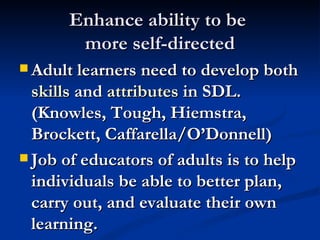
Enhance ability to be  more self-directed Adult learners need to develop both  skills  and  attributes  in SDL. (Knowles, Tough, Hiemstra, Brockett, Caffarella/O’Donnell) Job of educators of adults is to help individuals be able to better plan, carry out, and evaluate their own learning.
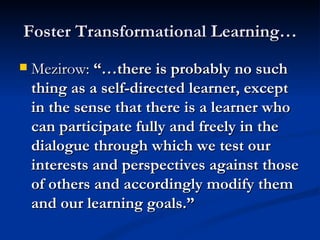
Foster Transformational Learning… Mezirow:  “…there is probably no such thing as a self-directed learner, except in the sense that there is a learner who can participate fully and freely in the dialogue through which we test our interests and perspectives against those of others and accordingly modify them and our learning goals.”
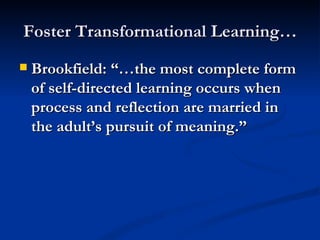
Foster Transformational Learning… Brookfield: “…the most complete form of self-directed learning occurs when process and reflection are married in the adult’s pursuit of meaning.”
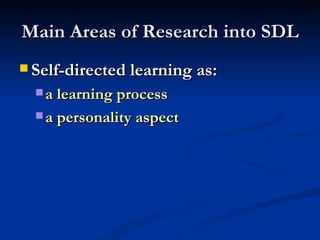
Main Areas of Research into SDL Self-directed learning as: a learning process  a personality aspect

What Is Self Directed Learning

  • 1.
    What is Self-DirectedLearning? The process of learning in which the learner assumes primary responsibility for planning, implementing, and evaluating a learning project. The learner chooses what to learn and how to learn, and also decides when to continue and when to end the learning project.
  • 2.
    Why study SDL?By studying these individuals, the researcher can "isolate the influence of the formal teaching environments on learning and thus permit the adult to be studied when he/she learns in a naturalistic and spontaneous fashion." (Danis & Tremblay)
  • 3.
    Goals of SDLEnhance ability of adults to be more self-directed in learning (humanistic approach) Foster transformational learning Promote social action
  • 4.
    Enhance ability tobe more self-directed Adult learners need to develop both skills and attributes in SDL. (Knowles, Tough, Hiemstra, Brockett, Caffarella/O’Donnell) Job of educators of adults is to help individuals be able to better plan, carry out, and evaluate their own learning.
  • 5.
    Foster Transformational Learning…Mezirow: “…there is probably no such thing as a self-directed learner, except in the sense that there is a learner who can participate fully and freely in the dialogue through which we test our interests and perspectives against those of others and accordingly modify them and our learning goals.”
  • 6.
    Foster Transformational Learning…Brookfield: “…the most complete form of self-directed learning occurs when process and reflection are married in the adult’s pursuit of meaning.”
  • 7.
    Main Areas ofResearch into SDL Self-directed learning as: a learning process a personality aspect