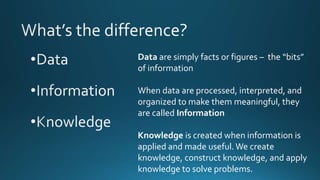
Data are simply facts or figures – the “bits”
of information
When data are processed, interpreted, and
organized to make them meaningful, they
are called Information
Knowledge is created when information is
applied and made useful.We create
knowledge, construct knowledge, and apply
knowledge to solve problems.
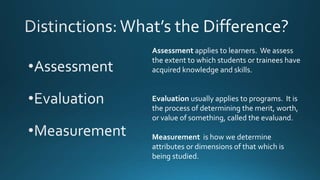
Assessment applies to learners. We assess
the extent to which students or trainees have
acquired knowledge and skills.
Evaluation usually applies to programs. It is
the process of determining the merit, worth,
or value of something, called the evaluand.
Measurement is how we determine
attributes or dimensions of that which is
being studied.
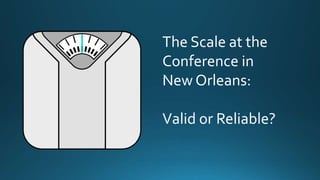
The Scale at the
Conference in
New Orleans:
Valid or Reliable?
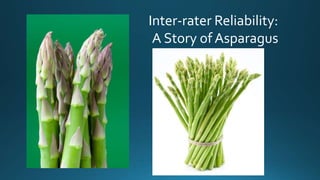
Inter-rater Reliability:
A Story of Asparagus
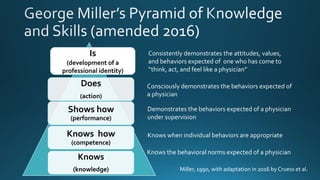
Does
(action)
Shows how
(performance)
Knows how
(competence)
Knows
(knowledge) Miller, 1990, with adaptation in 2016 by Cruess et al.
Is
(development of a
professional identity)
Consistently demonstrates the attitudes, values,
and behaviors expected of one who has come to
“think, act, and feel like a physician”
Consciously demonstrates the behaviors expected of
a physician
Demonstrates the behaviors expected of a physician
under supervision
Knows when individual behaviors are appropriate
Knows the behavioral norms expected of a physician
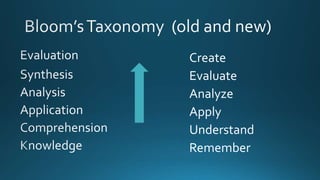
Create
Evaluate
Analyze
Apply
Understand
Remember
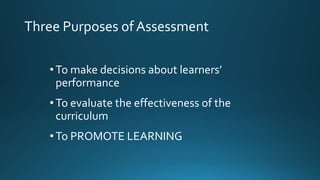
Three Purposes of Assessment
•To make decisions about learners’
performance
•To evaluate the effectiveness of the
curriculum
•To PROMOTE LEARNING
Assessment OF Learning or FOR Learning?
Assessment: the process of establishing successful learning
• Assessment OF learning: (Focus on what the FACULTY will
do)
• Assessment FOR learning: (Focus on what the LEARNER
will do)
Your Experiences
Assessment for Learning:What
does the literature say?
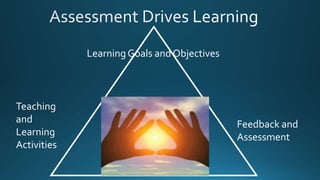
Teaching
and
Learning
Activities
Feedback and
Assessment
Learning Goals and Objectives
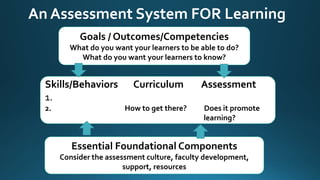
An Assessment System FOR Learning
Goals / Outcomes/Competencies
What do you want your learners to be able to do?
What do you want your learners to know?
Skills/Behaviors Curriculum Assessment
1.
2. How to get there? Does it promote
learning?
Essential Foundational Components
Consider the assessment culture, faculty development,
support, resources
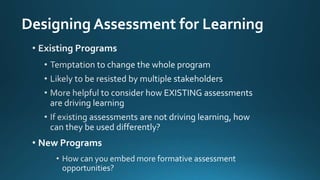
Designing Assessment for Learning
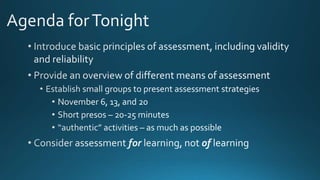
• New Programs
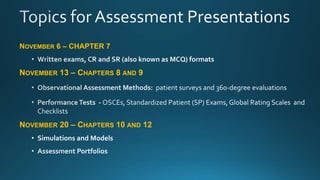
NOVEMBER 6 – CHAPTER 7
NOVEMBER 13 – CHAPTERS 8 AND 9
NOVEMBER 20 – CHAPTERS 10 AND 12
• Simulations and Models

Class 7 intro to assessment rev for 2017

  • 3.
    Data are simplyfacts or figures – the “bits” of information When data are processed, interpreted, and organized to make them meaningful, they are called Information Knowledge is created when information is applied and made useful.We create knowledge, construct knowledge, and apply knowledge to solve problems.
  • 4.
    Assessment applies tolearners. We assess the extent to which students or trainees have acquired knowledge and skills. Evaluation usually applies to programs. It is the process of determining the merit, worth, or value of something, called the evaluand. Measurement is how we determine attributes or dimensions of that which is being studied.
  • 7.
    The Scale atthe Conference in New Orleans: Valid or Reliable?
  • 9.
  • 10.
    Does (action) Shows how (performance) Knows how (competence) Knows (knowledge)Miller, 1990, with adaptation in 2016 by Cruess et al. Is (development of a professional identity) Consistently demonstrates the attitudes, values, and behaviors expected of one who has come to “think, act, and feel like a physician” Consciously demonstrates the behaviors expected of a physician Demonstrates the behaviors expected of a physician under supervision Knows when individual behaviors are appropriate Knows the behavioral norms expected of a physician
  • 11.
  • 13.
    Three Purposes ofAssessment •To make decisions about learners’ performance •To evaluate the effectiveness of the curriculum •To PROMOTE LEARNING
  • 15.
    Assessment OF Learningor FOR Learning? Assessment: the process of establishing successful learning • Assessment OF learning: (Focus on what the FACULTY will do) • Assessment FOR learning: (Focus on what the LEARNER will do)
  • 16.
  • 17.
  • 18.
  • 19.
    An Assessment SystemFOR Learning Goals / Outcomes/Competencies What do you want your learners to be able to do? What do you want your learners to know? Skills/Behaviors Curriculum Assessment 1. 2. How to get there? Does it promote learning? Essential Foundational Components Consider the assessment culture, faculty development, support, resources
  • 20.
    Designing Assessment forLearning • New Programs
  • 23.
    NOVEMBER 6 –CHAPTER 7 NOVEMBER 13 – CHAPTERS 8 AND 9 NOVEMBER 20 – CHAPTERS 10 AND 12 • Simulations and Models