LECTURE METHOD
PRESENTATION BY ,
Ms. VIKRANT KULTHE
MSc Nursing.
General objective:-
At the end of the class student will gain in-depth knowledge
to study the following teaching methods lecture and discussion and
will be able to apply in teaching and clinical practice.
Specific objectives:-
At the end of the class group will be able to:-
1. Define term lecture and discussion method.
2. Classify the types of lecture method.
3. Enlist the factors for planning a good lecture.
4. Discuss about the purposes and techniques of using lecture and
discussion method in class during teaching.
5. List down the principles involved in lecture method.
6. Identify the components of lecture method.
7. Discuss the advantages and disadvantages of lecture method.
8. List down the principles involved in discussion method.
9. Classify the types of discussion method.
10. Discuss the advantages and disadvantages of discussion method.
Lecture Method
Definition:
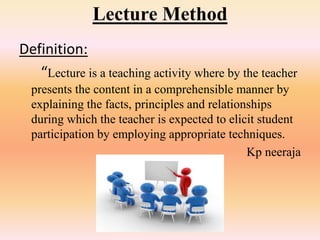
“Lecture is a teaching activity where by the teacher
presents the content in a comprehensible manner by
explaining the facts, principles and relationships
during which the teacher is expected to elicit student
participation by employing appropriate techniques.
Kp neeraja
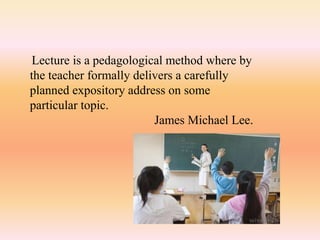
Lecture is a pedagological method where by
the teacher formally delivers a carefully
planned expository address on some
particular topic.
James Michael Lee.
Discussion Method
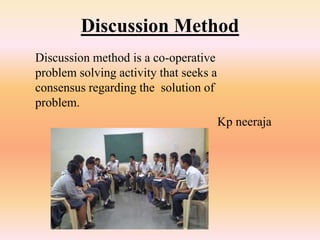
Discussion method is a co-operative
problem solving activity that seeks a
consensus regarding the solution of
problem.
Kp neeraja
“ A discussion is a conversation
with a focal such as a specific
topic, question, concept or
problem in which there is a
sincere desire to arrive at a
decision”.
Factors in planning a good lecture
1. Learner factor
2. Subject matter factor
3. Environmental factor
4. Psychological factor
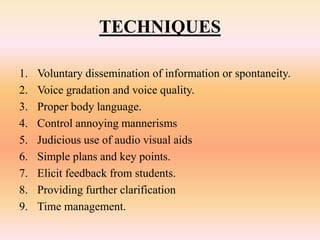
TECHNIQUES
1. Voluntary dissemination of information or spontaneity.
2. Voice gradation and voice quality.
3. Proper body language.
4. Control annoying mannerisms
5. Judicious use of audio visual aids
6. Simple plans and key points.
7. Elicit feedback from students.
8. Providing further clarification
9. Time management.
ACTIVITY
DISCUSSION ON TOPIC
ENVIRONMENT
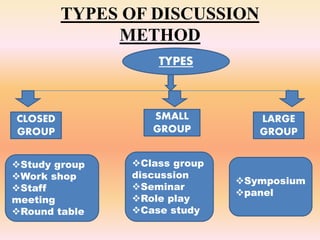
TYPES OF DISCUSSION
METHOD
TYPES
CLOSED
GROUP
SMALL
GROUP
LARGE
GROUP
Study group
Work shop
Staff
meeting
Round table
Class group
discussion
Seminar
Role play
Case study
Symposium
panel
CLOSED GROUP
 Study group
 Workshop
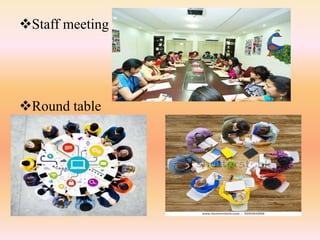
Staff meeting
Round table
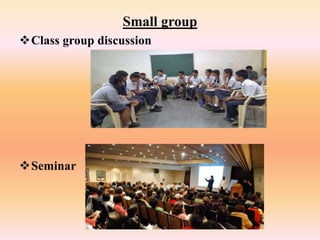
Small group
Class group discussion
Seminar
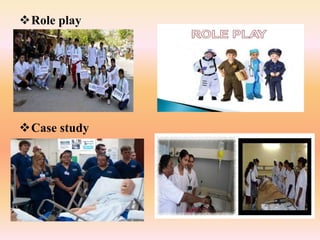
Role play
Case study
Large group
Symposium
Panel
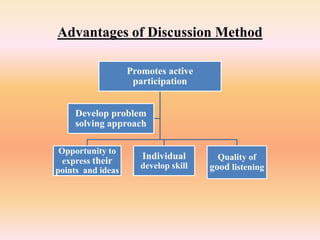
Advantages of Discussion Method
Promotes active
participation
Opportunity to
express their
points and ideas
Individual
develop skill
Quality of
good listening
Develop problem
solving approach
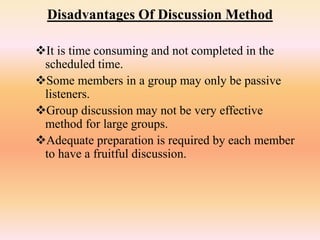
Disadvantages Of Discussion Method
It is time consuming and not completed in the
scheduled time.
Some members in a group may only be passive
listeners.
Group discussion may not be very effective
method for large groups.
Adequate preparation is required by each member
to have a fruitful discussion.
SUMMARY
A. Definition
B. Types
C. Factors
D. Purpose and techniques
E. Principles
F. Components
G. Advantages and disadvantages of lecture and
discussion method.
LECTURE METHOD
LECTURE METHOD

LECTURE METHOD

  • 1.
    LECTURE METHOD PRESENTATION BY, Ms. VIKRANT KULTHE MSc Nursing.
  • 2.
    General objective:- At theend of the class student will gain in-depth knowledge to study the following teaching methods lecture and discussion and will be able to apply in teaching and clinical practice. Specific objectives:- At the end of the class group will be able to:- 1. Define term lecture and discussion method. 2. Classify the types of lecture method. 3. Enlist the factors for planning a good lecture. 4. Discuss about the purposes and techniques of using lecture and discussion method in class during teaching. 5. List down the principles involved in lecture method. 6. Identify the components of lecture method. 7. Discuss the advantages and disadvantages of lecture method. 8. List down the principles involved in discussion method. 9. Classify the types of discussion method. 10. Discuss the advantages and disadvantages of discussion method.
  • 3.
    Lecture Method Definition: “Lecture isa teaching activity where by the teacher presents the content in a comprehensible manner by explaining the facts, principles and relationships during which the teacher is expected to elicit student participation by employing appropriate techniques. Kp neeraja
  • 4.
    Lecture is apedagological method where by the teacher formally delivers a carefully planned expository address on some particular topic. James Michael Lee.
  • 5.
    Discussion Method Discussion methodis a co-operative problem solving activity that seeks a consensus regarding the solution of problem. Kp neeraja
  • 6.
    “ A discussionis a conversation with a focal such as a specific topic, question, concept or problem in which there is a sincere desire to arrive at a decision”.
  • 7.
    Factors in planninga good lecture 1. Learner factor 2. Subject matter factor 3. Environmental factor 4. Psychological factor
  • 8.
    TECHNIQUES 1. Voluntary disseminationof information or spontaneity. 2. Voice gradation and voice quality. 3. Proper body language. 4. Control annoying mannerisms 5. Judicious use of audio visual aids 6. Simple plans and key points. 7. Elicit feedback from students. 8. Providing further clarification 9. Time management.
  • 11.
  • 12.
    TYPES OF DISCUSSION METHOD TYPES CLOSED GROUP SMALL GROUP LARGE GROUP Studygroup Work shop Staff meeting Round table Class group discussion Seminar Role play Case study Symposium panel
  • 13.
    CLOSED GROUP  Studygroup  Workshop
  • 14.
  • 15.
    Small group Class groupdiscussion Seminar
  • 16.
  • 17.
  • 18.
    Advantages of DiscussionMethod Promotes active participation Opportunity to express their points and ideas Individual develop skill Quality of good listening Develop problem solving approach
  • 19.
    Disadvantages Of DiscussionMethod It is time consuming and not completed in the scheduled time. Some members in a group may only be passive listeners. Group discussion may not be very effective method for large groups. Adequate preparation is required by each member to have a fruitful discussion.
  • 20.
    SUMMARY A. Definition B. Types C.Factors D. Purpose and techniques E. Principles F. Components G. Advantages and disadvantages of lecture and discussion method.