Self Directed Learning
By
Dr. I. Uma Maheswari
Principal
Peniel Rural College of Education, Vemparali, Dindigul District
iuma_maheswari@yahoo.co.in
Introduction
 Self-directed learning is viewed as a process “in which a learner
assumes primary responsibility for planning, implementing and
evaluating the learning process” (Brockett and Hiemstra 1991).
 Self –directed learners learn more things and learn better than teacher –
directed learners (TDL).
Basic ideas of self-directed learning
 Three distinctive ideas:
 (1) A self-initiated process of learning that stresses individual’s ability to plan
and manage his/her own learning.
 (2) An attribute or characteristic of learners with personal autonomy as its
hallmark.
 (3) A way of organizing instruction in formal settings that allows for greater
learner control
Definitions
 Knowles (1995) defined SDL as a process in which individuals take the
initiative’ without the help of others, in diagnosing their learning needs,
formulating learning goals, identifying human and material resources for
learning, choosing and implementing appropriate learning strategies and
evaluating those learning outcomes.
 Self- directed learning is any knowledge, skill, accomplishment or personal
development that an individual selects and brings about by his or her own
efforts using any method in any circumstances at any time (Gibbons 2002).
Goals of self-directed learning
 to enhance the ability of adult learners to be self directed in their
learning
 to foster transformational learning as central to SDL
 to promote emancipatory learning and social action as an integral part
of SDL.
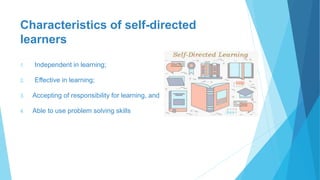
Characteristics of self-directed
learners
1. Independent in learning;
2. Effective in learning;
3. Accepting of responsibility for learning, and
4. Able to use problem solving skills
Competencies for being a self directed
learner
1. Understanding the differences between teacher- directed and self-directed learning;
2. Determining one’s concept as a self-directed being;
3. Relating to peers collaboratively and as resources for learning;
4. Diagnosing learning needs and formulating objectives;
5. Viewing teachers as facilitators;
6. Identifying other resources;
7. Collecting and validating evidence of accomplishments
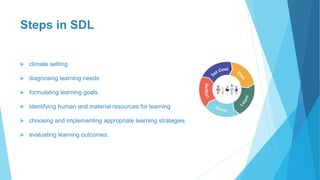
Steps in SDL
 climate setting
 diagnosing learning needs
 formulating learning goals
 identifying human and material resources for learning
 choosing and implementing appropriate learning strategies
 evaluating learning outcomes.
Advantages of SDL
1. Self-directed learning promotes self-confidence, initiative, perseverance and life satisfaction.
2. Self-directed learning helps learners to be motivated, independent, self-reflective, self-
disciplined and goal oriented.
3. Self-directed learning provides opportunities to pursue wider range of interests other than the
usual school curriculum.
4. Self-directed learners can gain new skills, knowledge and attitudes to improve their work
performances.
5. Self-directed learning in higher education provides opportunities for adult learners to learn how
to learn as well as lifelong learning.
6. Self-directed learning can not only leads to be more effective learning, but can also result in
immediate professional successes.
Disadvantages of SDL
1. Self-directed learning is prone to frequent errors.
2. Self-directed learning is quite time consuming.
Conclusion
 Self-directed learning is fully an autonomous learning.
 SDL is a process that centres on the activities of planning,
implementing and evaluating learning.
 SDL provides a foundation for transformative learning.

Skills - Self directed learning

  • 1.
    Self Directed Learning By Dr.I. Uma Maheswari Principal Peniel Rural College of Education, Vemparali, Dindigul District iuma_maheswari@yahoo.co.in
  • 2.
    Introduction  Self-directed learningis viewed as a process “in which a learner assumes primary responsibility for planning, implementing and evaluating the learning process” (Brockett and Hiemstra 1991).  Self –directed learners learn more things and learn better than teacher – directed learners (TDL).
  • 3.
    Basic ideas ofself-directed learning  Three distinctive ideas:  (1) A self-initiated process of learning that stresses individual’s ability to plan and manage his/her own learning.  (2) An attribute or characteristic of learners with personal autonomy as its hallmark.  (3) A way of organizing instruction in formal settings that allows for greater learner control
  • 4.
    Definitions  Knowles (1995)defined SDL as a process in which individuals take the initiative’ without the help of others, in diagnosing their learning needs, formulating learning goals, identifying human and material resources for learning, choosing and implementing appropriate learning strategies and evaluating those learning outcomes.  Self- directed learning is any knowledge, skill, accomplishment or personal development that an individual selects and brings about by his or her own efforts using any method in any circumstances at any time (Gibbons 2002).
  • 5.
    Goals of self-directedlearning  to enhance the ability of adult learners to be self directed in their learning  to foster transformational learning as central to SDL  to promote emancipatory learning and social action as an integral part of SDL.
  • 6.
    Characteristics of self-directed learners 1.Independent in learning; 2. Effective in learning; 3. Accepting of responsibility for learning, and 4. Able to use problem solving skills
  • 7.
    Competencies for beinga self directed learner 1. Understanding the differences between teacher- directed and self-directed learning; 2. Determining one’s concept as a self-directed being; 3. Relating to peers collaboratively and as resources for learning; 4. Diagnosing learning needs and formulating objectives; 5. Viewing teachers as facilitators; 6. Identifying other resources; 7. Collecting and validating evidence of accomplishments
  • 8.
    Steps in SDL climate setting  diagnosing learning needs  formulating learning goals  identifying human and material resources for learning  choosing and implementing appropriate learning strategies  evaluating learning outcomes.
  • 9.
    Advantages of SDL 1.Self-directed learning promotes self-confidence, initiative, perseverance and life satisfaction. 2. Self-directed learning helps learners to be motivated, independent, self-reflective, self- disciplined and goal oriented. 3. Self-directed learning provides opportunities to pursue wider range of interests other than the usual school curriculum. 4. Self-directed learners can gain new skills, knowledge and attitudes to improve their work performances. 5. Self-directed learning in higher education provides opportunities for adult learners to learn how to learn as well as lifelong learning. 6. Self-directed learning can not only leads to be more effective learning, but can also result in immediate professional successes.
  • 10.
    Disadvantages of SDL 1.Self-directed learning is prone to frequent errors. 2. Self-directed learning is quite time consuming.
  • 11.
    Conclusion  Self-directed learningis fully an autonomous learning.  SDL is a process that centres on the activities of planning, implementing and evaluating learning.  SDL provides a foundation for transformative learning.