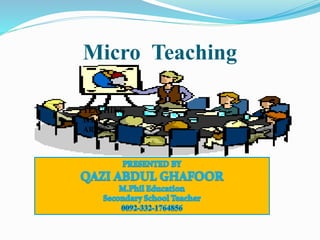
Micro Teaching
TEACHING
is an
ART
Micro Teaching……..
Introduction
 Early mid 1960's
 Mounting and towering personality Dwight Allen from the
Stanford University developed a training program.
FOCUS……
Microteaching is an excellent way to build up
 skill
 confidence
 lecturing style
 constructive feedback.
 In Microteaching teacher “under the microscope” of a small
group audience.
 Microteaching trains teaching behaviors and skills in small
group settings aided by video-recordings.
Micro Teaching……..
This environment provides well-intended collegial
feedback.
 During microteaching session there is a chance to get an
insight into students' needs and expectations.
 It is a good time for teacher to learn from others.
 Microteaching session eliminates pressure resulting from the
length of the lecture (boring)
3s concept of Microteaching
 S1 Small class
 S2 Small content
 S3 Smart time
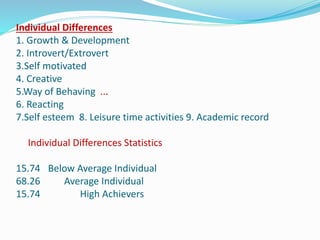
Individual Differences
1. Growth & Development
2. Introvert/Extrovert
3.Self motivated
4. Creative
5.Way of Behaving ...
6. Reacting
7.Self esteem 8. Leisure time activities 9. Academic record
Individual Differences Statistics
15.74 Below Average Individual
68.26 Average Individual
15.74 High Achievers
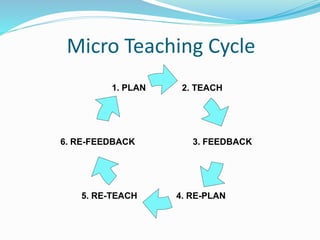
Micro Teaching Cycle
3. FEEDBACK
1. PLAN 2. TEACH
4. RE-PLAN
6. RE-FEEDBACK
5. RE-TEACH
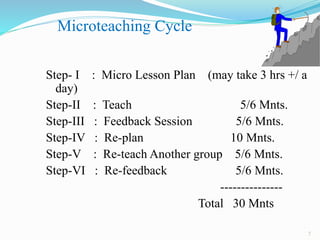
Microteaching Cycle
Step- I : Micro Lesson Plan (may take 3 hrs +/ a
day)
Step-II : Teach 5/6 Mnts.
Step-III : Feedback Session 5/6 Mnts.
Step-IV : Re-plan 10 Mnts.
Step-V : Re-teach Another group 5/6 Mnts.
Step-VI : Re-feedback 5/6 Mnts.
---------------
Total 30 Mnts
7
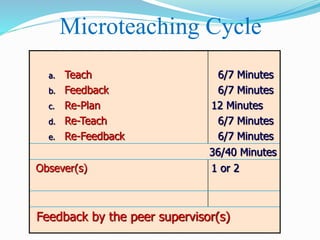
Microteaching Cycle
a. Teach
b. Feedback
c. Re-Plan
d. Re-Teach
e. Re-Feedback
6/7 Minutes
6/7 Minutes
12 Minutes
6/7 Minutes
6/7 Minutes
36/40 Minutes
Obsever(s) 1 or 2
Feedback by the peer supervisor(s)
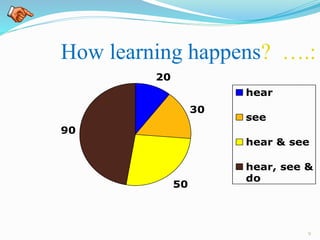
How learning happens? ….:
20
30
50
90
hear
see
hear & see
hear, see &
do
9
Components of Micro Teaching
 Teacher
 Students
 Observer/s
 Supervisor/s
 T.V
 Camera
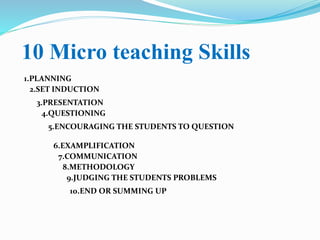
10 Micro teaching Skills
1.PLANNING
2.SET INDUCTION
3.PRESENTATION
4.QUESTIONING
5.ENCOURAGING THE STUDENTS TO QUESTION
6.EXAMPLIFICATION
7.COMMUNICATION
8.METHODOLOGY
9.JUDGING THE STUDENTS PROBLEMS
10.END OR SUMMING UP
PLANNING
If you need to teach for 40 minutes you need 40 x 5 = 200
minutes for planning.
 Gathering the sources
 Outline from A-to-Z
Possible bottle necks
 Expected questions
 Time budget vs content
 Method of attack
 feedback
SET INDUCTION
 How to start
 Learning readiness
 Motivation
 Known to unknown
 Easy to difficult
 Questions
 Incidents, Stories, Events
 Localization
Clear concepts
 Sequential organization
 Exemplification
Linkages
 Student’s participation
 Knowledge and Understanding
PRESENTATION
 QUESTIONING
 Float the question
 Give time to think
Give option for answering (Volunteer)
 Correct the answer if wrong
 Be polite
ENCOURAGING THE STUDENTS TO QUESTION
 Brainstorming
 Probing
 Appreciating the questions
 EXAMPLIFICATION
 Subject oriented
 Environment oriented
 Problem Solving examples
 Relevance
 Valid Examples
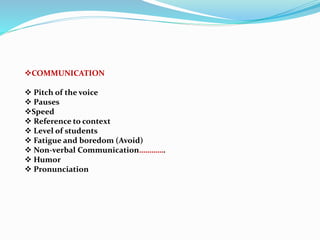
COMMUNICATION
 Pitch of the voice
 Pauses
Speed
 Reference to context
 Level of students
 Fatigue and boredom (Avoid)
 Non-verbal Communication………….
 Humor
 Pronunciation
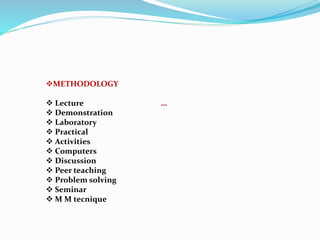
METHODOLOGY
 Lecture …
 Demonstration
 Laboratory
 Practical
 Activities
 Computers
 Discussion
 Peer teaching
 Problem solving
 Seminar
 M M tecnique
JUDGING THE STUDENTS PROBLEMS
 Level of Students
 Talented, Normal, Slow learners,
Disturbed students
 Knowing individual differences,
difficulties etc. and helping them out
 Making the difficult concepts
understandable for all
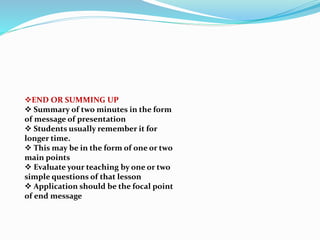
END OR SUMMING UP
 Summary of two minutes in the form
of message of presentation
 Students usually remember it for
longer time.
 This may be in the form of one or two
main points
 Evaluate your teaching by one or two
simple questions of that lesson
 Application should be the focal point
of end message
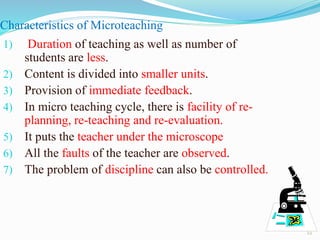
Characteristics of Microteaching
1) Duration of teaching as well as number of
students are less.
2) Content is divided into smaller units.
3) Provision of immediate feedback.
4) In micro teaching cycle, there is facility of re-
planning, re-teaching and re-evaluation.
5) It puts the teacher under the microscope
6) All the faults of the teacher are observed.
7) The problem of discipline can also be controlled.
22
Advantages Of Microteaching
1. It focuses on sharpening and developing specific
teaching skill and eliminating errors.
2. It enables understanding of behaviors important
in class-room teaching.
3. It increases the confidence of the learner teacher.
4. It is a vehicle of continuous training for both
beginners and for senior teachers.
5. It provides experts supervision and constructive
feedback.
23
Why teaching profession is good?
24
Remember!!!
Even the best teacher can learn a great
deal from his or her students……...
25
Secret
26
Need of the hour
27
Working Together, We Can achieve our goal and
expected qualities in higher education. ……………….
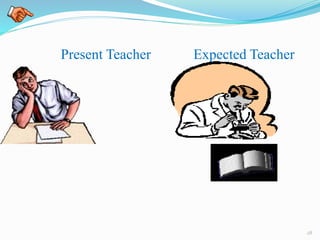
Present Teacher Expected Teacher
28
Thanks
.
29