Prepared by:
Paul Ebenezer
1st year M.Sc. Nursing
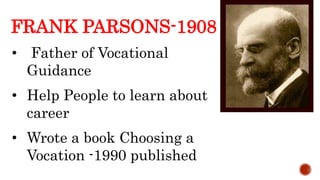
FRANK PARSONS-1908
• Help People to learn about
career
• Wrote a book Choosing a
Vocation -1990 published
• Father of Vocational
Guidance
Is a Process of assisting the individuals to choose
an occupation , prepare for it, and progressing in
it. -Vocational Guidance Association
A facilitative process, a service rendered to the
individuals to aid in him choosing and adjusting
to an occupation -John D. Crites
•Every vocation needs a certain educational and
professional background.
•Fresh and new occupational outlets undreamt of
before are emerging.
•To assist the students to have a reasonable estimate
of their abilities and limitations, strike a balance
between their aspirations and those of their parents.
Acquire knowledge regarding the occupation.
Discover his/her own potentials.
To think critically regarding the choice of
occupations.
To evaluate his/her own capabilities &
interests.
Helps to develop a positive attitude towards
the occupation.
Assist the pupil to secure the
necessary information about
facilities offered by educational
institutions.
Alerting the pupil to the long
range training needed to become
proficient in most lives.
Helping the learner to learn the
realization.
 DISCOVER INFORMATION ABOUT THEMSELVES.
 PROVIDE INFORMATION REGARDING THE DYNAMIC NATURE OF THE
MORDEN WORLD.
 PROVIDES A FRAME OF REFERENCE AND ORIENTATION TO AN OCCUPATION,
 PROMOTE SELF UNDERSTANDING AND DEVELOP EDUCATIONAL AND
OCCUPATIONAL PLANS.
 PROVIDING PLACEMENT SERVICES.
 PROVIDING FOLLOW UP SERVICES TO HELP THEM.
 TRAIN STUDENTS FOR ENTREPRENEURSHIP,
Occupation is looked as a source of income to people.
The individual needs to understand the total perspective of a
vocation
The selection of a vocation is not confined to a single, fixed decision,
it is a series of social and personal factors.
Vocational guidance is based on individual differences
Different strategies need to be used to cater to the individual
vocational needs of the students
Vocational guidance service must fulfill the vocational needs of
every student
VARIOUS APPROACHES IN
VOCATIONAL GUIDANCE
(STRATEGIES) CAREER CORNER
 CAREER CONFERENCE
 CAREER TALK
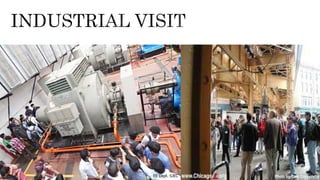
 INDUSTRIAL VISITS
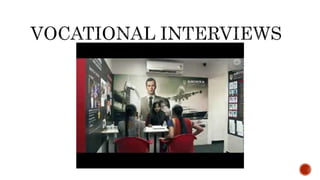
 SIMULATED INTERVIEWS
 VOCATIONAL COUNSELLING
FACTORS AFFECTING
VOCATIONAL
DEVELOPMENT–Family
–Personality
–Industrialization
–Public policy
–Vocational Adjustment
–Economic factors
–Ability
INTERNATIONAL
ASSOCIATION FOR
EDUCATIONAL AND
VOCATIONAL GUIDANCE• Each person should have free and easy access to educational and
vocational guidance.
• Special target groups.
• Providers should meet recognised quality standards of counsellor
training and service delivery and follow code of ethics.
• Should guarantee impartiality and confidentiality and proceed
with client’s voluntary and active participation.
• Counsellors should have specified competencies & have to be
supervised.
The functions of Vocational
Guidance in Nursing
Education.
THANK YOU
FOR
LISTINING

Vocational guidance

  • 1.
  • 3.
    FRANK PARSONS-1908 • HelpPeople to learn about career • Wrote a book Choosing a Vocation -1990 published • Father of Vocational Guidance
  • 4.
    Is a Processof assisting the individuals to choose an occupation , prepare for it, and progressing in it. -Vocational Guidance Association A facilitative process, a service rendered to the individuals to aid in him choosing and adjusting to an occupation -John D. Crites
  • 5.
    •Every vocation needsa certain educational and professional background. •Fresh and new occupational outlets undreamt of before are emerging. •To assist the students to have a reasonable estimate of their abilities and limitations, strike a balance between their aspirations and those of their parents.
  • 6.
    Acquire knowledge regardingthe occupation. Discover his/her own potentials. To think critically regarding the choice of occupations. To evaluate his/her own capabilities & interests. Helps to develop a positive attitude towards the occupation.
  • 7.
    Assist the pupilto secure the necessary information about facilities offered by educational institutions. Alerting the pupil to the long range training needed to become proficient in most lives. Helping the learner to learn the realization.
  • 8.
     DISCOVER INFORMATIONABOUT THEMSELVES.  PROVIDE INFORMATION REGARDING THE DYNAMIC NATURE OF THE MORDEN WORLD.  PROVIDES A FRAME OF REFERENCE AND ORIENTATION TO AN OCCUPATION,  PROMOTE SELF UNDERSTANDING AND DEVELOP EDUCATIONAL AND OCCUPATIONAL PLANS.  PROVIDING PLACEMENT SERVICES.  PROVIDING FOLLOW UP SERVICES TO HELP THEM.  TRAIN STUDENTS FOR ENTREPRENEURSHIP,
  • 9.
    Occupation is lookedas a source of income to people. The individual needs to understand the total perspective of a vocation The selection of a vocation is not confined to a single, fixed decision, it is a series of social and personal factors. Vocational guidance is based on individual differences Different strategies need to be used to cater to the individual vocational needs of the students Vocational guidance service must fulfill the vocational needs of every student
  • 10.
    VARIOUS APPROACHES IN VOCATIONALGUIDANCE (STRATEGIES) CAREER CORNER  CAREER CONFERENCE  CAREER TALK  INDUSTRIAL VISITS  SIMULATED INTERVIEWS  VOCATIONAL COUNSELLING
  • 17.
  • 18.
    INTERNATIONAL ASSOCIATION FOR EDUCATIONAL AND VOCATIONALGUIDANCE• Each person should have free and easy access to educational and vocational guidance. • Special target groups. • Providers should meet recognised quality standards of counsellor training and service delivery and follow code of ethics. • Should guarantee impartiality and confidentiality and proceed with client’s voluntary and active participation. • Counsellors should have specified competencies & have to be supervised.
  • 19.
    The functions ofVocational Guidance in Nursing Education.
  • 20.

Editor's Notes

  • #2 Micro Teaching
  • #3 VOCARE – TO CALL CARRER OR CALLING
  • #9 >THEIR ABILITIES INTRESTES, NEEDS, AMBITIONS AND ABOVE ALL WHAT IS EXPECTING FROM THEM. THE ADVANTAGE AND DISADVANTAGE OF DIFFERENT OCCUPATION AND EDUCATIONAL COURSES the Qualification necessary for entry into them and opportunities Orient them to helping agency available to them and alert them future decision making points in the carrier
  • #12 It is a display place for imparting vocational information. Materials must be attractively displayed. A suitable place for the display is essential.
  • #13 A number of experts from various industries, coming together with teachers and students for the purpose of discussing the identified themes for vocational guidance.
  • #14 A talk by a professional on various aspects of an occupation or a group of related occupations. A panel of speakers may be invited for discussion. Information is obtained from experts in the field.
  • #15 An industrial visit helps the student to get firsthand information about the different aspects of the industry such as the work culture, organizational hierarchy, facilities provided.
  • #16 In vocational counseling problems such as selection of a vocation, preparing for a vocation and progress in vocation are handled
  • #17 Simulation means artificial creation of the real situation. Sometimes it may not be possible to provide a real setting to the students for training to face an interview.