Making Your
Curriculum
Design a Reality
CLASS SESSION 11
Tonight’
s
Agenda
For next week: Final course reflection (on
blog)
Considering how to best implement your
curricular project
Prepare for next week: 5-minute individual
overview (PowerPoint optional / single slide
Four Components of Effective Teaching
Beginning of Instruction
Knowledge of
Subject
Matter
Teacher-
Learner
Interactions
Management of
the Learning
Environment
Design of
Instruction
Interpersonal and social skills
Facilitation
Skills, setting a good
Learning
climate
Skill development
Discipline or specialty-specific
How Do We Achieve
Significant
Learning?
BASED ON DEE FINK’S BOOK, CREATING
SIGNIFICANT LEARNING EXPERIENCES (2003)
Two Ways to Put a Course (Learning
Experience) Together
• List of topics
• Learning centered approach: put the course
together systematically using “integrated
course design”
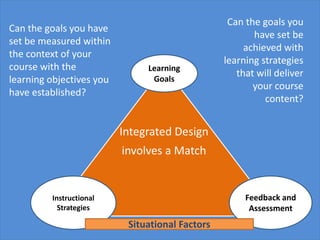
Can the goals you have
set be measured within
the context of your
course with the
learning objectives you
have established?
Integrated Design
involves a Match
Learning
Goals
Feedback and
Assessment
Instructional
Strategies
Can the goals you
have set be
achieved with
learning strategies
that will deliver
your course
content?
Situational Factors
Writing Objectives that Align with Your
Goals
WW
Who
will do
how much (or how well)
of what
by when
By the end of this rotation, learners will have … (past
tense, strong active verb)
By the end of this course, students will be able to ….
(future orientation, strong active verb)
The stem of the sentence can be written in
one of two ways:
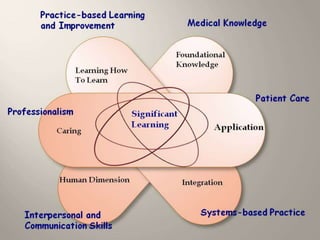
Questions for Formulating Significant
Learning Goals
WW
Foundational Knowledge
Application (what kinds of thinking needed?)
Integration (what connections should they
recognize)
Human Dimension (what should your
learners learn about themselves?)
Caring (what changes would you like to see in
what they care about? Feelings, interests,
values?)
Learning How to Learn (what do you want
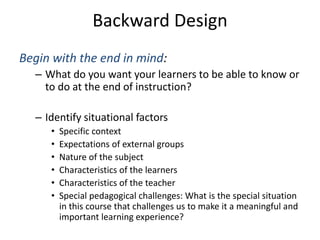
Backward Design
Begin with the end in mind:
– What do you want your learners to be able to know or
to do at the end of instruction?
– Identify situational factors
• Specific context
• Expectations of external groups
• Nature of the subject
• Characteristics of the learners
• Characteristics of the teacher
• Special pedagogical challenges: What is the special situation
in this course that challenges us to make it a meaningful and
important learning experience?
Things that Can Get in the Way
 Resources – personnel, time, facilities, funding
 Obtaining Support – internal/external
 Administration of the Curriculum
 Needed communications / coordination, operations, i.e.,
how it will work in practice
 Anticipating Barriers
 Introducing the Curriculum
 Piloting, phasing in, full implementation
Which of these dimensions are
present in your curriculum?
Which do you need to revisit?
The Difference Between Audit-ive
and Educative Assessment
Audit-ive Educative
 Backward-looking:
what did they do?
 Grading is the only
mechanism
 Forward looking: What will
they do?
 Cycle of performance –
feedback- revision- and new
performance
 Self-Assessment by
Learners
 Fidelity Feedback
 Frequent / Intermediate /
Discriminating (based on
criteria and standards) / Done
lovingly
 Established criteria and
standards
 Result is better learning
How would you assess your own
performance in this course?
(self-assessment)

Session 11 significant learning

  • 1.
    Making Your Curriculum Design aReality CLASS SESSION 11
  • 2.
    Tonight’ s Agenda For next week:Final course reflection (on blog) Considering how to best implement your curricular project Prepare for next week: 5-minute individual overview (PowerPoint optional / single slide
  • 3.
    Four Components ofEffective Teaching Beginning of Instruction Knowledge of Subject Matter Teacher- Learner Interactions Management of the Learning Environment Design of Instruction Interpersonal and social skills Facilitation Skills, setting a good Learning climate Skill development Discipline or specialty-specific
  • 4.
    How Do WeAchieve Significant Learning? BASED ON DEE FINK’S BOOK, CREATING SIGNIFICANT LEARNING EXPERIENCES (2003)
  • 5.
    Two Ways toPut a Course (Learning Experience) Together • List of topics • Learning centered approach: put the course together systematically using “integrated course design”
  • 6.
    Can the goalsyou have set be measured within the context of your course with the learning objectives you have established? Integrated Design involves a Match Learning Goals Feedback and Assessment Instructional Strategies Can the goals you have set be achieved with learning strategies that will deliver your course content? Situational Factors
  • 7.
    Writing Objectives thatAlign with Your Goals WW Who will do how much (or how well) of what by when By the end of this rotation, learners will have … (past tense, strong active verb) By the end of this course, students will be able to …. (future orientation, strong active verb) The stem of the sentence can be written in one of two ways:
  • 8.
    Questions for FormulatingSignificant Learning Goals WW Foundational Knowledge Application (what kinds of thinking needed?) Integration (what connections should they recognize) Human Dimension (what should your learners learn about themselves?) Caring (what changes would you like to see in what they care about? Feelings, interests, values?) Learning How to Learn (what do you want
  • 9.
    Backward Design Begin withthe end in mind: – What do you want your learners to be able to know or to do at the end of instruction? – Identify situational factors • Specific context • Expectations of external groups • Nature of the subject • Characteristics of the learners • Characteristics of the teacher • Special pedagogical challenges: What is the special situation in this course that challenges us to make it a meaningful and important learning experience?
  • 10.
    Things that CanGet in the Way  Resources – personnel, time, facilities, funding  Obtaining Support – internal/external  Administration of the Curriculum  Needed communications / coordination, operations, i.e., how it will work in practice  Anticipating Barriers  Introducing the Curriculum  Piloting, phasing in, full implementation
  • 12.
    Which of thesedimensions are present in your curriculum? Which do you need to revisit?
  • 13.
    The Difference BetweenAudit-ive and Educative Assessment
  • 14.
    Audit-ive Educative  Backward-looking: whatdid they do?  Grading is the only mechanism  Forward looking: What will they do?  Cycle of performance – feedback- revision- and new performance  Self-Assessment by Learners  Fidelity Feedback  Frequent / Intermediate / Discriminating (based on criteria and standards) / Done lovingly  Established criteria and standards  Result is better learning
  • 15.
    How would youassess your own performance in this course? (self-assessment)