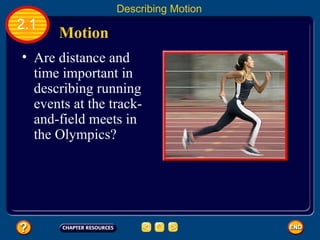
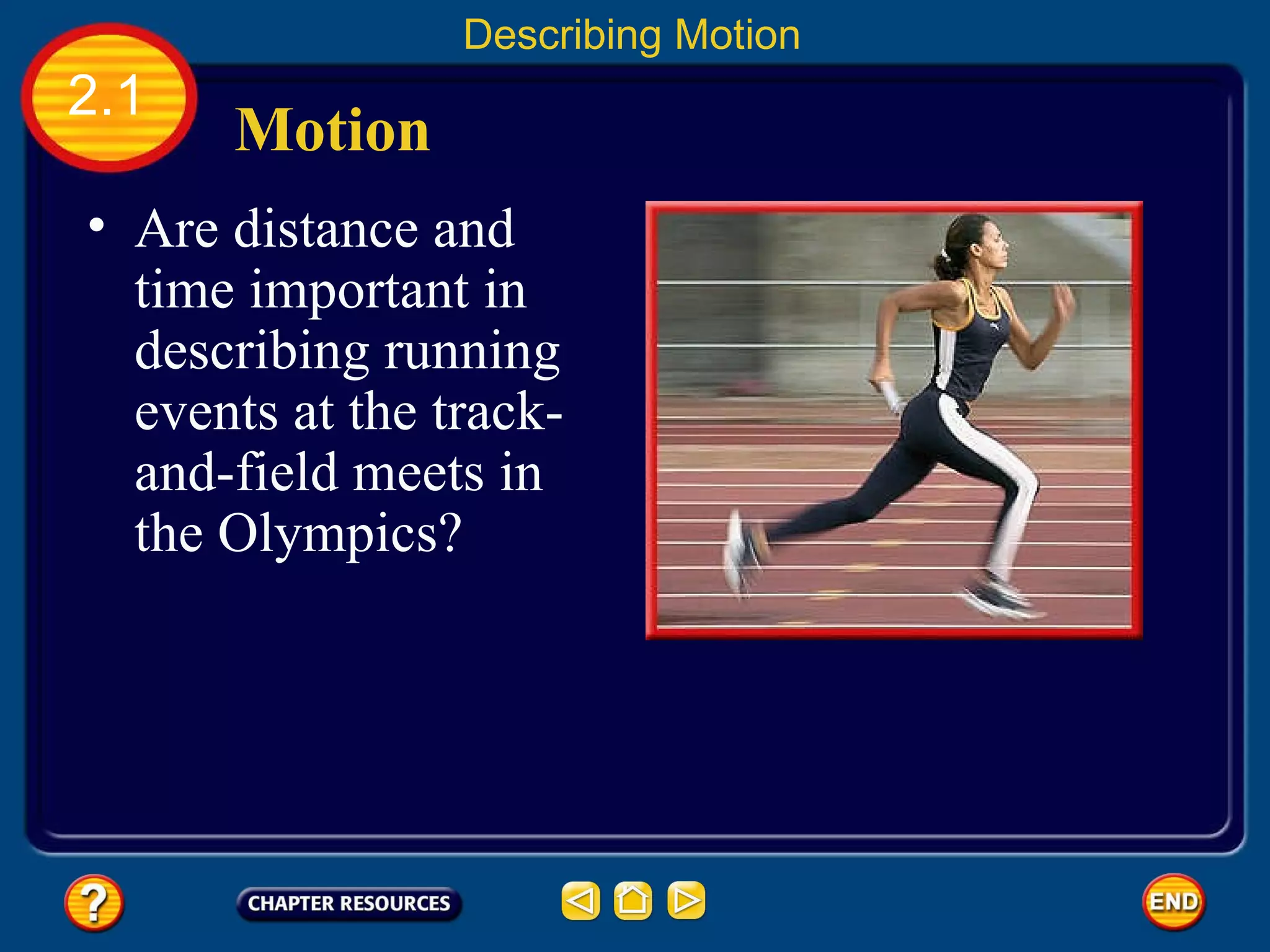
Are distance and time important in describing running events at the track-and-field meets in the Olympics?   Motion 2.1 Describing Motion
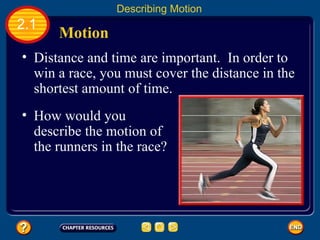
Distance and time are important.  In order to win a race, you must cover the distance in the shortest amount of time.   How would you describe the motion of the runners in the race? Motion 2.1 Describing Motion
You don't always need to see something move to know that motion has taken place.   A reference point is needed to determine the position of an object.   Motion and Position   2.1 Describing Motion Motion occurs when an object changes its position relative to a reference point. The motion of an object depends on the reference point that is chosen.
If you are sitting in a chair reading this sentence, you are moving.   You are not moving relative to your desk or your school building, but you are moving relative to the other planets in the solar system and the Sun.   Relative Motion   2.1 Describing Motion
An important part of describing the motion of an object is to describe how far it has moved, which is  distance .   The SI unit of length or distance is the meter (m).  Longer distances are measured in kilometers (km).   Distance  2.1 Describing Motion
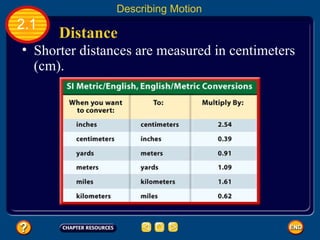
Distance  2.1 Describing Motion Shorter distances are measured in centimeters (cm).
You could describe movement by the distance traveled and by the displacement from the starting point.   You also might want to describe how fast it is moving. Speed  2.1 Describing Motion Speed  is the distance an object travels per unit of time.
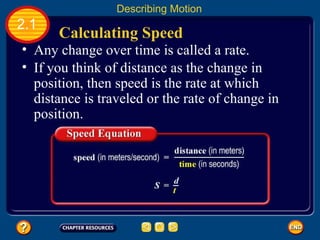
Any change over time is called a rate.   If you think of distance as the change in position, then speed is the rate at which distance is traveled or the rate of change in position.   Calculating Speed   2.1 Describing Motion
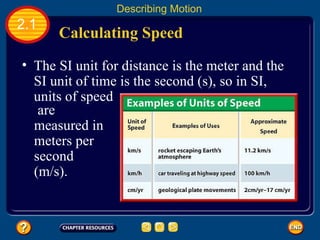
Calculating Speed   2.1 Describing Motion The SI unit for distance is the meter and the SI unit of time is the second (s), so in SI, units of speed   are measured in meters per second (m/s).
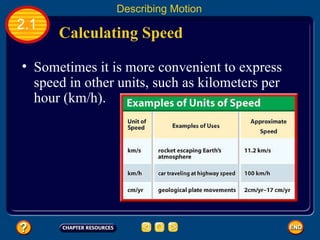
Sometimes it is more convenient to express speed in other units, such as kilometers per hour (km/h). Calculating Speed   2.1 Describing Motion
Suppose you are in a car traveling on a nearly empty freeway.  You look at the speedometer and see that the car's speed hardly changes.   If you are traveling at a constant speed, you can measure your speed over any distance interval.   Motion with Constant Speed   2.1 Describing Motion
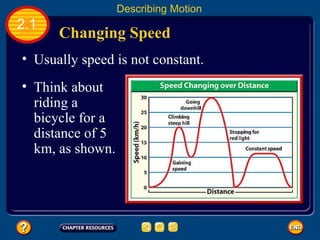
Usually speed is not constant.   Changing Speed   2.1 Describing Motion Think about riding a bicycle for a distance of 5 km, as shown.
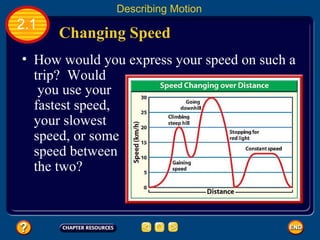
Changing Speed   2.1 Describing Motion How would you express your speed on such a trip?  Would   you use your fastest speed, your slowest speed, or some speed between the two?
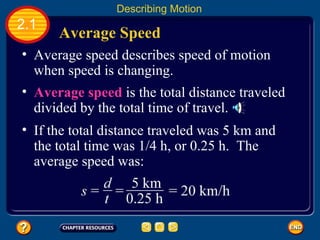
Average speed describes speed of motion when speed is changing.   Average Speed   2.1 Describing Motion Average speed  is the total distance traveled divided by the total time of travel.  If the total distance traveled was 5 km and the total time was 1/4 h, or 0.25 h.  The average speed was:
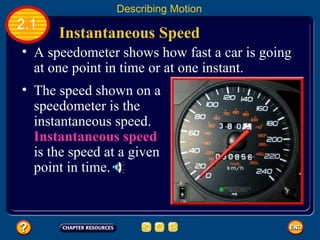
A speedometer shows how fast a car is going at one point in time or at one instant.   Instantaneous Speed   2.1 Describing Motion The speed shown on a speedometer is the instantaneous speed.   Instantaneous speed  is the speed at a given point in time.
When something is speeding up or slowing down, its instantaneous speed is changing. Changing Instantaneous Speed   2.1 Describing Motion If an object is moving with constant speed, the instantaneous speed doesn't change.
The motion of an object over a period of time can be shown on a distance-time graph.   Graphing Motion   2.1 Describing Motion Time is plotted along the horizontal axis of the graph and the distance traveled is plotted along the vertical axis of the graph.   Click image to play movie
On a distance-time graph, the distance is plotted on the vertical axis and the time on the horizontal axis.   Plotting a Distance-Time Graph 2.1 Describing Motion Each axis must have a scale that covers the range of number to be plotted.
Once the scales for each axis are in place, the data points can be plotted.   Plotting a Distance-Time Graph 2.1 Describing Motion After plotting the data points, draw a line connecting the points.
Speed describes only how fast something is moving.   Velocity  2.1 Describing Motion To determine direction you need to know the velocity.   Velocity  includes the speed of an object and the direction of its motion.
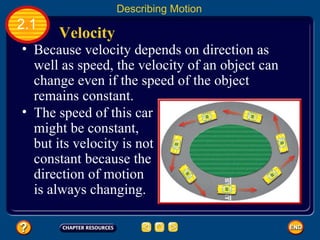
Because velocity depends on direction as well as speed, the velocity of an object can change even if the speed of the object remains constant.   Velocity  2.1 Describing Motion The speed of this car might be constant, but its velocity is not constant because the direction of motion is always changing.
2.1 Question 2 __________ is the distance an object travels per unit of time. Section Check A.  acceleration B.  displacement C.  speed D.  velocity
2.1 Answer The answer is C. Speed is the distance an object travels per unit of time.  Section Check
2.1 Answer Instantaneous speed is the speed at a given point in time. Section Check Question 3 What is instantaneous speed?
Acceleration, Speed and Velocity   Acceleration  is the rate of change of velocity.  When the velocity of an object changes, the object is accelerating.  A change in velocity can be either a change in how fast something is moving, or a change in the direction it is moving.  Acceleration occurs when an object changes its speed, it's direction, or both.  2.2 Acceleration
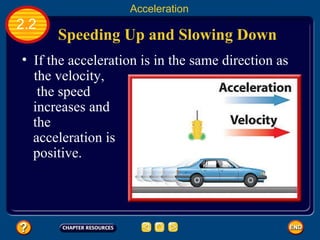
Speeding Up and Slowing Down   When you think of acceleration, you probably think of something speeding up.  However, an object that is slowing down also is accelerating.   Acceleration also has direction, just as velocity does.   2.2 Acceleration
Speeding Up and Slowing Down   2.2 Acceleration If the acceleration is in the same direction as the velocity,    the speed increases and the acceleration is positive.
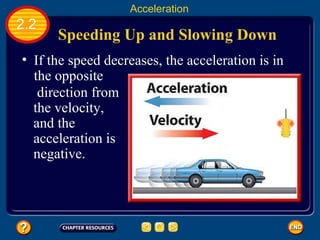
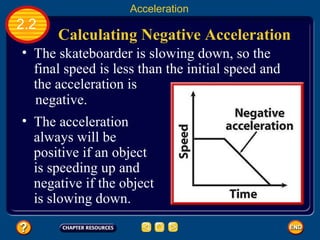
Speeding Up and Slowing Down   2.2 Acceleration If the speed decreases, the acceleration is in the opposite   direction from the velocity, and the acceleration is negative.
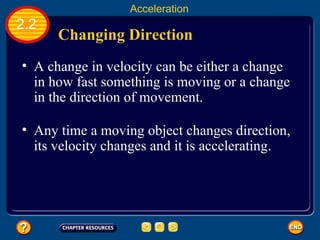
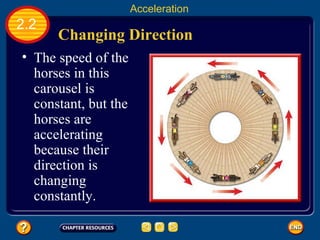
Changing Direction   A change in velocity can be either a change in how fast something is moving or a change in the direction of movement. Any time a moving object changes direction, its velocity changes and it is accelerating.  2.2 Acceleration
Changing Direction   The speed of the horses in this carousel is constant, but the horses are accelerating because their direction is changing constantly.   2.2 Acceleration
Calculating Acceleration   To calculate the acceleration of an object, the change in velocity is divided by the length of time interval over which the change occurred.   2.2 Acceleration To calculate the change in velocity, subtract the initial velocity—the velocity at the beginning of the time interval—from the final velocity—the velocity at the end of the time interval.
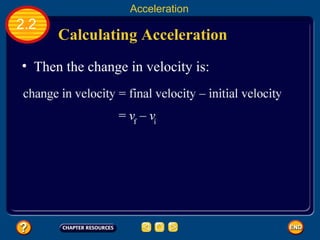
Calculating Acceleration   Then the change in velocity is: 2.2 Acceleration
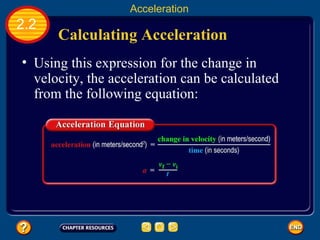
Calculating Acceleration   Using this expression for the change in velocity, the acceleration can be calculated from the following equation:   2.2 Acceleration
Calculating Acceleration   If the direction of motion doesn't change and the object moves in a straight line, the change in velocity is the same as the change in speed.   2.2 Acceleration The change in velocity then is the final speed minus the initial speed.
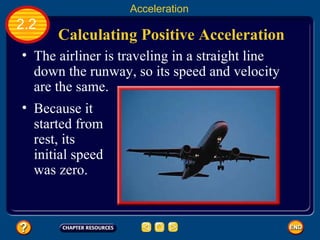
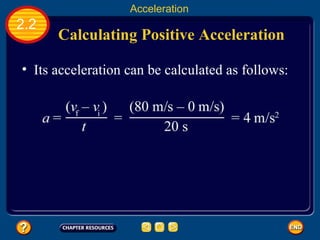
Calculating Positive Acceleration   How is the acceleration for an object that is speeding up different from that of an object that is slowing down?   2.2 Acceleration Suppose a jet airliner starts at rest at the end of a runway and reaches a speed of 80 m/s in 20 s.
Calculating Positive Acceleration   The airliner is traveling in a straight line down the runway, so its speed and velocity are the same.   2.2 Acceleration Because it started from rest, its initial speed was zero.
Calculating Positive Acceleration   Its acceleration can be calculated as follows:   2.2 Acceleration
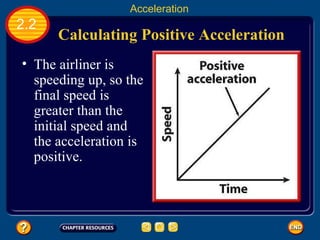
Calculating Positive Acceleration   2.2 Acceleration The airliner is speeding up, so the final speed is greater than the initial speed and the acceleration is positive.
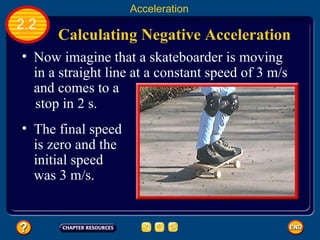
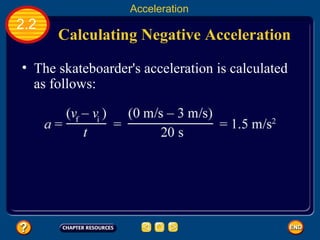
Calculating Negative Acceleration   2.2 Acceleration The final speed is zero and the initial speed was 3 m/s.   Now imagine that a skateboarder is moving in a straight line at a constant speed of 3 m/s and comes to a   stop in 2 s.
Calculating Negative Acceleration   The skateboarder's acceleration is calculated as follows:   2.2 Acceleration
Calculating Negative Acceleration   2.2 Acceleration The acceleration always will be positive if an object is speeding up and negative if the object is slowing down.   The skateboarder is slowing down, so the final speed is less than the initial speed and the acceleration is   negative.
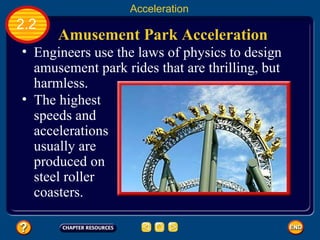
Amusement Park Acceleration   Engineers use the laws of physics to design amusement park rides that are thrilling, but harmless.   2.2 Acceleration The highest speeds and accelerations usually are produced on steel roller coasters.
Amusement Park Acceleration   Steel roller coasters can offer multiple steep drops and inversion loops, which give the rider large accelerations.   2.2 Acceleration As the rider moves down a steep hill or an inversion loop, he or she will accelerate toward the ground due to gravity.
Amusement Park Acceleration   When riders go around a sharp turn, they also are accelerated.   2.2 Acceleration This acceleration makes them feel as if a force is pushing them toward the side of the car.
2.2 Question 1 Acceleration is the rate of change of __________. Section Check
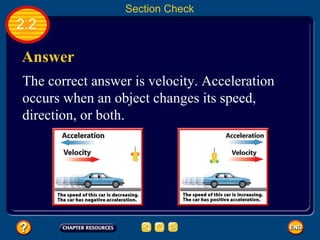
2.2 Answer The correct answer is velocity. Acceleration occurs when an object changes its speed, direction, or both.  Section Check
2.2 Question 2 Which is NOT a form of acceleration? Section Check A.  maintaining a constant speed and direction B.  speeding up C.  slowing down D.  turning
2.2 Answer The answer is A. Any change of speed or direction results in acceleration. Section Check
2.2 Question 3 What is the acceleration of a hockey player who is skating at 10 m/s and comes to a complete stop in 2 s? Section Check A.  5 m/s 2 B.  -5 m/s 2 C.  20 m/s 2 D.  -20 m/s 2
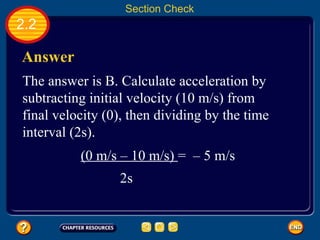
2.2 Answer The answer is B. Calculate acceleration by subtracting initial velocity (10 m/s) from final velocity (0), then dividing by the time interval (2s). Section Check (0 m/s – 10 m/s)  =  – 5 m/s 2s

Velocity and acceleration

  • 1.
    Are distance andtime important in describing running events at the track-and-field meets in the Olympics? Motion 2.1 Describing Motion
  • 2.
    Distance and timeare important. In order to win a race, you must cover the distance in the shortest amount of time. How would you describe the motion of the runners in the race? Motion 2.1 Describing Motion
  • 3.
    You don't alwaysneed to see something move to know that motion has taken place. A reference point is needed to determine the position of an object. Motion and Position 2.1 Describing Motion Motion occurs when an object changes its position relative to a reference point. The motion of an object depends on the reference point that is chosen.
  • 4.
    If you aresitting in a chair reading this sentence, you are moving. You are not moving relative to your desk or your school building, but you are moving relative to the other planets in the solar system and the Sun. Relative Motion 2.1 Describing Motion
  • 5.
    An important partof describing the motion of an object is to describe how far it has moved, which is distance . The SI unit of length or distance is the meter (m). Longer distances are measured in kilometers (km). Distance 2.1 Describing Motion
  • 6.
    Distance 2.1Describing Motion Shorter distances are measured in centimeters (cm).
  • 7.
    You could describemovement by the distance traveled and by the displacement from the starting point. You also might want to describe how fast it is moving. Speed 2.1 Describing Motion Speed is the distance an object travels per unit of time.
  • 8.
    Any change overtime is called a rate. If you think of distance as the change in position, then speed is the rate at which distance is traveled or the rate of change in position. Calculating Speed 2.1 Describing Motion
  • 9.
    Calculating Speed 2.1 Describing Motion The SI unit for distance is the meter and the SI unit of time is the second (s), so in SI, units of speed are measured in meters per second (m/s).
  • 10.
    Sometimes it ismore convenient to express speed in other units, such as kilometers per hour (km/h). Calculating Speed 2.1 Describing Motion
  • 11.
    Suppose you arein a car traveling on a nearly empty freeway. You look at the speedometer and see that the car's speed hardly changes. If you are traveling at a constant speed, you can measure your speed over any distance interval. Motion with Constant Speed 2.1 Describing Motion
  • 12.
    Usually speed isnot constant. Changing Speed 2.1 Describing Motion Think about riding a bicycle for a distance of 5 km, as shown.
  • 13.
    Changing Speed 2.1 Describing Motion How would you express your speed on such a trip? Would you use your fastest speed, your slowest speed, or some speed between the two?
  • 14.
    Average speed describesspeed of motion when speed is changing. Average Speed 2.1 Describing Motion Average speed is the total distance traveled divided by the total time of travel. If the total distance traveled was 5 km and the total time was 1/4 h, or 0.25 h. The average speed was:
  • 15.
    A speedometer showshow fast a car is going at one point in time or at one instant. Instantaneous Speed 2.1 Describing Motion The speed shown on a speedometer is the instantaneous speed. Instantaneous speed is the speed at a given point in time.
  • 16.
    When something isspeeding up or slowing down, its instantaneous speed is changing. Changing Instantaneous Speed 2.1 Describing Motion If an object is moving with constant speed, the instantaneous speed doesn't change.
  • 17.
    The motion ofan object over a period of time can be shown on a distance-time graph. Graphing Motion 2.1 Describing Motion Time is plotted along the horizontal axis of the graph and the distance traveled is plotted along the vertical axis of the graph. Click image to play movie
  • 18.
    On a distance-timegraph, the distance is plotted on the vertical axis and the time on the horizontal axis. Plotting a Distance-Time Graph 2.1 Describing Motion Each axis must have a scale that covers the range of number to be plotted.
  • 19.
    Once the scalesfor each axis are in place, the data points can be plotted. Plotting a Distance-Time Graph 2.1 Describing Motion After plotting the data points, draw a line connecting the points.
  • 20.
    Speed describes onlyhow fast something is moving. Velocity 2.1 Describing Motion To determine direction you need to know the velocity. Velocity includes the speed of an object and the direction of its motion.
  • 21.
    Because velocity dependson direction as well as speed, the velocity of an object can change even if the speed of the object remains constant. Velocity 2.1 Describing Motion The speed of this car might be constant, but its velocity is not constant because the direction of motion is always changing.
  • 22.
    2.1 Question 2__________ is the distance an object travels per unit of time. Section Check A. acceleration B. displacement C. speed D. velocity
  • 23.
    2.1 Answer Theanswer is C. Speed is the distance an object travels per unit of time. Section Check
  • 24.
    2.1 Answer Instantaneousspeed is the speed at a given point in time. Section Check Question 3 What is instantaneous speed?
  • 25.
    Acceleration, Speed andVelocity Acceleration is the rate of change of velocity. When the velocity of an object changes, the object is accelerating. A change in velocity can be either a change in how fast something is moving, or a change in the direction it is moving. Acceleration occurs when an object changes its speed, it's direction, or both. 2.2 Acceleration
  • 26.
    Speeding Up andSlowing Down When you think of acceleration, you probably think of something speeding up. However, an object that is slowing down also is accelerating. Acceleration also has direction, just as velocity does. 2.2 Acceleration
  • 27.
    Speeding Up andSlowing Down 2.2 Acceleration If the acceleration is in the same direction as the velocity, the speed increases and the acceleration is positive.
  • 28.
    Speeding Up andSlowing Down 2.2 Acceleration If the speed decreases, the acceleration is in the opposite direction from the velocity, and the acceleration is negative.
  • 29.
    Changing Direction A change in velocity can be either a change in how fast something is moving or a change in the direction of movement. Any time a moving object changes direction, its velocity changes and it is accelerating. 2.2 Acceleration
  • 30.
    Changing Direction The speed of the horses in this carousel is constant, but the horses are accelerating because their direction is changing constantly. 2.2 Acceleration
  • 31.
    Calculating Acceleration To calculate the acceleration of an object, the change in velocity is divided by the length of time interval over which the change occurred. 2.2 Acceleration To calculate the change in velocity, subtract the initial velocity—the velocity at the beginning of the time interval—from the final velocity—the velocity at the end of the time interval.
  • 32.
    Calculating Acceleration Then the change in velocity is: 2.2 Acceleration
  • 33.
    Calculating Acceleration Using this expression for the change in velocity, the acceleration can be calculated from the following equation: 2.2 Acceleration
  • 34.
    Calculating Acceleration If the direction of motion doesn't change and the object moves in a straight line, the change in velocity is the same as the change in speed. 2.2 Acceleration The change in velocity then is the final speed minus the initial speed.
  • 35.
    Calculating Positive Acceleration How is the acceleration for an object that is speeding up different from that of an object that is slowing down? 2.2 Acceleration Suppose a jet airliner starts at rest at the end of a runway and reaches a speed of 80 m/s in 20 s.
  • 36.
    Calculating Positive Acceleration The airliner is traveling in a straight line down the runway, so its speed and velocity are the same. 2.2 Acceleration Because it started from rest, its initial speed was zero.
  • 37.
    Calculating Positive Acceleration Its acceleration can be calculated as follows: 2.2 Acceleration
  • 38.
    Calculating Positive Acceleration 2.2 Acceleration The airliner is speeding up, so the final speed is greater than the initial speed and the acceleration is positive.
  • 39.
    Calculating Negative Acceleration 2.2 Acceleration The final speed is zero and the initial speed was 3 m/s. Now imagine that a skateboarder is moving in a straight line at a constant speed of 3 m/s and comes to a stop in 2 s.
  • 40.
    Calculating Negative Acceleration The skateboarder's acceleration is calculated as follows: 2.2 Acceleration
  • 41.
    Calculating Negative Acceleration 2.2 Acceleration The acceleration always will be positive if an object is speeding up and negative if the object is slowing down. The skateboarder is slowing down, so the final speed is less than the initial speed and the acceleration is negative.
  • 42.
    Amusement Park Acceleration Engineers use the laws of physics to design amusement park rides that are thrilling, but harmless. 2.2 Acceleration The highest speeds and accelerations usually are produced on steel roller coasters.
  • 43.
    Amusement Park Acceleration Steel roller coasters can offer multiple steep drops and inversion loops, which give the rider large accelerations. 2.2 Acceleration As the rider moves down a steep hill or an inversion loop, he or she will accelerate toward the ground due to gravity.
  • 44.
    Amusement Park Acceleration When riders go around a sharp turn, they also are accelerated. 2.2 Acceleration This acceleration makes them feel as if a force is pushing them toward the side of the car.
  • 45.
    2.2 Question 1Acceleration is the rate of change of __________. Section Check
  • 46.
    2.2 Answer Thecorrect answer is velocity. Acceleration occurs when an object changes its speed, direction, or both. Section Check
  • 47.
    2.2 Question 2Which is NOT a form of acceleration? Section Check A. maintaining a constant speed and direction B. speeding up C. slowing down D. turning
  • 48.
    2.2 Answer Theanswer is A. Any change of speed or direction results in acceleration. Section Check
  • 49.
    2.2 Question 3What is the acceleration of a hockey player who is skating at 10 m/s and comes to a complete stop in 2 s? Section Check A. 5 m/s 2 B. -5 m/s 2 C. 20 m/s 2 D. -20 m/s 2
  • 50.
    2.2 Answer Theanswer is B. Calculate acceleration by subtracting initial velocity (10 m/s) from final velocity (0), then dividing by the time interval (2s). Section Check (0 m/s – 10 m/s) = – 5 m/s 2s