GENERAL PHYSICS:
MEASUREMENTS
Main Points to be studied in this section
Measurements
• Use and describe the use of rules and measuring cylinders to calculate a length or a volume
• Use and describe the use of a mechanical method for the measurement of a small distance
(including use of a micrometer screw gauge)
• Use and describe the use of clocks and devices for measuring an interval of time.
• Measure and describe how to measure a short interval of time (including the period of a
pendulum)
• Show familiarity with the idea of the mass of a body
• State that weight is a force
• Demonstrate understanding that weights (and hence masses) may be compared using a
balance
• Describe an experiment to determine the density of a liquid and of a regularly shaped solid
and make the necessary calculation
• Describe the determination of the density of an irregularly shaped solid by the method of
displacement, and make the necessary calculation
(Cambridge IGCSE Physics ….Syllabus
2014)
• PHYSICAL QUANTITIES
• LENGTH
• TIME
• MASS
• VOLUME
• DENSITY
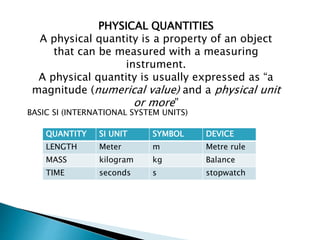
PHYSICAL QUANTITIES
A physical quantity is a property of an object
that can be measured with a measuring
instrument.
A physical quantity is usually expressed as “a
magnitude (numerical value) and a physical unit
or more”
BASIC SI (INTERNATIONAL SYSTEM UNITS)
QUANTITY SI UNIT SYMBOL DEVICE
LENGTH Meter m Metre rule
MASS kilogram kg Balance
TIME seconds s stopwatch
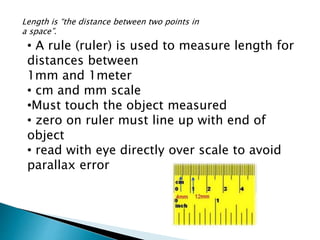
Length is “the distance between two points in
a space”.
• A rule (ruler) is used to measure length for
distances between
1mm and 1meter
• cm and mm scale
•Must touch the object measured
• zero on ruler must line up with end of
object
• read with eye directly over scale to avoid
parallax error
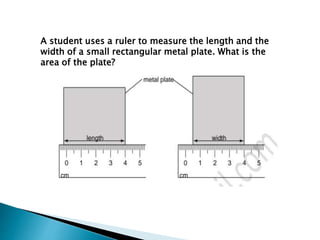
A student uses a ruler to measure the length and the
width of a small rectangular metal plate. What is the
area of the plate?
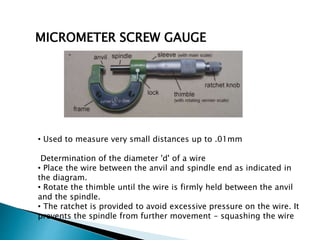
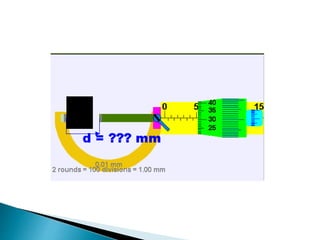
MICROMETER SCREW GAUGE
• Used to measure very small distances up to .01mm
Determination of the diameter 'd' of a wire
• Place the wire between the anvil and spindle end as indicated in
the diagram.
• Rotate the thimble until the wire is firmly held between the anvil
and the spindle.
• The ratchet is provided to avoid excessive pressure on the wire. It
prevents the spindle from further movement - squashing the wire
35
30
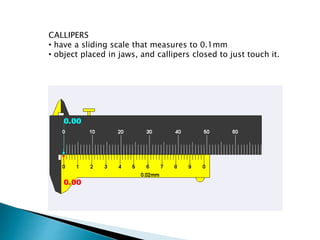
CALLIPERS
• have a sliding scale that measures to 0.1mm
• object placed in jaws, and callipers closed to just touch it.
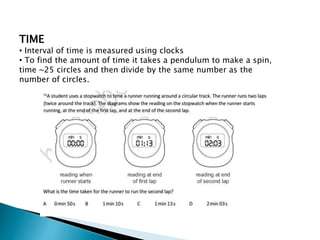
TIME
• Interval of time is measured using clocks
• To find the amount of time it takes a pendulum to make a spin,
time ~25 circles and then divide by the same number as the
number of circles.
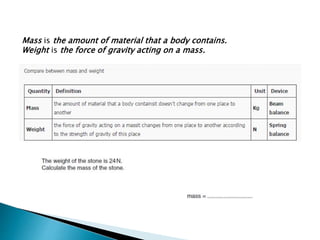
Mass is the amount of material that a body contains.
Weight is the force of gravity acting on a mass.
VOLUME
• To find out volume of regular object, use mathematical formula
• To find out volume of irregular object, put object into measuring
cylinder with water. When object added, it displaces water,
making water level rise. Measure this rise. This is the volume.
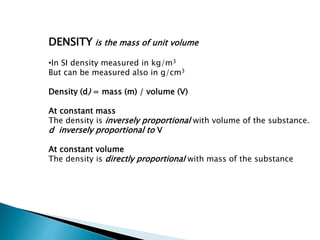
DENSITY is the mass of unit volume
•In SI density measured in kg/m3
But can be measured also in g/cm3
Density (d) = mass (m) / volume (V)
At constant mass
The density is inversely proportional with volume of the substance.
d inversely proportional to V
At constant volume
The density is directly proportional with mass of the substance
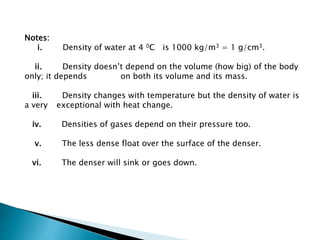
Notes:
i. Density of water at 4 0C is 1000 kg/m3 = 1 g/cm3.
ii. Density doesn’t depend on the volume (how big) of the body
only; it depends on both its volume and its mass.
iii. Density changes with temperature but the density of water is
a very exceptional with heat change.
iv. Densities of gases depend on their pressure too.
v. The less dense float over the surface of the denser.
vi. The denser will sink or goes down.
IGCSE PHYSICS:Measurement

IGCSE PHYSICS:Measurement

  • 1.
  • 2.
    Main Points tobe studied in this section Measurements • Use and describe the use of rules and measuring cylinders to calculate a length or a volume • Use and describe the use of a mechanical method for the measurement of a small distance (including use of a micrometer screw gauge) • Use and describe the use of clocks and devices for measuring an interval of time. • Measure and describe how to measure a short interval of time (including the period of a pendulum) • Show familiarity with the idea of the mass of a body • State that weight is a force • Demonstrate understanding that weights (and hence masses) may be compared using a balance • Describe an experiment to determine the density of a liquid and of a regularly shaped solid and make the necessary calculation • Describe the determination of the density of an irregularly shaped solid by the method of displacement, and make the necessary calculation (Cambridge IGCSE Physics ….Syllabus 2014)
  • 3.
    • PHYSICAL QUANTITIES •LENGTH • TIME • MASS • VOLUME • DENSITY
  • 4.
    PHYSICAL QUANTITIES A physicalquantity is a property of an object that can be measured with a measuring instrument. A physical quantity is usually expressed as “a magnitude (numerical value) and a physical unit or more” BASIC SI (INTERNATIONAL SYSTEM UNITS) QUANTITY SI UNIT SYMBOL DEVICE LENGTH Meter m Metre rule MASS kilogram kg Balance TIME seconds s stopwatch
  • 5.
    Length is “thedistance between two points in a space”. • A rule (ruler) is used to measure length for distances between 1mm and 1meter • cm and mm scale •Must touch the object measured • zero on ruler must line up with end of object • read with eye directly over scale to avoid parallax error
  • 6.
    A student usesa ruler to measure the length and the width of a small rectangular metal plate. What is the area of the plate?
  • 7.
    MICROMETER SCREW GAUGE •Used to measure very small distances up to .01mm Determination of the diameter 'd' of a wire • Place the wire between the anvil and spindle end as indicated in the diagram. • Rotate the thimble until the wire is firmly held between the anvil and the spindle. • The ratchet is provided to avoid excessive pressure on the wire. It prevents the spindle from further movement - squashing the wire
  • 9.
  • 10.
    CALLIPERS • have asliding scale that measures to 0.1mm • object placed in jaws, and callipers closed to just touch it.
  • 11.
    TIME • Interval oftime is measured using clocks • To find the amount of time it takes a pendulum to make a spin, time ~25 circles and then divide by the same number as the number of circles.
  • 13.
    Mass is theamount of material that a body contains. Weight is the force of gravity acting on a mass.
  • 14.
    VOLUME • To findout volume of regular object, use mathematical formula • To find out volume of irregular object, put object into measuring cylinder with water. When object added, it displaces water, making water level rise. Measure this rise. This is the volume.
  • 17.
    DENSITY is themass of unit volume •In SI density measured in kg/m3 But can be measured also in g/cm3 Density (d) = mass (m) / volume (V) At constant mass The density is inversely proportional with volume of the substance. d inversely proportional to V At constant volume The density is directly proportional with mass of the substance
  • 18.
    Notes: i. Density ofwater at 4 0C is 1000 kg/m3 = 1 g/cm3. ii. Density doesn’t depend on the volume (how big) of the body only; it depends on both its volume and its mass. iii. Density changes with temperature but the density of water is a very exceptional with heat change. iv. Densities of gases depend on their pressure too. v. The less dense float over the surface of the denser. vi. The denser will sink or goes down.