Waves and Vibrations
Waves are everywhere in nature Sound waves,  visible light waves,  radio waves,  microwaves,  water waves,  sine waves,  telephone chord waves,  stadium waves,  earthquake waves,  waves on a string,  slinky waves
What is a wave? a wave is a disturbance that travels through a medium from one location to another. a wave is the motion of a disturbance
Kinds of Wave Mechanical Wave –  a wave that requires a medium to exist. The medium could be any solid, liquid or gas. Non-mechanical Wave –  a wave that does not require a medium to exist
Slinky Wave Let’s use a slinky wave as an example. When the slinky is stretched from end to end and is held at rest, it assumes a natural position known as the  equilibrium or rest position . To introduce a wave here we must first create a disturbance. We must move a particle away from its rest position.
Slinky Wave One way to do this is to jerk the slinky forward the beginning of the slinky moves away from its equilibrium position and then back. the disturbance continues down the slinky. this disturbance that moves down the slinky is called a  pulse . if we keep “pulsing” the slinky back and forth, we could get a repeating disturbance.
Slinky Wave This disturbance would look something like this This type of wave is called a  LONGITUDINAL  wave. The pulse is transferred through the medium of the slinky, but the slinky itself does not actually move. It just displaces from its rest position and then returns to it. So what really is being transferred?
Slinky Wave Energy   is being transferred . The metal of the slinky is the MEDIUM in that transfers the energy pulse of the wave. The medium ends up in the same place as it started … it just gets disturbed and then returns to it rest position . The same can be seen with a stadium wave.
Longitudinal Wave The wave we see here is a longitudinal wave. The medium particles vibrate parallel to the motion of the pulse . This is the same type of wave that we use to transfer sound.
Transverse waves A second type of wave is a transverse wave. We said in a longitudinal wave the pulse travels in a direction parallel to the disturbance. In a transverse wave the pulse travels perpendicular to the disturbance .
Transverse Waves The differences between the two can be seen
Transverse Waves Transverse waves occur when we wiggle the slinky back and forth. They also occur when the source disturbance follows a periodic motion. A spring or a pendulum can accomplish this. The wave formed here is a SINE wave.
Transverse Waves This is an example of a transverse wave: Another example is light.
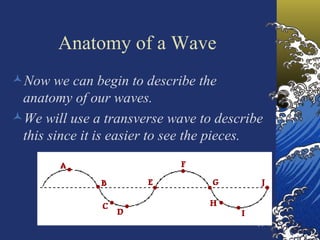
Anatomy of a Wave Now we can begin to describe the anatomy of our waves. We will use a transverse wave to describe this since it is easier to see the pieces.
Anatomy of a Wave In our wave here the dashed line represents the equilibrium position. Once the medium is disturbed, it moves away from this position and then returns to it
Anatomy of a Wave The points A and F are called the  CRESTS  of the wave. This is the point where the wave exhibits the maximum amount of positive or upwards displacement crest
Anatomy of a Wave The points D and I are called the  TROUGHS  of the wave. These are the points where the wave exhibits its maximum negative or downward displacement. trough
Anatomy of a Wave The distance between the dashed line and point A is called the  Amplitude  of the wave.\ This is the maximum displacement that the wave moves away from its equilibrium. Amplitude
Anatomy of a Wave The distance between two consecutive similar points (in this case two crests) is called the  wavelength (  ). This is the length of the wave pulse. Between what other points is can a wavelength be measured? (D and I, B and G, C and H, E and I) wavelength
Anatomy of a Wave What else can we determine? We know that things that repeat have a frequency and a period.  How could we find a frequency and a period of a wave?
Wave frequency We know that frequency measure how often something happens over a certain amount of time. We can measure how many times a pulse passes a fixed point over a given amount of time, and this will give us the  frequency .
Wave frequency the number of cycles that a vibrating object moves through in one second.
Wave frequency Suppose you wiggle a slinky back and forth, and count that 6 waves pass a point in 2 seconds.  What would the frequency be? 3 cycles / second 3 Hz we use the term Hertz (Hz) to stand for cycles per second.
Wave Period The period is the time it takes for one cycle to complete. It is the reciprocal of the frequency. T = 1 / f f = 1 / T What is the relationship of frequency and period? Direct or inverse proportionality?
Wave Speed We can use what we know to determine how fast a wave is moving. What is the formula for velocity? velocity = distance / time What distance do we know about a wave wavelength and what time do we know period
Wave Speed so if we plug these in we get velocity =  length of pulse /  time for pulse to move pass a fixed point v =    / T we use the symbol    to represent wavelength
Wave Speed Some waves have a constant speed. The speed of sound (in air) is  331 m/s . The speed of light is  3 x 10 8  m/s.  The particles of light are actually the fastest moving particles existing.
Wave Speed
Wave Speed Example:  A marine tank at sea sends a signal in the form of a sound to another tank. It took 8s for the sound to reach the second tank.  How far are they from each other if the temperature of the air is 30 0 C?
Wave Speed
Wave Speed

Waves ii

  • 1.
  • 2.
    Waves are everywherein nature Sound waves, visible light waves, radio waves, microwaves, water waves, sine waves, telephone chord waves, stadium waves, earthquake waves, waves on a string, slinky waves
  • 3.
    What is awave? a wave is a disturbance that travels through a medium from one location to another. a wave is the motion of a disturbance
  • 4.
    Kinds of WaveMechanical Wave – a wave that requires a medium to exist. The medium could be any solid, liquid or gas. Non-mechanical Wave – a wave that does not require a medium to exist
  • 5.
    Slinky Wave Let’suse a slinky wave as an example. When the slinky is stretched from end to end and is held at rest, it assumes a natural position known as the equilibrium or rest position . To introduce a wave here we must first create a disturbance. We must move a particle away from its rest position.
  • 6.
    Slinky Wave Oneway to do this is to jerk the slinky forward the beginning of the slinky moves away from its equilibrium position and then back. the disturbance continues down the slinky. this disturbance that moves down the slinky is called a pulse . if we keep “pulsing” the slinky back and forth, we could get a repeating disturbance.
  • 7.
    Slinky Wave Thisdisturbance would look something like this This type of wave is called a LONGITUDINAL wave. The pulse is transferred through the medium of the slinky, but the slinky itself does not actually move. It just displaces from its rest position and then returns to it. So what really is being transferred?
  • 8.
    Slinky Wave Energy is being transferred . The metal of the slinky is the MEDIUM in that transfers the energy pulse of the wave. The medium ends up in the same place as it started … it just gets disturbed and then returns to it rest position . The same can be seen with a stadium wave.
  • 9.
    Longitudinal Wave Thewave we see here is a longitudinal wave. The medium particles vibrate parallel to the motion of the pulse . This is the same type of wave that we use to transfer sound.
  • 10.
    Transverse waves Asecond type of wave is a transverse wave. We said in a longitudinal wave the pulse travels in a direction parallel to the disturbance. In a transverse wave the pulse travels perpendicular to the disturbance .
  • 11.
    Transverse Waves Thedifferences between the two can be seen
  • 12.
    Transverse Waves Transversewaves occur when we wiggle the slinky back and forth. They also occur when the source disturbance follows a periodic motion. A spring or a pendulum can accomplish this. The wave formed here is a SINE wave.
  • 13.
    Transverse Waves Thisis an example of a transverse wave: Another example is light.
  • 14.
    Anatomy of aWave Now we can begin to describe the anatomy of our waves. We will use a transverse wave to describe this since it is easier to see the pieces.
  • 15.
    Anatomy of aWave In our wave here the dashed line represents the equilibrium position. Once the medium is disturbed, it moves away from this position and then returns to it
  • 16.
    Anatomy of aWave The points A and F are called the CRESTS of the wave. This is the point where the wave exhibits the maximum amount of positive or upwards displacement crest
  • 17.
    Anatomy of aWave The points D and I are called the TROUGHS of the wave. These are the points where the wave exhibits its maximum negative or downward displacement. trough
  • 18.
    Anatomy of aWave The distance between the dashed line and point A is called the Amplitude of the wave.\ This is the maximum displacement that the wave moves away from its equilibrium. Amplitude
  • 19.
    Anatomy of aWave The distance between two consecutive similar points (in this case two crests) is called the wavelength (  ). This is the length of the wave pulse. Between what other points is can a wavelength be measured? (D and I, B and G, C and H, E and I) wavelength
  • 20.
    Anatomy of aWave What else can we determine? We know that things that repeat have a frequency and a period. How could we find a frequency and a period of a wave?
  • 21.
    Wave frequency Weknow that frequency measure how often something happens over a certain amount of time. We can measure how many times a pulse passes a fixed point over a given amount of time, and this will give us the frequency .
  • 22.
    Wave frequency thenumber of cycles that a vibrating object moves through in one second.
  • 23.
    Wave frequency Supposeyou wiggle a slinky back and forth, and count that 6 waves pass a point in 2 seconds. What would the frequency be? 3 cycles / second 3 Hz we use the term Hertz (Hz) to stand for cycles per second.
  • 24.
    Wave Period Theperiod is the time it takes for one cycle to complete. It is the reciprocal of the frequency. T = 1 / f f = 1 / T What is the relationship of frequency and period? Direct or inverse proportionality?
  • 25.
    Wave Speed Wecan use what we know to determine how fast a wave is moving. What is the formula for velocity? velocity = distance / time What distance do we know about a wave wavelength and what time do we know period
  • 26.
    Wave Speed soif we plug these in we get velocity = length of pulse / time for pulse to move pass a fixed point v =  / T we use the symbol  to represent wavelength
  • 27.
    Wave Speed Somewaves have a constant speed. The speed of sound (in air) is 331 m/s . The speed of light is 3 x 10 8 m/s. The particles of light are actually the fastest moving particles existing.
  • 28.
  • 29.
    Wave Speed Example: A marine tank at sea sends a signal in the form of a sound to another tank. It took 8s for the sound to reach the second tank. How far are they from each other if the temperature of the air is 30 0 C?
  • 30.
  • 31.