GOOD MORNING!

Today we will:
  begin investigation 5.2
  takes some notes


Please do BEFORE the BELL
  get your lab book
  get a textbook and open to page 492
  get out something to write with
MAKING WAVES
What kinds of waves are there?
INVESTIGATION 5.2

Open your lab book to the first clean page and
 title it, “Making Waves.” Be sure to make a
 TOC entry as well.
WHAT DO YOU THINK?

How does water move to make a wave?


Tsunami
Stadium Wave
INVESTIGATION 5.2

Today we will complete # 1 – 5 of the
 investigation.

By the end of this portion of the lab, you
 should know and be able to describe:
  what a transverse wave is
  what a wave’s amplitude is
  what happens when two waves add together
Key
WAVES TRANSFER ENERGY                        Term
                                             Alert!

How would you define the word “wave”?


A wave is a transfer of energy with no net
 transfer of mass.

  To transfer energy to the slinky, you used chemical
   energy stored in your arm muscles to create the
   mechanical energy of the motion of your hand
   which was them passed on to the slinky which
   began moving.
Key
WAVES TRANSFER ENERGY                 Term
                                      Alert!

Some waves (like sound waves) must have a
 medium to pass their energy through
What was the medium in our investigation?
  the slinky


The word “medium” in this context means a
 substance through which something else is
 transmitted or carried on
WAVES TRANSFER ENERGY

The medium for water waves is the surface of
 the water.
Leonardo da Vinci explained this principle by
 stating,
  “The wave flees the place of creation, while the
   water does not.”
The medium for sound waves can be the air
 around us, the ground under us, or even the
 water in our rivers, oceans, and streams.
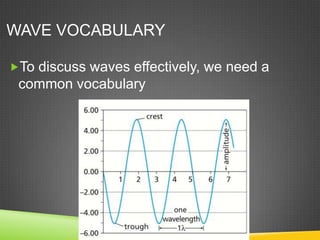
WAVE VOCABULARY

To discuss waves effectively, we need a
 common vocabulary
VOCABULARY TERMS – WRITE DOWN,
LEAVE SPACE

periodic wave   period

crest           transverse wave

trough          longitudinal wave

amplitude       compression
                  wave
wavelength
                 standing wave
frequency
                 node
                 antinode
PG 499 - 501

Between the pages of 499 and 501 in your
 textbook, you will find definitions, diagrams,
 and examples of each of the vocabulary
 terms.

Define all words + give an example and/or
 create a diagram for each. Beside each word,
 put the page number where you found your
 information.
20 minutes independent work
CALCULATING THE SPEED OF A WAVE

The distance the crest of a wave moves in 0.2
 seconds is 2 meters. Calculate the speed of
 the wave.

That’s an easy enough problem. But what if
 you don’t have wavelength and time? What if
 you have frequency and wavelength?
CALCULATING SPEED USING FREQUENCY
AND WAVELENGTH
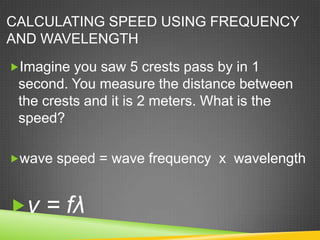
Imagine you saw 5 crests pass by in 1
 second. You measure the distance between
 the crests and it is 2 meters. What is the
 speed?

wave speed = wave frequency x wavelength


v = fλ
CALCULATING SPEED USING FREQUENCY
AND WAVELENGTH
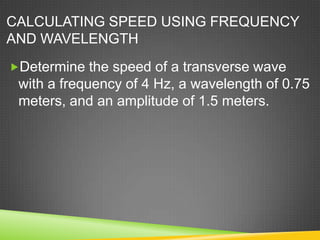
Determine the speed of a transverse wave
 with a frequency of 4 Hz, a wavelength of 0.75
 meters, and an amplitude of 1.5 meters.
Characteristics of waves

  • 1.
    GOOD MORNING! Today wewill: begin investigation 5.2 takes some notes Please do BEFORE the BELL get your lab book get a textbook and open to page 492 get out something to write with
  • 2.
    MAKING WAVES What kindsof waves are there?
  • 3.
    INVESTIGATION 5.2 Open yourlab book to the first clean page and title it, “Making Waves.” Be sure to make a TOC entry as well.
  • 4.
    WHAT DO YOUTHINK? How does water move to make a wave? Tsunami Stadium Wave
  • 5.
    INVESTIGATION 5.2 Today wewill complete # 1 – 5 of the investigation. By the end of this portion of the lab, you should know and be able to describe: what a transverse wave is what a wave’s amplitude is what happens when two waves add together
  • 6.
    Key WAVES TRANSFER ENERGY Term Alert! How would you define the word “wave”? A wave is a transfer of energy with no net transfer of mass. To transfer energy to the slinky, you used chemical energy stored in your arm muscles to create the mechanical energy of the motion of your hand which was them passed on to the slinky which began moving.
  • 7.
    Key WAVES TRANSFER ENERGY Term Alert! Some waves (like sound waves) must have a medium to pass their energy through What was the medium in our investigation? the slinky The word “medium” in this context means a substance through which something else is transmitted or carried on
  • 8.
    WAVES TRANSFER ENERGY Themedium for water waves is the surface of the water. Leonardo da Vinci explained this principle by stating, “The wave flees the place of creation, while the water does not.” The medium for sound waves can be the air around us, the ground under us, or even the water in our rivers, oceans, and streams.
  • 9.
    WAVE VOCABULARY To discusswaves effectively, we need a common vocabulary
  • 10.
    VOCABULARY TERMS –WRITE DOWN, LEAVE SPACE periodic wave period crest transverse wave trough longitudinal wave amplitude compression wave wavelength standing wave frequency node antinode
  • 11.
    PG 499 -501 Between the pages of 499 and 501 in your textbook, you will find definitions, diagrams, and examples of each of the vocabulary terms. Define all words + give an example and/or create a diagram for each. Beside each word, put the page number where you found your information. 20 minutes independent work
  • 12.
    CALCULATING THE SPEEDOF A WAVE The distance the crest of a wave moves in 0.2 seconds is 2 meters. Calculate the speed of the wave. That’s an easy enough problem. But what if you don’t have wavelength and time? What if you have frequency and wavelength?
  • 13.
    CALCULATING SPEED USINGFREQUENCY AND WAVELENGTH Imagine you saw 5 crests pass by in 1 second. You measure the distance between the crests and it is 2 meters. What is the speed? wave speed = wave frequency x wavelength v = fλ
  • 14.
    CALCULATING SPEED USINGFREQUENCY AND WAVELENGTH Determine the speed of a transverse wave with a frequency of 4 Hz, a wavelength of 0.75 meters, and an amplitude of 1.5 meters.