Introduction to
Waves
What is a Wave?
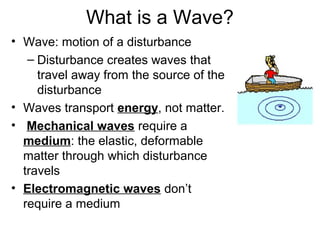
• Wave: motion of a disturbance
– Disturbance creates waves that
travel away from the source of the
disturbance
• Waves transport energy, not matter.
• Mechanical waves require a
medium: the elastic, deformable
matter through which disturbance
travels
• Electromagnetic waves don’t
require a medium
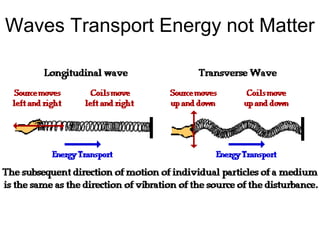
Waves Transport Energy not Matter
Types of Waves
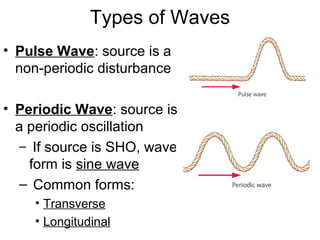
• Pulse Wave: source is a
non-periodic disturbance
• Periodic Wave: source is
a periodic oscillation
– If source is SHO, wave
form is sine wave
– Common forms:
• Transverse
• Longitudinal
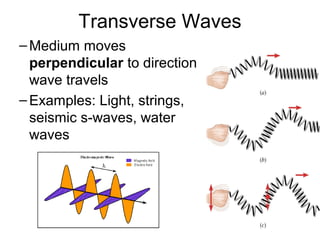
Transverse Waves
–Medium moves
perpendicular to direction
wave travels
–Examples: Light, strings,
seismic s-waves, water
waves
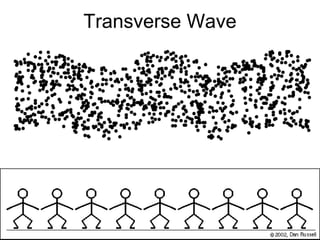
Transverse Wave
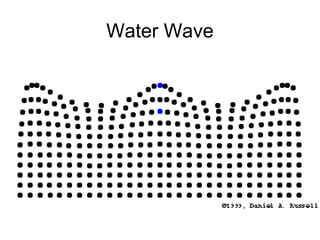
Water Wave
Longitudinal Wave
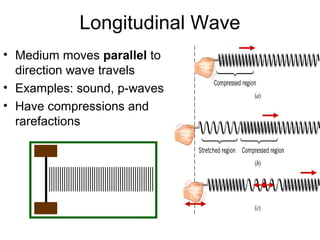
• Medium moves parallel to
direction wave travels
• Examples: sound, p-waves
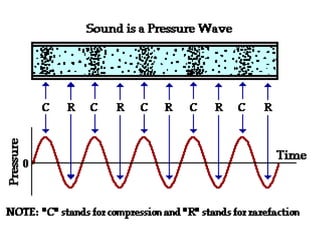
• Have compressions and
rarefactions
Longitudinal Waves (cont.)
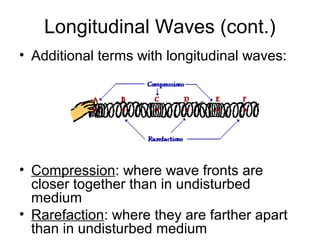
• Additional terms with longitudinal waves:
• Compression: where wave fronts are
closer together than in undisturbed
medium
• Rarefaction: where they are farther apart
than in undisturbed medium
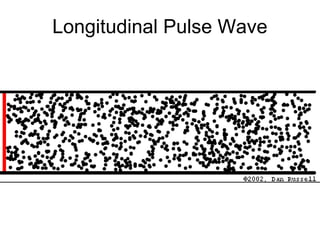
Longitudinal Pulse Wave
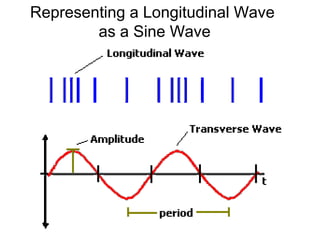
Representing a Longitudinal Wave
as a Sine Wave
Wave Parameters
The following parameters are used to
describe waves:
–Amplitude
–Wave length
–Frequency
–Period
–Speed
Amplitude (A)
• How “tall” (or “wide”) the wave is
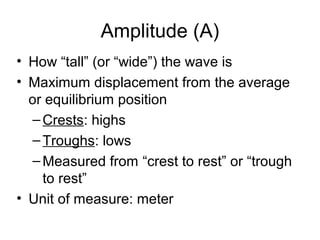
• Maximum displacement from the average
or equilibrium position
–Crests: highs
–Troughs: lows
–Measured from “crest to rest” or “trough
to rest”
• Unit of measure: meter
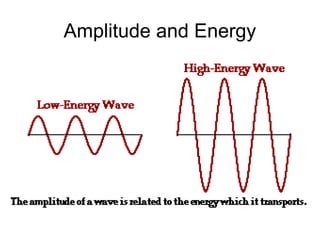
Amplitude and Energy
Amplitude (cont.)
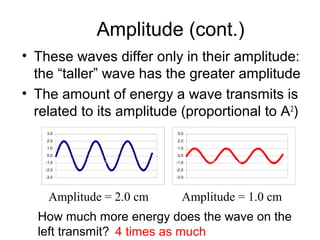
• These waves differ only in their amplitude:
the “taller” wave has the greater amplitude
• The amount of energy a wave transmits is
related to its amplitude (proportional to A2
)
-3.0
-2.0
-1.0
0.0
1.0
2.0
3.0
0.0 5.0 10.0 15.0 20.0
-3.0
-2.0
-1.0
0.0
1.0
2.0
3.0
0.0 5.0 10.0 15.0 20.0
Amplitude = 2.0 cm Amplitude = 1.0 cm
How much more energy does the wave on the
left transmit? 4 times as much
Wave Length (λ)
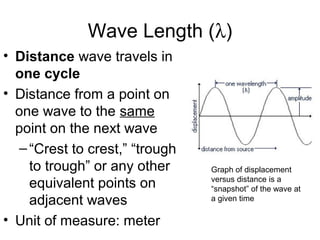
• Distance wave travels in
one cycle
• Distance from a point on
one wave to the same
point on the next wave
–“Crest to crest,” “trough
to trough” or any other
equivalent points on
adjacent waves
• Unit of measure: meter
Graph of displacement
versus distance is a
“snapshot” of the wave at
a given time
Parts of the Wave
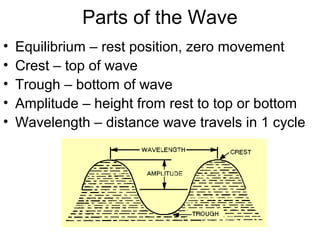
• Equilibrium – rest position, zero movement
• Crest – top of wave
• Trough – bottom of wave
• Amplitude – height from rest to top or bottom
• Wavelength – distance wave travels in 1 cycle
Frequency
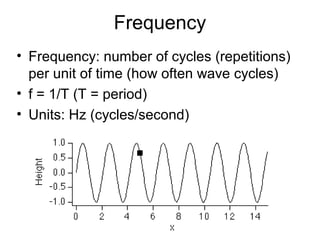
• Frequency: number of cycles (repetitions)
per unit of time (how often wave cycles)
• f = 1/T (T = period)
• Units: Hz (cycles/second)
Frequency (cont.)
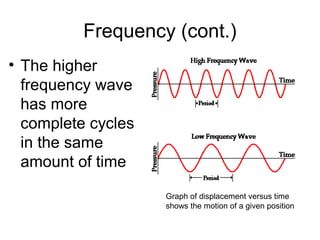
• The higher
frequency wave
has more
complete cycles
in the same
amount of time
Graph of displacement versus time
shows the motion of a given position
Period (T)
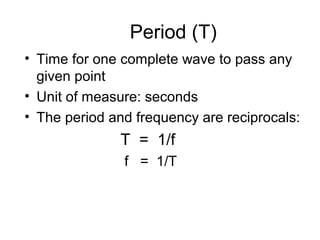
• Time for one complete wave to pass any
given point
• Unit of measure: seconds
• The period and frequency are reciprocals:
T = 1/f
f = 1/T
Wave Speed (v)
• How fast a wave transmits energy from
one place to another
• IMPORTANT: Wave speed depends only
on specific properties of the medium)
• For example:
– Wave in string: tension and density
– Wave in fluid: rigidity and density
– Wave in solid: elasticity and density
• Constant for a given medium at given
conditions
• Changes only if properties of medium do!
• Unit of measure: meter/sec
Wave Speed (cont.)
• Wave speeds vary widely:
–Water waves: a few miles per hour
–Sound (in air): about 340 m/sec or 1100
ft/sec (depends on temperature)
–Electromagnetic waves (in vacuum): about
3.0 x 10⁸
meters/sec or 186,000 miles/sec
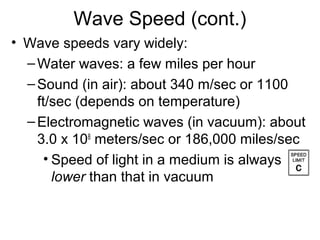
• Speed of light in a medium is always
lower than that in vacuum
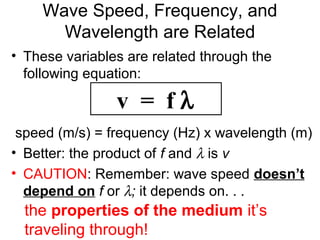
Wave Speed, Frequency, and
Wavelength are Related
• These variables are related through the
following equation:
speed (m/s) = frequency (Hz) x wavelength (m)
• Better: the product of f and λ is v
• CAUTION: Remember: wave speed doesn’t
depend on f or λ; it depends on. . .
v = f λ
the properties of the medium it’s
traveling through!
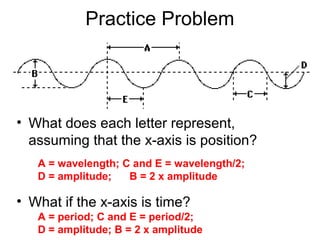
Practice Problem
• What does each letter represent,
assuming that the x-axis is position?
• What if the x-axis is time?
A = wavelength; C and E = wavelength/2;
D = amplitude; B = 2 x amplitude
A = period; C and E = period/2;
D = amplitude; B = 2 x amplitude
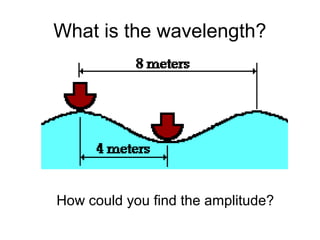
What is the wavelength?
How could you find the amplitude?
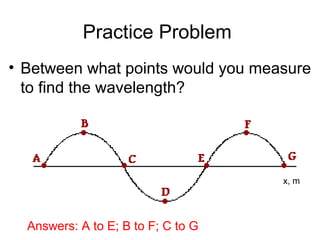
Practice Problem
• Between what points would you measure
to find the wavelength?
x, m
Answers: A to E; B to F; C to G
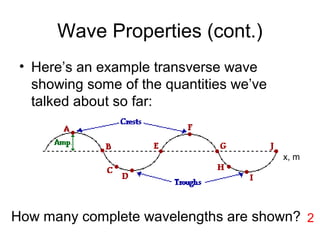
Wave Properties (cont.)
• Here’s an example transverse wave
showing some of the quantities we’ve
talked about so far:
How many complete wavelengths are shown?
x, m
2

Waves Intro

  • 1.
  • 2.
    What is aWave? • Wave: motion of a disturbance – Disturbance creates waves that travel away from the source of the disturbance • Waves transport energy, not matter. • Mechanical waves require a medium: the elastic, deformable matter through which disturbance travels • Electromagnetic waves don’t require a medium
  • 3.
  • 4.
    Types of Waves •Pulse Wave: source is a non-periodic disturbance • Periodic Wave: source is a periodic oscillation – If source is SHO, wave form is sine wave – Common forms: • Transverse • Longitudinal
  • 5.
    Transverse Waves –Medium moves perpendicularto direction wave travels –Examples: Light, strings, seismic s-waves, water waves
  • 6.
  • 7.
  • 8.
    Longitudinal Wave • Mediummoves parallel to direction wave travels • Examples: sound, p-waves • Have compressions and rarefactions
  • 9.
    Longitudinal Waves (cont.) •Additional terms with longitudinal waves: • Compression: where wave fronts are closer together than in undisturbed medium • Rarefaction: where they are farther apart than in undisturbed medium
  • 10.
  • 11.
    Representing a LongitudinalWave as a Sine Wave
  • 13.
    Wave Parameters The followingparameters are used to describe waves: –Amplitude –Wave length –Frequency –Period –Speed
  • 14.
    Amplitude (A) • How“tall” (or “wide”) the wave is • Maximum displacement from the average or equilibrium position –Crests: highs –Troughs: lows –Measured from “crest to rest” or “trough to rest” • Unit of measure: meter
  • 15.
  • 16.
    Amplitude (cont.) • Thesewaves differ only in their amplitude: the “taller” wave has the greater amplitude • The amount of energy a wave transmits is related to its amplitude (proportional to A2 ) -3.0 -2.0 -1.0 0.0 1.0 2.0 3.0 0.0 5.0 10.0 15.0 20.0 -3.0 -2.0 -1.0 0.0 1.0 2.0 3.0 0.0 5.0 10.0 15.0 20.0 Amplitude = 2.0 cm Amplitude = 1.0 cm How much more energy does the wave on the left transmit? 4 times as much
  • 17.
    Wave Length (λ) •Distance wave travels in one cycle • Distance from a point on one wave to the same point on the next wave –“Crest to crest,” “trough to trough” or any other equivalent points on adjacent waves • Unit of measure: meter Graph of displacement versus distance is a “snapshot” of the wave at a given time
  • 18.
    Parts of theWave • Equilibrium – rest position, zero movement • Crest – top of wave • Trough – bottom of wave • Amplitude – height from rest to top or bottom • Wavelength – distance wave travels in 1 cycle
  • 19.
    Frequency • Frequency: numberof cycles (repetitions) per unit of time (how often wave cycles) • f = 1/T (T = period) • Units: Hz (cycles/second)
  • 20.
    Frequency (cont.) • Thehigher frequency wave has more complete cycles in the same amount of time Graph of displacement versus time shows the motion of a given position
  • 21.
    Period (T) • Timefor one complete wave to pass any given point • Unit of measure: seconds • The period and frequency are reciprocals: T = 1/f f = 1/T
  • 22.
    Wave Speed (v) •How fast a wave transmits energy from one place to another • IMPORTANT: Wave speed depends only on specific properties of the medium) • For example: – Wave in string: tension and density – Wave in fluid: rigidity and density – Wave in solid: elasticity and density • Constant for a given medium at given conditions • Changes only if properties of medium do! • Unit of measure: meter/sec
  • 23.
    Wave Speed (cont.) •Wave speeds vary widely: –Water waves: a few miles per hour –Sound (in air): about 340 m/sec or 1100 ft/sec (depends on temperature) –Electromagnetic waves (in vacuum): about 3.0 x 10⁸ meters/sec or 186,000 miles/sec • Speed of light in a medium is always lower than that in vacuum
  • 24.
    Wave Speed, Frequency,and Wavelength are Related • These variables are related through the following equation: speed (m/s) = frequency (Hz) x wavelength (m) • Better: the product of f and λ is v • CAUTION: Remember: wave speed doesn’t depend on f or λ; it depends on. . . v = f λ the properties of the medium it’s traveling through!
  • 25.
    Practice Problem • Whatdoes each letter represent, assuming that the x-axis is position? • What if the x-axis is time? A = wavelength; C and E = wavelength/2; D = amplitude; B = 2 x amplitude A = period; C and E = period/2; D = amplitude; B = 2 x amplitude
  • 26.
    What is thewavelength? How could you find the amplitude?
  • 27.
    Practice Problem • Betweenwhat points would you measure to find the wavelength? x, m Answers: A to E; B to F; C to G
  • 28.
    Wave Properties (cont.) •Here’s an example transverse wave showing some of the quantities we’ve talked about so far: How many complete wavelengths are shown? x, m 2

Editor's Notes

  • #2 Resources: The Physics Classroom, Daniel A. Russell
  • #17 How much more energy per unit time does the wave on the left transmit? Since its amplitude is twice as large, it transmits 4 times the energy
  • #21 The upper wave has 2 x the frequency of the bottom. Note that the x-axis has units of time in this graph.
  • #23 Examples: Speed of wave in string depends on tension and linear density. Speed of wave in fluid depends on bulk modulus and density. Speed of wave in solid depends on elastic modulus and density.
  • #25 Recall that speed v = distance traveled/time, or v = wavelength/period = wavelength x frequency
  • #29 Answer: 2 complete wavelengths are shown