CONCEPT AND
MEASUREMENT OF
WATERSHED
KMJ26403 HYDROLOGY AND WATER RESOURCES ENGINEERING
MRS SITI KAMARIAH MD SA’AT
FKTM
UNIMAP
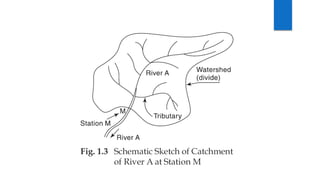
Watershed
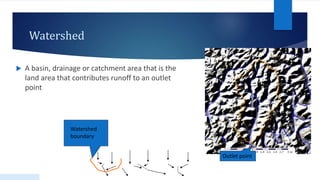
 A basin, drainage or catchment area that is the
land area that contributes runoff to an outlet
point
Outlet point
Watershed
boundary
Watersheds
 Area of land draining into a stream at a given location. In US called watershed.
 Also known as Catchment, Catchment area, Catchment basin, Drainage area, River
basin, Water basin
 Rainfall that falls in a watershed will generate runoff to that watershed outlet.
 Topographic elevation is used to define a Watershed boundary (land survey or
LIDAR)
 Scale is a big issue for analysis
3
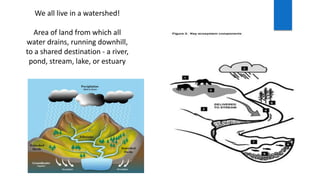
We all live in a watershed!
Area of land from which all
water drains, running downhill,
to a shared destination - a river,
pond, stream, lake, or estuary
Functions
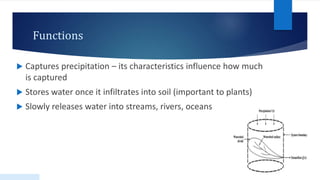
 Captures precipitation – its characteristics influence how much
is captured
 Stores water once it infiltrates into soil (important to plants)
 Slowly releases water into streams, rivers, oceans
Why are watersheds important?
 Activities within a watershed impact runoff and water quality of water
leaving the watershed
 Must manage at a watershed level rather than other boundaries to attain
goals related to runoff and water quality
Types of watershed
 Forested watershed
 Urban watershed
 Agricultural watershed
 Rural watershed
 Coastal/swamp/desert watershed
 Combination of above
1/9/2024
Add a footer
7
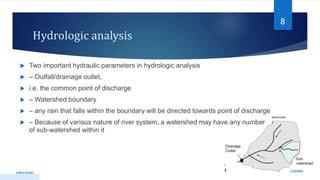
Hydrologic analysis
 Two important hydraulic parameters in hydrologic analysis
 – Outfall/drainage outlet,
 i.e. the common point of discharge
 – Watershed boundary
 – any rain that falls within the boundary will be directed towards point of discharge
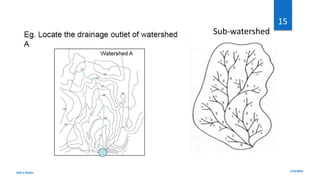
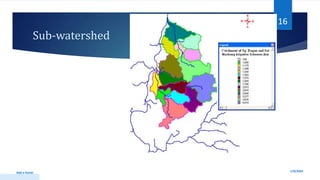
 – Because of various nature of river system, a watershed may have any number
of sub-watershed within it
1/9/2024
Add a footer
8
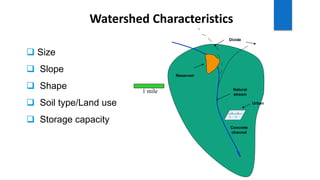
Watershed Characteristics
 Size
 Slope
 Shape
 Soil type/Land use
 Storage capacity
Reservoir
Divide
Natural
stream
Urban
Concrete
channel
1 mile
Watershed size
 Watershed area (km2, ha)
 Runoff generation on these watersheds can be considered in two phases: i)
land phase and ii) channel phase
 Small watersheds (< 250 km2)
 They have dominant land phase and overland flow, have relatively less conspicuous
channel phase.
 They are highly sensitive to high-intensity, short-duration rainfalls.
 Large watersheds (>250 km2)
 They have well-developed channel networks and channel phase, and, thus, channel
storage is dominant.
 They are less sensitive to high-intensity rainfalls of short duration.
11
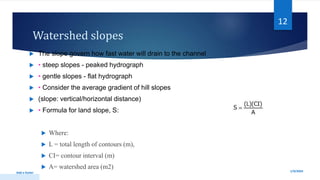
Watershed slopes
 The slope govern how fast water will drain to the channel
 • steep slopes - peaked hydrograph
 • gentle slopes - flat hydrograph
 • Consider the average gradient of hill slopes
 (slope: vertical/horizontal distance)
 • Formula for land slope, S:
 Where:
 L = total length of contours (m),
 CI= contour interval (m)
 A= watershed area (m2)
1/9/2024
Add a footer
12
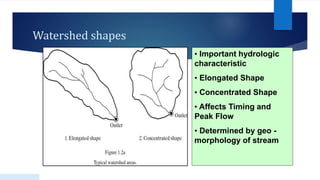
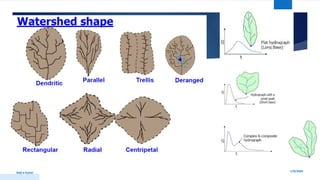
• Important hydrologic
characteristic
• Elongated Shape
• Concentrated Shape
• Affects Timing and
Peak Flow
• Determined by geo -
morphology of stream
Watershed shapes
1/9/2024
Add a footer
14
1/9/2024
Add a footer
15
Sub-watershed
Sub-watershed
1/9/2024
Add a footer
16
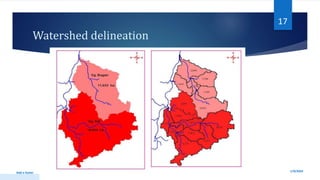
Watershed delineation
1/9/2024
Add a footer
17
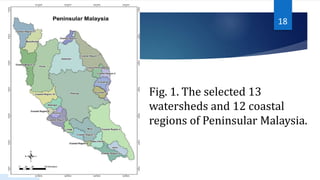
Fig. 1. The selected 13
watersheds and 12 coastal
regions of Peninsular Malaysia.
18
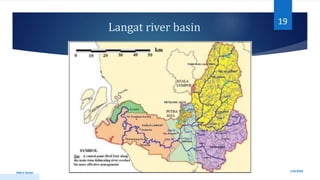
Langat river basin
1/9/2024
Add a footer
19
RUNOFF WHAT IS RUNOFF?
1/9/2024
Add a footer
20
What is runoff?
 Runoff = draining or flowing off of precipitation from a catchment area through a surface channel enters
into stream channel.
 Output from catchment in a given unit of time.
 Based on the time delay between the precipitation and the runoff, the runoff is classified into two
categories; as
 (a) Direct runoff : runoff which enters the stream immediately after the rainfall. It includes surface
runoff, prompt interflow and rainfall on the surface of the stream. Direct storm runoff and storm runoff
are also used to designate direct runoff.
 (b) Base flow : The delayed flow that reaches a stream essentially as groundwater flow is called base
flow.
1/9/2024
21
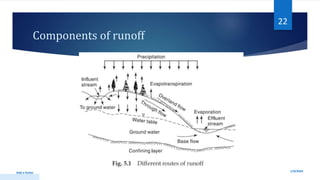
Components of runoff
1/9/2024
Add a footer
22
Factors affecting catchment runoff
 a) Precipitation characteristics
 b) Shape and size of catchment
 c) Topography
 d) Geologic characteristics
 e) Meteorological characteristics
 f) Storage characteristics of a catchment
1/9/2024
Add a footer
23
Runoff estimation RATIONAL METHOD
Runoff estimation method
 Rational method
 Infiltration Approach
 Hydrograph method
 NRCS Curve Number (Formerly SCS) Method
1/9/2024
25
Rational Method
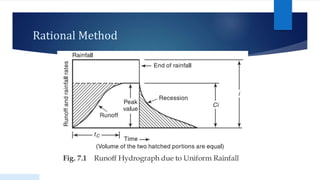
 Used for determination of peak flow rate
 Assumption: A constant intensity of rain uniformly distributed over an area
 maximum runoff: occur when the rainfall duration equals the time of
concentration
 For small size (<50 km2) catchments
 This not cover what is MSMA (Manual Saliran Mesra Alam Malaysia)/Urban
Stormwater Management Manual.
Rational Method
 The maximum possible flow generated by rainfall event of a watershed
• Knowledge of Qp is required for drainage design to avoid/minimize project from flooding
• Rational method: is a prediction method and based on characteristics of watershed and
rainfall
 Assumptions:
 • Waters is small (<200 acres)
 • Peak flow occurs when the entire area is contributing
 • Rainfall intensity is uniform over a time of concentration
 • A rational coefficient represent rainfall:runoff ratio
1/9/2024
Add a footer
27
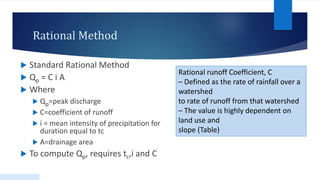
Rational Method
 Standard Rational Method
 Qp = C i A
 Where
 Qp=peak discharge
 C=coefficient of runoff
 i = mean intensity of precipitation for
duration equal to tc
 A=drainage area
 To compute Qp, requires tc,i and C
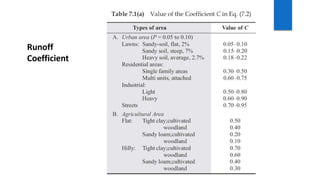
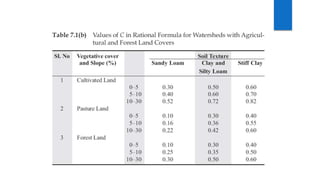
Rational runoff Coefficient, C
– Defined as the rate of rainfall over a
watershed
to rate of runoff from that watershed
– The value is highly dependent on
land use and
slope (Table)
Rational method
1/9/2024
Add a footer
29
Rational Method
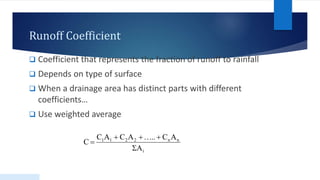
Runoff Coefficient
 Coefficient that represents the fraction of runoff to rainfall
 Depends on type of surface
 When a drainage area has distinct parts with different
coefficients…
 Use weighted average
A
A
C
..
A
C
A
C
C
i
n
n
2
2
1
1






Runoff
Coefficient
1/9/2024
Add a footer
34
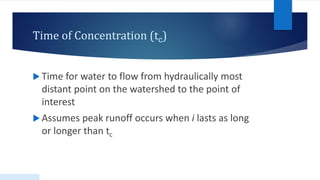
Time of Concentration (tc)
 Time for water to flow from hydraulically most
distant point on the watershed to the point of
interest
 Assumes peak runoff occurs when i lasts as long
or longer than tc
Time of concentration, tc
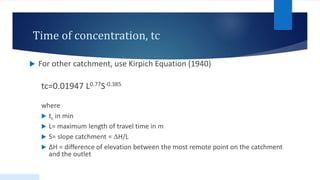
 For other catchment, use Kirpich Equation (1940)
tc=0.01947 L0.77S-0.385
where
 tc in min
 L= maximum length of travel time in m
 S= slope catchment = ∆H/L
 ∆H = difference of elevation between the most remote point on the catchment
and the outlet
Time of concentration, tc
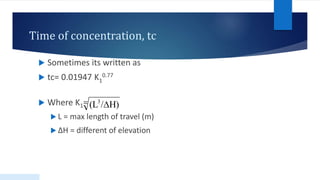
 Sometimes its written as
 tc= 0.01947 K1
0.77
 Where K1=
 L = max length of travel (m)
 ∆H = different of elevation
H)
/
(L3

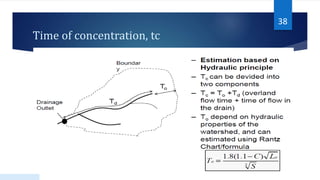
Time of concentration, tc
38
Time of Concentration (tc)
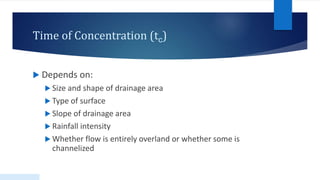
 Depends on:
 Size and shape of drainage area
 Type of surface
 Slope of drainage area
 Rainfall intensity
 Whether flow is entirely overland or whether some is
channelized
Rainfall Intensity, i
 Corresponding to a duration tc and the desired
probability of exceedence P
 Return period, T=1/P
 Found from rainfall intensity—duration-frequency (IDF)
curve
Intensity-Duration-
Frequency(IDF) Curve
1/9/2024
Add a footer
41
Rainfall Intensity, i
 Average intensity for a selected frequency and duration
 Based on “design” event (i.e. 50-year storm)
 Overdesign is costly (what else?)
 Underdesign may be inadequate
Rainfall Intensity, i
 Based on values of tc and T
tc = time of concentration
T = recurrence interval or design frequency
 As a minimum equal to the time of concentration,
tc, (mm/hr)
Recurrence Interval (Design Event)
 2-year interval -- Design of intakes and spread of water
on pavement for primary highways and city streets
 10-year interval -- Design of intakes and spread of water
on pavement for freeways and interstate highways
 50 - year -- Design of subways (underpasses) and sag
vertical curves where storm sewer pipe is the only outlet
 100 – year interval -- Major storm check on all projects
ARI = Average recurrent interval
- Average length of time between rain events
that exceed the same magnitude, volume
and duration
Design according to
MSMA V2
1/9/2024
Add a footer
Example 1:
Rational Method
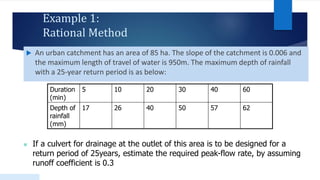
 An urban catchment has an area of 85 ha. The slope of the catchment is 0.006 and
the maximum length of travel of water is 950m. The maximum depth of rainfall
with a 25-year return period is as below:
Duration
(min)
5 10 20 30 40 60
Depth of
rainfall
(mm)
17 26 40 50 57 62
 If a culvert for drainage at the outlet of this area is to be designed for a
return period of 25years, estimate the required peak-flow rate, by assuming
runoff coefficient is 0.3
Solution
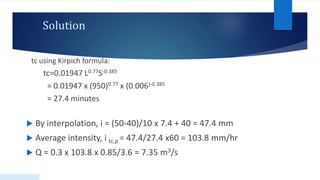
tc using Kirpich formula:
tc=0.01947 L0.77S-0.385
= 0.01947 x (950)0.77 x (0.006)-0.385
= 27.4 minutes
 By interpolation, i = (50-40)/10 x 7.4 + 40 = 47.4 mm
 Average intensity, i tc,p = 47.4/27.4 x60 = 103.8 mm/hr
 Q = 0.3 x 103.8 x 0.85/3.6 = 7.35 m3/s
47
Example 2:
Rational Method
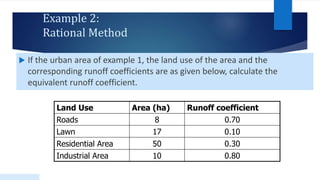
 If the urban area of example 1, the land use of the area and the
corresponding runoff coefficients are as given below, calculate the
equivalent runoff coefficient.
Land Use Area (ha) Runoff coefficient
Roads 8 0.70
Lawn 17 0.10
Residential Area 50 0.30
Industrial Area 10 0.80
Solution
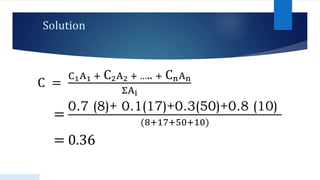
C =
C1A1 + C2A2 + ….. + CnAn
ΣAi
=
0.7 (8)+ 0.1(17)+0.3(50)+0.8 (10)
(8+17+50+10)
= 0.36
49
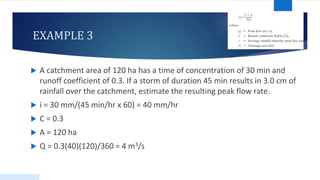
EXAMPLE 3
 A catchment area of 120 ha has a time of concentration of 30 min and
runoff coefficient of 0.3. If a storm of duration 45 min results in 3.0 cm of
rainfall over the catchment, estimate the resulting peak flow rate.
 i = 30 mm/(45 min/hr x 60) = 40 mm/hr
 C = 0.3
 A = 120 ha
 Q = 0.3(40)(120)/360 = 4 m3/s
50
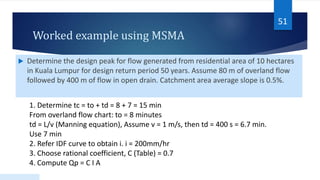
Worked example using MSMA
 Determine the design peak for flow generated from residential area of 10 hectares
in Kuala Lumpur for design return period 50 years. Assume 80 m of overland flow
followed by 400 m of flow in open drain. Catchment area average slope is 0.5%.
51
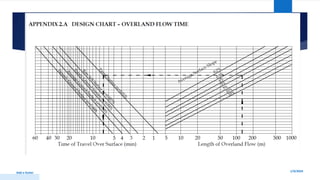
1. Determine tc = to + td = 8 + 7 = 15 min
From overland flow chart: to = 8 minutes
td = L/v (Manning equation), Assume v = 1 m/s, then td = 400 s = 6.7 min.
Use 7 min
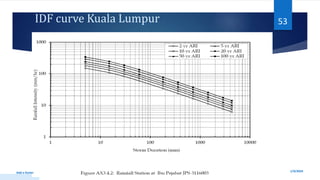
2. Refer IDF curve to obtain i. i = 200mm/hr
3. Choose rational coefficient, C (Table) = 0.7
4. Compute Qp = C I A
1/9/2024
Add a footer
52
IDF curve Kuala Lumpur
1/9/2024
Add a footer
53
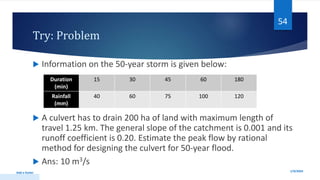
Try: Problem
 Information on the 50-year storm is given below:
 A culvert has to drain 200 ha of land with maximum length of
travel 1.25 km. The general slope of the catchment is 0.001 and its
runoff coefficient is 0.20. Estimate the peak flow by rational
method for designing the culvert for 50-year flood.
 Ans: 10 m3/s
1/9/2024
Add a footer
54
Duration
(min)
15 30 45 60 180
Rainfall
(mm)
40 60 75 100 120
Thank you
1/9/2024
Add a footer
55
Student password
3is1jd

WATERSHED CATCHMENT.pptx

  • 1.
    CONCEPT AND MEASUREMENT OF WATERSHED KMJ26403HYDROLOGY AND WATER RESOURCES ENGINEERING MRS SITI KAMARIAH MD SA’AT FKTM UNIMAP
  • 2.
    Watershed  A basin,drainage or catchment area that is the land area that contributes runoff to an outlet point Outlet point Watershed boundary
  • 3.
    Watersheds  Area ofland draining into a stream at a given location. In US called watershed.  Also known as Catchment, Catchment area, Catchment basin, Drainage area, River basin, Water basin  Rainfall that falls in a watershed will generate runoff to that watershed outlet.  Topographic elevation is used to define a Watershed boundary (land survey or LIDAR)  Scale is a big issue for analysis 3
  • 4.
    We all livein a watershed! Area of land from which all water drains, running downhill, to a shared destination - a river, pond, stream, lake, or estuary
  • 5.
    Functions  Captures precipitation– its characteristics influence how much is captured  Stores water once it infiltrates into soil (important to plants)  Slowly releases water into streams, rivers, oceans
  • 6.
    Why are watershedsimportant?  Activities within a watershed impact runoff and water quality of water leaving the watershed  Must manage at a watershed level rather than other boundaries to attain goals related to runoff and water quality
  • 7.
    Types of watershed Forested watershed  Urban watershed  Agricultural watershed  Rural watershed  Coastal/swamp/desert watershed  Combination of above 1/9/2024 Add a footer 7
  • 8.
    Hydrologic analysis  Twoimportant hydraulic parameters in hydrologic analysis  – Outfall/drainage outlet,  i.e. the common point of discharge  – Watershed boundary  – any rain that falls within the boundary will be directed towards point of discharge  – Because of various nature of river system, a watershed may have any number of sub-watershed within it 1/9/2024 Add a footer 8
  • 10.
    Watershed Characteristics  Size Slope  Shape  Soil type/Land use  Storage capacity Reservoir Divide Natural stream Urban Concrete channel 1 mile
  • 11.
    Watershed size  Watershedarea (km2, ha)  Runoff generation on these watersheds can be considered in two phases: i) land phase and ii) channel phase  Small watersheds (< 250 km2)  They have dominant land phase and overland flow, have relatively less conspicuous channel phase.  They are highly sensitive to high-intensity, short-duration rainfalls.  Large watersheds (>250 km2)  They have well-developed channel networks and channel phase, and, thus, channel storage is dominant.  They are less sensitive to high-intensity rainfalls of short duration. 11
  • 12.
    Watershed slopes  Theslope govern how fast water will drain to the channel  • steep slopes - peaked hydrograph  • gentle slopes - flat hydrograph  • Consider the average gradient of hill slopes  (slope: vertical/horizontal distance)  • Formula for land slope, S:  Where:  L = total length of contours (m),  CI= contour interval (m)  A= watershed area (m2) 1/9/2024 Add a footer 12
  • 13.
    • Important hydrologic characteristic •Elongated Shape • Concentrated Shape • Affects Timing and Peak Flow • Determined by geo - morphology of stream Watershed shapes
  • 14.
  • 15.
  • 16.
  • 17.
  • 18.
    Fig. 1. Theselected 13 watersheds and 12 coastal regions of Peninsular Malaysia. 18
  • 19.
  • 20.
    RUNOFF WHAT ISRUNOFF? 1/9/2024 Add a footer 20
  • 21.
    What is runoff? Runoff = draining or flowing off of precipitation from a catchment area through a surface channel enters into stream channel.  Output from catchment in a given unit of time.  Based on the time delay between the precipitation and the runoff, the runoff is classified into two categories; as  (a) Direct runoff : runoff which enters the stream immediately after the rainfall. It includes surface runoff, prompt interflow and rainfall on the surface of the stream. Direct storm runoff and storm runoff are also used to designate direct runoff.  (b) Base flow : The delayed flow that reaches a stream essentially as groundwater flow is called base flow. 1/9/2024 21
  • 22.
  • 23.
    Factors affecting catchmentrunoff  a) Precipitation characteristics  b) Shape and size of catchment  c) Topography  d) Geologic characteristics  e) Meteorological characteristics  f) Storage characteristics of a catchment 1/9/2024 Add a footer 23
  • 24.
  • 25.
    Runoff estimation method Rational method  Infiltration Approach  Hydrograph method  NRCS Curve Number (Formerly SCS) Method 1/9/2024 25
  • 26.
    Rational Method  Usedfor determination of peak flow rate  Assumption: A constant intensity of rain uniformly distributed over an area  maximum runoff: occur when the rainfall duration equals the time of concentration  For small size (<50 km2) catchments  This not cover what is MSMA (Manual Saliran Mesra Alam Malaysia)/Urban Stormwater Management Manual.
  • 27.
    Rational Method  Themaximum possible flow generated by rainfall event of a watershed • Knowledge of Qp is required for drainage design to avoid/minimize project from flooding • Rational method: is a prediction method and based on characteristics of watershed and rainfall  Assumptions:  • Waters is small (<200 acres)  • Peak flow occurs when the entire area is contributing  • Rainfall intensity is uniform over a time of concentration  • A rational coefficient represent rainfall:runoff ratio 1/9/2024 Add a footer 27
  • 28.
    Rational Method  StandardRational Method  Qp = C i A  Where  Qp=peak discharge  C=coefficient of runoff  i = mean intensity of precipitation for duration equal to tc  A=drainage area  To compute Qp, requires tc,i and C Rational runoff Coefficient, C – Defined as the rate of rainfall over a watershed to rate of runoff from that watershed – The value is highly dependent on land use and slope (Table)
  • 29.
  • 30.
  • 31.
    Runoff Coefficient  Coefficientthat represents the fraction of runoff to rainfall  Depends on type of surface  When a drainage area has distinct parts with different coefficients…  Use weighted average A A C .. A C A C C i n n 2 2 1 1      
  • 32.
  • 34.
  • 35.
    Time of Concentration(tc)  Time for water to flow from hydraulically most distant point on the watershed to the point of interest  Assumes peak runoff occurs when i lasts as long or longer than tc
  • 36.
    Time of concentration,tc  For other catchment, use Kirpich Equation (1940) tc=0.01947 L0.77S-0.385 where  tc in min  L= maximum length of travel time in m  S= slope catchment = ∆H/L  ∆H = difference of elevation between the most remote point on the catchment and the outlet
  • 37.
    Time of concentration,tc  Sometimes its written as  tc= 0.01947 K1 0.77  Where K1=  L = max length of travel (m)  ∆H = different of elevation H) / (L3 
  • 38.
  • 39.
    Time of Concentration(tc)  Depends on:  Size and shape of drainage area  Type of surface  Slope of drainage area  Rainfall intensity  Whether flow is entirely overland or whether some is channelized
  • 40.
    Rainfall Intensity, i Corresponding to a duration tc and the desired probability of exceedence P  Return period, T=1/P  Found from rainfall intensity—duration-frequency (IDF) curve
  • 41.
  • 42.
    Rainfall Intensity, i Average intensity for a selected frequency and duration  Based on “design” event (i.e. 50-year storm)  Overdesign is costly (what else?)  Underdesign may be inadequate
  • 43.
    Rainfall Intensity, i Based on values of tc and T tc = time of concentration T = recurrence interval or design frequency  As a minimum equal to the time of concentration, tc, (mm/hr)
  • 44.
    Recurrence Interval (DesignEvent)  2-year interval -- Design of intakes and spread of water on pavement for primary highways and city streets  10-year interval -- Design of intakes and spread of water on pavement for freeways and interstate highways  50 - year -- Design of subways (underpasses) and sag vertical curves where storm sewer pipe is the only outlet  100 – year interval -- Major storm check on all projects ARI = Average recurrent interval - Average length of time between rain events that exceed the same magnitude, volume and duration
  • 45.
    Design according to MSMAV2 1/9/2024 Add a footer
  • 46.
    Example 1: Rational Method An urban catchment has an area of 85 ha. The slope of the catchment is 0.006 and the maximum length of travel of water is 950m. The maximum depth of rainfall with a 25-year return period is as below: Duration (min) 5 10 20 30 40 60 Depth of rainfall (mm) 17 26 40 50 57 62  If a culvert for drainage at the outlet of this area is to be designed for a return period of 25years, estimate the required peak-flow rate, by assuming runoff coefficient is 0.3
  • 47.
    Solution tc using Kirpichformula: tc=0.01947 L0.77S-0.385 = 0.01947 x (950)0.77 x (0.006)-0.385 = 27.4 minutes  By interpolation, i = (50-40)/10 x 7.4 + 40 = 47.4 mm  Average intensity, i tc,p = 47.4/27.4 x60 = 103.8 mm/hr  Q = 0.3 x 103.8 x 0.85/3.6 = 7.35 m3/s 47
  • 48.
    Example 2: Rational Method If the urban area of example 1, the land use of the area and the corresponding runoff coefficients are as given below, calculate the equivalent runoff coefficient. Land Use Area (ha) Runoff coefficient Roads 8 0.70 Lawn 17 0.10 Residential Area 50 0.30 Industrial Area 10 0.80
  • 49.
    Solution C = C1A1 +C2A2 + ….. + CnAn ΣAi = 0.7 (8)+ 0.1(17)+0.3(50)+0.8 (10) (8+17+50+10) = 0.36 49
  • 50.
    EXAMPLE 3  Acatchment area of 120 ha has a time of concentration of 30 min and runoff coefficient of 0.3. If a storm of duration 45 min results in 3.0 cm of rainfall over the catchment, estimate the resulting peak flow rate.  i = 30 mm/(45 min/hr x 60) = 40 mm/hr  C = 0.3  A = 120 ha  Q = 0.3(40)(120)/360 = 4 m3/s 50
  • 51.
    Worked example usingMSMA  Determine the design peak for flow generated from residential area of 10 hectares in Kuala Lumpur for design return period 50 years. Assume 80 m of overland flow followed by 400 m of flow in open drain. Catchment area average slope is 0.5%. 51 1. Determine tc = to + td = 8 + 7 = 15 min From overland flow chart: to = 8 minutes td = L/v (Manning equation), Assume v = 1 m/s, then td = 400 s = 6.7 min. Use 7 min 2. Refer IDF curve to obtain i. i = 200mm/hr 3. Choose rational coefficient, C (Table) = 0.7 4. Compute Qp = C I A
  • 52.
  • 53.
    IDF curve KualaLumpur 1/9/2024 Add a footer 53
  • 54.
    Try: Problem  Informationon the 50-year storm is given below:  A culvert has to drain 200 ha of land with maximum length of travel 1.25 km. The general slope of the catchment is 0.001 and its runoff coefficient is 0.20. Estimate the peak flow by rational method for designing the culvert for 50-year flood.  Ans: 10 m3/s 1/9/2024 Add a footer 54 Duration (min) 15 30 45 60 180 Rainfall (mm) 40 60 75 100 120
  • 55.
    Thank you 1/9/2024 Add afooter 55 Student password 3is1jd