HYDROGRAPH
Components,Types, Unit Hydrograph, Uses and
Limitations
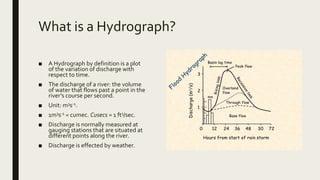
What is a Hydrograph?
■ A Hydrograph by definition is a plot
of the variation of discharge with
respect to time.
■ The discharge of a river: the volume
of water that flows past a point in the
river’s course per second.
■ Unit: m3s-1.
■ 1m3s-1 = cumec. Cusecs = 1 ft3/sec.
■ Discharge is normally measured at
gauging stations that are situated at
different points along the river.
■ Discharge is effected by weather.
Components of a Hydrograph
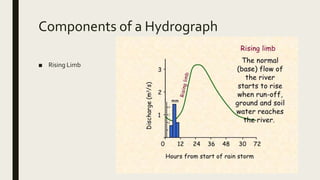
■ Rising Limb
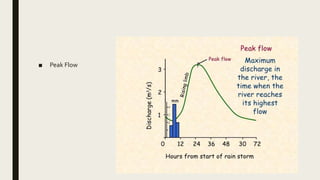
■ Peak Flow
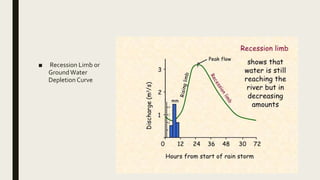
■ Recession Limb or
GroundWater
Depletion Curve
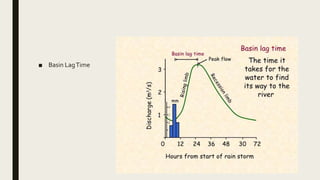
■ Basin LagTime
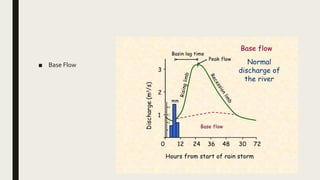
■ Base Flow
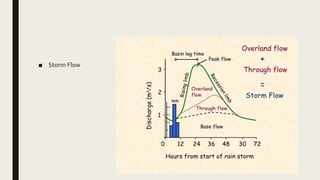
■ Storm Flow
Types of Hydrograph
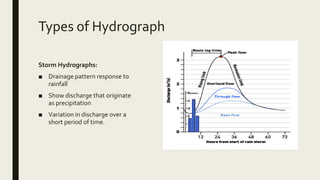
Storm Hydrographs:
■ Drainage pattern response to
rainfall
■ Show discharge that originate
as precipitation
■ Variation in discharge over a
short period of time.
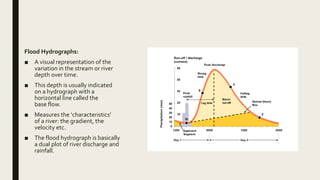
Flood Hydrographs:
■ A visual representation of the
variation in the stream or river
depth over time.
■ This depth is usually indicated
on a hydrograph with a
horizontal line called the
base flow.
■ Measures the ‘characteristics’
of a river: the gradient, the
velocity etc.
■ The flood hydrograph is basically
a dual plot of river discharge and
rainfall.
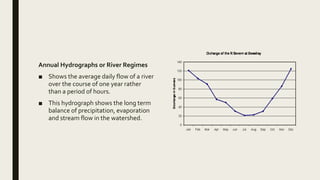
Annual Hydrographs or River Regimes
■ Shows the average daily flow of a river
over the course of one year rather
than a period of hours.
■ This hydrograph shows the long term
balance of precipitation, evaporation
and stream flow in the watershed.
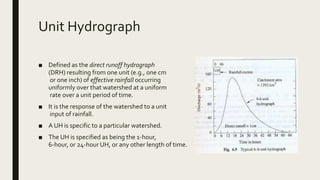
Unit Hydrograph
■ Defined as the direct runoff hydrograph
(DRH) resulting from one unit (e.g., one cm
or one inch) of effective rainfall occurring
uniformly over that watershed at a uniform
rate over a unit period of time.
■ It is the response of the watershed to a unit
input of rainfall.
■ A UH is specific to a particular watershed.
■ The UH is specified as being the 1-hour,
6-hour, or 24-hour UH, or any other length of time.
■ UH quantifies the effect of a unit of rainfall on the corresponding runoff from a
particular drainage basin.
■ UH theory assumes that a watershed's runoff response is linear and time-invariant,
and that the effective rainfall occurs uniformly over the watershed.
Limitations of UH
■ Unit hydrographs assume uniform distribution of rainfall over the catchment and
uniform intensity during the duration of rainfall excess. In practice, these two
conditions are never satisfied.
■ Under conditions of non-uniform areal distribution and variation of intensity, the unit
hydrograph theory can still be used if the areal distribution is consistent between
different storms.
■ The upper limit for use of the unit hydrograph method is 5000km2.
Why do we construct hydrographs?
■ i.To find out the discharge patterns of a particular drainage basin.
■ ii. For the development of flood hydrographs for extreme rainfall magnitudes
■ iii.To obtain extension of flood flow records based on rainfall records
■ iv. For the development of flood forecasting and warning systems based on rainfall.

Hydrology

  • 1.
  • 2.
    What is aHydrograph? ■ A Hydrograph by definition is a plot of the variation of discharge with respect to time. ■ The discharge of a river: the volume of water that flows past a point in the river’s course per second. ■ Unit: m3s-1. ■ 1m3s-1 = cumec. Cusecs = 1 ft3/sec. ■ Discharge is normally measured at gauging stations that are situated at different points along the river. ■ Discharge is effected by weather.
  • 3.
    Components of aHydrograph ■ Rising Limb
  • 4.
  • 5.
    ■ Recession Limbor GroundWater Depletion Curve
  • 6.
  • 7.
  • 8.
  • 9.
    Types of Hydrograph StormHydrographs: ■ Drainage pattern response to rainfall ■ Show discharge that originate as precipitation ■ Variation in discharge over a short period of time.
  • 10.
    Flood Hydrographs: ■ Avisual representation of the variation in the stream or river depth over time. ■ This depth is usually indicated on a hydrograph with a horizontal line called the base flow. ■ Measures the ‘characteristics’ of a river: the gradient, the velocity etc. ■ The flood hydrograph is basically a dual plot of river discharge and rainfall.
  • 11.
    Annual Hydrographs orRiver Regimes ■ Shows the average daily flow of a river over the course of one year rather than a period of hours. ■ This hydrograph shows the long term balance of precipitation, evaporation and stream flow in the watershed.
  • 12.
    Unit Hydrograph ■ Definedas the direct runoff hydrograph (DRH) resulting from one unit (e.g., one cm or one inch) of effective rainfall occurring uniformly over that watershed at a uniform rate over a unit period of time. ■ It is the response of the watershed to a unit input of rainfall. ■ A UH is specific to a particular watershed. ■ The UH is specified as being the 1-hour, 6-hour, or 24-hour UH, or any other length of time.
  • 13.
    ■ UH quantifiesthe effect of a unit of rainfall on the corresponding runoff from a particular drainage basin. ■ UH theory assumes that a watershed's runoff response is linear and time-invariant, and that the effective rainfall occurs uniformly over the watershed.
  • 14.
    Limitations of UH ■Unit hydrographs assume uniform distribution of rainfall over the catchment and uniform intensity during the duration of rainfall excess. In practice, these two conditions are never satisfied. ■ Under conditions of non-uniform areal distribution and variation of intensity, the unit hydrograph theory can still be used if the areal distribution is consistent between different storms. ■ The upper limit for use of the unit hydrograph method is 5000km2.
  • 15.
    Why do weconstruct hydrographs? ■ i.To find out the discharge patterns of a particular drainage basin. ■ ii. For the development of flood hydrographs for extreme rainfall magnitudes ■ iii.To obtain extension of flood flow records based on rainfall records ■ iv. For the development of flood forecasting and warning systems based on rainfall.