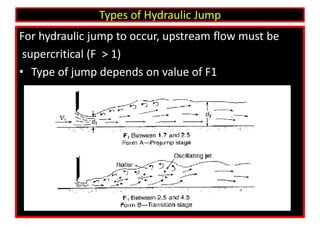
Types of Hydraulic Jump
For hydraulic jump to occur, upstream flow must be
supercritical (F > 1)
• Type of jump depends on value of F1
Types of Hydraulic Jump
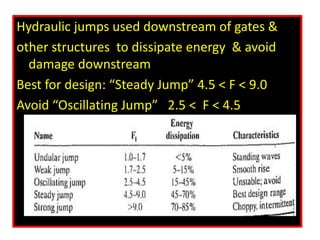
Hydraulic jumps used downstream of gates &
other structures to dissipate energy & avoid
damage downstream
Best for design: “Steady Jump” 4.5 < F < 9.0
Avoid “Oscillating Jump” 2.5 < F < 4.5
Stilling Basins
• Use stilling basin to initiate jump
• Allows dissipation of energy
within a structure that will
minimize damage
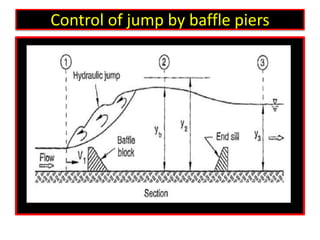
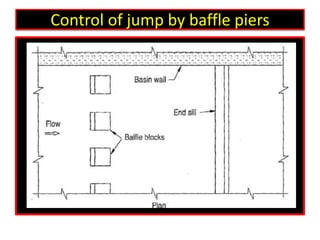
• Baffle blocks used to make jump
position more stable
Stilling Basins: Design Considerations
Length of jump Governs length of stilling basin
Approximately 6 y2 for 4.5 < F1 < 13
Surface profile of jump
– Governs height of sidewalls of
– Dictates pressure on floor of basin
– Depends on y1 and F1
• Control of jump
(1) Chute Blocks (2) Baffle Blocks (3) End Sill
Components used to initiate jump, stabilize jump, &
make basin as short as possible
Control of jump by baffle piers
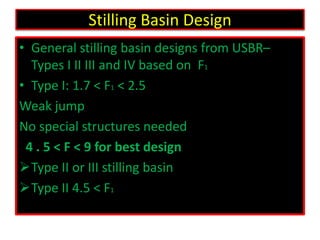
Stilling Basin Design
• General stilling basin designs from USBR–
Types I II III and IV based on F1
• Type I: 1.7 < F1 < 2.5
Weak jump
No special structures needed
4 . 5 < F < 9 for best design
Type II or III stilling basin
Type II 4.5 < F1
TYPE III 4.5 < F1
Use for incoming velocity V1 < 60 ft/s
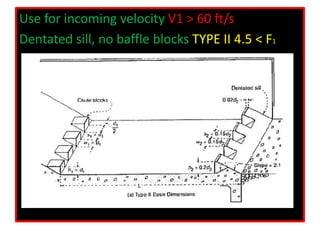
Use for incoming velocity V1 > 60 ft/s
Dentated sill, no baffle blocks TYPE II 4.5 < F1
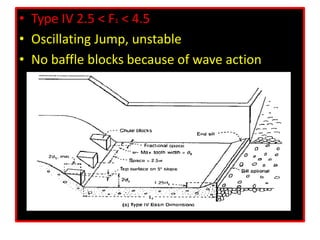
• Type IV 2.5 < F1 < 4.5
• Oscillating Jump, unstable
• No baffle blocks because of wave action

Stilling basin

  • 1.
    Types of HydraulicJump For hydraulic jump to occur, upstream flow must be supercritical (F > 1) • Type of jump depends on value of F1
  • 2.
  • 3.
    Hydraulic jumps useddownstream of gates & other structures to dissipate energy & avoid damage downstream Best for design: “Steady Jump” 4.5 < F < 9.0 Avoid “Oscillating Jump” 2.5 < F < 4.5
  • 4.
    Stilling Basins • Usestilling basin to initiate jump • Allows dissipation of energy within a structure that will minimize damage • Baffle blocks used to make jump position more stable
  • 5.
    Stilling Basins: DesignConsiderations Length of jump Governs length of stilling basin Approximately 6 y2 for 4.5 < F1 < 13 Surface profile of jump – Governs height of sidewalls of – Dictates pressure on floor of basin – Depends on y1 and F1 • Control of jump (1) Chute Blocks (2) Baffle Blocks (3) End Sill Components used to initiate jump, stabilize jump, & make basin as short as possible
  • 6.
    Control of jumpby baffle piers
  • 7.
    Control of jumpby baffle piers
  • 8.
    Stilling Basin Design •General stilling basin designs from USBR– Types I II III and IV based on F1 • Type I: 1.7 < F1 < 2.5 Weak jump No special structures needed 4 . 5 < F < 9 for best design Type II or III stilling basin Type II 4.5 < F1
  • 9.
    TYPE III 4.5< F1 Use for incoming velocity V1 < 60 ft/s
  • 10.
    Use for incomingvelocity V1 > 60 ft/s Dentated sill, no baffle blocks TYPE II 4.5 < F1
  • 11.
    • Type IV2.5 < F1 < 4.5 • Oscillating Jump, unstable • No baffle blocks because of wave action