1
Arba Minch university
School of Post Graduate
Course: Hydrological process
Instructor: Kassa Tadele (PhD)
April, 2013
2
 Questions
 Generation of runoff/definitions
 Factors affecting runoff
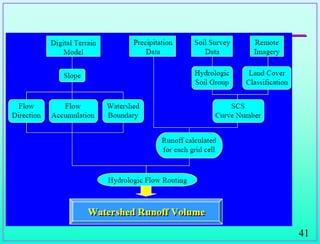
 Methods to determine runoff
 Representation of runoff by different
models
 Selected Papers
Chapter 4
Surface runoff
3
4.1 Questions
For process research, the following questions has to be clear:
 How can we isolate different runoff response mechanisms?
 What are the key state variables controlling runoff
generation?
What do we want to know?
 Volumes of storm runoff
 Entire storm hydrographs
 Deterministic prediction of peak rates of runoff from small
watersheds
 Probabilistic prediction of peak flows (from any size of
watershed)
 Continuous simulation of streamflow (storm and dry-
weather flow)
4
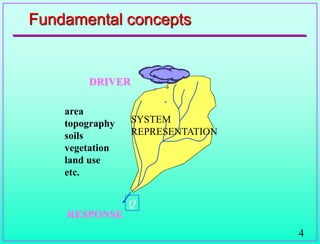
Fundamental concepts
DRIVER
Q
RESPONSE
SYSTEM
REPRESENTATION
area
topography
soils
vegetation
land use
etc.
5
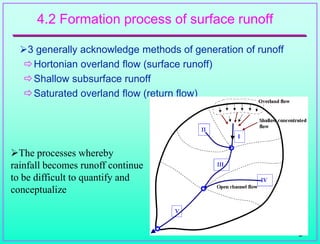
4.2 Formation process of surface runoff
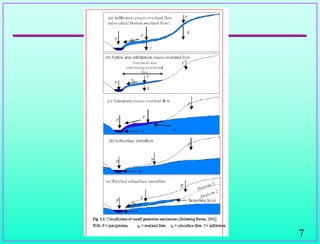
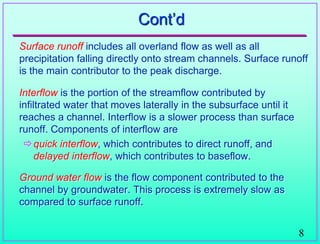
3 generally acknowledge methods of generation of runoff
Hortonian overland flow (surface runoff)
Shallow subsurface runoff
Saturated overland flow (return flow)
The processes whereby
rainfall becomes runoff continue
to be difficult to quantify and
conceptualize
6
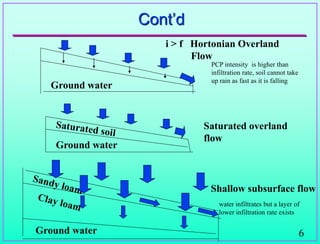
Cont‟d
Ground water
i > f Hortonian Overland
Flow
Ground water
Saturated overland
flow
Ground water
Shallow subsurface flow
PCP intensity is higher than
infiltration rate, soil cannot take
up rain as fast as it is falling
water infiltrates but a layer of
lower infiltration rate exists
7
8
Cont‟d
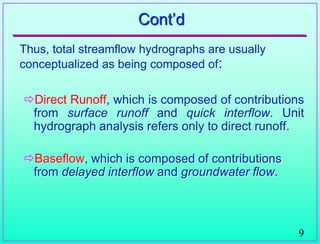
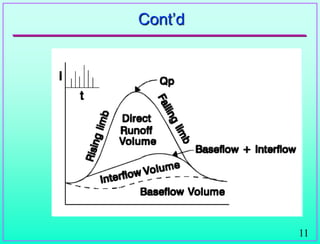
Surface runoff includes all overland flow as well as all
precipitation falling directly onto stream channels. Surface runoff
is the main contributor to the peak discharge.
Interflow is the portion of the streamflow contributed by
infiltrated water that moves laterally in the subsurface until it
reaches a channel. Interflow is a slower process than surface
runoff. Components of interflow are
quick interflow, which contributes to direct runoff, and
delayed interflow, which contributes to baseflow.
Ground water flow is the flow component contributed to the
channel by groundwater. This process is extremely slow as
compared to surface runoff.
9
Cont‟d
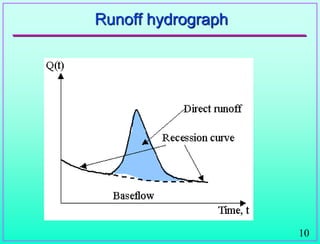
Thus, total streamflow hydrographs are usually
conceptualized as being composed of:
Direct Runoff, which is composed of contributions
from surface runoff and quick interflow. Unit
hydrograph analysis refers only to direct runoff.
Baseflow, which is composed of contributions
from delayed interflow and groundwater flow.
10
Runoff hydrograph
11
Cont‟d
12
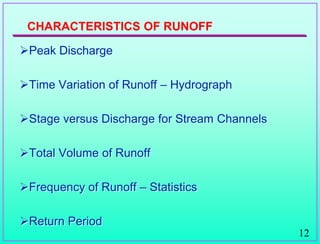
CHARACTERISTICS OF RUNOFF
Peak Discharge
Time Variation of Runoff – Hydrograph
Stage versus Discharge for Stream Channels
Total Volume of Runoff
Frequency of Runoff – Statistics
Return Period
1.
2
3.
4.
5.
6.
13
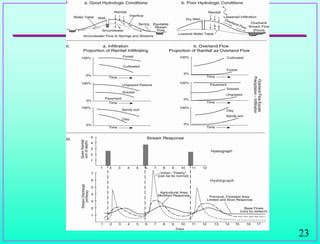
4.3 Factors affecting runoff
The main factors affecting runoff:
o Drainage characteristics: basin area, basin shape (form
and compactness), basin slope, soil type and land use,
drainage density, and drainage network topology. Most
changes in land use tend to increase the amount of runoff
for a given storm.
o Rainfall characteristics: rainfall intensity, duration, and their
spatial and temporal distribution; and storm motion, as
storms moving in the general downstream direction tend to
produce larger peak flows than storms moving upstream.
14
Cont‟d
1. Rainfall characteristics:
a. Type of storm and season
b. Intensity
c. Duration
d. Arial Distribution
e. Frequency
f. Antecedent precipitation
g. Direction of storm movement
2. Meteorological factors:
a. Temperature,
b. Humidity
c. Wind velocity
d. Pressure difference
15
3. Watershed Factor:
a. Size
b. Shape
c. Altitude
d. Topography
e. Geology [Soil type]
f. Land use [vegetation], Orientation
g. Type of drainage network
h. Proximate to ocean and mountain range
4. Storage Characteristics:
a. Depressions
b. Ponds, lakes and pools.
c. Stream
d. Channels.
e. Check dams in gullies
f. Upstream reservoirs or tanks.
g. Ground water storage in deposits/aquifers
16
Watershed Factors that Affect Runoff
Size- area of watershed
Topography – slope of watershed
Shape of watershed
Aspect of watershed
Geology
Soil
Land cover
17
Effect of watershed area
1mm of rain on 1km2 of watershed represents an input of
1,000 m3 of water or about 250,000 gallons of water.
If a watershed, of 10 km2 receives an annual precipitation of
300 mm, it is inputting about 3.0 1 billion m3.
18
Watershed Factors that Affect Runoff
Size- area of watershed
Topography – slope of watershed
May include drainage density effects
Shape of watershed
Aspect of watershed
Geology
Soil
Land cover
19
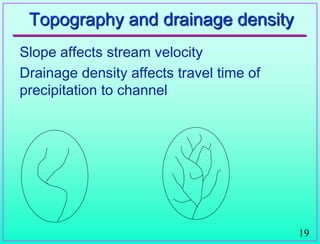
Topography and drainage density
Slope affects stream velocity
Drainage density affects travel time of
precipitation to channel
20
Watershed Factors that Affect Runoff
Size- area of watershed
Topography – slope of watershed
May include drainage density effects
Shape of watershed
Aspect of watershed
Geology
Soil
Land cover
21
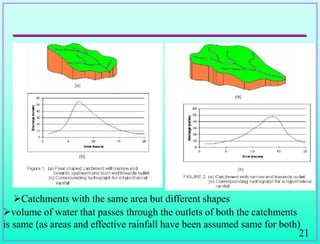
Catchments with the same area but different shapes
volume of water that passes through the outlets of both the catchments
is same (as areas and effective rainfall have been assumed same for both)
22
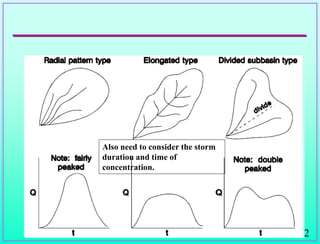
Also need to consider the storm
duration and time of
concentration.
23
24
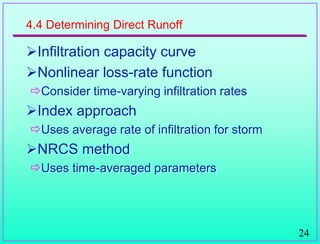
4.4 Determining Direct Runoff
Infiltration capacity curve
Nonlinear loss-rate function
Consider time-varying infiltration rates
Index approach
Uses average rate of infiltration for storm
NRCS method
Uses time-averaged parameters
25
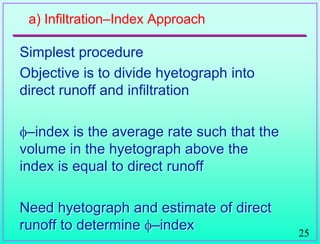
a) Infiltration–Index Approach
Simplest procedure
Objective is to divide hyetograph into
direct runoff and infiltration
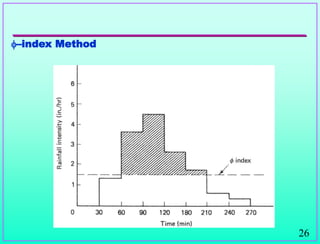
f–index is the average rate such that the
volume in the hyetograph above the
index is equal to direct runoff
Need hyetograph and estimate of direct
runoff to determine f–index
26
f–index Method
27
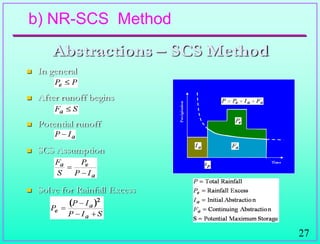
b) NR-SCS Method
28
Cont‟d
where Q = surface runoff [L]
P = precipitation [L]
Ia = initial abstraction
S = potential maximum soil retention [L]
Note that Q represents cumulative runoff corresponding to
cumulative P
S)
I
(P
)
I
(P
Q
a
2
a




29
Cont‟d
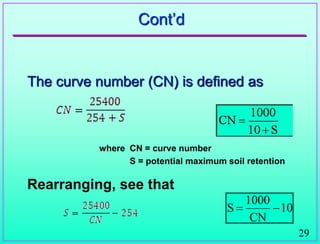
The curve number (CN) is defined as
where CN = curve number
S = potential maximum soil retention
Rearranging, see that
S 
1000
CN
10
30
Cont‟d
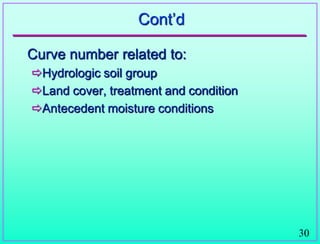
Curve number related to:
Hydrologic soil group
Land cover, treatment and condition
Antecedent moisture conditions
31
A parameter that combines soil type and land use to
estimate runoff potential.
Based on the Hydrologic Soil Group (HSG), land use
and condition.
Range between 0 and 100. The greater the curve
number, the greater the potential for RO.
Impervious areas and water surfaces are assigned
curve numbers of 98-100.
Curve Number
32
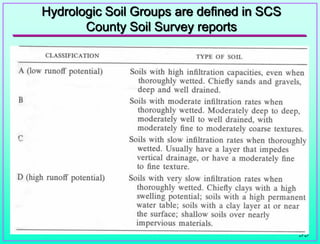
oSCS classified more than 4000 soils into four
general HSG (A, B, C, and D)
oBased on soils minimum infiltration rate when the
soil is bare and after prolonged wetting.
oIn general A have the highest infiltration capacity
and lowest runoff potential (sandy soils) and D have
lowest infiltration rates and highest runoff potential
(clay soils)
Hydrologic Soil Groups
33
Land Use and Condition
•Curve numbers for various land uses ranging from
cultivated land to industrial and residential districts.
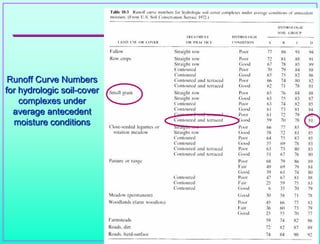
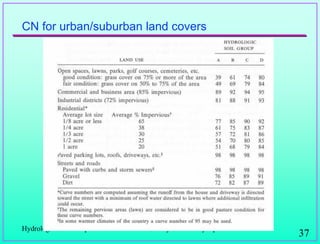
•Curve numbers are found in the table by using the
appropriate HSG and land use.
•When good condition and poor condition are
considered, good condition refers to areas for more
potential for infiltration and less for runoff.
34
Runoff Curve Numbers
for hydrologic soil-cover
complexes under
average antecedent
moisture conditions
35
Hydrologic Soil Groups are defined in SCS
County Soil Survey reports
36
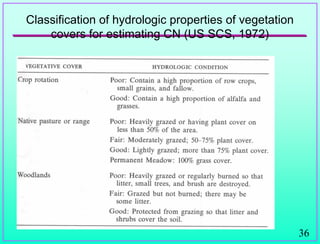
Classification of hydrologic properties of vegetation
covers for estimating CN (US SCS, 1972)
37
CN for urban/suburban land covers
Hydrologic Soil Groups are defined in SCS County Soil Survey reports
38
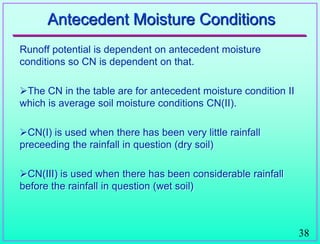
Antecedent Moisture Conditions
Runoff potential is dependent on antecedent moisture
conditions so CN is dependent on that.
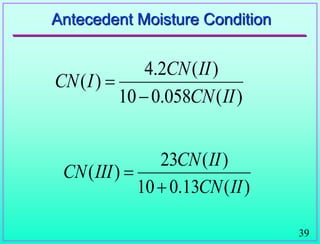
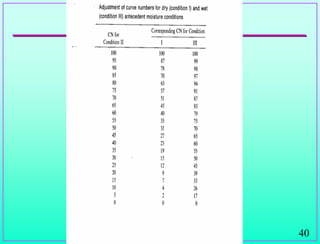
The CN in the table are for antecedent moisture condition II
which is average soil moisture conditions CN(II).
CN(I) is used when there has been very little rainfall
preceeding the rainfall in question (dry soil)
CN(III) is used when there has been considerable rainfall
before the rainfall in question (wet soil)
39
Antecedent Moisture Condition
)
(
058
.
0
10
)
(
2
.
4
)
(
II
CN
II
CN
I
CN


)
(
13
.
0
10
)
(
23
)
(
II
CN
II
CN
III
CN


40
41
42
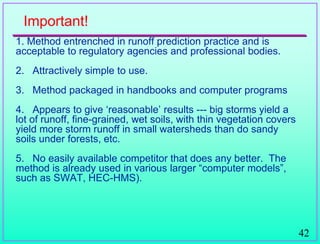
Important!
1. Method entrenched in runoff prediction practice and is
acceptable to regulatory agencies and professional bodies.
2. Attractively simple to use.
3. Method packaged in handbooks and computer programs
4. Appears to give „reasonable‟ results --- big storms yield a
lot of runoff, fine-grained, wet soils, with thin vegetation covers
yield more storm runoff in small watersheds than do sandy
soils under forests, etc.
5. No easily available competitor that does any better. The
method is already used in various larger “computer models”,
such as SWAT, HEC-HMS).
43
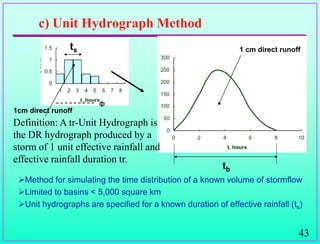
F
1cm direct runoff
ts
tb
1 cm direct runoff
c) Unit Hydrograph Method
Method for simulating the time distribution of a known volume of stormflow
Limited to basins < 5,000 square km
Unit hydrographs are specified for a known duration of effective rainfall (ts)
Definition: A tr-Unit Hydrograph is
the DR hydrograph produced by a
storm of 1 unit effective rainfall and
effective rainfall duration tr.
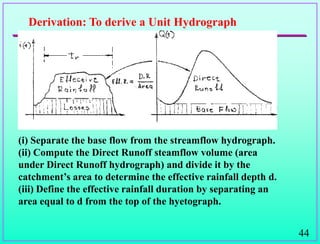
44
(i) Separate the base flow from the streamflow hydrograph.
(ii) Compute the Direct Runoff steamflow volume (area
under Direct Runoff hydrograph) and divide it by the
catchment’s area to determine the effective rainfall depth d.
(iii) Define the effective rainfall duration by separating an
area equal to d from the top of the hyetograph.
Derivation: To derive a Unit Hydrograph
45
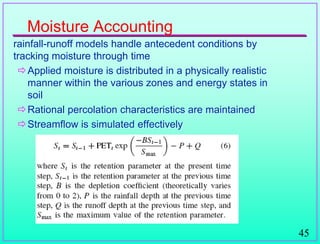
Moisture Accounting
rainfall-runoff models handle antecedent conditions by
tracking moisture through time
Applied moisture is distributed in a physically realistic
manner within the various zones and energy states in
soil
Rational percolation characteristics are maintained
Streamflow is simulated effectively
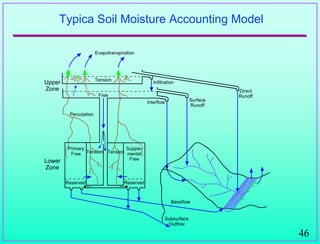
46
Typica Soil Moisture Accounting Model
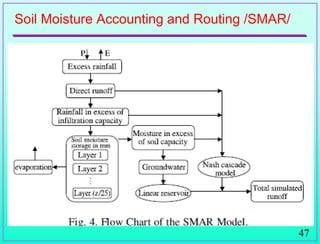
47
Soil Moisture Accounting and Routing /SMAR/
48
Generally any hydrologic processes is measured as
1. Point Sample
-Measurements made through time at a fixed
location in space.
-The resulting data forms a “Time Series”.
2. Distributed Samples
-Measurement made over a line or area in space at
a specific point in time.
-The resulting data forms a “Space Series”.
4.4 Runoff Measurement
49
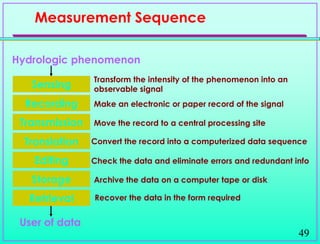
Sensing
Recording
Transmission
Translation
Editing
Storage
Retrieval
Hydrologic phenomenon
User of data
Transform the intensity of the phenomenon into an
observable signal
Make an electronic or paper record of the signal
Move the record to a central processing site
Convert the record into a computerized data sequence
Check the data and eliminate errors and redundant info
Archive the data on a computer tape or disk
Recover the data in the form required
Measurement Sequence
50
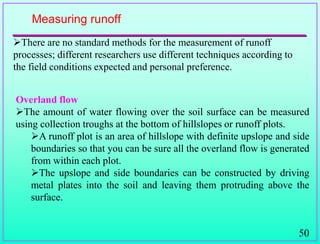
Measuring runoff
There are no standard methods for the measurement of runoff
processes; different researchers use different techniques according to
the field conditions expected and personal preference.
Overland flow
The amount of water flowing over the soil surface can be measured
using collection troughs at the bottom of hillslopes or runoff plots.
A runoff plot is an area of hillslope with definite upslope and side
boundaries so that you can be sure all the overland flow is generated
from within each plot.
The upslope and side boundaries can be constructed by driving
metal plates into the soil and leaving them protruding above the
surface.
51
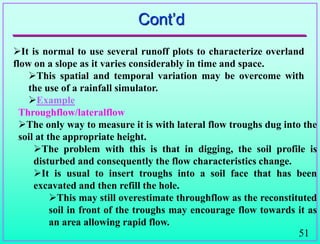
Cont‟d
It is normal to use several runoff plots to characterize overland
flow on a slope as it varies considerably in time and space.
This spatial and temporal variation may be overcome with
the use of a rainfall simulator.
Example
Throughflow/lateralflow
The only way to measure it is with lateral flow troughs dug into the
soil at the appropriate height.
The problem with this is that in digging, the soil profile is
disturbed and consequently the flow characteristics change.
It is usual to insert troughs into a soil face that has been
excavated and then refill the hole.
This may still overestimate throughflow as the reconstituted
soil in front of the troughs may encourage flow towards it as
an area allowing rapid flow.
52
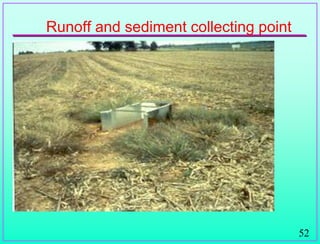
Runoff and sediment collecting point
53
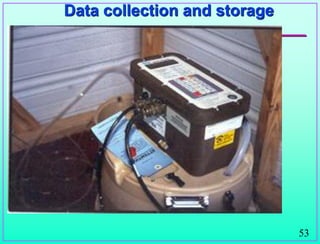
Data collection and storage
54
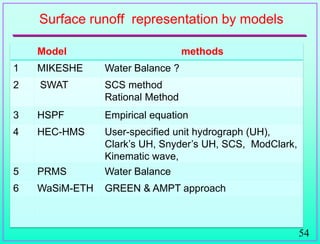
Surface runoff representation by models
Model methods
1 MIKESHE Water Balance ?
2 SWAT SCS method
Rational Method
3 HSPF Empirical equation
4 HEC-HMS User-specified unit hydrograph (UH),
Clark‟s UH, Snyder‟s UH, SCS, ModClark,
Kinematic wave,
5 PRMS Water Balance
6 WaSiM-ETH GREEN & AMPT approach
55
Selected papers
Paper1
Paper2
Paper3
Thesis (PhD)
Thesis1
Thesis2

Chapter 4-Surface runoff1.pdf format of document

  • 1.
    1 Arba Minch university Schoolof Post Graduate Course: Hydrological process Instructor: Kassa Tadele (PhD) April, 2013
  • 2.
    2  Questions  Generationof runoff/definitions  Factors affecting runoff  Methods to determine runoff  Representation of runoff by different models  Selected Papers Chapter 4 Surface runoff
  • 3.
    3 4.1 Questions For processresearch, the following questions has to be clear:  How can we isolate different runoff response mechanisms?  What are the key state variables controlling runoff generation? What do we want to know?  Volumes of storm runoff  Entire storm hydrographs  Deterministic prediction of peak rates of runoff from small watersheds  Probabilistic prediction of peak flows (from any size of watershed)  Continuous simulation of streamflow (storm and dry- weather flow)
  • 4.
  • 5.
    5 4.2 Formation processof surface runoff 3 generally acknowledge methods of generation of runoff Hortonian overland flow (surface runoff) Shallow subsurface runoff Saturated overland flow (return flow) The processes whereby rainfall becomes runoff continue to be difficult to quantify and conceptualize
  • 6.
    6 Cont‟d Ground water i >f Hortonian Overland Flow Ground water Saturated overland flow Ground water Shallow subsurface flow PCP intensity is higher than infiltration rate, soil cannot take up rain as fast as it is falling water infiltrates but a layer of lower infiltration rate exists
  • 7.
  • 8.
    8 Cont‟d Surface runoff includesall overland flow as well as all precipitation falling directly onto stream channels. Surface runoff is the main contributor to the peak discharge. Interflow is the portion of the streamflow contributed by infiltrated water that moves laterally in the subsurface until it reaches a channel. Interflow is a slower process than surface runoff. Components of interflow are quick interflow, which contributes to direct runoff, and delayed interflow, which contributes to baseflow. Ground water flow is the flow component contributed to the channel by groundwater. This process is extremely slow as compared to surface runoff.
  • 9.
    9 Cont‟d Thus, total streamflowhydrographs are usually conceptualized as being composed of: Direct Runoff, which is composed of contributions from surface runoff and quick interflow. Unit hydrograph analysis refers only to direct runoff. Baseflow, which is composed of contributions from delayed interflow and groundwater flow.
  • 10.
  • 11.
  • 12.
    12 CHARACTERISTICS OF RUNOFF PeakDischarge Time Variation of Runoff – Hydrograph Stage versus Discharge for Stream Channels Total Volume of Runoff Frequency of Runoff – Statistics Return Period 1. 2 3. 4. 5. 6.
  • 13.
    13 4.3 Factors affectingrunoff The main factors affecting runoff: o Drainage characteristics: basin area, basin shape (form and compactness), basin slope, soil type and land use, drainage density, and drainage network topology. Most changes in land use tend to increase the amount of runoff for a given storm. o Rainfall characteristics: rainfall intensity, duration, and their spatial and temporal distribution; and storm motion, as storms moving in the general downstream direction tend to produce larger peak flows than storms moving upstream.
  • 14.
    14 Cont‟d 1. Rainfall characteristics: a.Type of storm and season b. Intensity c. Duration d. Arial Distribution e. Frequency f. Antecedent precipitation g. Direction of storm movement 2. Meteorological factors: a. Temperature, b. Humidity c. Wind velocity d. Pressure difference
  • 15.
    15 3. Watershed Factor: a.Size b. Shape c. Altitude d. Topography e. Geology [Soil type] f. Land use [vegetation], Orientation g. Type of drainage network h. Proximate to ocean and mountain range 4. Storage Characteristics: a. Depressions b. Ponds, lakes and pools. c. Stream d. Channels. e. Check dams in gullies f. Upstream reservoirs or tanks. g. Ground water storage in deposits/aquifers
  • 16.
    16 Watershed Factors thatAffect Runoff Size- area of watershed Topography – slope of watershed Shape of watershed Aspect of watershed Geology Soil Land cover
  • 17.
    17 Effect of watershedarea 1mm of rain on 1km2 of watershed represents an input of 1,000 m3 of water or about 250,000 gallons of water. If a watershed, of 10 km2 receives an annual precipitation of 300 mm, it is inputting about 3.0 1 billion m3.
  • 18.
    18 Watershed Factors thatAffect Runoff Size- area of watershed Topography – slope of watershed May include drainage density effects Shape of watershed Aspect of watershed Geology Soil Land cover
  • 19.
    19 Topography and drainagedensity Slope affects stream velocity Drainage density affects travel time of precipitation to channel
  • 20.
    20 Watershed Factors thatAffect Runoff Size- area of watershed Topography – slope of watershed May include drainage density effects Shape of watershed Aspect of watershed Geology Soil Land cover
  • 21.
    21 Catchments with thesame area but different shapes volume of water that passes through the outlets of both the catchments is same (as areas and effective rainfall have been assumed same for both)
  • 22.
    22 Also need toconsider the storm duration and time of concentration.
  • 23.
  • 24.
    24 4.4 Determining DirectRunoff Infiltration capacity curve Nonlinear loss-rate function Consider time-varying infiltration rates Index approach Uses average rate of infiltration for storm NRCS method Uses time-averaged parameters
  • 25.
    25 a) Infiltration–Index Approach Simplestprocedure Objective is to divide hyetograph into direct runoff and infiltration f–index is the average rate such that the volume in the hyetograph above the index is equal to direct runoff Need hyetograph and estimate of direct runoff to determine f–index
  • 26.
  • 27.
  • 28.
    28 Cont‟d where Q =surface runoff [L] P = precipitation [L] Ia = initial abstraction S = potential maximum soil retention [L] Note that Q represents cumulative runoff corresponding to cumulative P S) I (P ) I (P Q a 2 a    
  • 29.
    29 Cont‟d The curve number(CN) is defined as where CN = curve number S = potential maximum soil retention Rearranging, see that S  1000 CN 10
  • 30.
    30 Cont‟d Curve number relatedto: Hydrologic soil group Land cover, treatment and condition Antecedent moisture conditions
  • 31.
    31 A parameter thatcombines soil type and land use to estimate runoff potential. Based on the Hydrologic Soil Group (HSG), land use and condition. Range between 0 and 100. The greater the curve number, the greater the potential for RO. Impervious areas and water surfaces are assigned curve numbers of 98-100. Curve Number
  • 32.
    32 oSCS classified morethan 4000 soils into four general HSG (A, B, C, and D) oBased on soils minimum infiltration rate when the soil is bare and after prolonged wetting. oIn general A have the highest infiltration capacity and lowest runoff potential (sandy soils) and D have lowest infiltration rates and highest runoff potential (clay soils) Hydrologic Soil Groups
  • 33.
    33 Land Use andCondition •Curve numbers for various land uses ranging from cultivated land to industrial and residential districts. •Curve numbers are found in the table by using the appropriate HSG and land use. •When good condition and poor condition are considered, good condition refers to areas for more potential for infiltration and less for runoff.
  • 34.
    34 Runoff Curve Numbers forhydrologic soil-cover complexes under average antecedent moisture conditions
  • 35.
    35 Hydrologic Soil Groupsare defined in SCS County Soil Survey reports
  • 36.
    36 Classification of hydrologicproperties of vegetation covers for estimating CN (US SCS, 1972)
  • 37.
    37 CN for urban/suburbanland covers Hydrologic Soil Groups are defined in SCS County Soil Survey reports
  • 38.
    38 Antecedent Moisture Conditions Runoffpotential is dependent on antecedent moisture conditions so CN is dependent on that. The CN in the table are for antecedent moisture condition II which is average soil moisture conditions CN(II). CN(I) is used when there has been very little rainfall preceeding the rainfall in question (dry soil) CN(III) is used when there has been considerable rainfall before the rainfall in question (wet soil)
  • 39.
  • 40.
  • 41.
  • 42.
    42 Important! 1. Method entrenchedin runoff prediction practice and is acceptable to regulatory agencies and professional bodies. 2. Attractively simple to use. 3. Method packaged in handbooks and computer programs 4. Appears to give „reasonable‟ results --- big storms yield a lot of runoff, fine-grained, wet soils, with thin vegetation covers yield more storm runoff in small watersheds than do sandy soils under forests, etc. 5. No easily available competitor that does any better. The method is already used in various larger “computer models”, such as SWAT, HEC-HMS).
  • 43.
    43 F 1cm direct runoff ts tb 1cm direct runoff c) Unit Hydrograph Method Method for simulating the time distribution of a known volume of stormflow Limited to basins < 5,000 square km Unit hydrographs are specified for a known duration of effective rainfall (ts) Definition: A tr-Unit Hydrograph is the DR hydrograph produced by a storm of 1 unit effective rainfall and effective rainfall duration tr.
  • 44.
    44 (i) Separate thebase flow from the streamflow hydrograph. (ii) Compute the Direct Runoff steamflow volume (area under Direct Runoff hydrograph) and divide it by the catchment’s area to determine the effective rainfall depth d. (iii) Define the effective rainfall duration by separating an area equal to d from the top of the hyetograph. Derivation: To derive a Unit Hydrograph
  • 45.
    45 Moisture Accounting rainfall-runoff modelshandle antecedent conditions by tracking moisture through time Applied moisture is distributed in a physically realistic manner within the various zones and energy states in soil Rational percolation characteristics are maintained Streamflow is simulated effectively
  • 46.
    46 Typica Soil MoistureAccounting Model
  • 47.
    47 Soil Moisture Accountingand Routing /SMAR/
  • 48.
    48 Generally any hydrologicprocesses is measured as 1. Point Sample -Measurements made through time at a fixed location in space. -The resulting data forms a “Time Series”. 2. Distributed Samples -Measurement made over a line or area in space at a specific point in time. -The resulting data forms a “Space Series”. 4.4 Runoff Measurement
  • 49.
    49 Sensing Recording Transmission Translation Editing Storage Retrieval Hydrologic phenomenon User ofdata Transform the intensity of the phenomenon into an observable signal Make an electronic or paper record of the signal Move the record to a central processing site Convert the record into a computerized data sequence Check the data and eliminate errors and redundant info Archive the data on a computer tape or disk Recover the data in the form required Measurement Sequence
  • 50.
    50 Measuring runoff There areno standard methods for the measurement of runoff processes; different researchers use different techniques according to the field conditions expected and personal preference. Overland flow The amount of water flowing over the soil surface can be measured using collection troughs at the bottom of hillslopes or runoff plots. A runoff plot is an area of hillslope with definite upslope and side boundaries so that you can be sure all the overland flow is generated from within each plot. The upslope and side boundaries can be constructed by driving metal plates into the soil and leaving them protruding above the surface.
  • 51.
    51 Cont‟d It is normalto use several runoff plots to characterize overland flow on a slope as it varies considerably in time and space. This spatial and temporal variation may be overcome with the use of a rainfall simulator. Example Throughflow/lateralflow The only way to measure it is with lateral flow troughs dug into the soil at the appropriate height. The problem with this is that in digging, the soil profile is disturbed and consequently the flow characteristics change. It is usual to insert troughs into a soil face that has been excavated and then refill the hole. This may still overestimate throughflow as the reconstituted soil in front of the troughs may encourage flow towards it as an area allowing rapid flow.
  • 52.
    52 Runoff and sedimentcollecting point
  • 53.
  • 54.
    54 Surface runoff representationby models Model methods 1 MIKESHE Water Balance ? 2 SWAT SCS method Rational Method 3 HSPF Empirical equation 4 HEC-HMS User-specified unit hydrograph (UH), Clark‟s UH, Snyder‟s UH, SCS, ModClark, Kinematic wave, 5 PRMS Water Balance 6 WaSiM-ETH GREEN & AMPT approach
  • 55.