This document discusses methods for measuring stream flow, including direct and indirect techniques. Direct measurement involves area-velocity methods where velocity is measured at different depths and the area is calculated. Indirect methods include using hydraulic structures like weirs that relate stage to discharge, and slope-area methods using the Manning and continuity equations. Developing a stage-discharge rating curve allows estimating discharge from stage readings over time. Backwater effects and unsteady flow can impact ratings and require adjustments.
Introduction to stream flow measurement including surface water hydrology, importance in various sectors, and discharge units (m³/sec, cfs).
Overview of direct (area-velocity, dilution, electromagnetic, ultrasonic) and indirect measurement techniques (hydraulic structures, slope area method).
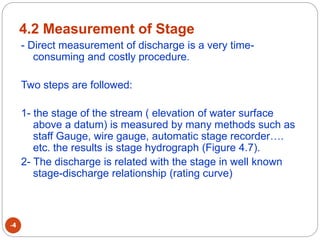
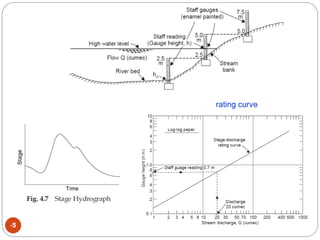
Stage measurement methods including gauging methods and introduction to stage-discharge relationship (rating curve).
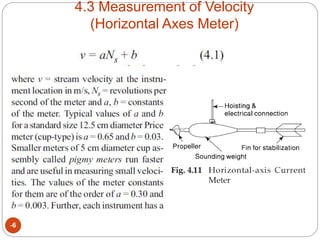
Focus on measuring velocity using the area-velocity method, including specific depth measurement details.
Explanation of indirect methods like flow measuring structures and slope-area method, including the Manning equation details.
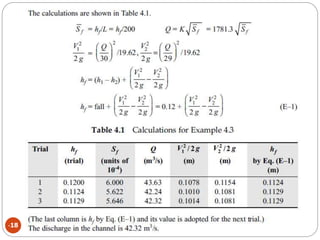
Step-by-step procedure for discharge estimation using trials and errors to refine values.
Discussion on measuring and plotting stage vs discharge to create rating curves in a gauging section.
Process of establishing permanent control using the G-Q curve, including regression analysis for best fit.
Methods for estimating stage for zero discharge through plotting and best fit curves.
Impact of changing channel characteristics on stage-discharge relationships and the need for updated rating curves.
Strategies for accounting backwater effects in gauging sections, including adjustment curves.
Analysis of the impact of unsteady flow on stage-discharge relationships and the resulting measurement complexities.
CHAPTER FOUR
Stream flowmeasurement
-1
Engineering Hydrology
(ECIV 4323)
Instructor:
Dr. Yunes Mogheir
2015
2.
-2
- Surface waterhydrology deals with the
movement of water a long earth’s surface as
a result of precipitation and snow melt
- Knowledge of quantity and quality of stream
flow is a request of municipal, industrial,
agricultural and other water supply projects.
- The water flowing in stream is measured as
discharge of water with a unit of volume
(m3/sec, cubic of feet per second – cfs)
4.1 Introduction
3.
Stream Measurements
-3
1) Directmeasurement of stream
- Area-velocity methods
- Dilution techniques
- Electromagnetic methods
- Ultrasonic method
2) Indirect measurement of stream
- Hydraulic structure such as weir, flumes and gated
structure
- Slope area method
4.
4.2 Measurement ofStage
-4
- Direct measurement of discharge is a very time-
consuming and costly procedure.
Two steps are followed:
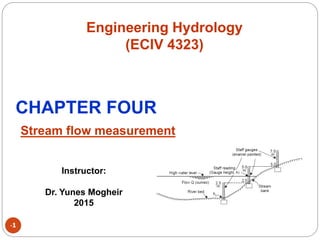
1- the stage of the stream ( elevation of water surface
above a datum) is measured by many methods such as
staff Gauge, wire gauge, automatic stage recorder….
etc. the results is stage hydrograph (Figure 4.7).
2- The discharge is related with the stage in well known
stage-discharge relationship (rating curve)
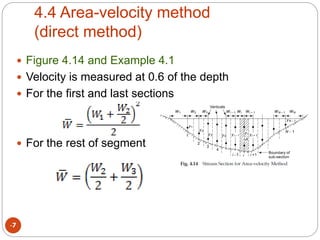
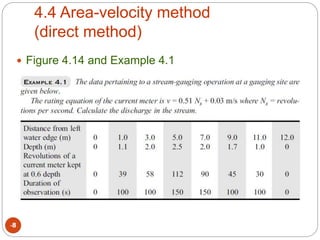
4.4 Area-velocity method
(directmethod)
-7
Figure 4.14 and Example 4.1
Velocity is measured at 0.6 of the depth
For the first and last sections
For the rest of segment
4.8 indirect method
-11
-Make use of the relation between the discharge and
the flow discharge and the depths at specified
locations.
1. Flow measuring structures (weirs, flume…etc)
2. Slope area methods
For flow measuring structures the discharge Q is a function
of the water-surface elevation measured at specified
location
Q=f(H)
12.
4.8 indirect method
Slope-Area method
-12
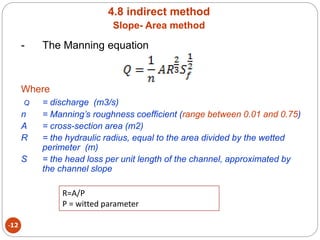
- The Manning equation
Where
Q = discharge (m3/s)
n = Manning’s roughness coefficient (range between 0.01 and 0.75)
A = cross-section area (m2)
R = the hydraulic radius, equal to the area divided by the wetted
perimeter (m)
S = the head loss per unit length of the channel, approximated by
the channel slope
R=A/P
P = witted parameter
13.
-13
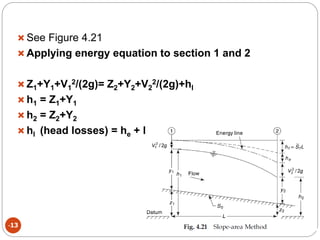
See Figure4.21
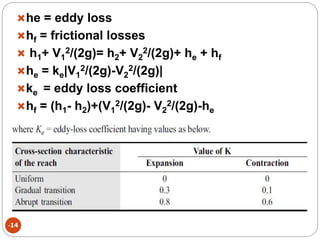
Applying energy equation to section 1 and 2
Z1+Y1+V1
2/(2g)= Z2+Y2+V2
2/(2g)+hl
h1 = Z1+Y1
h2 = Z2+Y2
hl (head losses) = he + hf
4.8 indirect method
Slope-Area method
-15
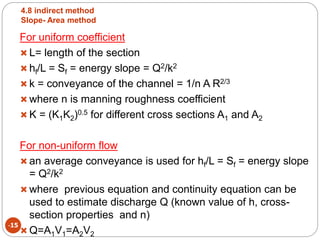
For uniform coefficient
L= length of the section
hf/L = Sf = energy slope = Q2/k2
k = conveyance of the channel = 1/n A R2/3
where n is manning roughness coefficient
K = (K1K2)0.5 for different cross sections A1 and A2
For non-uniform flow
an average conveyance is used for hf/L = Sf = energy slope
= Q2/k2
where previous equation and continuity equation can be
used to estimate discharge Q (known value of h, cross-
section properties and n)
Q=A1V1=A2V2
16.
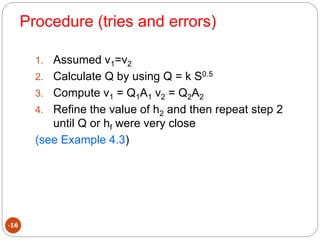
Procedure (tries anderrors)
-16
1. Assumed v1=v2
2. Calculate Q by using Q = k S0.5
3. Compute v1 = Q1A1 v2 = Q2A2
4. Refine the value of h2 and then repeat step 2
until Q or hf were very close
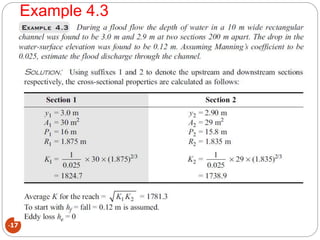
(see Example 4.3)
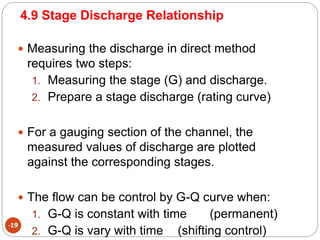
4.9 Stage DischargeRelationship
-19
Measuring the discharge in direct method
requires two steps:
1. Measuring the stage (G) and discharge.
2. Prepare a stage discharge (rating curve)
For a gauging section of the channel, the
measured values of discharge are plotted
against the corresponding stages.
The flow can be control by G-Q curve when:
1. G-Q is constant with time (permanent)
2. G-Q is vary with time (shifting control)
20.
Permanent control
-20
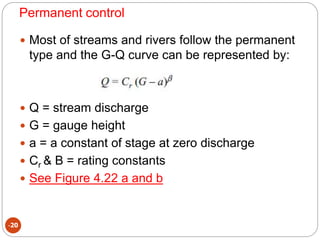
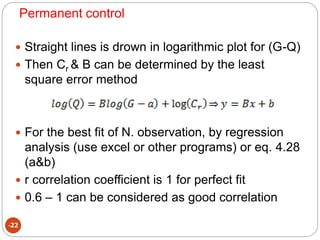
Mostof streams and rivers follow the permanent
type and the G-Q curve can be represented by:
Q = stream discharge
G = gauge height
a = a constant of stage at zero discharge
Cr & B = rating constants
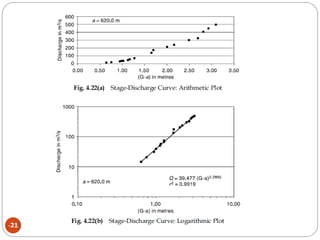
See Figure 4.22 a and b
Permanent control
-22
Straightlines is drown in logarithmic plot for (G-Q)
Then Cr & B can be determined by the least
square error method
For the best fit of N. observation, by regression
analysis (use excel or other programs) or eq. 4.28
(a&b)
r correlation coefficient is 1 for perfect fit
0.6 – 1 can be considered as good correlation
23.
Stage for zerodischarge (a)
-23
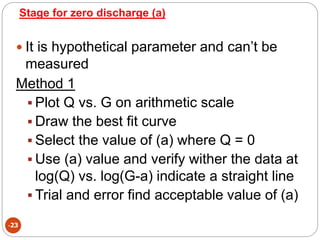
It is hypothetical parameter and can’t be
measured
Method 1
Plot Q vs. G on arithmetic scale
Draw the best fit curve
Select the value of (a) where Q = 0
Use (a) value and verify wither the data at
log(Q) vs. log(G-a) indicate a straight line
Trial and error find acceptable value of (a)
24.
Stage for zerodischarge (a)
-24
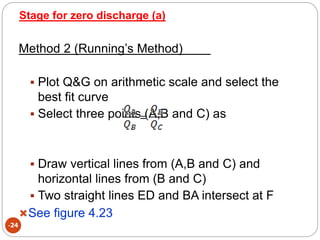
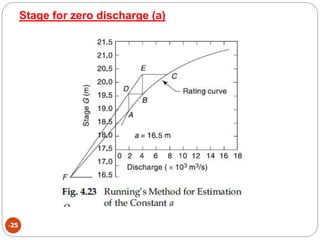
Method 2 (Running’s Method)
Plot Q&G on arithmetic scale and select the
best fit curve
Select three points (A,B and C) as
Draw vertical lines from (A,B and C) and
horizontal lines from (B and C)
Two straight lines ED and BA intersect at F
See figure 4.23
Stage for zerodischarge (a)
-26
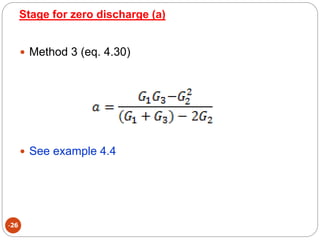
Method 3 (eq. 4.30)
See example 4.4
27.
Shifting controls (optional)
-27
Changeof stage discharge with time due to:
1. the changing characteristics of channel
2. aggradations or degradation of alluvial channel
3. variable backwater effect (the gauging section)
4. unsteady flow effects (rapidly change stage)
For 1 & 2 it is recommended to update rating
curves frequently
For 3 & 4 shifting control is recommended
28.
Backwater effect
-28
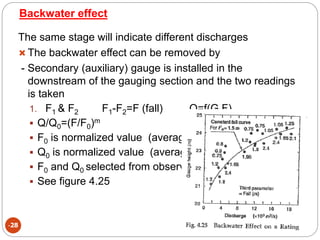
The samestage will indicate different discharges
The backwater effect can be removed by
- Secondary (auxiliary) gauge is installed in the
downstream of the gauging section and the two readings
is taken
1. F1 & F2 F1-F2=F (fall) Q=f(G,F)
Q/Q0=(F/F0)m
F0 is normalized value (average)
Q0 is normalized value (average)
F0 and Q0 selected from observation
See figure 4.25
29.
Backwater effect
-29
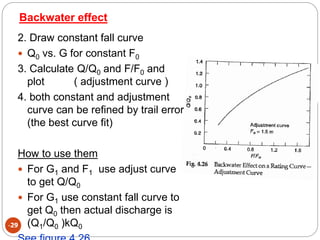
2. Drawconstant fall curve
Q0 vs. G for constant F0
3. Calculate Q/Q0 and F/F0 and
plot ( adjustment curve )
4. both constant and adjustment
curve can be refined by trail error
(the best curve fit)
How to use them
For G1 and F1 use adjust curve
to get Q/Q0
For G1 use constant fall curve to
get Q0 then actual discharge is
(Q1/Q0 )kQ0
30.
Unsteady flow effect
-30
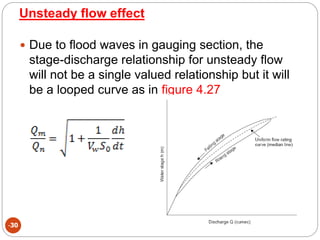
Due to flood waves in gauging section, the
stage-discharge relationship for unsteady flow
will not be a single valued relationship but it will
be a looped curve as in figure 4.27
31.
Unsteady flow effect
-31
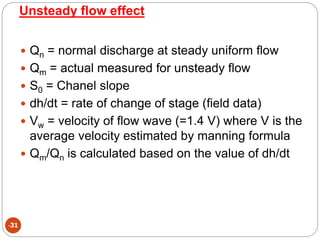
Qn = normal discharge at steady uniform flow
Qm = actual measured for unsteady flow
S0 = Chanel slope
dh/dt = rate of change of stage (field data)
Vw = velocity of flow wave (=1.4 V) where V is the
average velocity estimated by manning formula
Qm/Qn is calculated based on the value of dh/dt