Rainfall Runoff Models
Runoff estimation
 Runoff coefficient
 Water budget method
 Watershed routing technique
 Synthetic unit hydrograph
 Infiltration method
Methods of estimating Runoff rate
 Rational Method
 Curve number Method
RUNOFF COEFFICIENT
• The runoff coefficient is a key parameter used in hydrology to estimate the amount
of surface runoff generated from rainfall.
• It represents the fraction of total rainfall that becomes runoff, taking into account
factors like land use, soil type, vegetation cover, and slope. Values typically range
from 0 (no runoff) to 1 (total runoff).
• The coefficient is crucial for designing drainage systems, managing storm water,
and predicting flood risks, as it helps engineers and planners assess how much
water will flow into rivers and streams after precipitation events.
WATER BUDGET METHOD
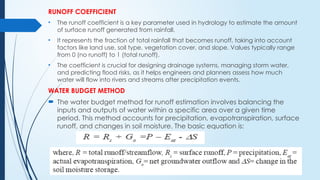
 The water budget method for runoff estimation involves balancing the
inputs and outputs of water within a specific area over a given time
period. This method accounts for precipitation, evapotranspiration, surface
runoff, and changes in soil moisture. The basic equation is:
By measuring or estimating each component, particularly precipitation and
evapotranspiration, one can calculate the amount of runoff generated. This
approach is useful for managing water resources, predicting flood events, and
assessing the impacts of land use changes on hydrology. It's particularly effective
in regions where direct measurements of runoff are challenging.
WATERSHED ROUTING TECHNIQUE
o The watershed routing technique is a method used to estimate the movement
and timing of runoff through a watershed. This approach considers the
watershed as a system that conveys water from its source (like rainfall or
snowmelt) to a discharge point. (river or stream)
o The watershed is divided into smaller units based on land use, soil type, and slope
which helps in understanding how different areas contribute to runoff.
o Flow Routing: Water is tracked as it moves through the watershed accounting for
travel time, storage, and transformation processes such as infiltration and
evaporation.
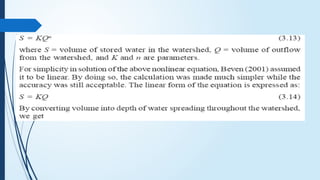
o Various models like the Muskingum or Kinematic Wave methods are used to
simulate the flow and predict how runoff will reach downstream points over time.
o This technique is valuable for flood forecasting, water quality assessment, and
managing watershed resources, providing insights into how different factors
influence runoff and its timing.
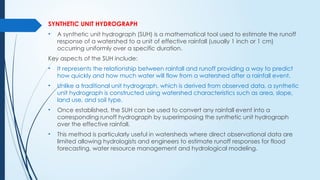
SYNTHETIC UNIT HYDROGRAPH
• A synthetic unit hydrograph (SUH) is a mathematical tool used to estimate the runoff
response of a watershed to a unit of effective rainfall (usually 1 inch or 1 cm)
occurring uniformly over a specific duration.
Key aspects of the SUH include:
• It represents the relationship between rainfall and runoff providing a way to predict
how quickly and how much water will flow from a watershed after a rainfall event.
• Unlike a traditional unit hydrograph, which is derived from observed data, a synthetic
unit hydrograph is constructed using watershed characteristics such as area, slope,
land use, and soil type.
• Once established, the SUH can be used to convert any rainfall event into a
corresponding runoff hydrograph by superimposing the synthetic unit hydrograph
over the effective rainfall.
• This method is particularly useful in watersheds where direct observational data are
limited allowing hydrologists and engineers to estimate runoff responses for flood
forecasting, water resource management and hydrological modeling.
INFILTRATION METHOD
• The infiltration method is used to estimate the amount of water that penetrates the
soil surface and becomes part of the groundwater or contributes to soil moisture,
rather than running off into streams or rivers.
Key aspects of the infiltration method include:
• Infiltration Capacity: This refers to the maximum rate at which water can enter the
soil, which varies based on soil type, moisture content, and land cover.
• Measurement Techniques: Common methods to estimate infiltration include field
tests (like the double-ring infiltrometer or pit tests) and empirical equations (like the
Horton or Kostiakov models) which describe how infiltration rates change over time.
• By estimating infiltration, hydrologists can better understand how much rainfall will
contribute to runoff versus being absorbed into the ground. This is critical for
designing drainage systems, managing water resources and assessing soil erosion
risks.
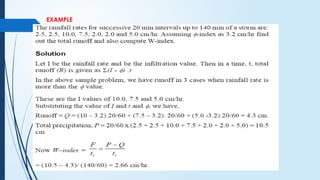
EXAMPLE
Methods of estimating Runoff rate
Rational method
Curve number method
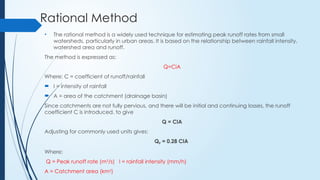
Rational Method
• The rational method is a widely used technique for estimating peak runoff rates from small
watersheds, particularly in urban areas. It is based on the relationship between rainfall intensity,
watershed area and runoff.
The method is expressed as:
Q=CiA
Where: C = coefficient of runoff/rainfall
 I = intensity of rainfall
 A = area of the catchment (drainage basin)
Since catchments are not fully pervious, and there will be initial and continuing losses, the runoff
coefficient C is introduced, to give
Q = CIA
Adjusting for commonly used units gives:
QP = 0.28 CIA
Where:
Q = Peak runoff rate (m3
/s) I = rainfall intensity (mm/h)
A = Catchment area (km2
)
• Runoff Coefficient: The runoff coefficient varies based on land use, soil type, and
surface conditions, reflecting how much rainfall is expected to generate runoff.
• Rainfall Intensity: The method requires accurate estimates of the rainfall intensity for
the specific duration of interest, usually using historical data or design storms.
The rational method is particularly effective for small drainage areas (typically less than
200 acres) and is commonly used in urban planning, stormwater management, and
designing drainage systems.
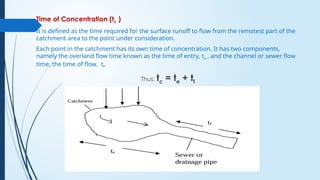
Time of Concentration (tc )
It is defined as the time required for the surface runoff to flow from the remotest part of the
catchment area to the point under consideration.
Each point in the catchment has its own time of concentration. It has two components,
namely the overland flow time known as the time of entry, te , and the channel or sewer flow
time, the time of flow, tf.
Thus; tc = te + tf
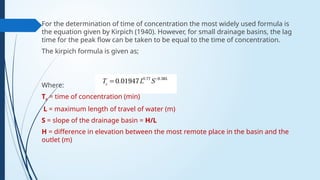
For the determination of time of concentration the most widely used formula is
the equation given by Kirpich (1940). However, for small drainage basins, the lag
time for the peak flow can be taken to be equal to the time of concentration.
The kirpich formula is given as;
Where:
Tc = time of concentration (min)
L = maximum length of travel of water (m)
S = slope of the drainage basin = H/L
H = difference in elevation between the most remote place in the basin and the
outlet (m)
Curve Number Method
This method is also called the Hydrologic soil cover complex number method or US Soil
Conservation Service (SCS) Method. It is based on the recharge capacity of the watershed.
The Curve Number (CN) method is a widely used approach in hydrology for estimating
direct runoff from rainfall in a given area. It was developed by the USDA Soil Conservation
Service and it takes into account land use, hydrologic soil groups and moisture conditions.
Key aspects of the Curve Number method include:
Curve Number Concept: Each land use type and hydrologic soil group combination is
assigned a Curve Number, which ranges from 30 to 100. A higher CN indicates a greater
potential for runoff. The CN reflects the area’s ability to absorb rainfall based on factors like
soil type, vegetation, and land management practices.
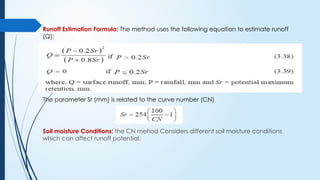
Runoff Estimation Formula: The method uses the following equation to estimate runoff
(Q):
The parameter Sr (mm) is related to the curve number (CN)
Soil moisture Conditions: the CN mehod Considers different soil moisture conditions
which can affect runoff potential.

Rainfall, precipitation,infiltration and runoff.pptx

  • 1.
  • 2.
    Runoff estimation  Runoffcoefficient  Water budget method  Watershed routing technique  Synthetic unit hydrograph  Infiltration method Methods of estimating Runoff rate  Rational Method  Curve number Method
  • 3.
    RUNOFF COEFFICIENT • Therunoff coefficient is a key parameter used in hydrology to estimate the amount of surface runoff generated from rainfall. • It represents the fraction of total rainfall that becomes runoff, taking into account factors like land use, soil type, vegetation cover, and slope. Values typically range from 0 (no runoff) to 1 (total runoff). • The coefficient is crucial for designing drainage systems, managing storm water, and predicting flood risks, as it helps engineers and planners assess how much water will flow into rivers and streams after precipitation events. WATER BUDGET METHOD  The water budget method for runoff estimation involves balancing the inputs and outputs of water within a specific area over a given time period. This method accounts for precipitation, evapotranspiration, surface runoff, and changes in soil moisture. The basic equation is:
  • 4.
    By measuring orestimating each component, particularly precipitation and evapotranspiration, one can calculate the amount of runoff generated. This approach is useful for managing water resources, predicting flood events, and assessing the impacts of land use changes on hydrology. It's particularly effective in regions where direct measurements of runoff are challenging.
  • 5.
    WATERSHED ROUTING TECHNIQUE oThe watershed routing technique is a method used to estimate the movement and timing of runoff through a watershed. This approach considers the watershed as a system that conveys water from its source (like rainfall or snowmelt) to a discharge point. (river or stream) o The watershed is divided into smaller units based on land use, soil type, and slope which helps in understanding how different areas contribute to runoff. o Flow Routing: Water is tracked as it moves through the watershed accounting for travel time, storage, and transformation processes such as infiltration and evaporation. o Various models like the Muskingum or Kinematic Wave methods are used to simulate the flow and predict how runoff will reach downstream points over time. o This technique is valuable for flood forecasting, water quality assessment, and managing watershed resources, providing insights into how different factors influence runoff and its timing.
  • 8.
    SYNTHETIC UNIT HYDROGRAPH •A synthetic unit hydrograph (SUH) is a mathematical tool used to estimate the runoff response of a watershed to a unit of effective rainfall (usually 1 inch or 1 cm) occurring uniformly over a specific duration. Key aspects of the SUH include: • It represents the relationship between rainfall and runoff providing a way to predict how quickly and how much water will flow from a watershed after a rainfall event. • Unlike a traditional unit hydrograph, which is derived from observed data, a synthetic unit hydrograph is constructed using watershed characteristics such as area, slope, land use, and soil type. • Once established, the SUH can be used to convert any rainfall event into a corresponding runoff hydrograph by superimposing the synthetic unit hydrograph over the effective rainfall. • This method is particularly useful in watersheds where direct observational data are limited allowing hydrologists and engineers to estimate runoff responses for flood forecasting, water resource management and hydrological modeling.
  • 9.
    INFILTRATION METHOD • Theinfiltration method is used to estimate the amount of water that penetrates the soil surface and becomes part of the groundwater or contributes to soil moisture, rather than running off into streams or rivers. Key aspects of the infiltration method include: • Infiltration Capacity: This refers to the maximum rate at which water can enter the soil, which varies based on soil type, moisture content, and land cover. • Measurement Techniques: Common methods to estimate infiltration include field tests (like the double-ring infiltrometer or pit tests) and empirical equations (like the Horton or Kostiakov models) which describe how infiltration rates change over time. • By estimating infiltration, hydrologists can better understand how much rainfall will contribute to runoff versus being absorbed into the ground. This is critical for designing drainage systems, managing water resources and assessing soil erosion risks.
  • 10.
  • 11.
    Methods of estimatingRunoff rate Rational method Curve number method
  • 12.
    Rational Method • Therational method is a widely used technique for estimating peak runoff rates from small watersheds, particularly in urban areas. It is based on the relationship between rainfall intensity, watershed area and runoff. The method is expressed as: Q=CiA Where: C = coefficient of runoff/rainfall  I = intensity of rainfall  A = area of the catchment (drainage basin) Since catchments are not fully pervious, and there will be initial and continuing losses, the runoff coefficient C is introduced, to give Q = CIA Adjusting for commonly used units gives: QP = 0.28 CIA Where: Q = Peak runoff rate (m3 /s) I = rainfall intensity (mm/h) A = Catchment area (km2 )
  • 13.
    • Runoff Coefficient:The runoff coefficient varies based on land use, soil type, and surface conditions, reflecting how much rainfall is expected to generate runoff. • Rainfall Intensity: The method requires accurate estimates of the rainfall intensity for the specific duration of interest, usually using historical data or design storms. The rational method is particularly effective for small drainage areas (typically less than 200 acres) and is commonly used in urban planning, stormwater management, and designing drainage systems.
  • 14.
    Time of Concentration(tc ) It is defined as the time required for the surface runoff to flow from the remotest part of the catchment area to the point under consideration. Each point in the catchment has its own time of concentration. It has two components, namely the overland flow time known as the time of entry, te , and the channel or sewer flow time, the time of flow, tf. Thus; tc = te + tf
  • 15.
    For the determinationof time of concentration the most widely used formula is the equation given by Kirpich (1940). However, for small drainage basins, the lag time for the peak flow can be taken to be equal to the time of concentration. The kirpich formula is given as; Where: Tc = time of concentration (min) L = maximum length of travel of water (m) S = slope of the drainage basin = H/L H = difference in elevation between the most remote place in the basin and the outlet (m)
  • 16.
    Curve Number Method Thismethod is also called the Hydrologic soil cover complex number method or US Soil Conservation Service (SCS) Method. It is based on the recharge capacity of the watershed. The Curve Number (CN) method is a widely used approach in hydrology for estimating direct runoff from rainfall in a given area. It was developed by the USDA Soil Conservation Service and it takes into account land use, hydrologic soil groups and moisture conditions. Key aspects of the Curve Number method include: Curve Number Concept: Each land use type and hydrologic soil group combination is assigned a Curve Number, which ranges from 30 to 100. A higher CN indicates a greater potential for runoff. The CN reflects the area’s ability to absorb rainfall based on factors like soil type, vegetation, and land management practices.
  • 17.
    Runoff Estimation Formula:The method uses the following equation to estimate runoff (Q): The parameter Sr (mm) is related to the curve number (CN) Soil moisture Conditions: the CN mehod Considers different soil moisture conditions which can affect runoff potential.

Editor's Notes

  • #14 This is an important term in storm sewer design. Time of entry: The time of entry will vary with catchment characteristics such as surface roughness, slope, and length of flow path together with rainfall characteristics. Time of flow: Time of flow is calculated from the sewer length and velocity of flow in the sewers.
  • #17 This method is particularly useful for watershed management, urban planning, and flood forecasting, as it provides a practical way to estimate runoff without requiring extensive data.