STREAMFLOW
MEASUREMENT
Mrs Siti Kamariah Bt Md Sa’at
Faculty of Mechanical Engineering & Technology
UniMAP
MMJ24203
HYDROLOGY AND WATER RESOURCES ENGINEERING
2
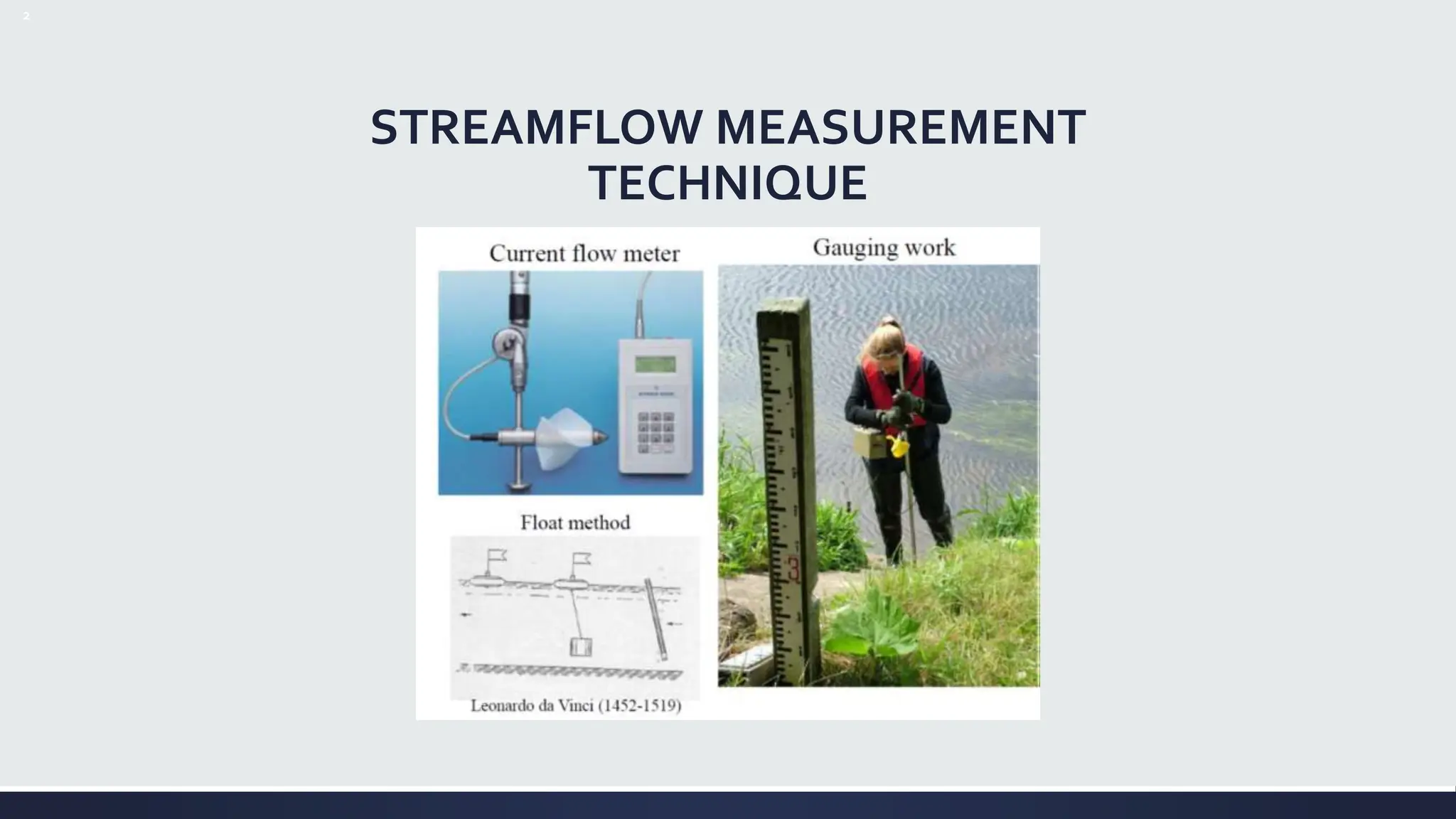
STREAMFLOW MEASUREMENT
TECHNIQUE
3
Streamflow and Measurement
▪ The character, amount, and timing of discharge from a basin tells a lot about flow
paths within the basin.
▪ Stream flow is one of the most important topics in engineering hydrology because
it directly relates to water supply, flood control, reservoir design, navigation,
irrigation, drainage, water quality, and others.
4
Need for Stream flow Measurements
▪ Floodplain management
▪ Flood forecasting & analysis
▪ Reservoir operations
▪ Low flows – water quality concerns
▪ Design structures – culverts, bridges, stormwater systems
▪ Evaluate changes in land use on watersheds and/or changes in
climatic regimes
5
Need for Streamflow Measurements
▪ Important to hydrogeologist to identify how to create stream hydrographs from
discharge measurements
6
Measurement of discharge
▪ Method used depends on type of study, size of river and flow, data
requirements, etc.
▪ Streamflow measurement techniques can be broadly classified into
2 categories:
▪ Direct determination – area-velocity method, dilution techniques,
electromagnetic method, ultrasonic method
▪ Indirect determination – hydraulic structures, slope-area method
7
Streamflow Measurements
▪ Serves as the basis for many water resources engineering designs
▪ Three approaches
▪ Measurement of water stage (water level)
▪ Measurement of flow velocity
▪ Hydraulic Structure
8
Streamflow Measurements
▪ Measurement ofWater Stage
▪ Water stage: the elevation above some arbitrary datum of water surface at a
station
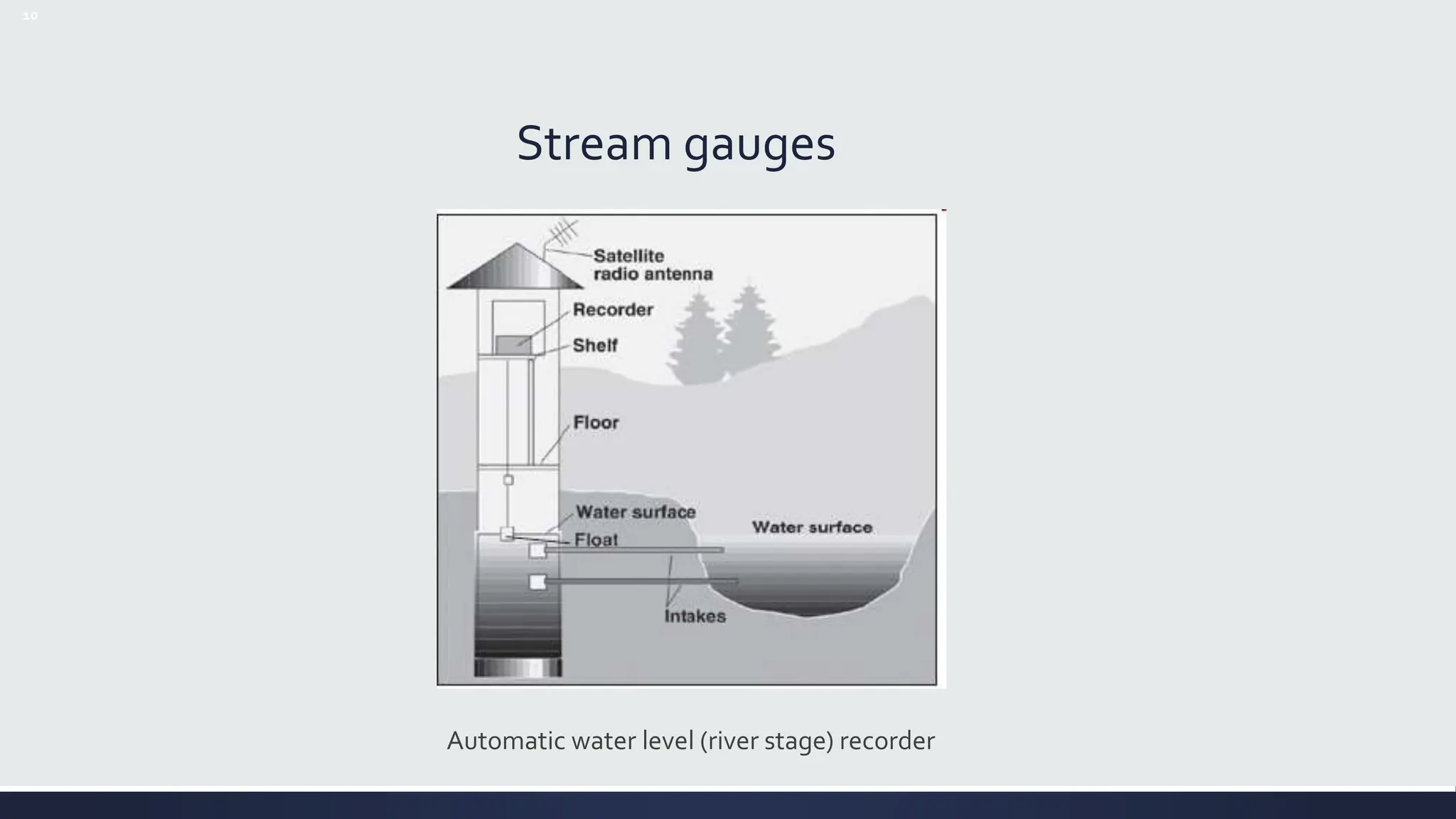
▪ Types of Gages Measuring River Stage:
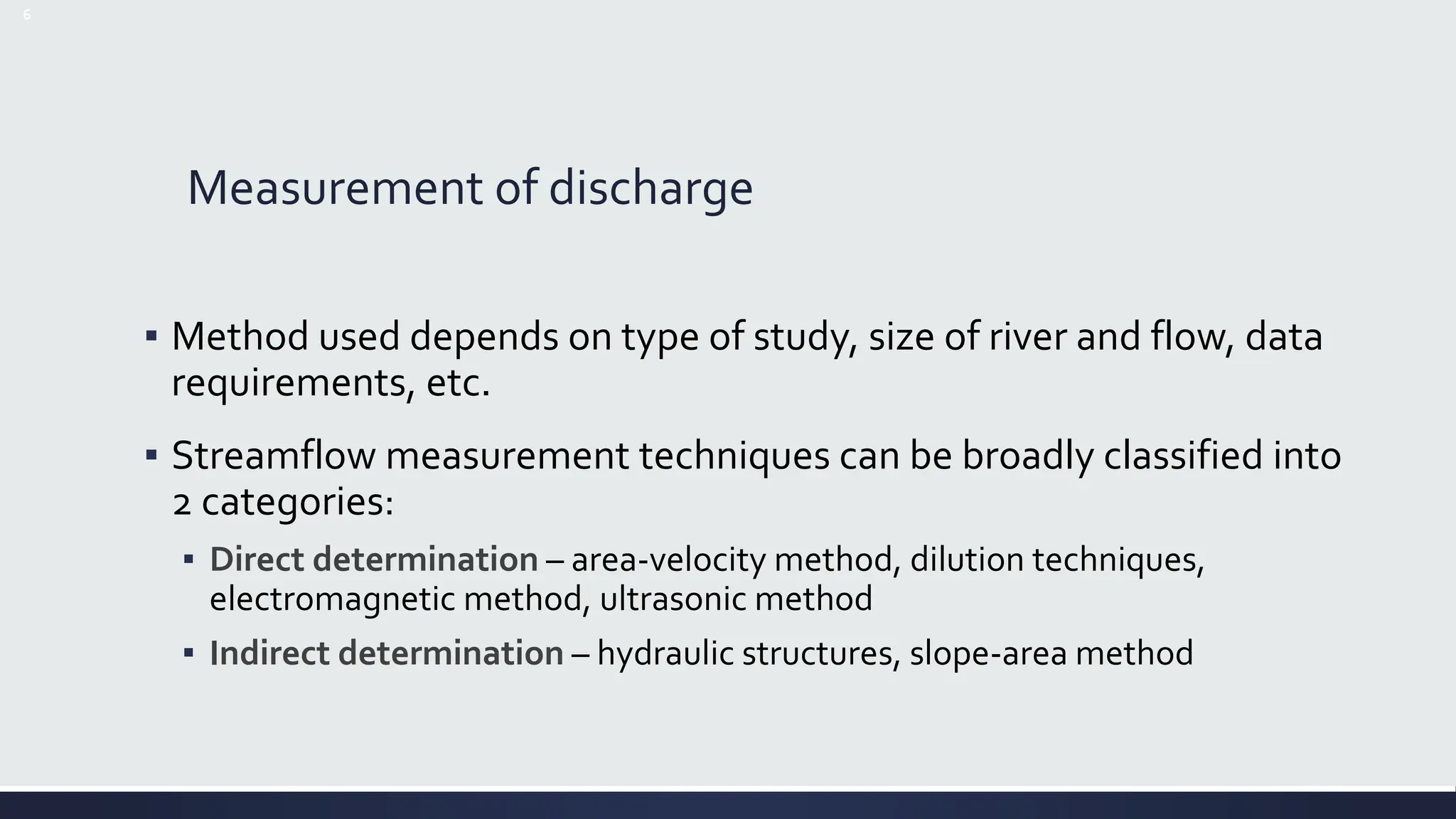
▪ Staff gage – vertical or inclined
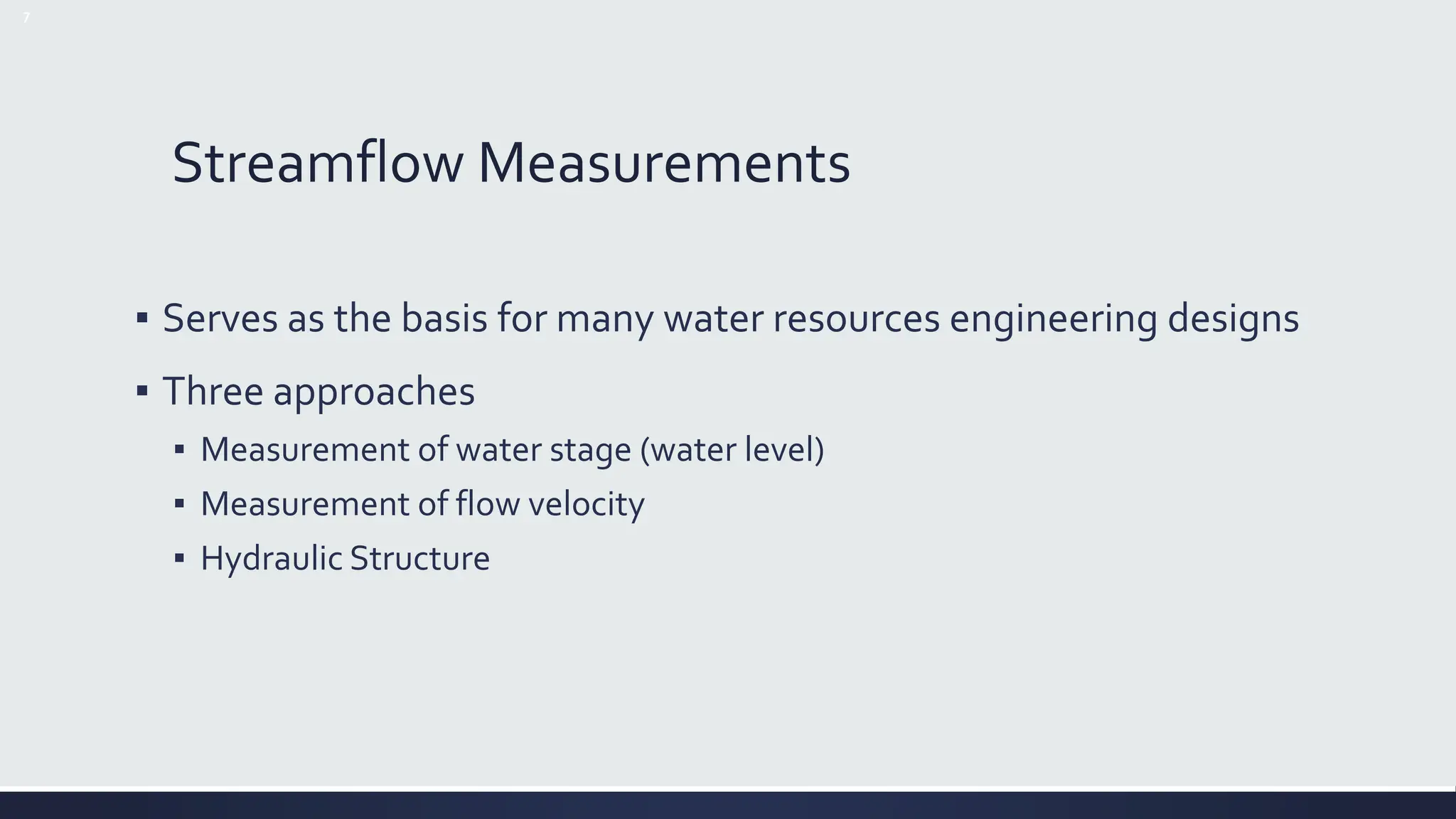
▪ Suspended – weight gage
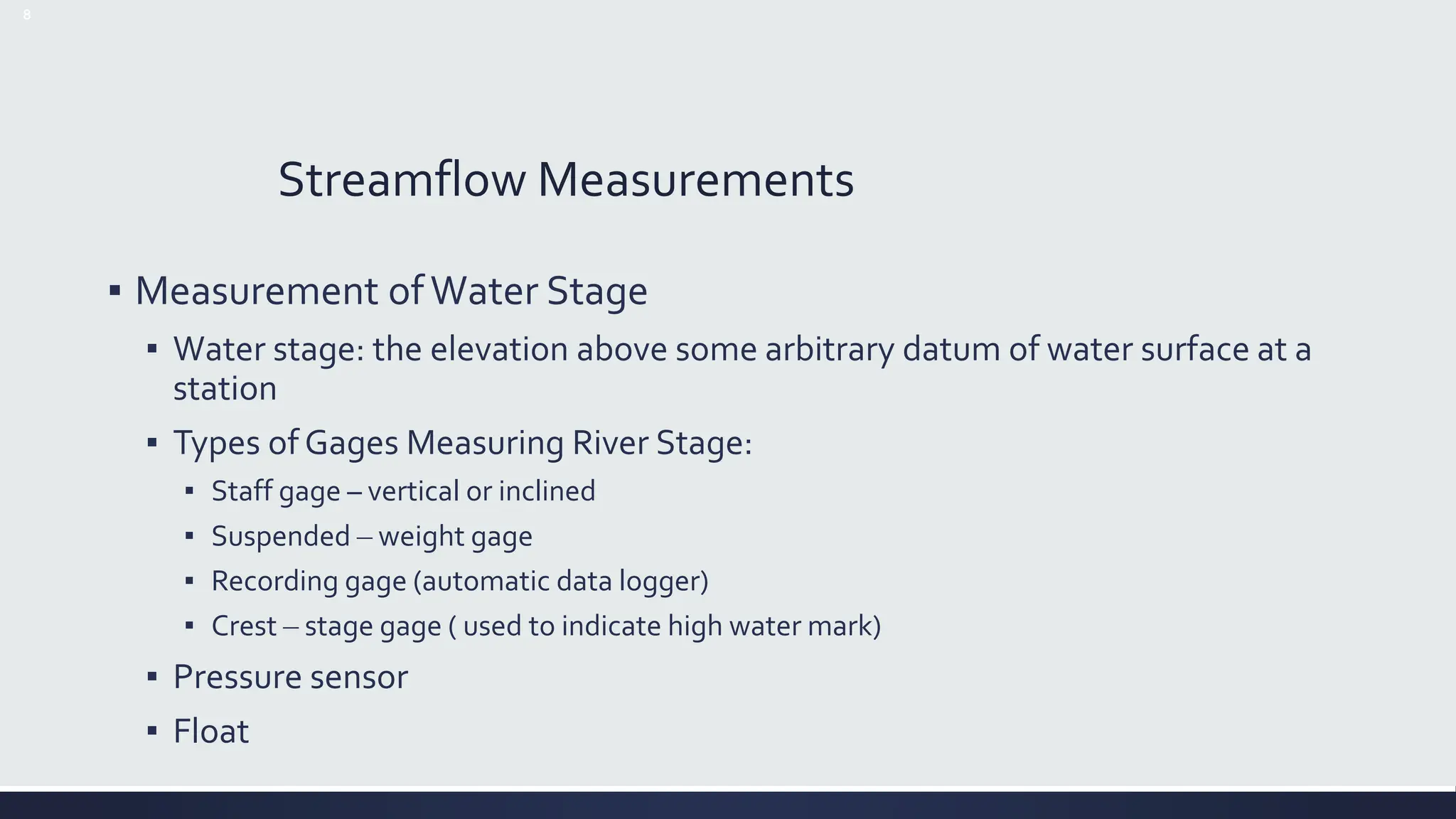
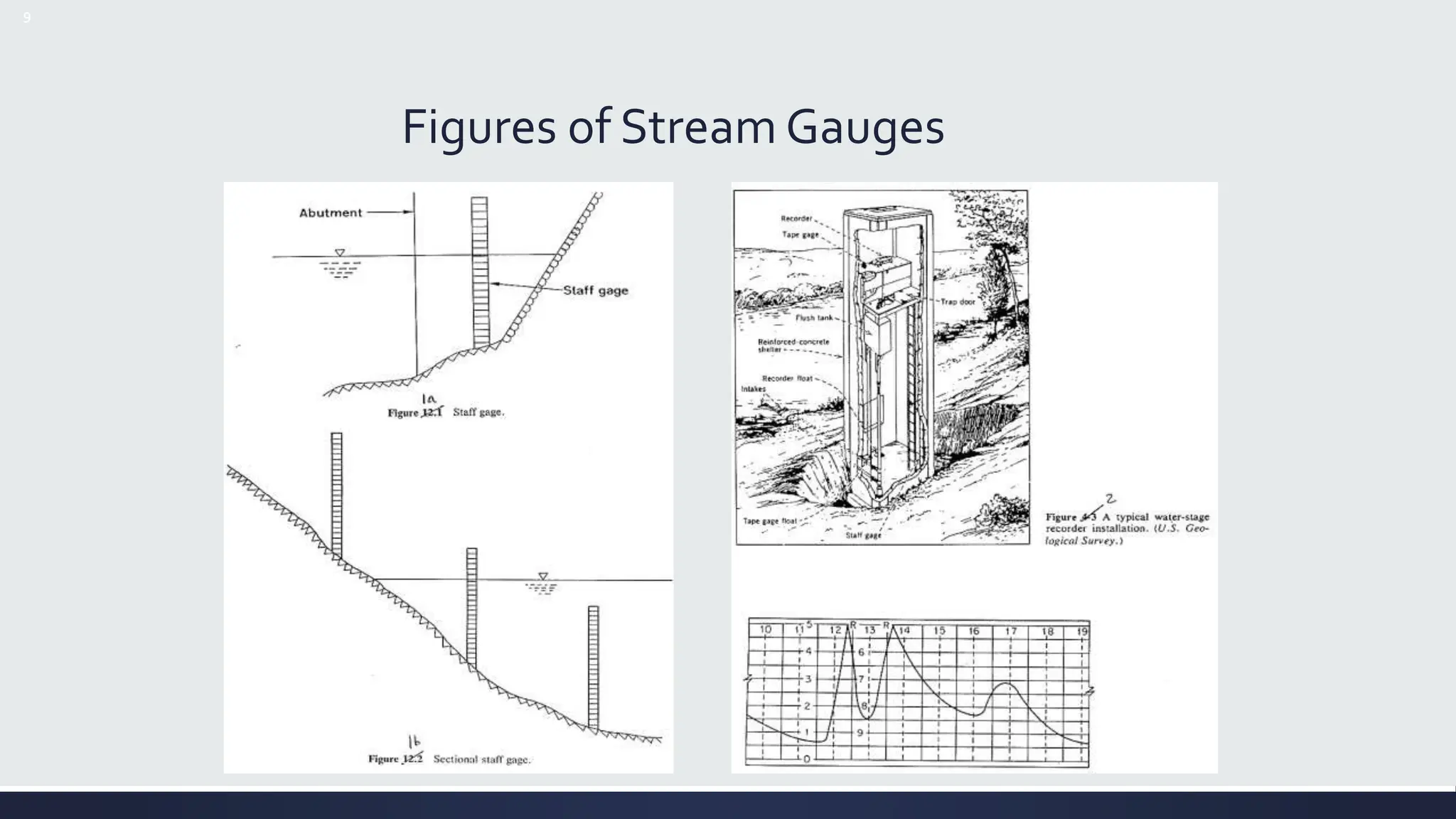
▪ Recording gage (automatic data logger)
▪ Crest – stage gage ( used to indicate high water mark)
▪ Pressure sensor
▪ Float
9
Figures of Stream Gauges
10
Stream gauges
Automatic water level (river stage) recorder
11
FLOWVELOCITY MEASUREMENT
▪ Measurement of FlowVelocity
▪ Current meter
▪ Dilution technique
▪ Manning Equation
▪ Floats: Suitable for straight channel,
▪ V = L/T
12
13
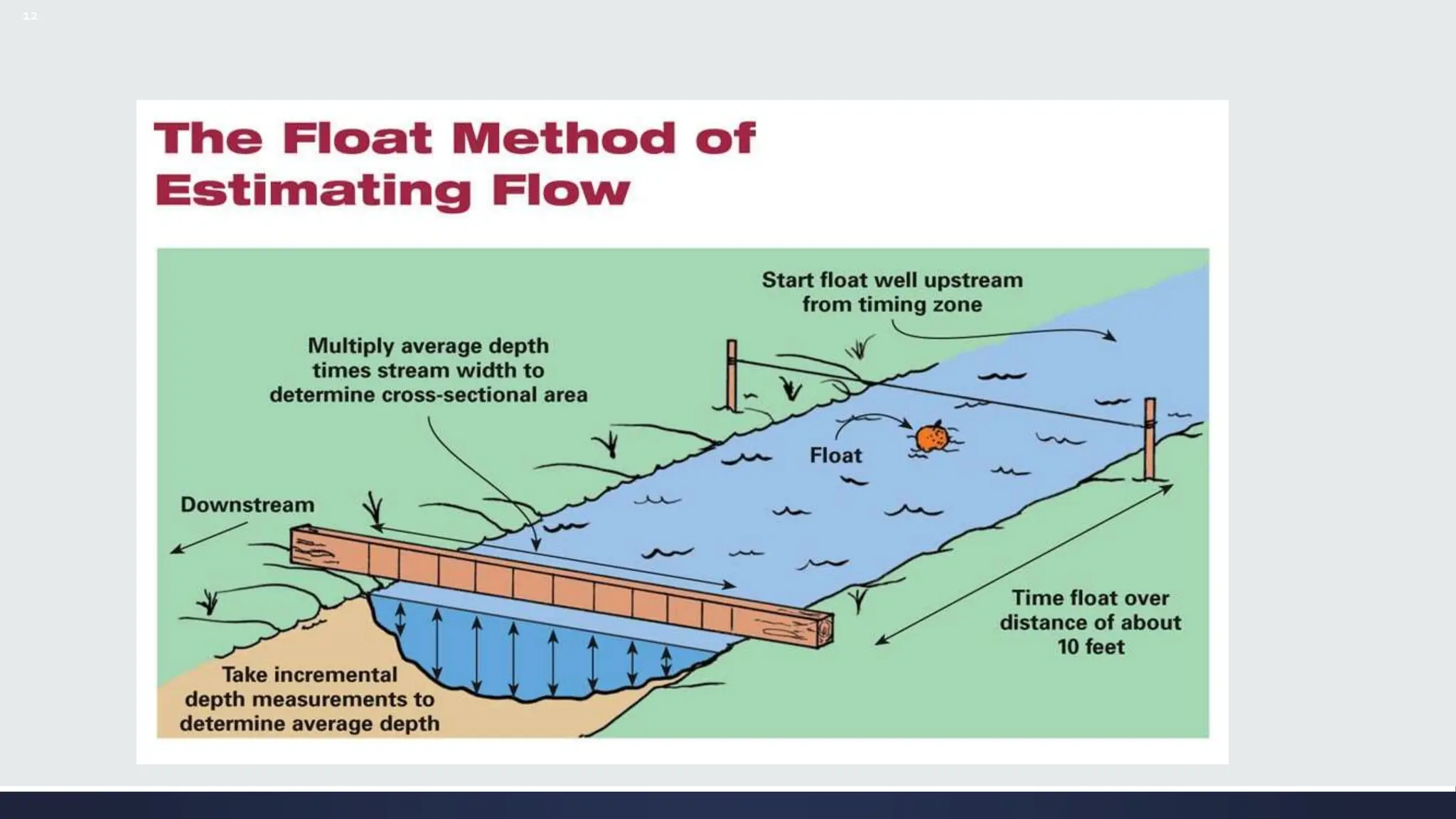
Float method
▪ Floats are a simple way of measuring the
velocity of a stream, but they are not very
accurate.
▪ The surface velocity is obtained by
measuring the time (t secs) for a float to
travel a measured distance (L metres).
▪ It is best to choose a straight, uniform river
section about 30m long, and to time the
float over a number of repeated runs.
14
Float method
▪ A factor of about 0.85 should be used to convert surface velocity to average velocity.
▪ Surface velocity (m/s) = L / t
▪ Average velocity (m/s) = 0.85 x L / t
▪ The cross section of the stream should be measured up carefully in a number of places along the
test distance, and the average cross-sectional area calculated (A sq m).
▪ Discharge (cubic metres per second)
= average velocity × cross sectional area of stream
= 0.85 × (L / t) × A
▪ Discharge (L/s) = 1000 × 0.85 × (L / t) × A
Discharge (Q) Measurement
16
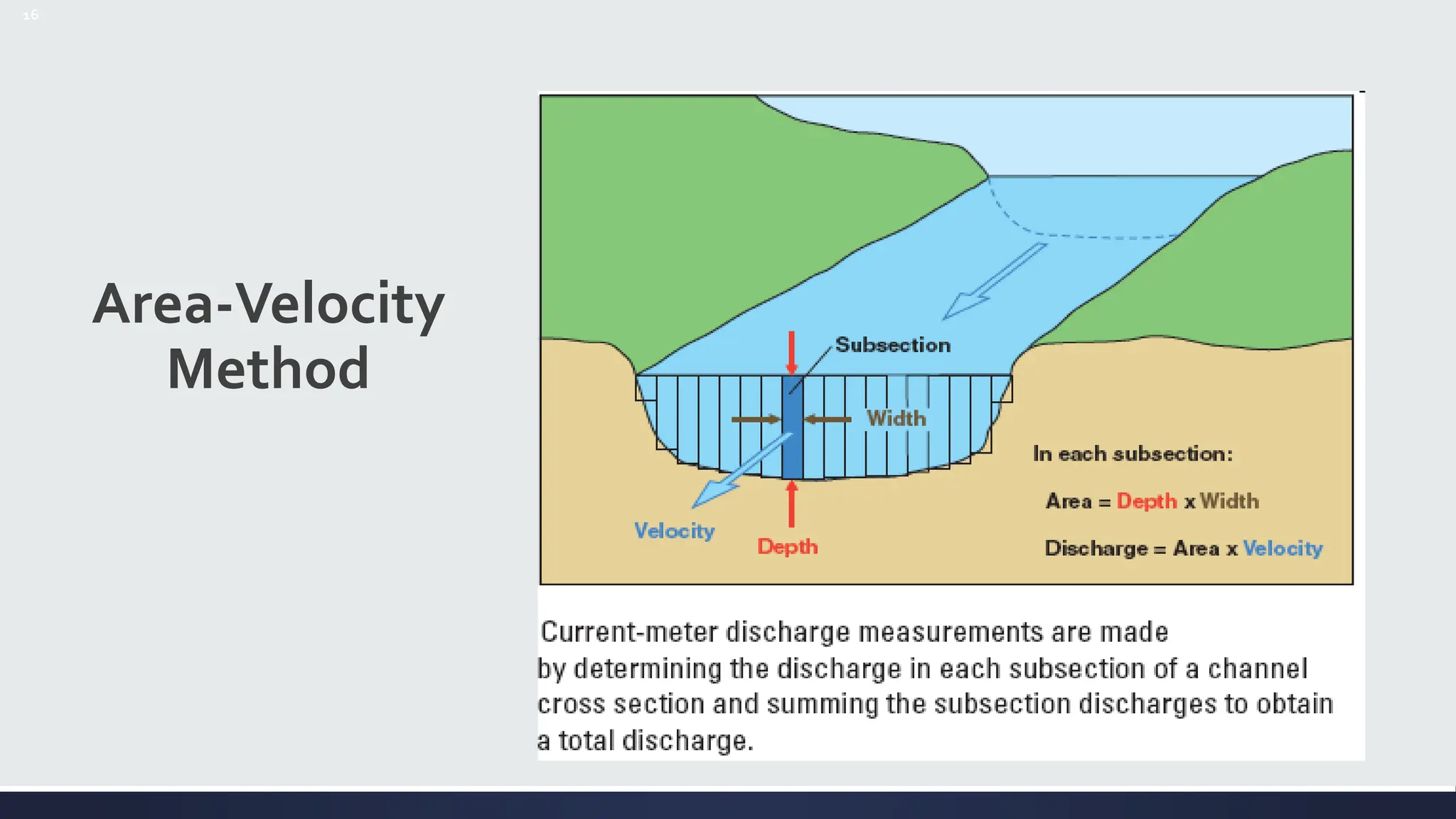
Area-Velocity
Method
17
VELOCITY MEASUREMENT
18
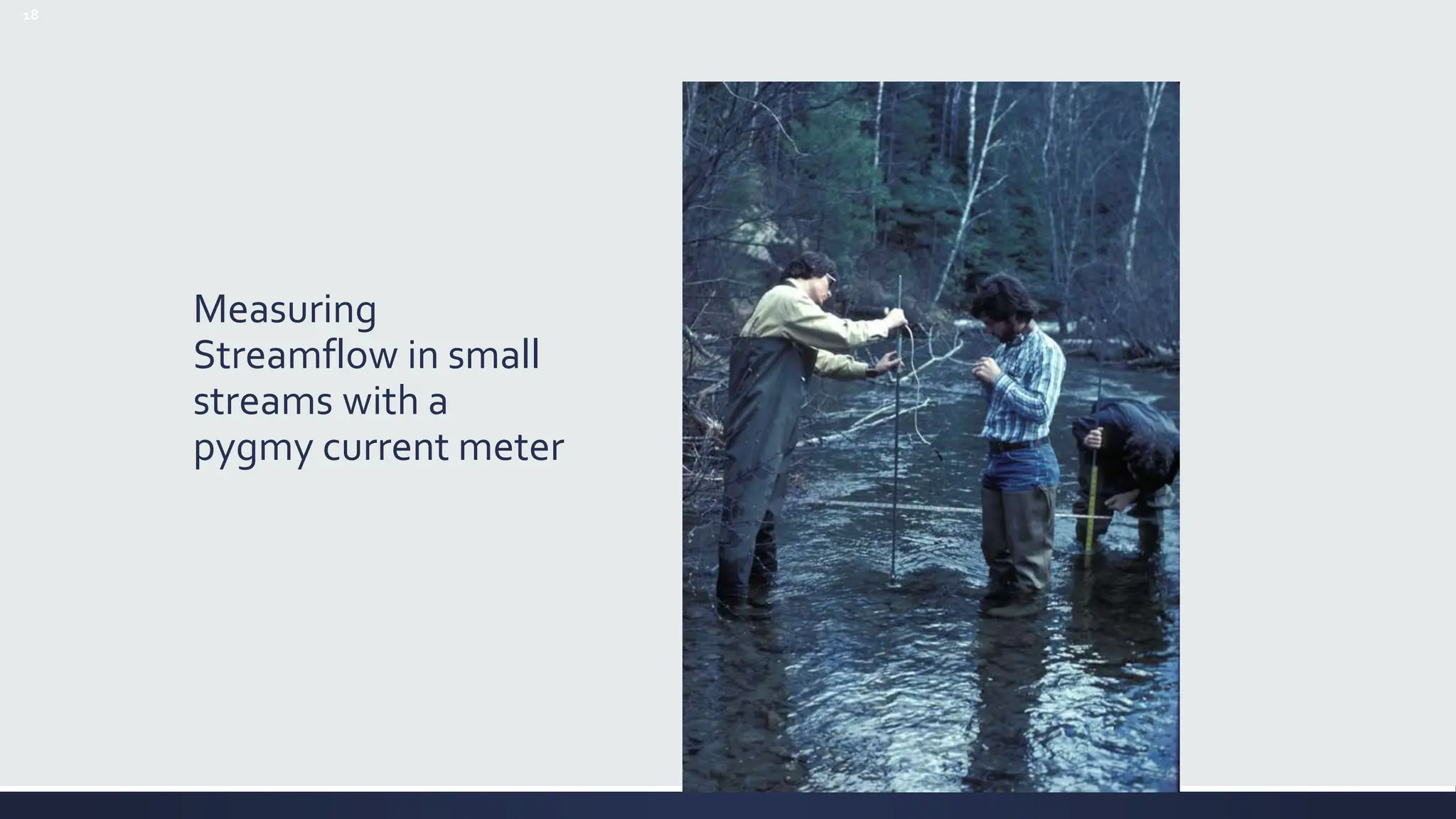
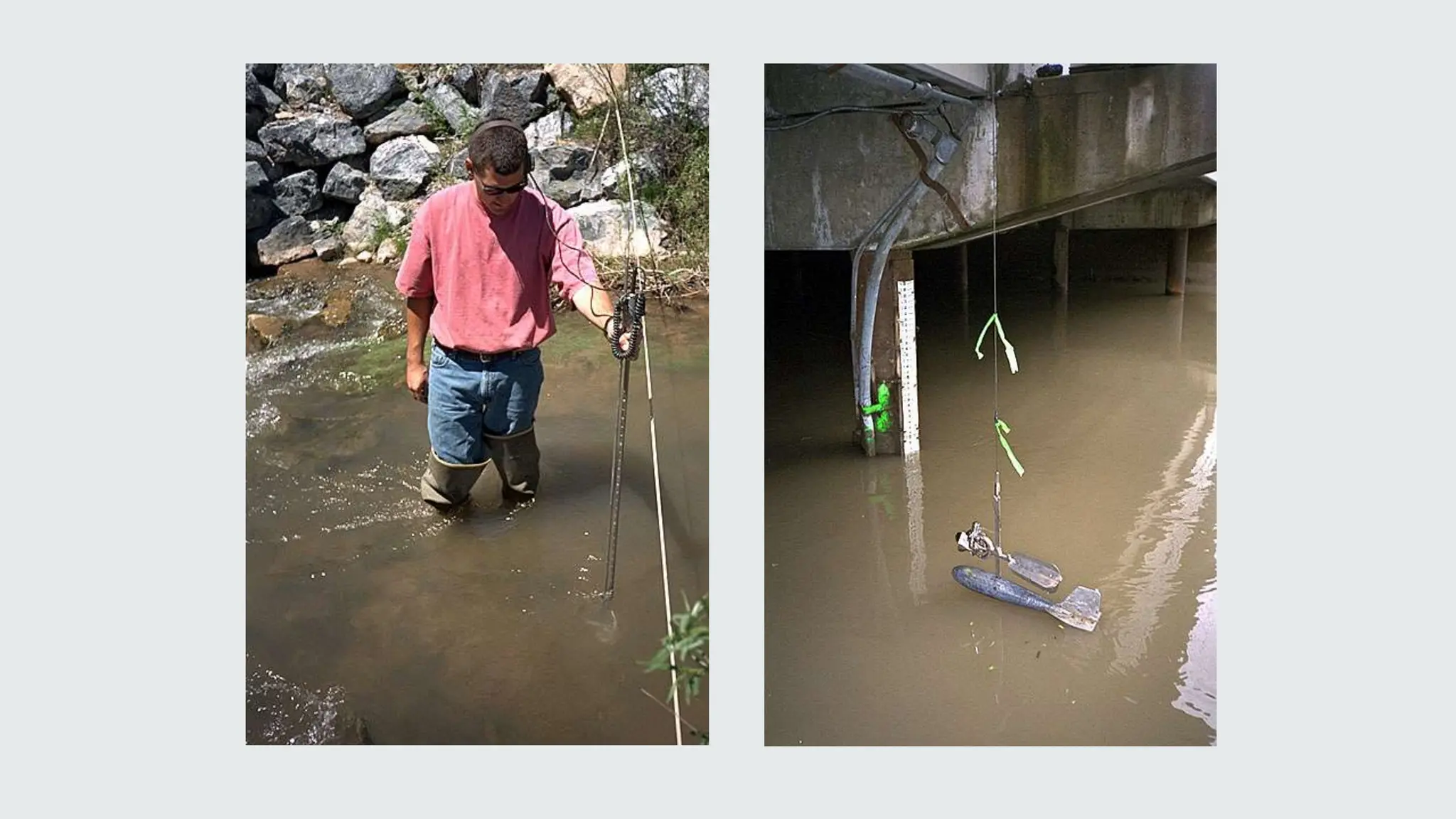
Measuring
Streamflow in small
streams with a
pygmy current meter
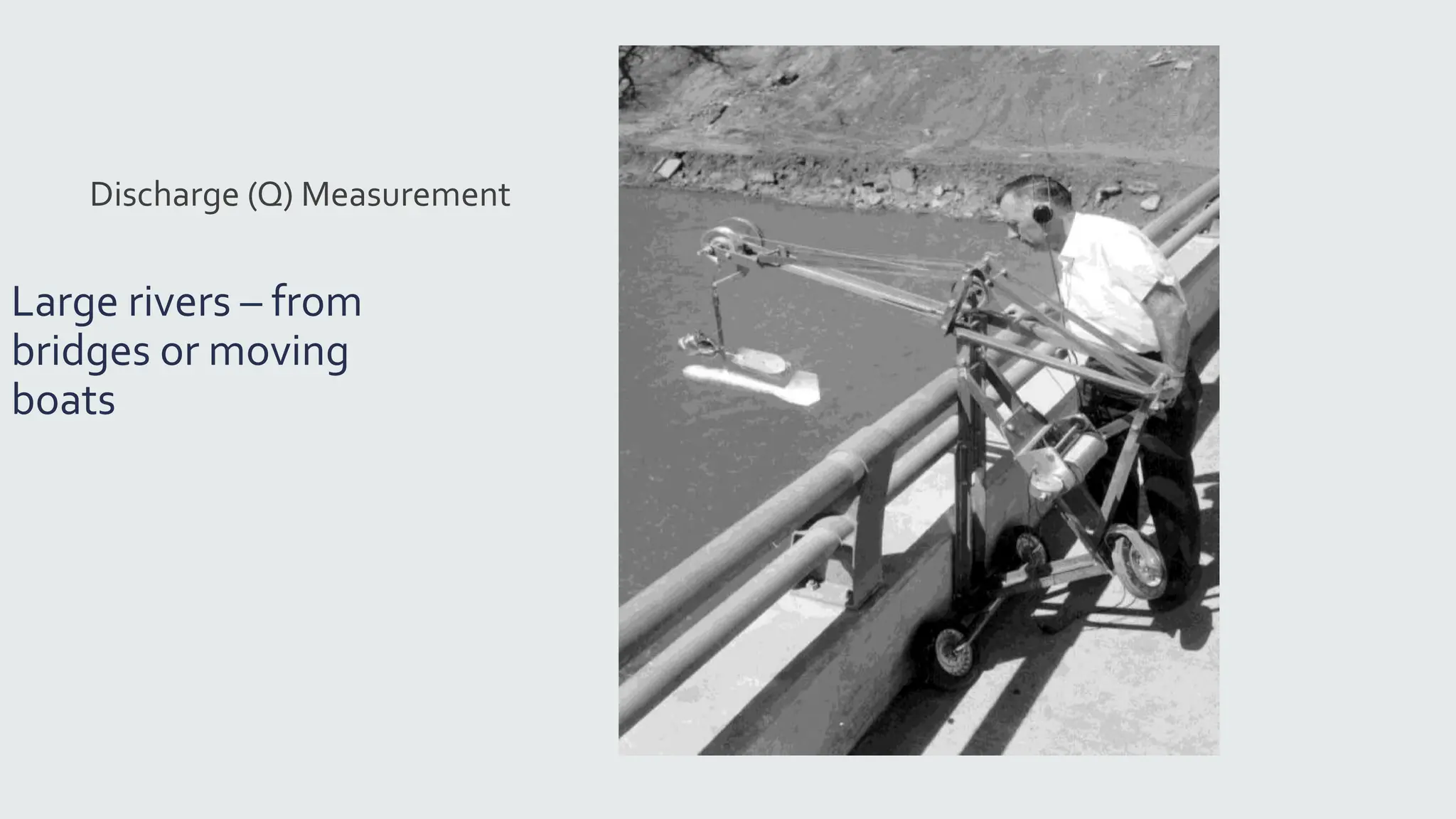
Discharge (Q) Measurement
Large rivers – from
bridges or moving
boats
22
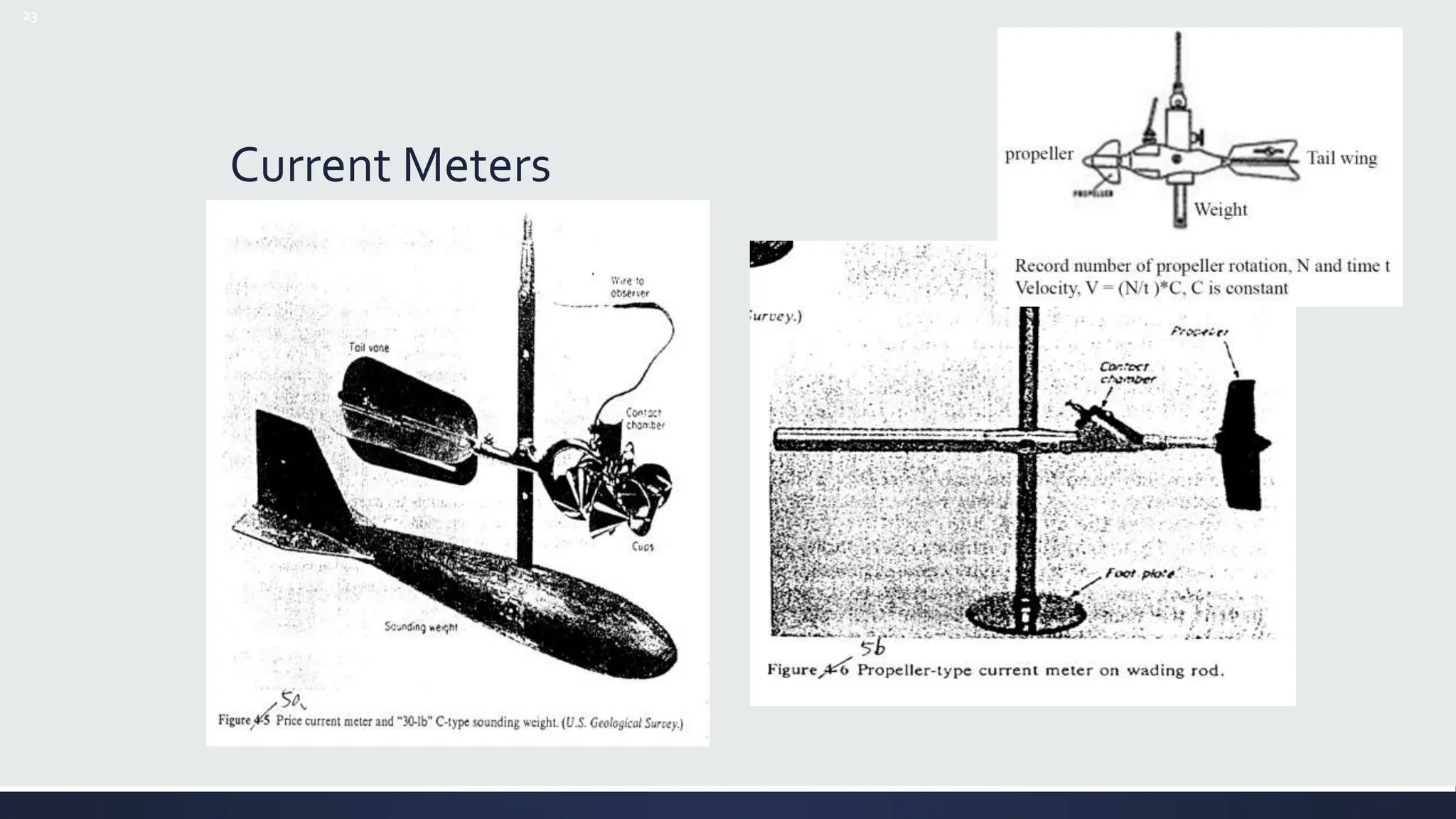
Current Meter Method
▪ 3 types of current meter
▪ Propeller type : for high discharge
▪ Price type using anemometer
▪ Electromagnetic type : for low river flow
▪ Rating curve for current meter is given by:
V = a + bN
whereV = flow velocity;
a = starting velocity to overcome
mechanical friction;
b = equipment calibration constant;
N = revolutions/sec.
23
Current Meters
24
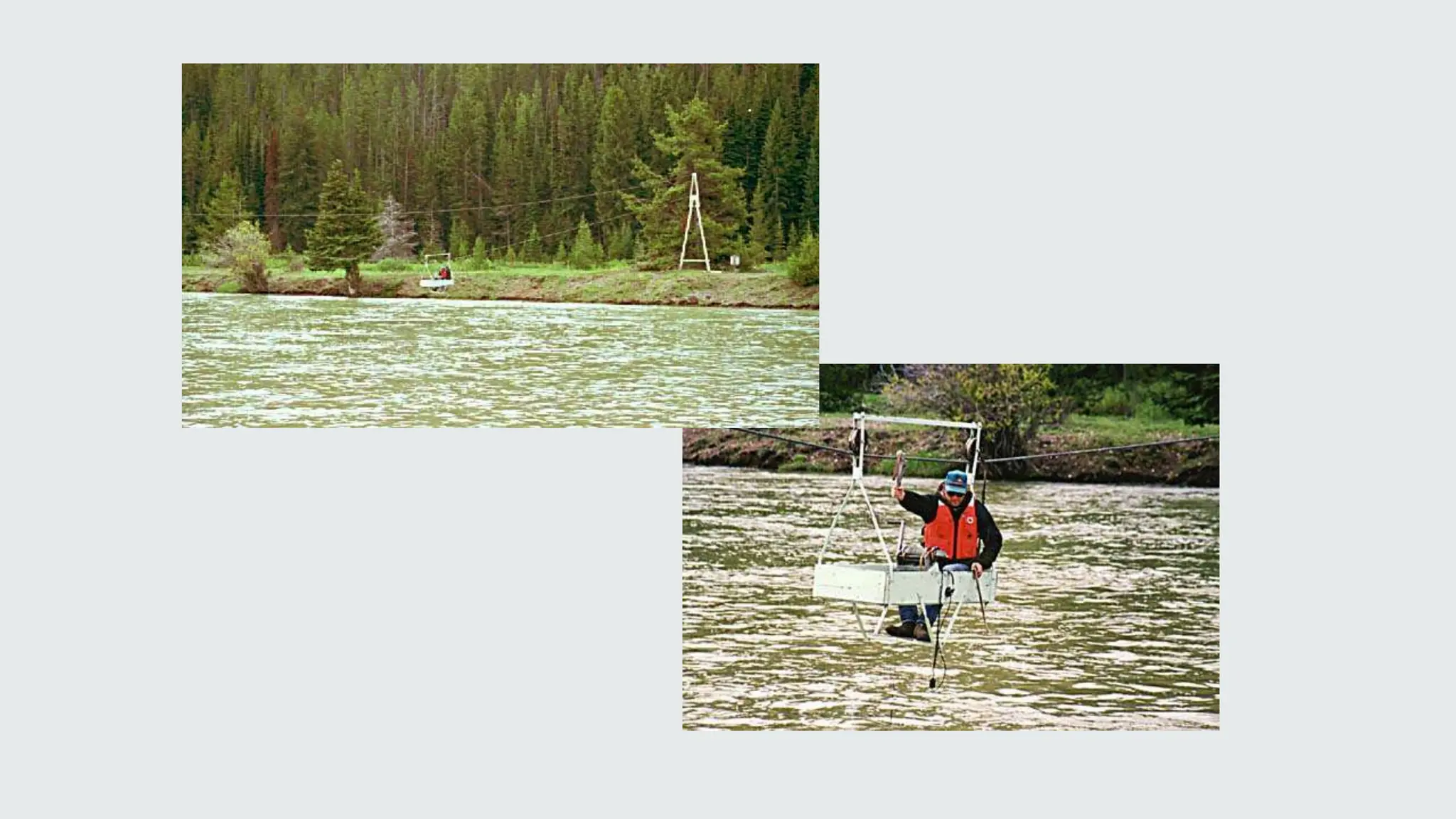
For river velocity measurement, we need:
▪ Wading/Paddle
▪ Bridges
▪ Boat
▪ Cablecar
▪ Cableway
25
Velocity-Area Method
▪ Mostly/frequently used
▪ River cross-section determined
▪ Velocity measured using
▪ Float (for straight channel)
▪ Current meter
▪ Vertical velocity measured at 0.2d and 0.8d if depth,d >0.6m. If d<0.6m,
velocity is measured at 0.6d m.
26
Velocity-Area Method
▪ Q = [Velocity x Area]
▪ Need to know width of channel (w), Depth of channel (d), andVelocity of flow (V) (ft/s or m/s)
▪ Area = w x d
▪ Because depth & velocity vary across a channel:
(1) Important to divide the channel into manageable segments (slices);Typically use 10-20
segments
(2) For each segment measure depth, width and velocity
27
Measuring Streamflow Discharge
▪ Procedure: at each segment measure depth then velocity
▪ If Depth < 0.6m, take one reading @ 60% depth
▪ If Depth > 0.6m take 2 measurements and compute the average
▪ One @ 20% depth
▪ One @ 80% depth
▪ Average the two readings
28
Measuring Streamflow Discharge
▪ Two method of measurement
▪ Mean section method
▪ Mid section method
29
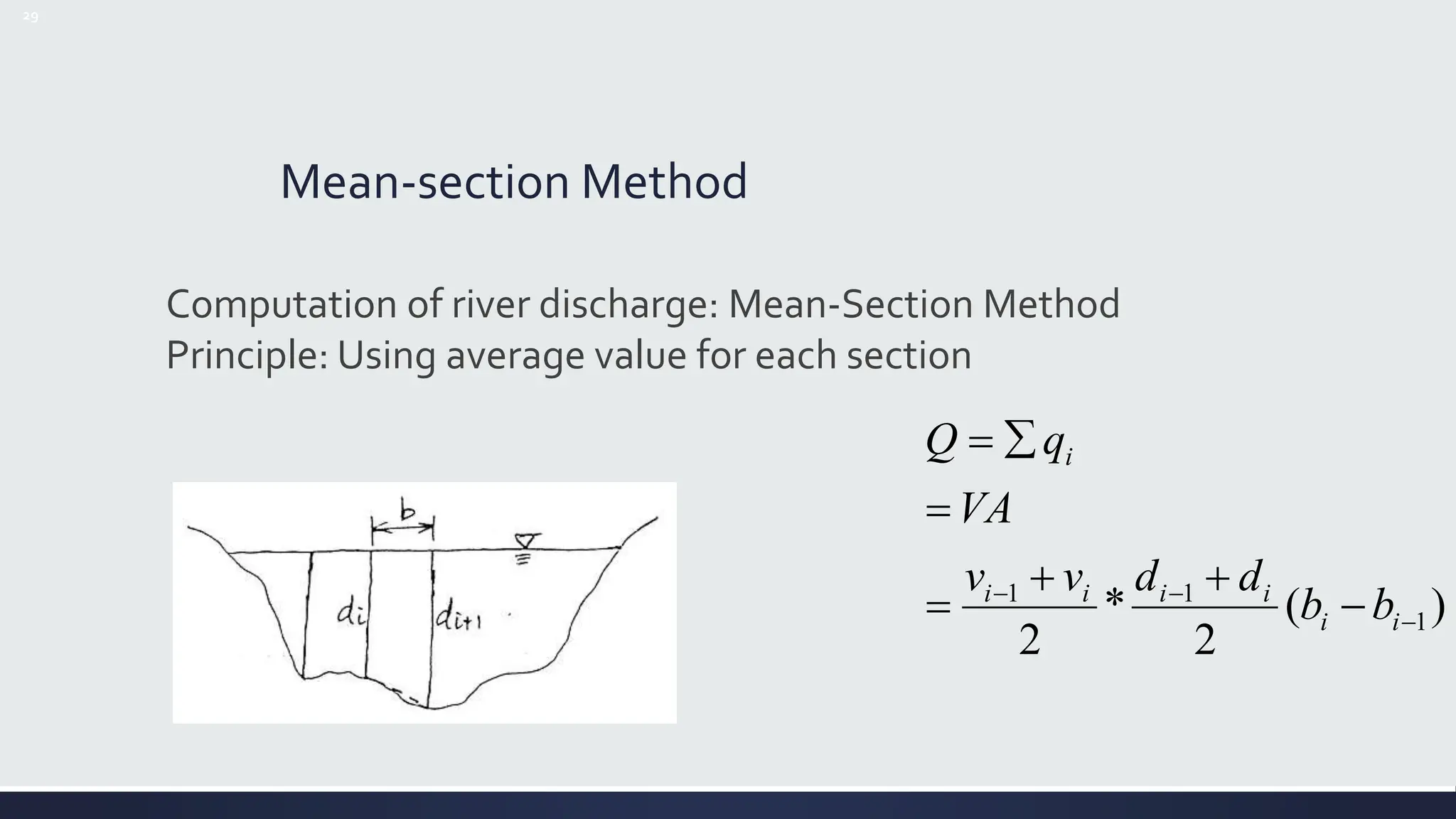
Mean-section Method
)
(
2
*
2
1
1
1










i
i
i
i
i
i
i
b
b
d
d
v
v
VA
q
Q
Computation of river discharge: Mean-Section Method
Principle: Using average value for each section
30
Mid-section Method
 
i
i
i
i
i
d
v
b
b
q
Q
)
2
( 1
1 
 



Computation of river discharge: Mid-Section Method
31
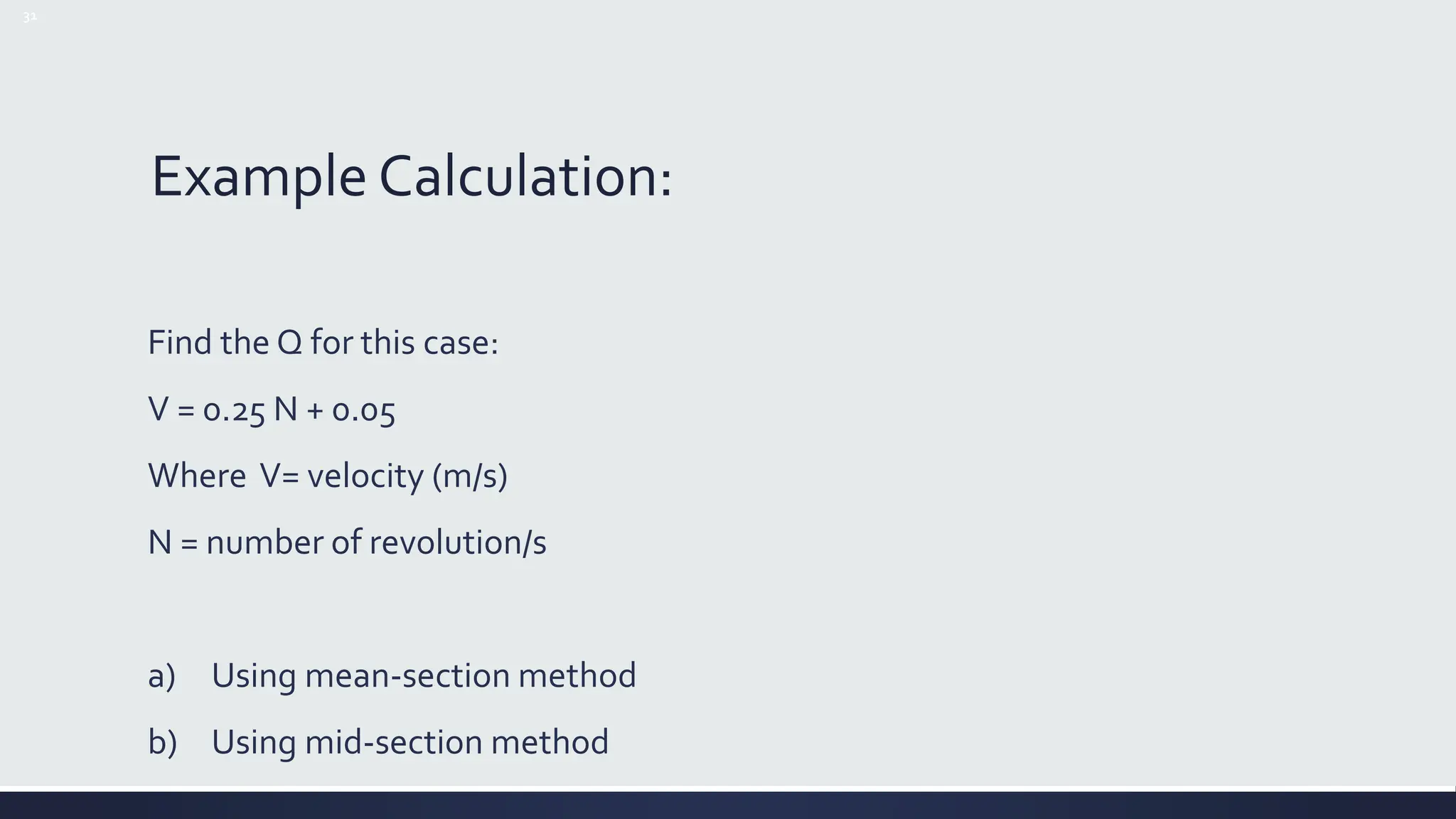
Example Calculation:
Find the Q for this case:
V = 0.25 N + 0.05
Where V= velocity (m/s)
N = number of revolution/s
a) Using mean-section method
b) Using mid-section method
32
Example Calculation:
Distance
from edge, b
(m)
Depth, d
(m)
Rev/min
0.6d 0.2d 0.8d
0 0
2 1.1 14
4 2.6 48 44
6 4.0 57 52
8 7.2 43 37
10 4.3 38 32
12 3.2 36 29
14 1.6 12
15.5 0
33
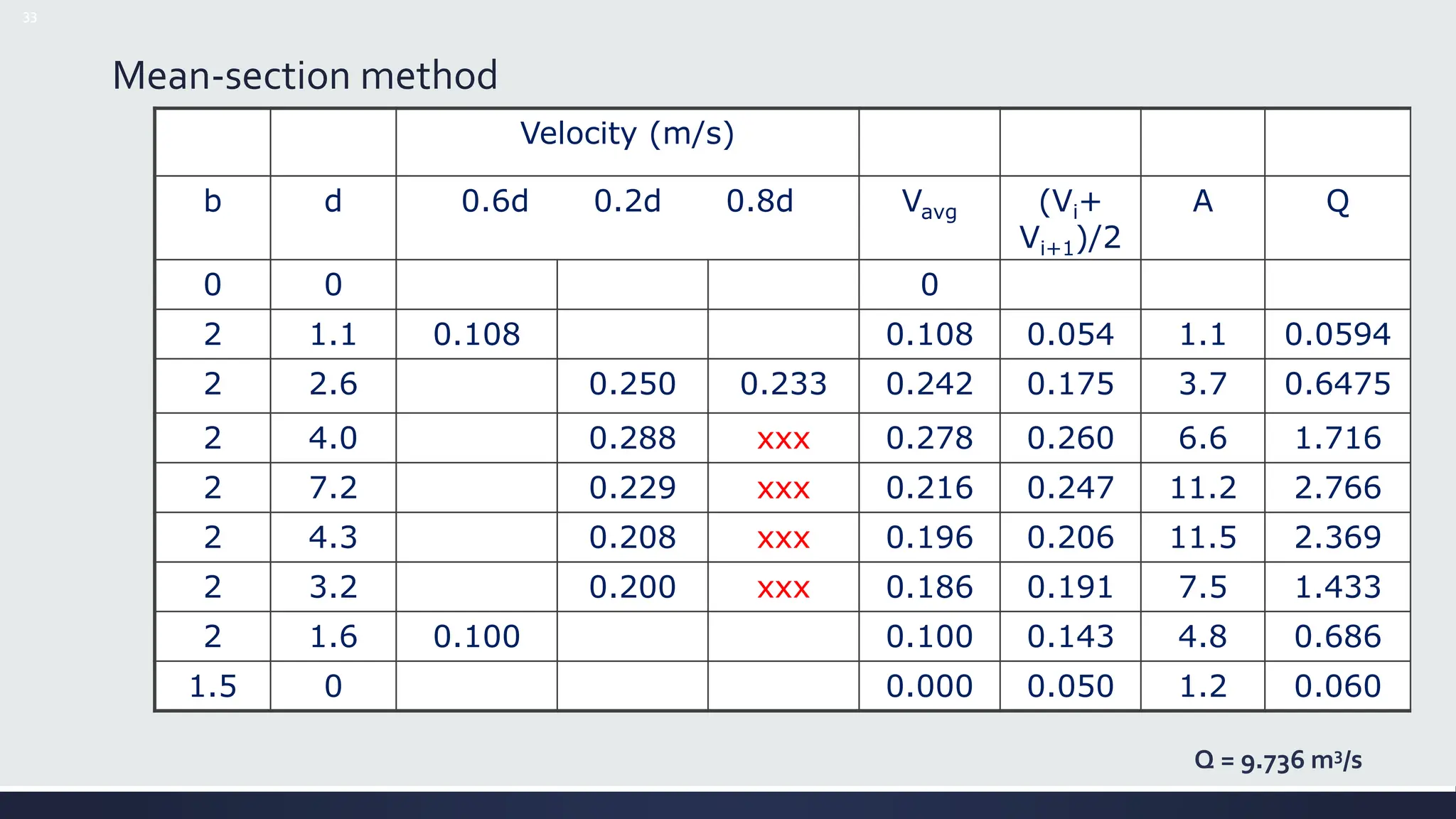
Mean-section method
Velocity (m/s)
b d 0.6d 0.2d 0.8d Vavg (Vi+
Vi+1)/2
A Q
0 0 0
2 1.1 0.108 0.108 0.054 1.1 0.0594
2 2.6 0.250 0.233 0.242 0.175 3.7 0.6475
2 4.0 0.288 xxx 0.278 0.260 6.6 1.716
2 7.2 0.229 xxx 0.216 0.247 11.2 2.766
2 4.3 0.208 xxx 0.196 0.206 11.5 2.369
2 3.2 0.200 xxx 0.186 0.191 7.5 1.433
2 1.6 0.100 0.100 0.143 4.8 0.686
1.5 0 0.000 0.050 1.2 0.060
Q = 9.736 m3/s
34
Mid-section method
Velocity (m/s)
b d 0.6d 0.2d 0.8d Vavg (bi+1-
bi-1)/2
qi
0 0 0
2 1.1 0.108 0.108 2 0.238
4 2.6 0.250 0.233 0.242 2 1.258
6 4.0 0.288 x 0.278 2 2.224
8 7.2 0.229 x 0.216 2 3.110
10 4.3 0.208 x 0.196 2 1.685
12 3.2 0.200 x 0.186 2 1.190
14 1.6 0.100 0.100 1.75 0.280
15.5 0 0.000
Q = 9.986 m3/s
35
Exercise
Calculate the discharge of the river gauging record shown inTable below
using mean and Mid section method.
Answer:
Mean section:Total Q= 20.52 m3/s
Mid-section:Total Q = 19.89 m3/s
36
Dilution gauging
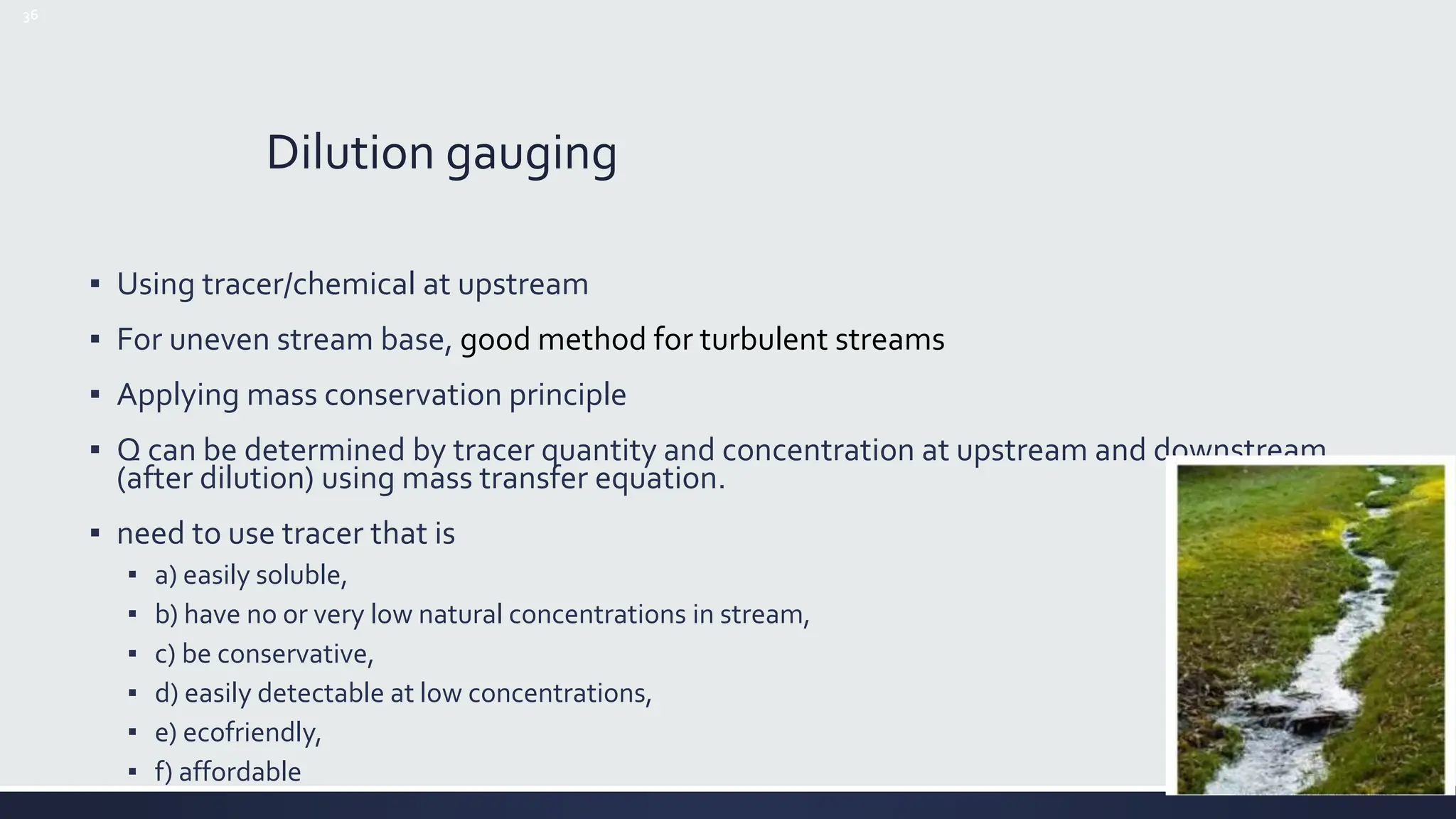
▪ Using tracer/chemical at upstream
▪ For uneven stream base, good method for turbulent streams
▪ Applying mass conservation principle
▪ Q can be determined by tracer quantity and concentration at upstream and downstream
(after dilution) using mass transfer equation.
▪ need to use tracer that is
▪ a) easily soluble,
▪ b) have no or very low natural concentrations in stream,
▪ c) be conservative,
▪ d) easily detectable at low concentrations,
▪ e) ecofriendly,
▪ f) affordable
37
Dilution gauging
▪ Advantage: suitable to any condition. Why?
▪ Disadvantage: difficult to find completely water soluble tracer. Sodium
Chloride (garam dapur) are commonly used
▪ Example of tracer:
▪ Chemical: Sodium cloride,sodium dicromat,manganese sulphate
▪ Dye: sodium fluoroscein, Rhodamine-WT
▪ Radioactive: Bromine-82,Sodium-24,Iodine-132
▪ 2 approach
▪ Sudden/Gulp injection
▪ Constant rate injection
39
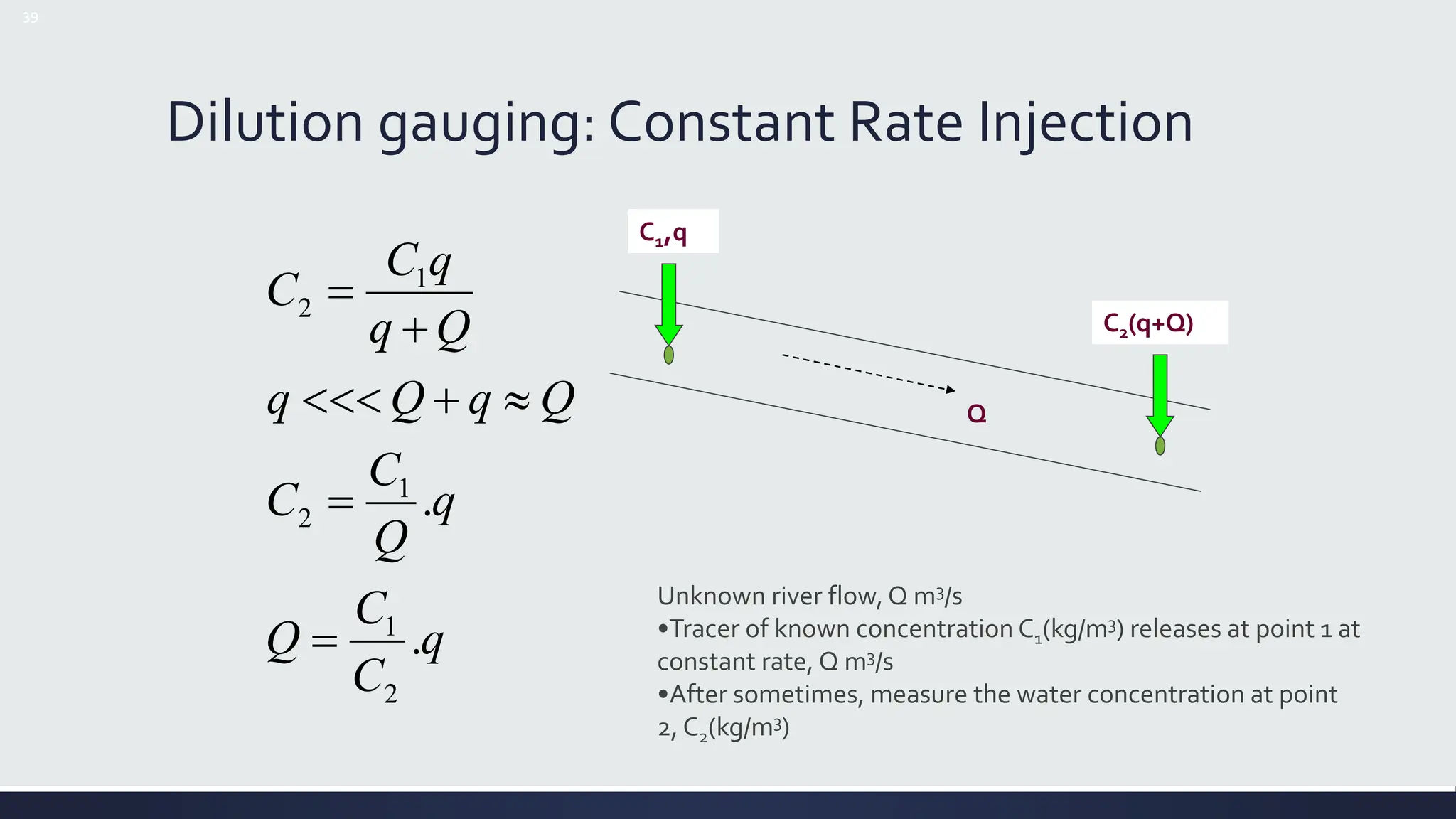
Dilution gauging: Constant Rate Injection
q
C
C
Q
q
Q
C
C
Q
q
Q
q
Q
q
q
C
C
.
.
2
1
1
2
1
2







C1,q
C2(q+Q)
Q
Unknown river flow, Q m3/s
•Tracer of known concentration C1(kg/m3) releases at point 1 at
constant rate, Q m3/s
•After sometimes, measure the water concentration at point
2, C2(kg/m3)
40
Example calculation
▪ 20 g/L of tracer injected at upstream of the river at rate 0.01 L/s. Concentration of
tracers at downstream is 5 ppb. Estimate the discharge of the river at downstrean.
Assume the initial concentration of tracer is very low.
Solution:
q =0.01 L/s = 10-5 m3/s
C1 = 20 g/L = 20 000 g/m3
C2 = 5 ppb = 5 x 10⁻⁶ g/L = 5 x 10⁻³ g/m3
Q = C1/C2 x q = (20 000/5 x 10-3 )x 10-5
= 40 m3/s = 40 000 L/s
41
Conversion factor
▪ 1 g/L = 10-3
▪ 1 mg/L = 10-6 = 1 ppm
▪ 1 μg/L = 10-9 =1 x 10⁻³ g/m3 = 1 ppb
42
Dilution gauging: Sudden Injection


2
1
2
1
t
t
dt
C
Q
VC
Where:
V = volume of tracers (m3)
t1=time of tracer induced at upstream(point 1)
t2=time of tracer detected at point 2
C1,V1
C2, Q2
Q
Unknown river flow, Q m3/s
•Tracer of known concentration C1(kg/m3)
and known volumeV m3/s releases at
point 1 at one short
•After certain time, water concentration
at point 2 are measured, C2(kg/m3)
43
Example Calculation:
▪ 100 liter NaCL at concentration 10 g/L induced at river upstream. Average NaCl
concentration after an hour at 800 m distance, at downstream are 0.02 mg/L.
Estimate the river discharge at downstream.
▪ Solution:
s
m
x
t
C
VC
Q
t
QC
VC
dt
C
Q
VC
t
t
/
89
.
13
3600
x
10
2
10
x
1
.
0 3
5
2
1
2
1
2
1
2
1









44
- Measure speed of small particles in the flow
- Can also track and subtract bottom speed
Sonic methods
Some gages are designed to measure just high flows
46
HYDRAULIC STRUCTURES
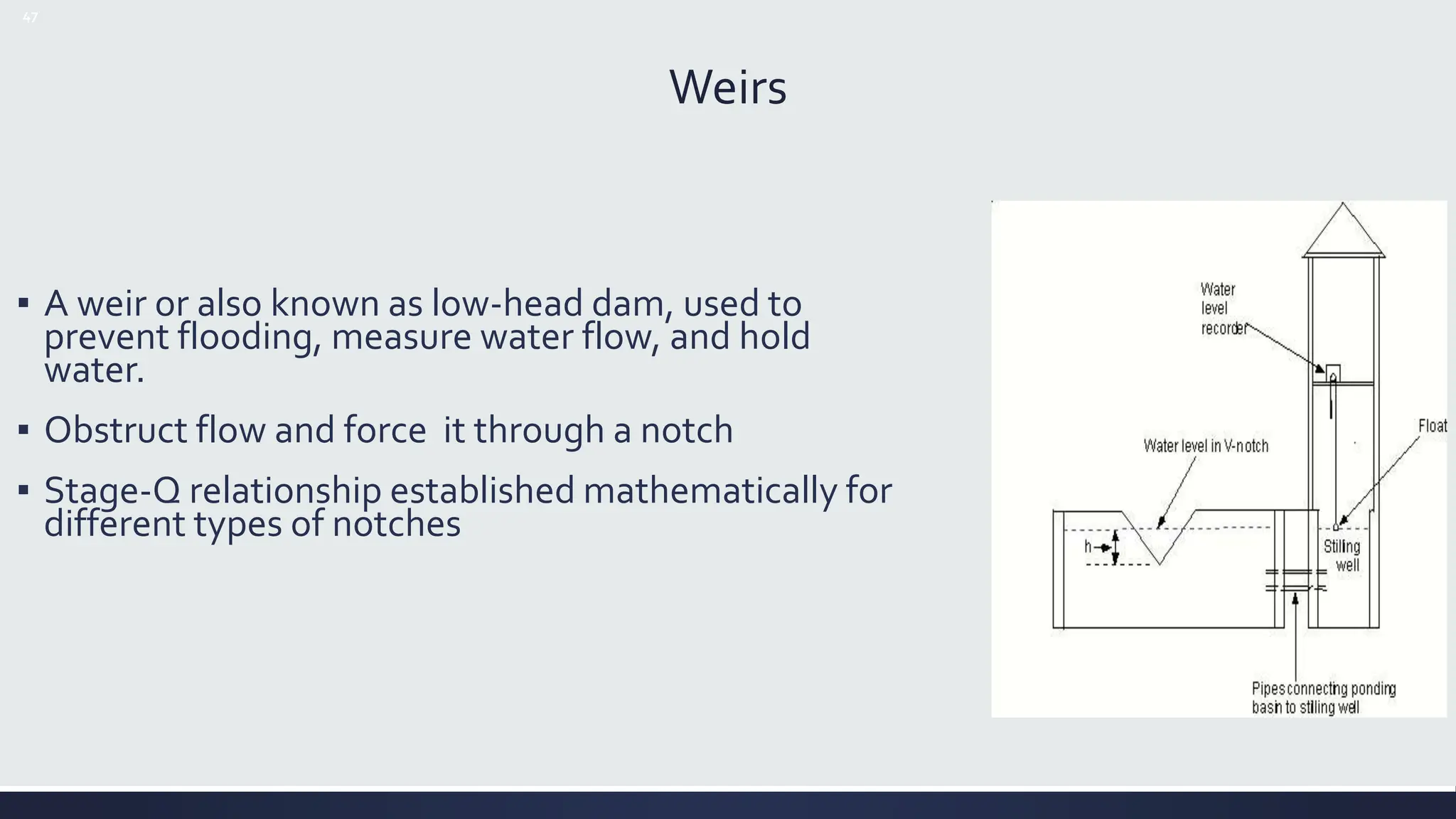
▪ Used for small watersheds – such as experimental watersheds –
where need accurate, continuous flow measurements.
▪ Two types:Weirs, Flumes
47
Weirs
▪ A weir or also known as low-head dam, used to
prevent flooding, measure water flow, and hold
water.
▪ Obstruct flow and force it through a notch
▪ Stage-Q relationship established mathematically for
different types of notches
48
Weirs
▪ Generally used in small streams
▪ Various types
▪ V-notch for accurate low flow
▪ Rectangular
▪ Handles higher flows
▪ Less accurate at low flows
▪ Trapezoidal -- an intermediate weir
▪ Concerns
▪ Sediment & debris are trapped
▪ Leakage
49
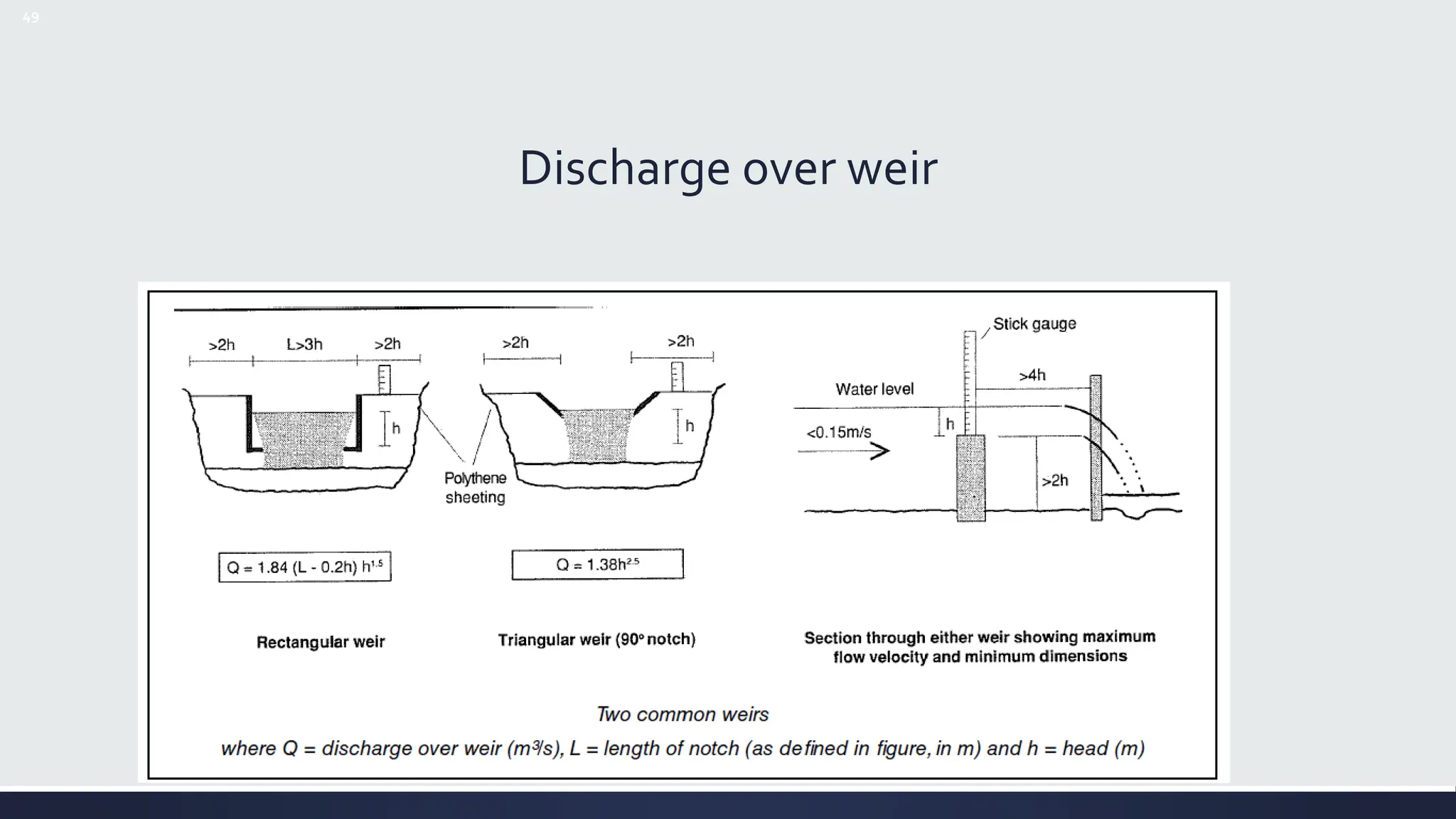
Discharge over weir
50
Trapezoidal Weir
51
TrapezoidalWeir
52
RectangularWeir
53
90 degreeV-notchWeir
54
V-notchWeir
2
5
2
tan
2
15
8
H
g
C
Q d


▪ For small river
▪ Q (m3/s) can be determine using equation:
▪
▪ Where:
▪ H = head loss
▪ Cd = discharge coefficient
▪ g gravity acceleration
▪ θ angle of the v-notch
55
90ºV-notchWeir
Q = 2.36CdH5/2
56
Flumes
• An artificial open channel built to contain flow within a
designed cross-section and length
• No impoundment
• Water height in flume measured with a stilling well
57
Flumes
▪ Used to measure flow in:
▪ water and wastewater treatment plants
▪ irrigation channels
▪ agricultural runoff
▪ runoff plots – research applications
▪ small watersheds
58
Large Crest Flumes
59
Long-throated Flume
60
Short-throated Flume
61
Parshall Flume
62
H Flume
63
Slope Area Method
▪ Manning Equation
▪ Chezy Equation
64
Estimating Discharge (Q) from channel features:
Manning’s Equation
2
1
3
2
1
S
R
n
v 
• v = average velocity (m/s)
• R = hydraulic radius
= [Area/wetted perimeter]
• S = Energy gradient, Approximated by water surface slope
• n = Manning’s roughness coefficient
Q = Av
65
Q
K
1
D
A
Chezy Equation
▪ Based on Chezy formula,
▪ with A = flow cross-section area; C = Chezy Coefficient;
▪ R = hydraulic radius, A/P; and S = channel slope.
▪ For a given section, = constant whereas for a wide channel (W>10D) RD.
Therefore,
RS
AC
Q 
S
C
D
A
K
Q 
Thank You

STREAMFLOW MEASUREMENT IN HYDROLOGY.pptx

  • 1.
    STREAMFLOW MEASUREMENT Mrs Siti KamariahBt Md Sa’at Faculty of Mechanical Engineering & Technology UniMAP MMJ24203 HYDROLOGY AND WATER RESOURCES ENGINEERING
  • 2.
  • 3.
    3 Streamflow and Measurement ▪The character, amount, and timing of discharge from a basin tells a lot about flow paths within the basin. ▪ Stream flow is one of the most important topics in engineering hydrology because it directly relates to water supply, flood control, reservoir design, navigation, irrigation, drainage, water quality, and others.
  • 4.
    4 Need for Streamflow Measurements ▪ Floodplain management ▪ Flood forecasting & analysis ▪ Reservoir operations ▪ Low flows – water quality concerns ▪ Design structures – culverts, bridges, stormwater systems ▪ Evaluate changes in land use on watersheds and/or changes in climatic regimes
  • 5.
    5 Need for StreamflowMeasurements ▪ Important to hydrogeologist to identify how to create stream hydrographs from discharge measurements
  • 6.
    6 Measurement of discharge ▪Method used depends on type of study, size of river and flow, data requirements, etc. ▪ Streamflow measurement techniques can be broadly classified into 2 categories: ▪ Direct determination – area-velocity method, dilution techniques, electromagnetic method, ultrasonic method ▪ Indirect determination – hydraulic structures, slope-area method
  • 7.
    7 Streamflow Measurements ▪ Servesas the basis for many water resources engineering designs ▪ Three approaches ▪ Measurement of water stage (water level) ▪ Measurement of flow velocity ▪ Hydraulic Structure
  • 8.
    8 Streamflow Measurements ▪ MeasurementofWater Stage ▪ Water stage: the elevation above some arbitrary datum of water surface at a station ▪ Types of Gages Measuring River Stage: ▪ Staff gage – vertical or inclined ▪ Suspended – weight gage ▪ Recording gage (automatic data logger) ▪ Crest – stage gage ( used to indicate high water mark) ▪ Pressure sensor ▪ Float
  • 9.
  • 10.
    10 Stream gauges Automatic waterlevel (river stage) recorder
  • 11.
    11 FLOWVELOCITY MEASUREMENT ▪ Measurementof FlowVelocity ▪ Current meter ▪ Dilution technique ▪ Manning Equation ▪ Floats: Suitable for straight channel, ▪ V = L/T
  • 12.
  • 13.
    13 Float method ▪ Floatsare a simple way of measuring the velocity of a stream, but they are not very accurate. ▪ The surface velocity is obtained by measuring the time (t secs) for a float to travel a measured distance (L metres). ▪ It is best to choose a straight, uniform river section about 30m long, and to time the float over a number of repeated runs.
  • 14.
    14 Float method ▪ Afactor of about 0.85 should be used to convert surface velocity to average velocity. ▪ Surface velocity (m/s) = L / t ▪ Average velocity (m/s) = 0.85 x L / t ▪ The cross section of the stream should be measured up carefully in a number of places along the test distance, and the average cross-sectional area calculated (A sq m). ▪ Discharge (cubic metres per second) = average velocity × cross sectional area of stream = 0.85 × (L / t) × A ▪ Discharge (L/s) = 1000 × 0.85 × (L / t) × A
  • 15.
  • 16.
  • 17.
  • 18.
    18 Measuring Streamflow in small streamswith a pygmy current meter
  • 20.
    Discharge (Q) Measurement Largerivers – from bridges or moving boats
  • 22.
    22 Current Meter Method ▪3 types of current meter ▪ Propeller type : for high discharge ▪ Price type using anemometer ▪ Electromagnetic type : for low river flow ▪ Rating curve for current meter is given by: V = a + bN whereV = flow velocity; a = starting velocity to overcome mechanical friction; b = equipment calibration constant; N = revolutions/sec.
  • 23.
  • 24.
    24 For river velocitymeasurement, we need: ▪ Wading/Paddle ▪ Bridges ▪ Boat ▪ Cablecar ▪ Cableway
  • 25.
    25 Velocity-Area Method ▪ Mostly/frequentlyused ▪ River cross-section determined ▪ Velocity measured using ▪ Float (for straight channel) ▪ Current meter ▪ Vertical velocity measured at 0.2d and 0.8d if depth,d >0.6m. If d<0.6m, velocity is measured at 0.6d m.
  • 26.
    26 Velocity-Area Method ▪ Q= [Velocity x Area] ▪ Need to know width of channel (w), Depth of channel (d), andVelocity of flow (V) (ft/s or m/s) ▪ Area = w x d ▪ Because depth & velocity vary across a channel: (1) Important to divide the channel into manageable segments (slices);Typically use 10-20 segments (2) For each segment measure depth, width and velocity
  • 27.
    27 Measuring Streamflow Discharge ▪Procedure: at each segment measure depth then velocity ▪ If Depth < 0.6m, take one reading @ 60% depth ▪ If Depth > 0.6m take 2 measurements and compute the average ▪ One @ 20% depth ▪ One @ 80% depth ▪ Average the two readings
  • 28.
    28 Measuring Streamflow Discharge ▪Two method of measurement ▪ Mean section method ▪ Mid section method
  • 29.
    29 Mean-section Method ) ( 2 * 2 1 1 1           i i i i i i i b b d d v v VA q Q Computation ofriver discharge: Mean-Section Method Principle: Using average value for each section
  • 30.
    30 Mid-section Method   i i i i i d v b b q Q ) 2 (1 1       Computation of river discharge: Mid-Section Method
  • 31.
    31 Example Calculation: Find theQ for this case: V = 0.25 N + 0.05 Where V= velocity (m/s) N = number of revolution/s a) Using mean-section method b) Using mid-section method
  • 32.
    32 Example Calculation: Distance from edge,b (m) Depth, d (m) Rev/min 0.6d 0.2d 0.8d 0 0 2 1.1 14 4 2.6 48 44 6 4.0 57 52 8 7.2 43 37 10 4.3 38 32 12 3.2 36 29 14 1.6 12 15.5 0
  • 33.
    33 Mean-section method Velocity (m/s) bd 0.6d 0.2d 0.8d Vavg (Vi+ Vi+1)/2 A Q 0 0 0 2 1.1 0.108 0.108 0.054 1.1 0.0594 2 2.6 0.250 0.233 0.242 0.175 3.7 0.6475 2 4.0 0.288 xxx 0.278 0.260 6.6 1.716 2 7.2 0.229 xxx 0.216 0.247 11.2 2.766 2 4.3 0.208 xxx 0.196 0.206 11.5 2.369 2 3.2 0.200 xxx 0.186 0.191 7.5 1.433 2 1.6 0.100 0.100 0.143 4.8 0.686 1.5 0 0.000 0.050 1.2 0.060 Q = 9.736 m3/s
  • 34.
    34 Mid-section method Velocity (m/s) bd 0.6d 0.2d 0.8d Vavg (bi+1- bi-1)/2 qi 0 0 0 2 1.1 0.108 0.108 2 0.238 4 2.6 0.250 0.233 0.242 2 1.258 6 4.0 0.288 x 0.278 2 2.224 8 7.2 0.229 x 0.216 2 3.110 10 4.3 0.208 x 0.196 2 1.685 12 3.2 0.200 x 0.186 2 1.190 14 1.6 0.100 0.100 1.75 0.280 15.5 0 0.000 Q = 9.986 m3/s
  • 35.
    35 Exercise Calculate the dischargeof the river gauging record shown inTable below using mean and Mid section method. Answer: Mean section:Total Q= 20.52 m3/s Mid-section:Total Q = 19.89 m3/s
  • 36.
    36 Dilution gauging ▪ Usingtracer/chemical at upstream ▪ For uneven stream base, good method for turbulent streams ▪ Applying mass conservation principle ▪ Q can be determined by tracer quantity and concentration at upstream and downstream (after dilution) using mass transfer equation. ▪ need to use tracer that is ▪ a) easily soluble, ▪ b) have no or very low natural concentrations in stream, ▪ c) be conservative, ▪ d) easily detectable at low concentrations, ▪ e) ecofriendly, ▪ f) affordable
  • 37.
    37 Dilution gauging ▪ Advantage:suitable to any condition. Why? ▪ Disadvantage: difficult to find completely water soluble tracer. Sodium Chloride (garam dapur) are commonly used ▪ Example of tracer: ▪ Chemical: Sodium cloride,sodium dicromat,manganese sulphate ▪ Dye: sodium fluoroscein, Rhodamine-WT ▪ Radioactive: Bromine-82,Sodium-24,Iodine-132 ▪ 2 approach ▪ Sudden/Gulp injection ▪ Constant rate injection
  • 39.
    39 Dilution gauging: ConstantRate Injection q C C Q q Q C C Q q Q q Q q q C C . . 2 1 1 2 1 2        C1,q C2(q+Q) Q Unknown river flow, Q m3/s •Tracer of known concentration C1(kg/m3) releases at point 1 at constant rate, Q m3/s •After sometimes, measure the water concentration at point 2, C2(kg/m3)
  • 40.
    40 Example calculation ▪ 20g/L of tracer injected at upstream of the river at rate 0.01 L/s. Concentration of tracers at downstream is 5 ppb. Estimate the discharge of the river at downstrean. Assume the initial concentration of tracer is very low. Solution: q =0.01 L/s = 10-5 m3/s C1 = 20 g/L = 20 000 g/m3 C2 = 5 ppb = 5 x 10⁻⁶ g/L = 5 x 10⁻³ g/m3 Q = C1/C2 x q = (20 000/5 x 10-3 )x 10-5 = 40 m3/s = 40 000 L/s
  • 41.
    41 Conversion factor ▪ 1g/L = 10-3 ▪ 1 mg/L = 10-6 = 1 ppm ▪ 1 μg/L = 10-9 =1 x 10⁻³ g/m3 = 1 ppb
  • 42.
    42 Dilution gauging: SuddenInjection   2 1 2 1 t t dt C Q VC Where: V = volume of tracers (m3) t1=time of tracer induced at upstream(point 1) t2=time of tracer detected at point 2 C1,V1 C2, Q2 Q Unknown river flow, Q m3/s •Tracer of known concentration C1(kg/m3) and known volumeV m3/s releases at point 1 at one short •After certain time, water concentration at point 2 are measured, C2(kg/m3)
  • 43.
    43 Example Calculation: ▪ 100liter NaCL at concentration 10 g/L induced at river upstream. Average NaCl concentration after an hour at 800 m distance, at downstream are 0.02 mg/L. Estimate the river discharge at downstream. ▪ Solution: s m x t C VC Q t QC VC dt C Q VC t t / 89 . 13 3600 x 10 2 10 x 1 . 0 3 5 2 1 2 1 2 1 2 1         
  • 44.
    44 - Measure speedof small particles in the flow - Can also track and subtract bottom speed Sonic methods
  • 45.
    Some gages aredesigned to measure just high flows
  • 46.
    46 HYDRAULIC STRUCTURES ▪ Usedfor small watersheds – such as experimental watersheds – where need accurate, continuous flow measurements. ▪ Two types:Weirs, Flumes
  • 47.
    47 Weirs ▪ A weiror also known as low-head dam, used to prevent flooding, measure water flow, and hold water. ▪ Obstruct flow and force it through a notch ▪ Stage-Q relationship established mathematically for different types of notches
  • 48.
    48 Weirs ▪ Generally usedin small streams ▪ Various types ▪ V-notch for accurate low flow ▪ Rectangular ▪ Handles higher flows ▪ Less accurate at low flows ▪ Trapezoidal -- an intermediate weir ▪ Concerns ▪ Sediment & debris are trapped ▪ Leakage
  • 49.
  • 50.
  • 51.
  • 52.
  • 53.
  • 54.
    54 V-notchWeir 2 5 2 tan 2 15 8 H g C Q d   ▪ Forsmall river ▪ Q (m3/s) can be determine using equation: ▪ ▪ Where: ▪ H = head loss ▪ Cd = discharge coefficient ▪ g gravity acceleration ▪ θ angle of the v-notch
  • 55.
  • 56.
    56 Flumes • An artificialopen channel built to contain flow within a designed cross-section and length • No impoundment • Water height in flume measured with a stilling well
  • 57.
    57 Flumes ▪ Used tomeasure flow in: ▪ water and wastewater treatment plants ▪ irrigation channels ▪ agricultural runoff ▪ runoff plots – research applications ▪ small watersheds
  • 58.
  • 59.
  • 60.
  • 61.
  • 62.
  • 63.
    63 Slope Area Method ▪Manning Equation ▪ Chezy Equation
  • 64.
    64 Estimating Discharge (Q)from channel features: Manning’s Equation 2 1 3 2 1 S R n v  • v = average velocity (m/s) • R = hydraulic radius = [Area/wetted perimeter] • S = Energy gradient, Approximated by water surface slope • n = Manning’s roughness coefficient Q = Av
  • 65.
    65 Q K 1 D A Chezy Equation ▪ Basedon Chezy formula, ▪ with A = flow cross-section area; C = Chezy Coefficient; ▪ R = hydraulic radius, A/P; and S = channel slope. ▪ For a given section, = constant whereas for a wide channel (W>10D) RD. Therefore, RS AC Q  S C D A K Q 
  • 66.