Rearrangement
Reactions
Rearrangement Reaction
   The term “rearrangements” is used to
   describe organic reactions which
   involve the migration of a H atom or
   of a larger molecular fragment.

♦ Carbonium ion rearrangement
♦ Carbanion rearrangements
♦ Radical rearrangements
Carbonium ion rearrangements
♦ Without change in carbon skeleton
1- Allylic rearrangement
♦ With change in carbon skeleton
1- Neopentyl rearrangement
2- Pinacol-pinacolone rearrangement
3- Wolf rearrangement
4- Rearrangement of hydrocarbons
Wagner-Meerwein
rearrangements
♦ The rearrangements involving change in
 carbon skeleton are collectively known as
 Wagner-Meerwein rearrangements
Wagner-Meerwein rearrangements
♦ Wagner-Meerwein Rearrangements are [1,2]-
  rearrangements of H atoms or alkyl groups in carbonium
  ions that do not contain any heteroatom attached to the
  valence-saturated center C-1 or to the valence-unsaturated
  center C-2.
         1                                         1
              R(H)                                     R(H)
                                              +
          C          C+                      C     C
         1'          2'                       1'        2'
Example is neopentyl rearrangement
Example:
♦ 1-Bromopropane isomerizes quantitatively to 2-
  bromopropane under Friedel-Crafts conditions.
  The [1,2]-shift A→B involved in this reaction
  again is an H-atom shift.
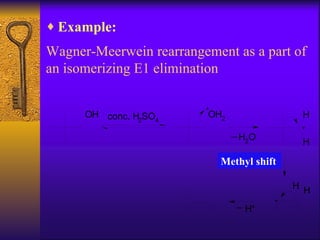
♦ Example:

Wagner-Meerwein rearrangement as a part of
an isomerizing E1 elimination

                         +
      OH conc. H SO       OH2                 H
                2  4
                                              +
                                _H O
                                  2           H

                             Methyl shift

                                             H H
                                         +
                                _
                                    H+
Example
♦ Conversion of p-xylene to m-xylene
 In the presence of acid methyl group moves
 to meta position, which is energetically
 more stable
♦ Example:

         CH3                      OH
                       HNO2
  H3C         CH2NH2          CH3 C CH2CH3
         CH3                      CH3

                                          Methyl shift
 Mechanism
               CH3          HNO2         CH3 +
        H3C        CH2NH2          CH3   C CH2
               CH3                       CH3

               +                         OH
        CH3 C CH2CH3 H2O           CH3   C CH2CH3
            CH3       H+                 CH3
♦ Amylalcohol is isopentyl alcohol
♦ Tertiarybutyl carbinol is neopentyl alcohol
♦ 2 methyl butanol is amyl alcohol

Wagner 1

  • 1.
  • 2.
    Rearrangement Reaction The term “rearrangements” is used to describe organic reactions which involve the migration of a H atom or of a larger molecular fragment. ♦ Carbonium ion rearrangement ♦ Carbanion rearrangements ♦ Radical rearrangements
  • 3.
    Carbonium ion rearrangements ♦Without change in carbon skeleton 1- Allylic rearrangement ♦ With change in carbon skeleton 1- Neopentyl rearrangement 2- Pinacol-pinacolone rearrangement 3- Wolf rearrangement 4- Rearrangement of hydrocarbons
  • 4.
    Wagner-Meerwein rearrangements ♦ The rearrangementsinvolving change in carbon skeleton are collectively known as Wagner-Meerwein rearrangements
  • 5.
    Wagner-Meerwein rearrangements ♦ Wagner-MeerweinRearrangements are [1,2]- rearrangements of H atoms or alkyl groups in carbonium ions that do not contain any heteroatom attached to the valence-saturated center C-1 or to the valence-unsaturated center C-2. 1 1 R(H) R(H) + C C+ C C 1' 2' 1' 2'
  • 6.
    Example is neopentylrearrangement
  • 8.
    Example: ♦ 1-Bromopropane isomerizesquantitatively to 2- bromopropane under Friedel-Crafts conditions. The [1,2]-shift A→B involved in this reaction again is an H-atom shift.
  • 9.
    ♦ Example: Wagner-Meerwein rearrangementas a part of an isomerizing E1 elimination + OH conc. H SO OH2 H 2 4 + _H O 2 H Methyl shift H H + _ H+
  • 10.
    Example ♦ Conversion ofp-xylene to m-xylene In the presence of acid methyl group moves to meta position, which is energetically more stable
  • 11.
    ♦ Example: CH3 OH HNO2 H3C CH2NH2 CH3 C CH2CH3 CH3 CH3 Methyl shift Mechanism CH3 HNO2 CH3 + H3C CH2NH2 CH3 C CH2 CH3 CH3 + OH CH3 C CH2CH3 H2O CH3 C CH2CH3 CH3 H+ CH3
  • 12.
    ♦ Amylalcohol isisopentyl alcohol ♦ Tertiarybutyl carbinol is neopentyl alcohol ♦ 2 methyl butanol is amyl alcohol