BIRCH REDUCTION
Prepared By
Dr. Krishnaswamy. G
Faculty
DOS & R in Organic Chemistry
Tumkur University
Tumakuru
1
Arthur John Birch 1915–1995
2
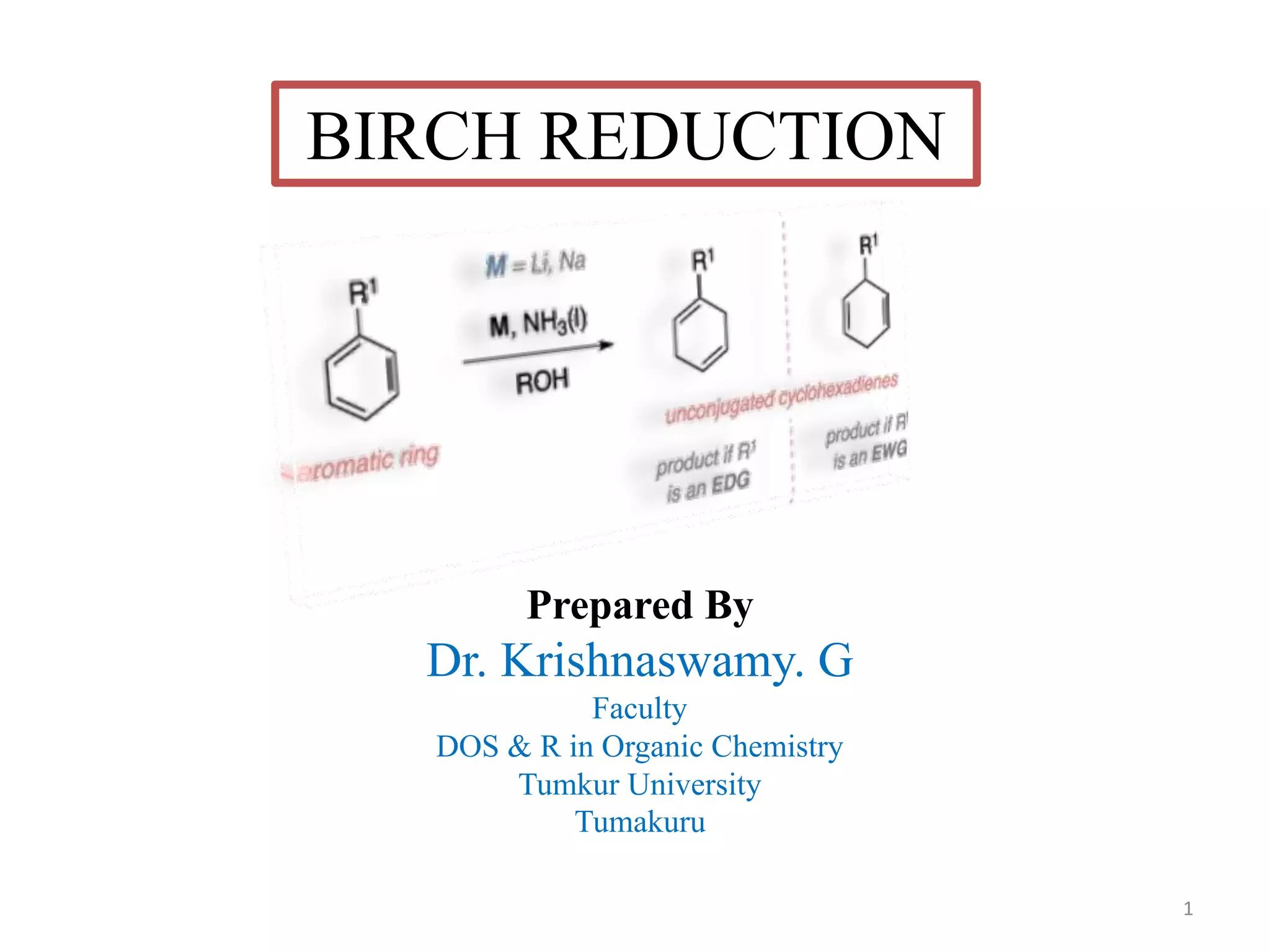
The Birch reduction is an organic reaction where
aromatic compounds undergo partial reduction to 1,4-
unconjugated cyclohexadiene compounds in presence of
alkali metals in liquid ammonia i.e. solvated electrons.
M liq. NH3 M [H3N-------e-------NH3]
M = Na / Li (Solvated Electron)
H H
H H
M / Liq. NH3
(Aromatic) (Non-aromatic)
M = Na / Li
The reduction is conducted by Sodium or Lithium metal
in liquid ammonia at -33oC
3
The solvated electrons give an intense blue color to the
solution and have to be captured as the metal releases
them, otherwise with time the blue color fades as the
electrons reduce the ammonia to NH2
- and H2.
Li Li e [NH3]n
NH3 e NH2 H
1/2 H2
(Blue solution)
(Colorless solution)
4
The mechanism begins with a single electron transfer
(SET) from the metal to the aromatic ring, forming a
radical anion.
The anion then picks up a proton from the alcohol which
results in a neutral radical intermediate.
Formed neutral radical intermediate picks up one electron
to form anion followed by abstraction of proton from
alcohol results in the final unconjugated cyclohexadiene.
MECHANISM
5
e
M / liq.NH3
H
H
H
H H
e
H
H H
H
H H
H
HOR
ROH
(Radical Anion)
6
Regioselectivity arises when there are substituents around
the aromatic ring.
REGIOSELECTIVITY
Electron Donating Groups such as alkyl or alkoxy groups
remains on the unreduced or Sp2 hybridised carbon atom
or ortho and meta carbon atoms are reduced.
EDG EDG
EDG = -OH, -OR, -NR2, -SR, -PR2, -alkyl, -CHO, -COOR
M / liq.NH3
Ortho Carbon reduced
from Sp2 to Sp3
Meta Carbon reduced
from Sp2 to Sp3
7
The Aldehydes and ester groups are in the electron
donation side because these are reduced to the
corresponding alcohols in Birch reduction prior to the
reduction of aromatic ring.
CHO CH2OH
M / liq.NH3 M / liq.NH3
CH2OH
COOR CH2OH
M / liq.NH3 M / liq.NH3
CH2OH
8
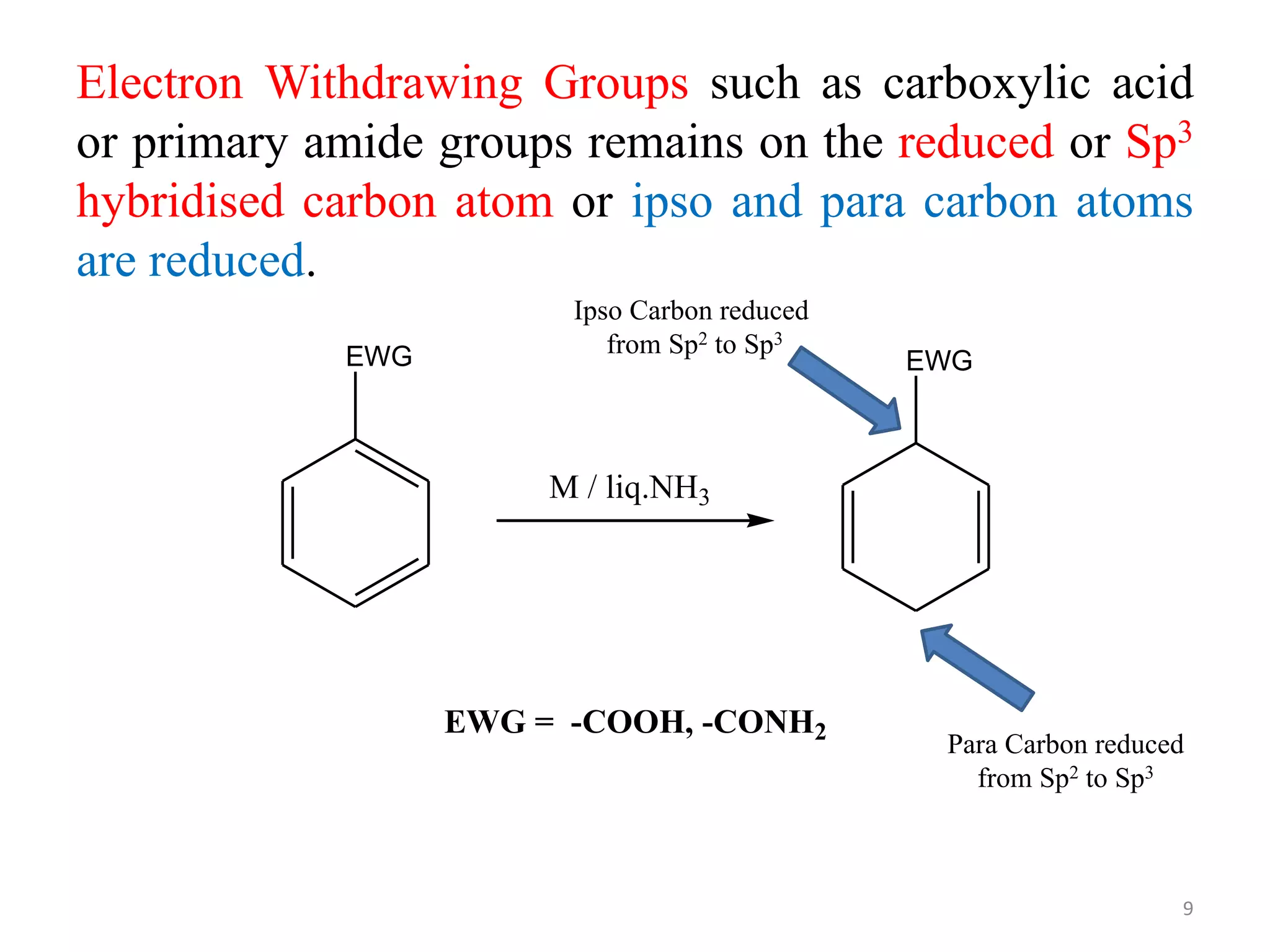
Electron Withdrawing Groups such as carboxylic acid
or primary amide groups remains on the reduced or Sp3
hybridised carbon atom or ipso and para carbon atoms
are reduced.
EWG EWG
EWG = -COOH, -CONH2
M / liq.NH3
Ipso Carbon reduced
from Sp2 to Sp3
Para Carbon reduced
from Sp2 to Sp3
9
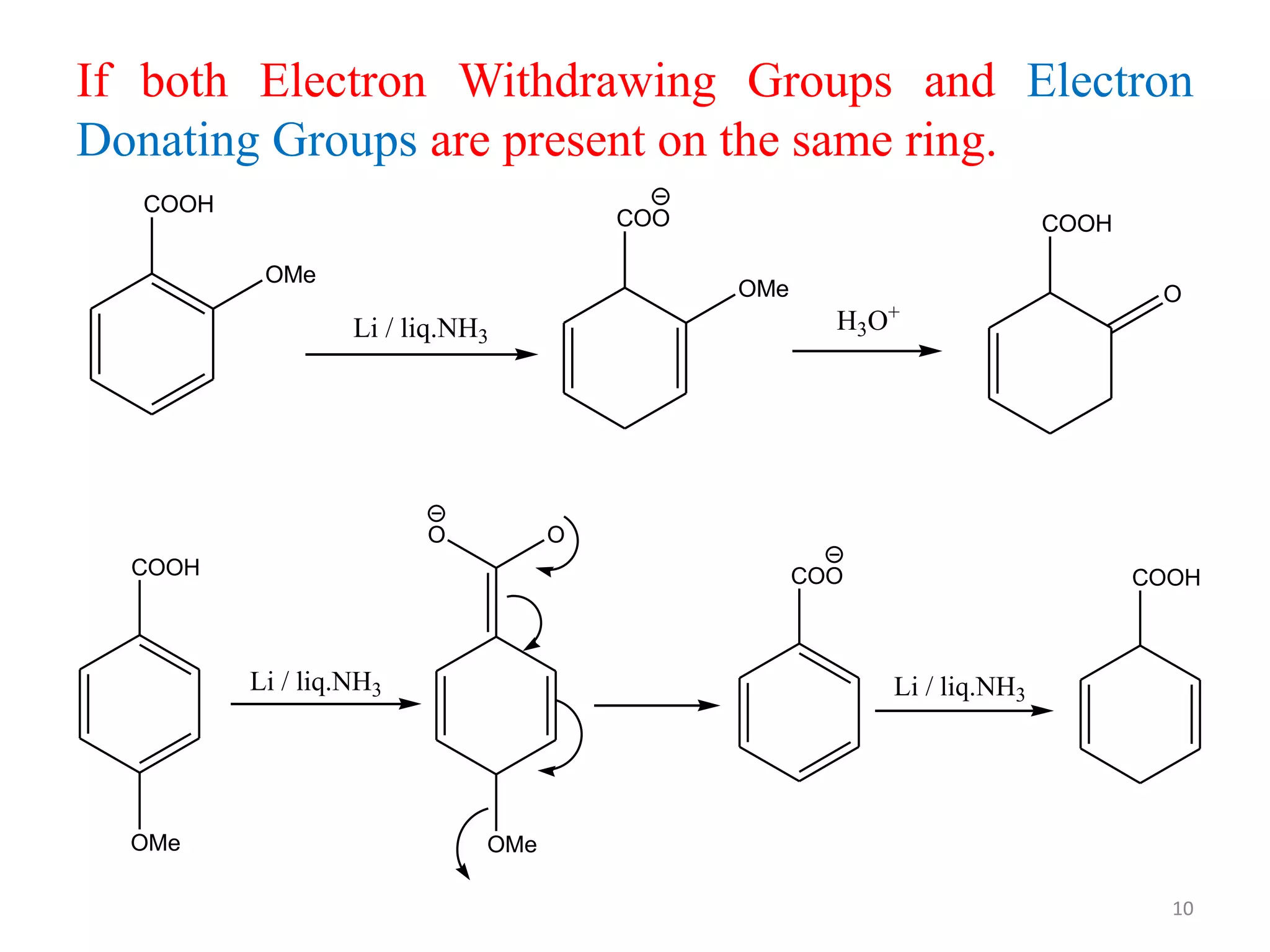
If both Electron Withdrawing Groups and Electron
Donating Groups are present on the same ring.
COOH
COO
Li / liq.NH3
COOH
OMe
OMe
H3O+
O
COOH
Li / liq.NH3
COO
OMe
O O
OMe
Li / liq.NH3
COOH
10
COOH COOH
Li / liq.NH3
OMe OMe
Different products are obtained depending upon the
positions of EDG.
In case of both EWG & EDG present in the same ring.
EWG placed on reduced carbon and EDG on the
unreduced carbon
11
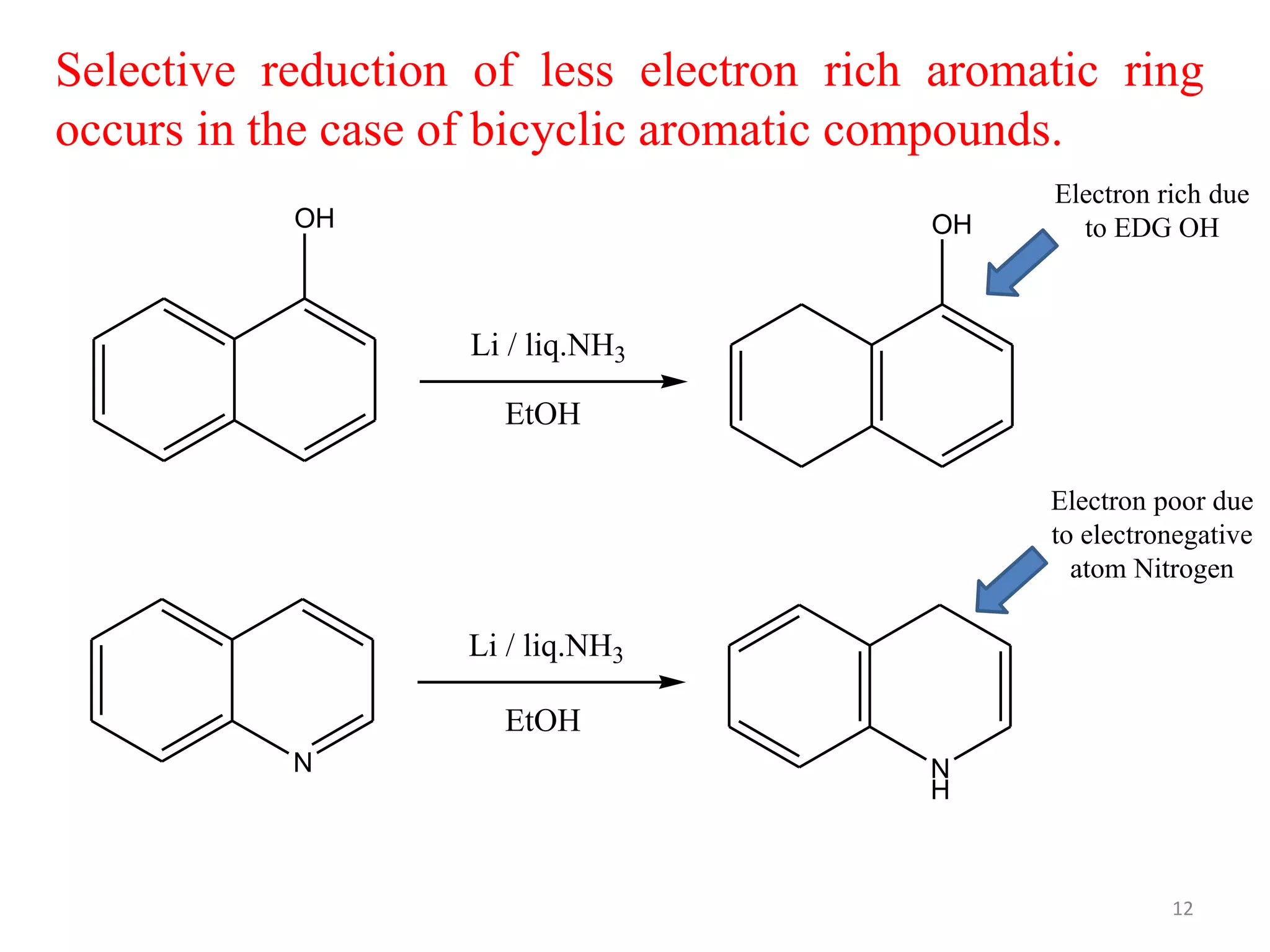
Selective reduction of less electron rich aromatic ring
occurs in the case of bicyclic aromatic compounds.
Li / liq.NH3
OH OH
Li / liq.NH3
N N
H
EtOH
EtOH
Electron rich due
to EDG OH
Electron poor due
to electronegative
atom Nitrogen
12
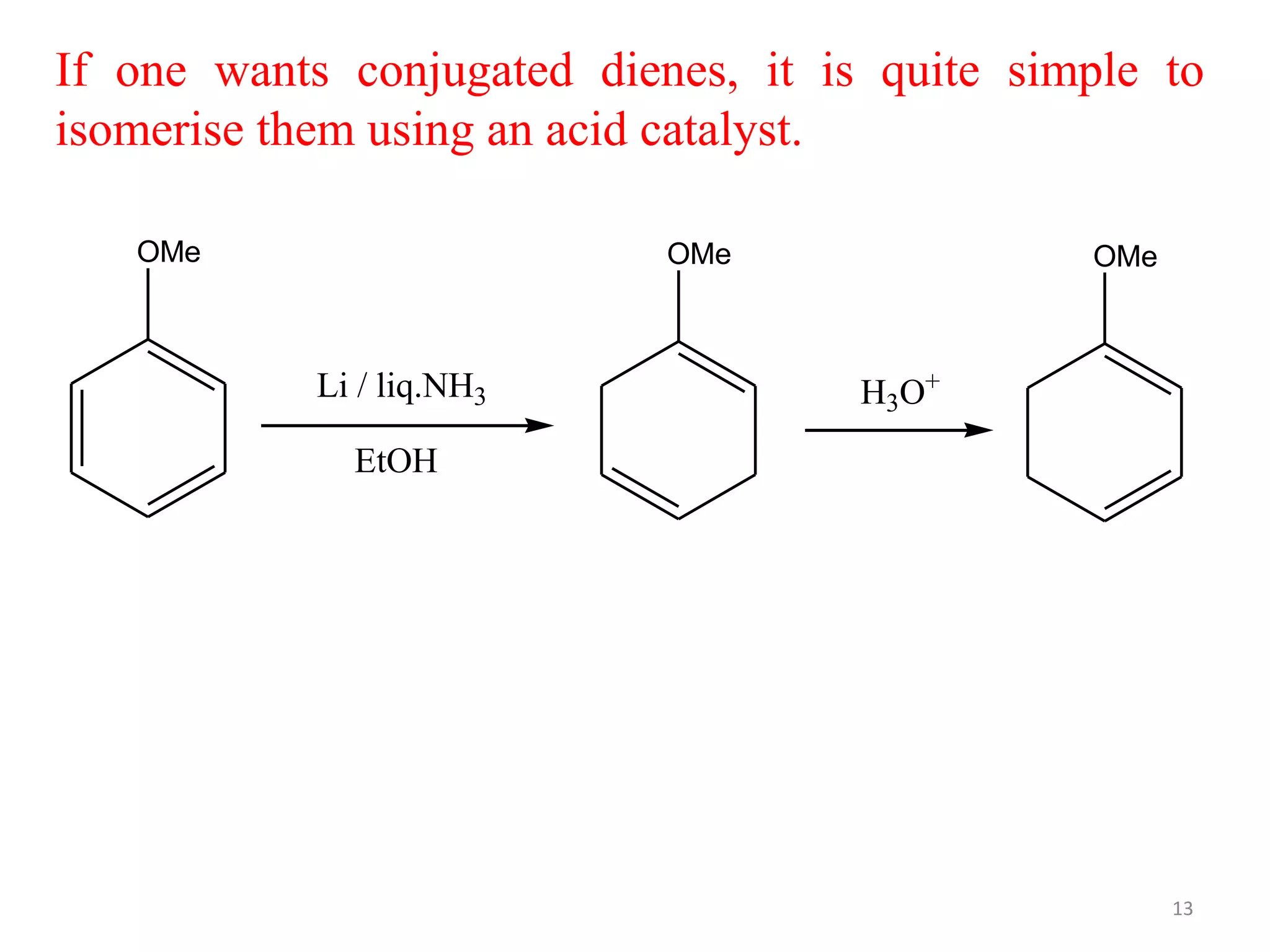
If one wants conjugated dienes, it is quite simple to
isomerise them using an acid catalyst.
Li / liq.NH3
EtOH
OMe OMe
H3O+
OMe
13
REFERENCES
 Birch, A. J. J. Chem. Soc. 1944, 430–436.
 https://www.name-reaction.com/birch-reduction
 https://en.wikipedia.org/wiki/Birch_reduction
14

Birch reduction

  • 1.
    BIRCH REDUCTION Prepared By Dr.Krishnaswamy. G Faculty DOS & R in Organic Chemistry Tumkur University Tumakuru 1
  • 2.
    Arthur John Birch1915–1995 2
  • 3.
    The Birch reductionis an organic reaction where aromatic compounds undergo partial reduction to 1,4- unconjugated cyclohexadiene compounds in presence of alkali metals in liquid ammonia i.e. solvated electrons. M liq. NH3 M [H3N-------e-------NH3] M = Na / Li (Solvated Electron) H H H H M / Liq. NH3 (Aromatic) (Non-aromatic) M = Na / Li The reduction is conducted by Sodium or Lithium metal in liquid ammonia at -33oC 3
  • 4.
    The solvated electronsgive an intense blue color to the solution and have to be captured as the metal releases them, otherwise with time the blue color fades as the electrons reduce the ammonia to NH2 - and H2. Li Li e [NH3]n NH3 e NH2 H 1/2 H2 (Blue solution) (Colorless solution) 4
  • 5.
    The mechanism beginswith a single electron transfer (SET) from the metal to the aromatic ring, forming a radical anion. The anion then picks up a proton from the alcohol which results in a neutral radical intermediate. Formed neutral radical intermediate picks up one electron to form anion followed by abstraction of proton from alcohol results in the final unconjugated cyclohexadiene. MECHANISM 5
  • 6.
    e M / liq.NH3 H H H HH e H H H H H H H HOR ROH (Radical Anion) 6
  • 7.
    Regioselectivity arises whenthere are substituents around the aromatic ring. REGIOSELECTIVITY Electron Donating Groups such as alkyl or alkoxy groups remains on the unreduced or Sp2 hybridised carbon atom or ortho and meta carbon atoms are reduced. EDG EDG EDG = -OH, -OR, -NR2, -SR, -PR2, -alkyl, -CHO, -COOR M / liq.NH3 Ortho Carbon reduced from Sp2 to Sp3 Meta Carbon reduced from Sp2 to Sp3 7
  • 8.
    The Aldehydes andester groups are in the electron donation side because these are reduced to the corresponding alcohols in Birch reduction prior to the reduction of aromatic ring. CHO CH2OH M / liq.NH3 M / liq.NH3 CH2OH COOR CH2OH M / liq.NH3 M / liq.NH3 CH2OH 8
  • 9.
    Electron Withdrawing Groupssuch as carboxylic acid or primary amide groups remains on the reduced or Sp3 hybridised carbon atom or ipso and para carbon atoms are reduced. EWG EWG EWG = -COOH, -CONH2 M / liq.NH3 Ipso Carbon reduced from Sp2 to Sp3 Para Carbon reduced from Sp2 to Sp3 9
  • 10.
    If both ElectronWithdrawing Groups and Electron Donating Groups are present on the same ring. COOH COO Li / liq.NH3 COOH OMe OMe H3O+ O COOH Li / liq.NH3 COO OMe O O OMe Li / liq.NH3 COOH 10
  • 11.
    COOH COOH Li /liq.NH3 OMe OMe Different products are obtained depending upon the positions of EDG. In case of both EWG & EDG present in the same ring. EWG placed on reduced carbon and EDG on the unreduced carbon 11
  • 12.
    Selective reduction ofless electron rich aromatic ring occurs in the case of bicyclic aromatic compounds. Li / liq.NH3 OH OH Li / liq.NH3 N N H EtOH EtOH Electron rich due to EDG OH Electron poor due to electronegative atom Nitrogen 12
  • 13.
    If one wantsconjugated dienes, it is quite simple to isomerise them using an acid catalyst. Li / liq.NH3 EtOH OMe OMe H3O+ OMe 13
  • 14.
    REFERENCES  Birch, A.J. J. Chem. Soc. 1944, 430–436.  https://www.name-reaction.com/birch-reduction  https://en.wikipedia.org/wiki/Birch_reduction 14