CHEMISTRY 3.5                                   ANSWERS

WORKSHEET NINE          ORGANIC CHEMISTRY
                               Carboxylic acids and their derivatives #2

1.   As a liquid at the reaction temperature, esters must have high melting points.
     This suggests that they have fairly strong intermolecular forces due to the
     polarity of the molecules.
     As sweet smelling liquids, the esters must also be moderately volatile.
     By forming a separate layer on top of the aqueous phase, esters show that they
     are not water soluble. This is because they are unable to hydrogen bond to
     water molecules.

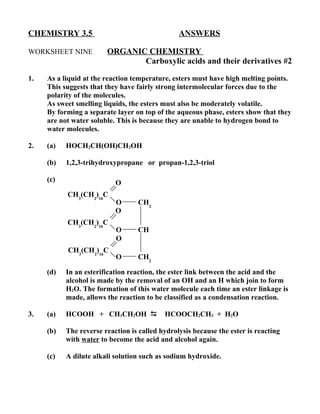
2.   (a)   HOCH2CH(OH)CH2OH

     (b)   1,2,3-trihydroxypropane or propan-1,2,3-triol

     (c)                   O
           CH3(CH2)16C
                           O      CH2
                           O
           CH3(CH2)16C
                           O      CH
                           O
           CH3(CH2)16C
                           O      CH2

     (d)   In an esterification reaction, the ester link between the acid and the
           alcohol is made by the removal of an OH and an H which join to form
           H2O. The formation of this water molecule each time an ester linkage is
           made, allows the reaction to be classified as a condensation reaction.

3.   (a)   HCOOH + CH3CH2OH               HCOOCH2CH3 + H2O

     (b)   The reverse reaction is called hydrolysis because the ester is reacting
           with water to become the acid and alcohol again.

     (c)   A dilute alkali solution such as sodium hydroxide.
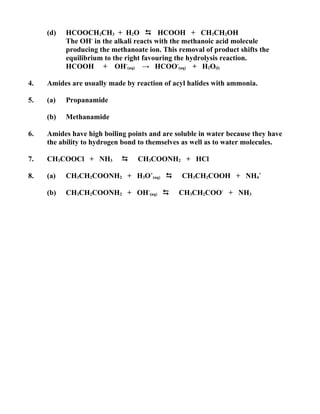
(d)   HCOOCH2CH3 + H2O  HCOOH + CH3CH2OH
           The OH- in the alkali reacts with the methanoic acid molecule
           producing the methanoate ion. This removal of product shifts the
           equilibrium to the right favouring the hydrolysis reaction.
           HCOOH + OH-(aq) → HCOO-(aq) + H2O(l)

4.   Amides are usually made by reaction of acyl halides with ammonia.

5.   (a)   Propanamide

     (b)   Methanamide

6.   Amides have high boiling points and are soluble in water because they have
     the ability to hydrogen bond to themselves as well as to water molecules.

7.   CH3COOCl + NH3             CH3COONH2 + HCl

8.   (a)   CH3CH2COONH2 + H3O+(aq)            CH3CH2COOH + NH4+

     (b)   CH3CH2COONH2 + OH-(aq)            CH3CH2COO- + NH3

Chem 3.5 answers #9

  • 1.
    CHEMISTRY 3.5 ANSWERS WORKSHEET NINE ORGANIC CHEMISTRY Carboxylic acids and their derivatives #2 1. As a liquid at the reaction temperature, esters must have high melting points. This suggests that they have fairly strong intermolecular forces due to the polarity of the molecules. As sweet smelling liquids, the esters must also be moderately volatile. By forming a separate layer on top of the aqueous phase, esters show that they are not water soluble. This is because they are unable to hydrogen bond to water molecules. 2. (a) HOCH2CH(OH)CH2OH (b) 1,2,3-trihydroxypropane or propan-1,2,3-triol (c) O CH3(CH2)16C O CH2 O CH3(CH2)16C O CH O CH3(CH2)16C O CH2 (d) In an esterification reaction, the ester link between the acid and the alcohol is made by the removal of an OH and an H which join to form H2O. The formation of this water molecule each time an ester linkage is made, allows the reaction to be classified as a condensation reaction. 3. (a) HCOOH + CH3CH2OH  HCOOCH2CH3 + H2O (b) The reverse reaction is called hydrolysis because the ester is reacting with water to become the acid and alcohol again. (c) A dilute alkali solution such as sodium hydroxide.
  • 2.
    (d) HCOOCH2CH3 + H2O  HCOOH + CH3CH2OH The OH- in the alkali reacts with the methanoic acid molecule producing the methanoate ion. This removal of product shifts the equilibrium to the right favouring the hydrolysis reaction. HCOOH + OH-(aq) → HCOO-(aq) + H2O(l) 4. Amides are usually made by reaction of acyl halides with ammonia. 5. (a) Propanamide (b) Methanamide 6. Amides have high boiling points and are soluble in water because they have the ability to hydrogen bond to themselves as well as to water molecules. 7. CH3COOCl + NH3  CH3COONH2 + HCl 8. (a) CH3CH2COONH2 + H3O+(aq)  CH3CH2COOH + NH4+ (b) CH3CH2COONH2 + OH-(aq)  CH3CH2COO- + NH3