1
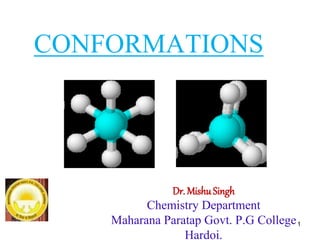
CONFORMATIONS
Dr. MishuSingh
Chemistry Department
Maharana Paratap Govt. P.G College
Hardoi.
conformations
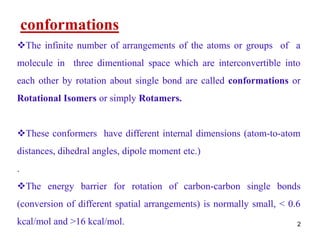
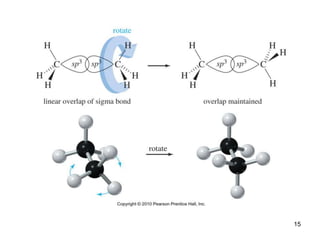
The infinite number of arrangements of the atoms or groups of a
molecule in three dimentional space which are interconvertible into
each other by rotation about single bond are called conformations or
Rotational Isomers or simply Rotamers.
These conformers have different internal dimensions (atom-to-atom
distances, dihedral angles, dipole moment etc.)
.
The energy barrier for rotation of carbon-carbon single bonds
(conversion of different spatial arrangements) is normally small, < 0.6
kcal/mol and >16 kcal/mol. 2
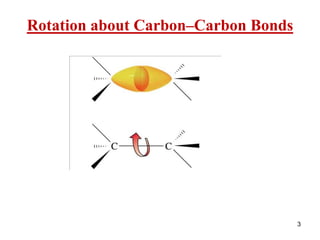
Rotation about Carbon–Carbon Bonds
3
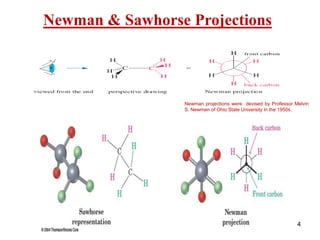
Newman & Sawhorse Projections
4
Newman projections were devised by Professor Melvin
S. Newman of Ohio State University in the 1950s.
5
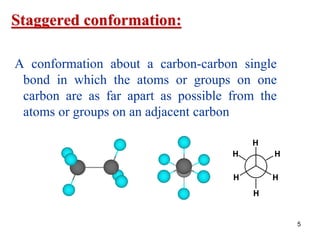
Staggered conformation:
A conformation about a carbon-carbon single
bond in which the atoms or groups on one
carbon are as far apart as possible from the
atoms or groups on an adjacent carbon
H
H H
H H
H
6
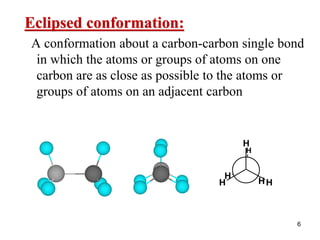
Eclipsed conformation:
A conformation about a carbon-carbon single bond
in which the atoms or groups of atoms on one
carbon are as close as possible to the atoms or
groups of atoms on an adjacent carbon
H
H H
H
H
H
7
•
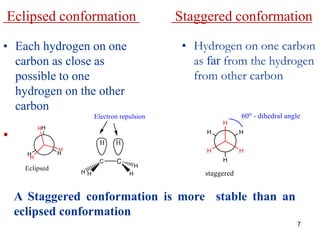
Eclipsed conformation Staggered conformation
• Each hydrogen on one
carbon as close as
possible to one
hydrogen on the other
carbon
• Hydrogen on one carbon
as far from the hydrogen
from other carbon
A Staggered conformation is more stable than an
eclipsed conformation
8
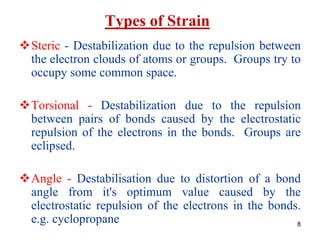
Types of Strain
Steric - Destabilization due to the repulsion between
the electron clouds of atoms or groups. Groups try to
occupy some common space.
Torsional - Destabilization due to the repulsion
between pairs of bonds caused by the electrostatic
repulsion of the electrons in the bonds. Groups are
eclipsed.
Angle - Destabilisation due to distortion of a bond
angle from it's optimum value caused by the
electrostatic repulsion of the electrons in the bonds.
e.g. cyclopropane
9
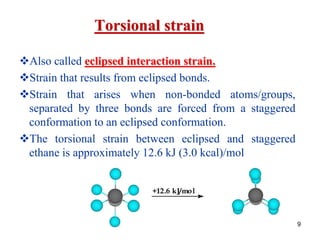
Torsional strain
Also called eclipsed interaction strain.
Strain that results from eclipsed bonds.
Strain that arises when non-bonded atoms/groups,
separated by three bonds are forced from a staggered
conformation to an eclipsed conformation.
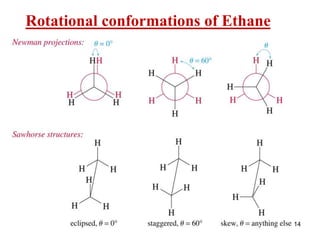
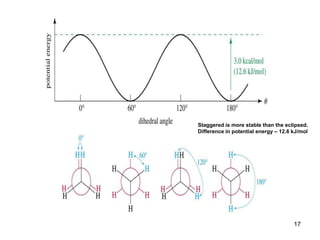
The torsional strain between eclipsed and staggered
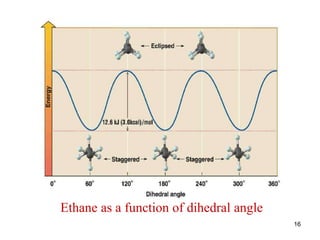
ethane is approximately 12.6 kJ (3.0 kcal)/mol
+12.6 kJ/mol
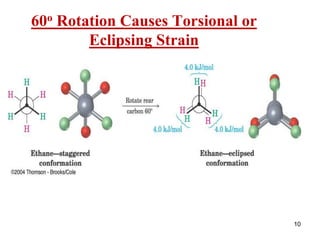
10
60o Rotation Causes Torsional or
Eclipsing Strain
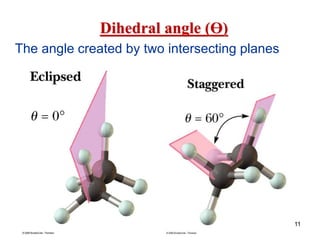
11
Dihedral angle (Ɵ)
The angle created by two intersecting planes
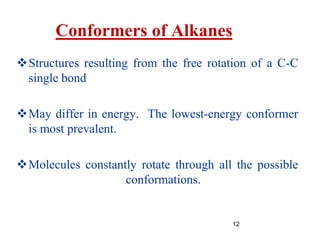
12
Conformers of Alkanes
Structures resulting from the free rotation of a C-C
single bond
May differ in energy. The lowest-energy conformer
is most prevalent.
Molecules constantly rotate through all the possible
conformations.
13
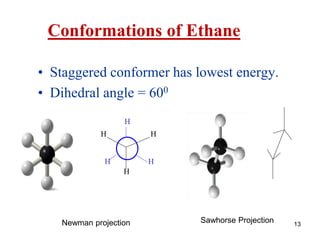
Conformations of Ethane
• Staggered conformer has lowest energy.
• Dihedral angle = 600
H
H
H
H
H H
Newman projection Sawhorse Projection
14
Rotational conformations of Ethane
15
16
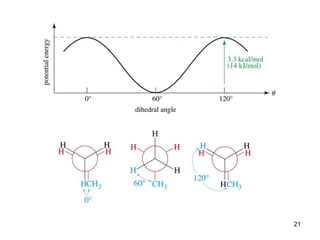
Ethane as a function of dihedral angle
17
Staggered is more stable than the eclipsed.
Difference in potential energy – 12.6 kJ/mol
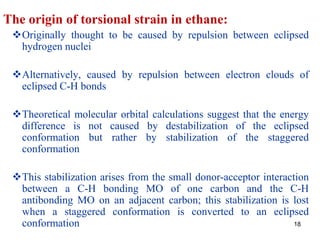
18
The origin of torsional strain in ethane:
Originally thought to be caused by repulsion between eclipsed
hydrogen nuclei
Alternatively, caused by repulsion between electron clouds of
eclipsed C-H bonds
Theoretical molecular orbital calculations suggest that the energy
difference is not caused by destabilization of the eclipsed
conformation but rather by stabilization of the staggered
conformation
This stabilization arises from the small donor-acceptor interaction
between a C-H bonding MO of one carbon and the C-H
antibonding MO on an adjacent carbon; this stabilization is lost
when a staggered conformation is converted to an eclipsed
conformation
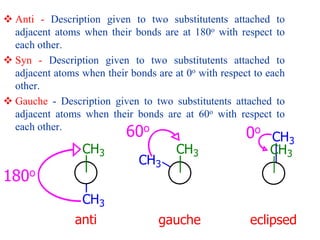
 Anti - Description given to two substitutents attached to
adjacent atoms when their bonds are at 180o with respect to
each other.
 Syn - Description given to two substitutents attached to
adjacent atoms when their bonds are at 0o with respect to each
other.
 Gauche - Description given to two substitutents attached to
adjacent atoms when their bonds are at 60o with respect to
each other.
CH3
CH3
anti
CH3
CH3
gauche
CH3
CH3
eclipsed
0o
180o
60o
20
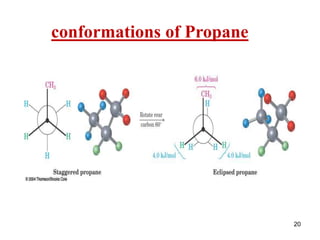
conformations of Propane
21
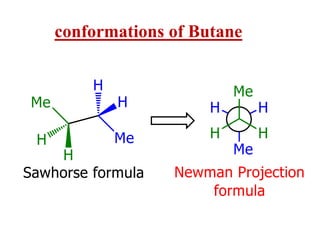
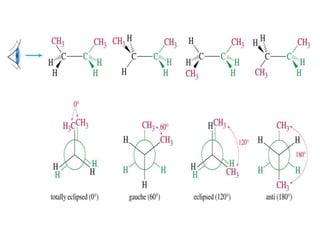
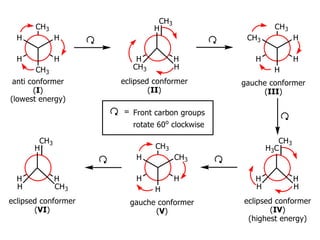
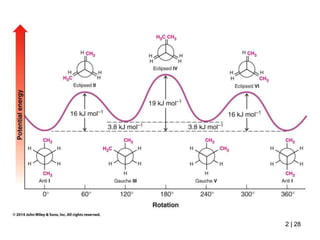
conformations of Butane
25
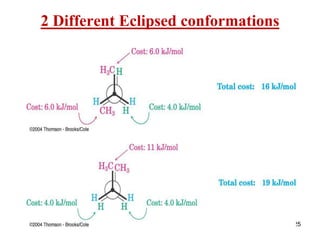
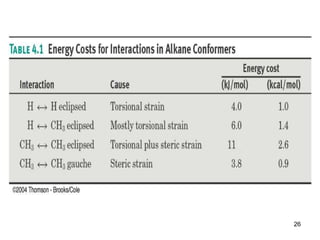
2 Different Eclipsed conformations
26
27
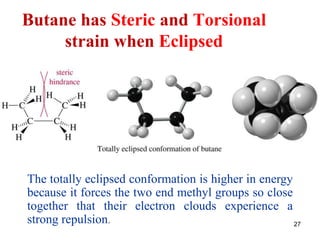
Butane has Steric and Torsional
strain when Eclipsed
The totally eclipsed conformation is higher in energy
because it forces the two end methyl groups so close
together that their electron clouds experience a
strong repulsion.
2 | 28
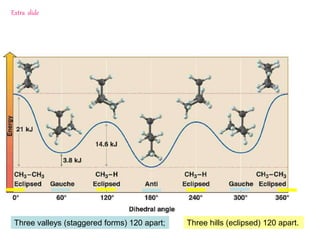
Three valleys (staggered forms) 120 apart; Three hills (eclipsed) 120 apart.
Extra slide
30
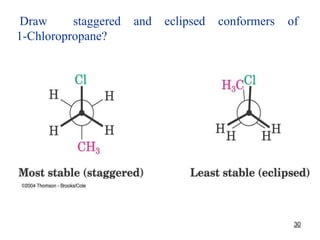
Draw staggered and eclipsed conformers of
1-Chloropropane?
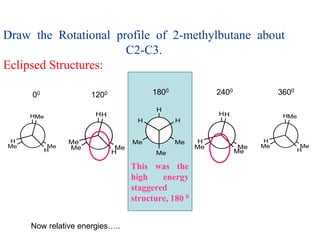
Draw the Rotational profile of 2-methylbutane about
C2-C3.
Eclipsed Structures:
Me
H
Me
H
Me
H
This was the
high energy
staggered
structure, 180 0
Me
H
Me
H
H
Me
Me
H
Me
H
Me
H
1200 24001800
Me
H
Me
Me
H
H
Me
H
Me
Me
H
H
00 3600
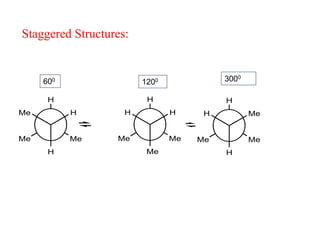
Now relative energies…..
Me
H
Me
H
Me
H
Me
H
Me
Me
H
H
Me
H
Me
H
H
Me
1200600 3000
Staggered Structures:
33
conformations
in
Cycloalkane
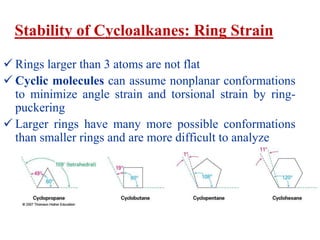
Stability of Cycloalkanes: Ring Strain
 Rings larger than 3 atoms are not flat
 Cyclic molecules can assume nonplanar conformations
to minimize angle strain and torsional strain by ring-
puckering
 Larger rings have many more possible conformations
than smaller rings and are more difficult to analyze
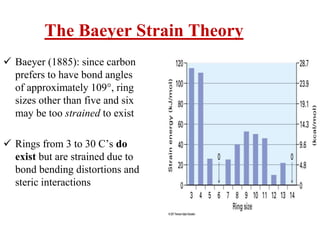
The Baeyer Strain Theory
 Baeyer (1885): since carbon
prefers to have bond angles
of approximately 109°, ring
sizes other than five and six
may be too strained to exist
 Rings from 3 to 30 C’s do
exist but are strained due to
bond bending distortions and
steric interactions
36
Summary: Types of Strain
 Angle strain - expansion or compression of bond angles away
from most stable
 Torsional strain - eclipsing of bonds on neighboring
atoms/gps
 Steric strain - repulsive interactions between nonbonded
atoms in close proximity
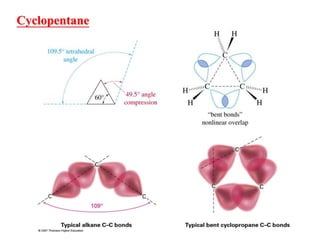
Cyclopentane
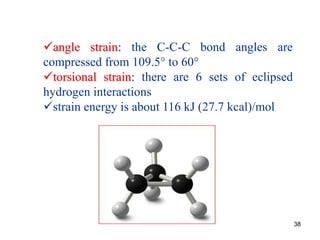
38
angle strain: the C-C-C bond angles are
compressed from 109.5° to 60°
torsional strain: there are 6 sets of eclipsed
hydrogen interactions
strain energy is about 116 kJ (27.7 kcal)/mol
39
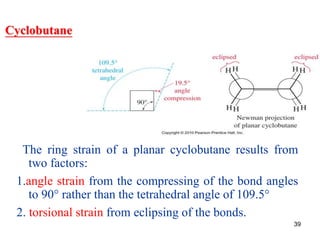
Cyclobutane
The ring strain of a planar cyclobutane results from
two factors:
1.angle strain from the compressing of the bond angles
to 90° rather than the tetrahedral angle of 109.5°
2. torsional strain from eclipsing of the bonds.
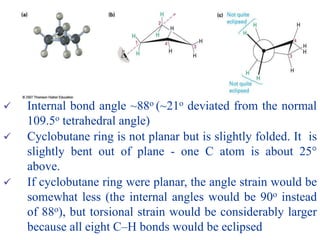
 Internal bond angle ~88o (~21o deviated from the normal
109.5o tetrahedral angle)
 Cyclobutane ring is not planar but is slightly folded. It is
slightly bent out of plane - one C atom is about 25°
above.
 If cyclobutane ring were planar, the angle strain would be
somewhat less (the internal angles would be 90o instead
of 88o), but torsional strain would be considerably larger
because all eight C–H bonds would be eclipsed
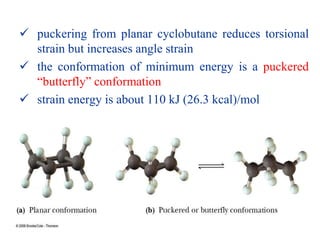
 puckering from planar cyclobutane reduces torsional
strain but increases angle strain
 the conformation of minimum energy is a puckered
“butterfly” conformation
 strain energy is about 110 kJ (26.3 kcal)/mol
42
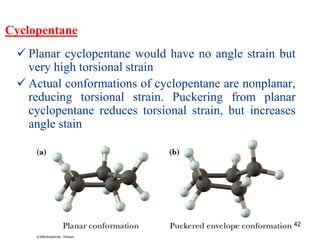
Cyclopentane
 Planar cyclopentane would have no angle strain but
very high torsional strain
 Actual conformations of cyclopentane are nonplanar,
reducing torsional strain. Puckering from planar
cyclopentane reduces torsional strain, but increases
angle stain
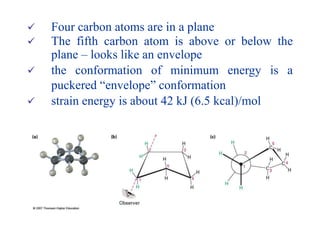
 Four carbon atoms are in a plane
 The fifth carbon atom is above or below the
plane – looks like an envelope
 the conformation of minimum energy is a
puckered “envelope” conformation
 strain energy is about 42 kJ (6.5 kcal)/mol
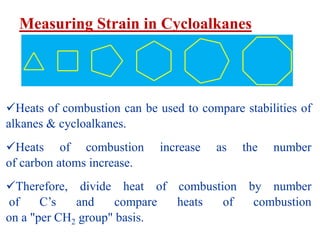
Measuring Strain in Cycloalkanes
Heats of combustion can be used to compare stabilities of
alkanes & cycloalkanes.
Heats of combustion increase as the number
of carbon atoms increase.
Therefore, divide heat of combustion by number
of C’s and compare heats of combustion
on a "per CH2 group" basis.
45
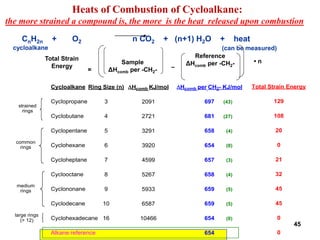
CnH2n + O2 n CO2 + (n+1) H2O + heat
cycloalkane (can be measured)
Total Strain
Energy
=
Sample
ΔHcomb per -CH2-
_
Reference
ΔHcomb per -CH2- • n
Heats of Combustion of Cycloalkane:
the more strained a compound is, the more is the heat released upon combustion
Cycloalkane
Cyclopropane
Cyclobutane
Cyclopentane
Cyclohexane
Cycloheptane
Cyclooctane
Cyclononane
Cyclodecane
Cyclohexadecane
Alkane reference
Ring Size (n)
3
4
5
6
7
8
9
10
16
Hcomb KJ/mol
2091
2721
3291
3920
4599
5267
5933
6587
10466
Hcomb per CH2- KJ/mol
697
681
658
654
657
658
659
659
654
654
Total Strain Energy
129
108
20
0
21
32
45
45
0
0
strained
rings
common
rings
medium
rings
large rings
(> 12)
(43)
(27)
(4)
(0)
(3)
(4)
(5)
(5)
(0)
According to Baeyer, cyclopentane should have less
angle strain than cyclohexane.
Cyclopentane 3,291 658
Cyclohexane 3,920 653
The heat of combustion per CH2 group is less for
cyclohexane than for cyclopentane. Therefore,
cyclohexane has less strain and more stable than
cyclopentane.
Heat of combustion suggests that angle strain
is unimportant in cyclohexane.
Tetrahedral bond angles require nonplanar
geometries.
conformations of Cyclohexane
Cyclohexane is by far the most common
cycloalkane in nature and also in organic
chemistry.
The cyclohexane ring is free of angle strain and
torsional strain. Zero ring strain implies the bond
angles must be 109.5°. (no angle strain) and also
no eclipsing interactions between the C-H bonds
(no torsional strain).
48
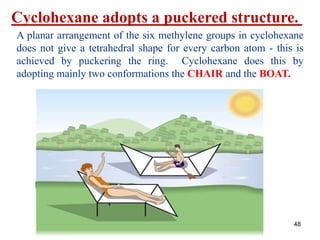
Cyclohexane adopts a puckered structure.
A planar arrangement of the six methylene groups in cyclohexane
does not give a tetrahedral shape for every carbon atom - this is
achieved by puckering the ring. Cyclohexane does this by
adopting mainly two conformations the CHAIR and the BOAT.
49
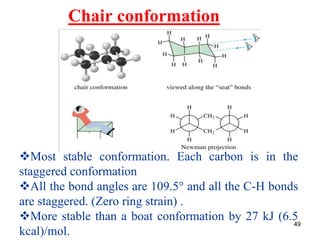
Chair conformation
Most stable conformation. Each carbon is in the
staggered conformation
All the bond angles are 109.5° and all the C-H bonds
are staggered. (Zero ring strain) .
More stable than a boat conformation by 27 kJ (6.5
kcal)/mol.
50
Boat conformation
51
52
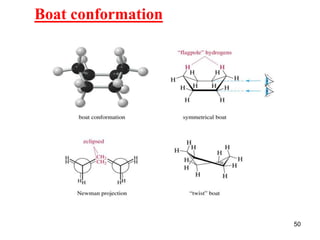
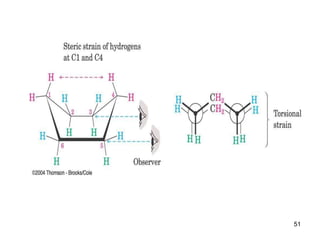
The boat is just a chair with the footrest flipped up.
C-1, C-4 are bent toward each other.
Four sets of eclipsed C-H interactions & one
flagpole interaction
This also has bond angles of 109.5° and thus avoids
any angle strain, but there is torsional strain.
The two hydrogens at the ends of the boat are in
close contact, causing torsional strain. These flagpole
hydrogens are eclipsed.
53
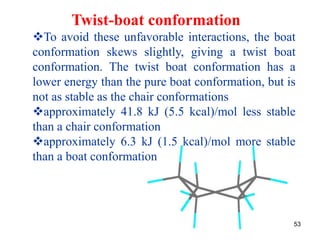
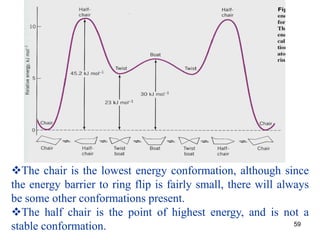
Twist-boat conformation
To avoid these unfavorable interactions, the boat
conformation skews slightly, giving a twist boat
conformation. The twist boat conformation has a
lower energy than the pure boat conformation, but is
not as stable as the chair conformations
approximately 41.8 kJ (5.5 kcal)/mol less stable
than a chair conformation
approximately 6.3 kJ (1.5 kcal)/mol more stable
than a boat conformation
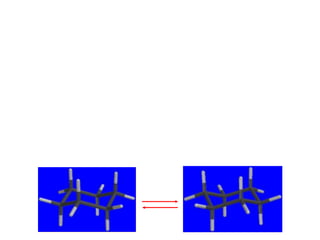
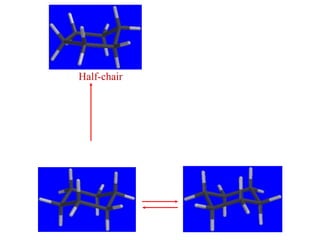
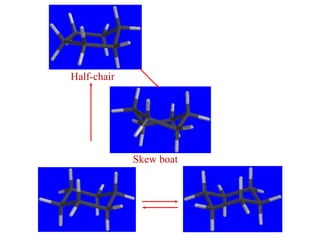
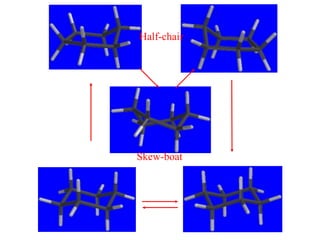
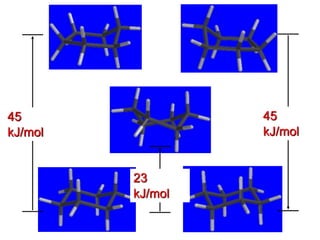
Half-chair
Half-chair
Skew boat
Half-chair
Skew-boat
45
kJ/mol
45
kJ/mol
23
kJ/mol
59
The chair is the lowest energy conformation, although since
the energy barrier to ring flip is fairly small, there will always
be some other conformations present.
The half chair is the point of highest energy, and is not a
stable conformation.
Axial and Equatorial Bonds in
Cyclohexane
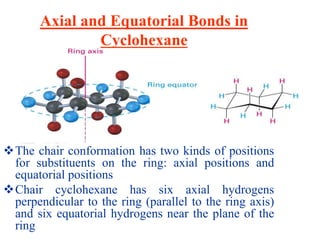
The chair conformation has two kinds of positions
for substituents on the ring: axial positions and
equatorial positions
Chair cyclohexane has six axial hydrogens
perpendicular to the ring (parallel to the ring axis)
and six equatorial hydrogens near the plane of the
ring
61
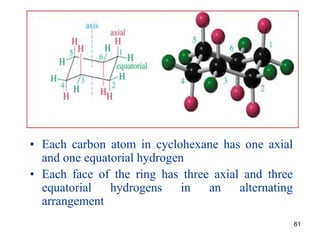
• Each carbon atom in cyclohexane has one axial
and one equatorial hydrogen
• Each face of the ring has three axial and three
equatorial hydrogens in an alternating
arrangement
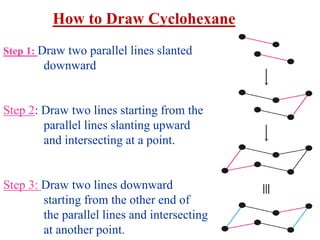
How to Draw Cyclohexane
Step 1: Draw two parallel lines slanted
downward
Step 2: Draw two lines starting from the
parallel lines slanting upward
and intersecting at a point.
Step 3: Draw two lines downward
starting from the other end of
the parallel lines and intersecting
at another point.
63
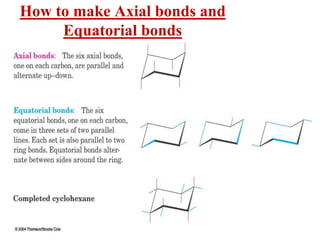
How to make Axial bonds and
Equatorial bonds
64
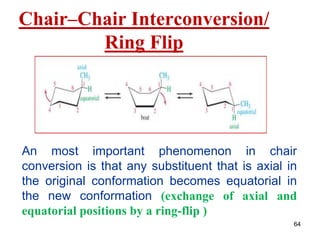
Chair–Chair Interconversion/
Ring Flip
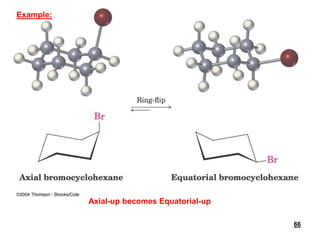
An most important phenomenon in chair
conversion is that any substituent that is axial in
the original conformation becomes equatorial in
the new conformation (exchange of axial and
equatorial positions by a ring-flip )
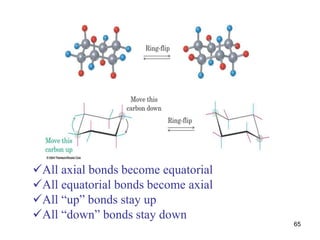
65
All axial bonds become equatorial
All equatorial bonds become axial
All “up” bonds stay up
All “down” bonds stay down
66
Example:
Axial-up becomes Equatorial-up
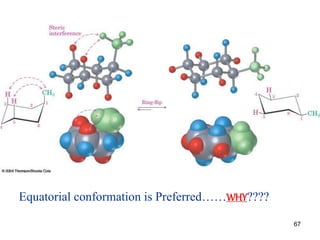
67
Equatorial conformation is Preferred……WHY????
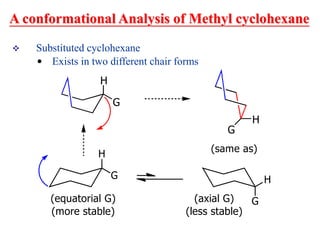
A conformational Analysis of Methyl cyclohexane
 Substituted cyclohexane
• Exists in two different chair forms
H
G
H
G
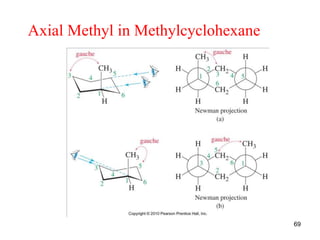
69
Axial Methyl in Methylcyclohexane
70
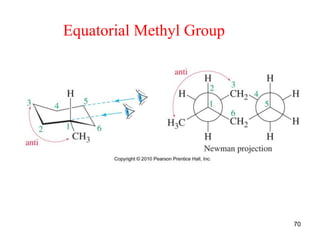
Equatorial Methyl Group
71
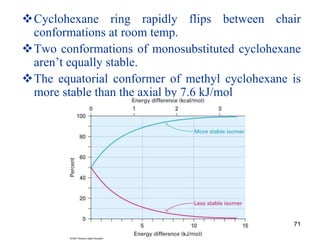
Cyclohexane ring rapidly flips between chair
conformations at room temp.
Two conformations of monosubstituted cyclohexane
aren’t equally stable.
The equatorial conformer of methyl cyclohexane is
more stable than the axial by 7.6 kJ/mol
72
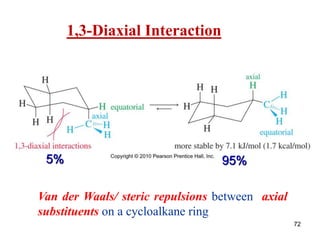
1,3-Diaxial Interaction
5% 95%
Van der Waals/ steric repulsions between axial
substituents on a cycloalkane ring
73
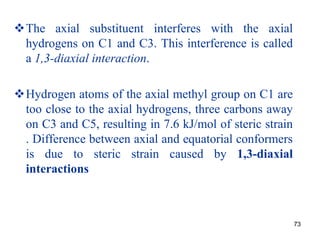
The axial substituent interferes with the axial
hydrogens on C1 and C3. This interference is called
a 1,3-diaxial interaction.
Hydrogen atoms of the axial methyl group on C1 are
too close to the axial hydrogens, three carbons away
on C3 and C5, resulting in 7.6 kJ/mol of steric strain
. Difference between axial and equatorial conformers
is due to steric strain caused by 1,3-diaxial
interactions
74
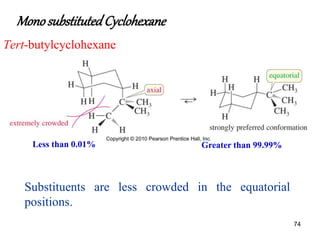
Tert-butylcyclohexane
Substituents are less crowded in the equatorial
positions.
MonosubstitutedCyclohexane
Less than 0.01% Greater than 99.99%
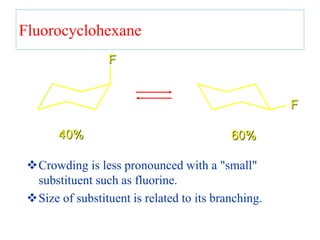
40% 60%
Crowding is less pronounced with a "small"
substituent such as fluorine.
Size of substituent is related to its branching.
Fluorocyclohexane
F
F
Keq = [equatorial conformer]/[axial conformer]
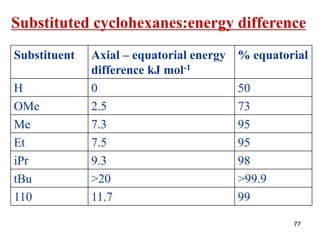
• The larger the substituent on a cyclohexane ring, the
more the equatorial substituted conformer will be
favored
77
Substituent Axial – equatorial energy
difference kJ mol-1
% equatorial
H 0 50
OMe 2.5 73
Me 7.3 95
Et 7.5 95
iPr 9.3 98
tBu >20 >99.9
110 11.7 99
Substituted cyclohexanes:energy difference
78
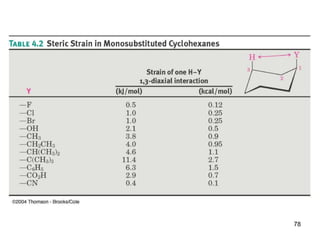
Chapter 4
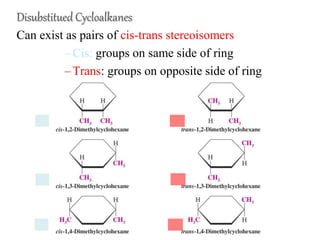
Disubstitued Cycloalkanes
Can exist as pairs of cis-trans stereoisomers
–Cis: groups on same side of ring
–Trans: groups on opposite side of ring
80
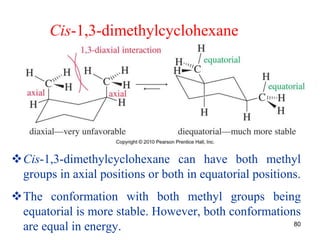
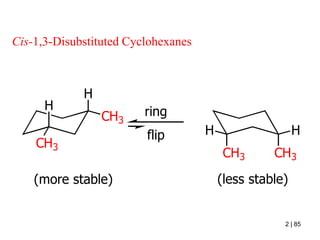
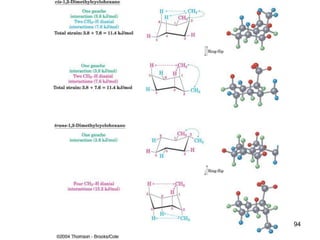
Cis-1,3-dimethylcyclohexane
Cis-1,3-dimethylcyclohexane can have both methyl
groups in axial positions or both in equatorial positions.
The conformation with both methyl groups being
equatorial is more stable. However, both conformations
are equal in energy.
81
82
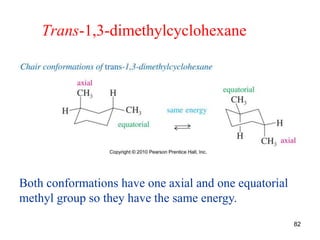
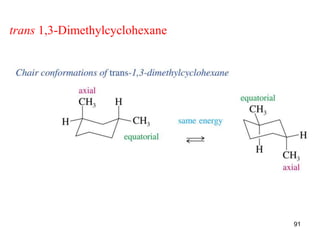
Trans-1,3-dimethylcyclohexane
Both conformations have one axial and one equatorial
methyl group so they have the same energy.
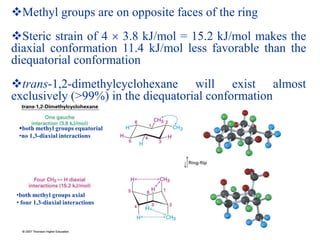
Methyl groups are on opposite faces of the ring
Steric strain of 4  3.8 kJ/mol = 15.2 kJ/mol makes the
diaxial conformation 11.4 kJ/mol less favorable than the
diequatorial conformation
trans-1,2-dimethylcyclohexane will exist almost
exclusively (>99%) in the diequatorial conformation
both methyl groups equatorial
•no 1,3-diaxial interactions
•both methyl groups axial
• four 1,3-diaxial interactions
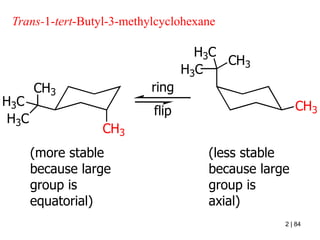
CH3
ring
flip
H3C
CH3
H3C
H3C
H3C
CH3
(more stable
because large
group is
equatorial)
(less stable
because large
group is
axial)
CH3
Trans-1-tert-Butyl-3-methylcyclohexane
2 | 84
Cis-1,3-Disubstituted Cyclohexanes
ring
flip
(more stable)
CH3
H
CH3
H
CH3
CH3
H H
(less stable)
2 | 85
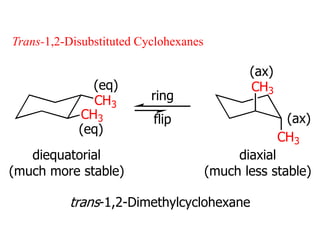
Trans-1,2-Disubstituted Cyclohexanes
ring
flip
trans-1,2-Dimethylcyclohexane
CH3
CH3(eq)
(ax)
(ax)
(eq)
CH3
CH3
diequatorial
(much more stable)
diaxial
(much less stable)
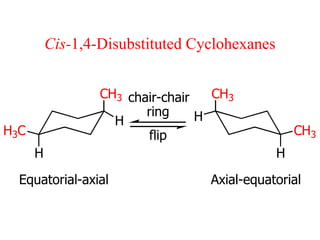
Cis-1,4-Disubstituted Cyclohexanes
H
HH
H3C
CH3 CH3
H
CH3
ring
flip
Equatorial-axial Axial-equatorial
chair-chair
CH3
CH3
ring
flip
H3C
CH3
H3C
H3C
H3C
CH3
(more stable
because large
group is
equatorial)
(less stable
because large
group is
axial)
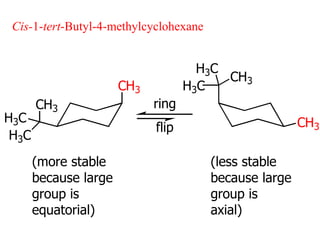
Cis-1-tert-Butyl-4-methylcyclohexane
89
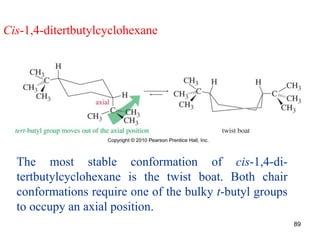
Cis-1,4-ditertbutylcyclohexane
The most stable conformation of cis-1,4-di-
tertbutylcyclohexane is the twist boat. Both chair
conformations require one of the bulky t-butyl groups
to occupy an axial position.
90
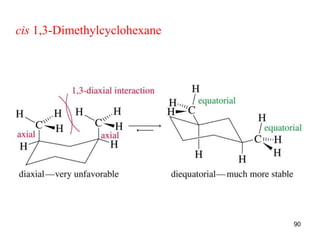
cis 1,3-Dimethylcyclohexane
91
trans 1,3-Dimethylcyclohexane
92
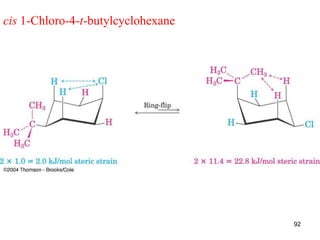
cis 1-Chloro-4-t-butylcyclohexane
CH3
ring
flipCH3
CH3
CH3
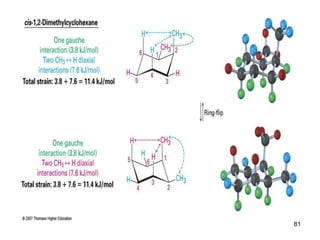
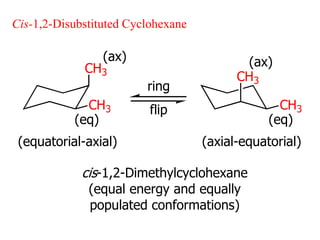
cis-1,2-Dimethylcyclohexane
(equal energy and equally
populated conformations)
(equatorial-axial) (axial-equatorial)
(eq)
(ax)
(eq)
(ax)
Cis-1,2-Disubstituted Cyclohexane
94
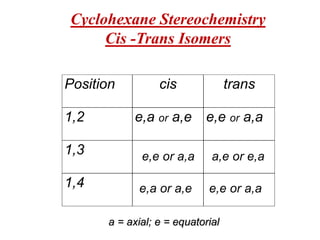
Cyclohexane Stereochemistry
Cis -Trans Isomers
Position cis trans
1,2 e,a or a,e e,e or a,a
1,3
1,4
a = axial; e = equatorial
e,a or a,e e,e or a,a
e,e or a,a a,e or e,a
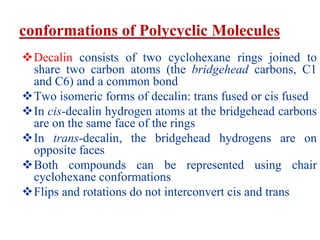
conformations of Polycyclic Molecules
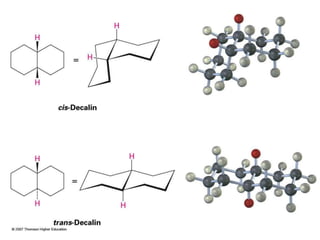
Decalin consists of two cyclohexane rings joined to
share two carbon atoms (the bridgehead carbons, C1
and C6) and a common bond
Two isomeric forms of decalin: trans fused or cis fused
In cis-decalin hydrogen atoms at the bridgehead carbons
are on the same face of the rings
In trans-decalin, the bridgehead hydrogens are on
opposite faces
Both compounds can be represented using chair
cyclohexane conformations
Flips and rotations do not interconvert cis and trans
97
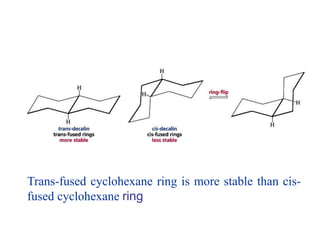
Trans-fused cyclohexane ring is more stable than cis-
fused cyclohexane ring
99
Problems
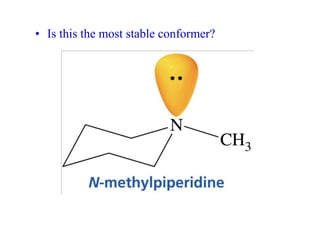
• Is this the most stable conformer?
101
Problem- 1
A. Draw both chair conformations of cis-1,2-
dimethylcyclohexane, and determine which
conformer is more stable?
B. Repeat for the trans isomer.
C. Predict which isomer (cis or trans) is more stable.
102
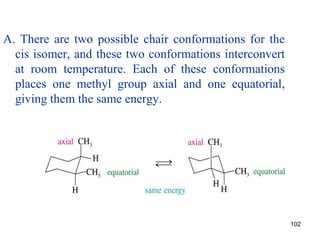
A. There are two possible chair conformations for the
cis isomer, and these two conformations interconvert
at room temperature. Each of these conformations
places one methyl group axial and one equatorial,
giving them the same energy.
103
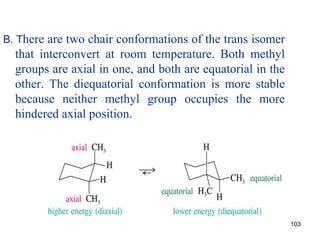
B. There are two chair conformations of the trans isomer
that interconvert at room temperature. Both methyl
groups are axial in one, and both are equatorial in the
other. The diequatorial conformation is more stable
because neither methyl group occupies the more
hindered axial position.
104
C. The trans isomer is more stable. The most stable
conformation of the trans isomer is diequatorial and
therefore about 7.6 kJ/mol (1.8 kcal/mol) lower in
energy than either conformation of the cis isomer,
each having one methyl axial and one equatorial.
Remember that cis and trans are distinct isomers and
cannot interconvert.

conformation

  • 1.
  • 2.
    conformations The infinite numberof arrangements of the atoms or groups of a molecule in three dimentional space which are interconvertible into each other by rotation about single bond are called conformations or Rotational Isomers or simply Rotamers. These conformers have different internal dimensions (atom-to-atom distances, dihedral angles, dipole moment etc.) . The energy barrier for rotation of carbon-carbon single bonds (conversion of different spatial arrangements) is normally small, < 0.6 kcal/mol and >16 kcal/mol. 2
  • 3.
  • 4.
    Newman & SawhorseProjections 4 Newman projections were devised by Professor Melvin S. Newman of Ohio State University in the 1950s.
  • 5.
    5 Staggered conformation: A conformationabout a carbon-carbon single bond in which the atoms or groups on one carbon are as far apart as possible from the atoms or groups on an adjacent carbon H H H H H H
  • 6.
    6 Eclipsed conformation: A conformationabout a carbon-carbon single bond in which the atoms or groups of atoms on one carbon are as close as possible to the atoms or groups of atoms on an adjacent carbon H H H H H H
  • 7.
    7 • Eclipsed conformation Staggeredconformation • Each hydrogen on one carbon as close as possible to one hydrogen on the other carbon • Hydrogen on one carbon as far from the hydrogen from other carbon A Staggered conformation is more stable than an eclipsed conformation
  • 8.
    8 Types of Strain Steric- Destabilization due to the repulsion between the electron clouds of atoms or groups. Groups try to occupy some common space. Torsional - Destabilization due to the repulsion between pairs of bonds caused by the electrostatic repulsion of the electrons in the bonds. Groups are eclipsed. Angle - Destabilisation due to distortion of a bond angle from it's optimum value caused by the electrostatic repulsion of the electrons in the bonds. e.g. cyclopropane
  • 9.
    9 Torsional strain Also calledeclipsed interaction strain. Strain that results from eclipsed bonds. Strain that arises when non-bonded atoms/groups, separated by three bonds are forced from a staggered conformation to an eclipsed conformation. The torsional strain between eclipsed and staggered ethane is approximately 12.6 kJ (3.0 kcal)/mol +12.6 kJ/mol
  • 10.
    10 60o Rotation CausesTorsional or Eclipsing Strain
  • 11.
    11 Dihedral angle (Ɵ) Theangle created by two intersecting planes
  • 12.
    12 Conformers of Alkanes Structuresresulting from the free rotation of a C-C single bond May differ in energy. The lowest-energy conformer is most prevalent. Molecules constantly rotate through all the possible conformations.
  • 13.
    13 Conformations of Ethane •Staggered conformer has lowest energy. • Dihedral angle = 600 H H H H H H Newman projection Sawhorse Projection
  • 14.
  • 15.
  • 16.
    16 Ethane as afunction of dihedral angle
  • 17.
    17 Staggered is morestable than the eclipsed. Difference in potential energy – 12.6 kJ/mol
  • 18.
    18 The origin oftorsional strain in ethane: Originally thought to be caused by repulsion between eclipsed hydrogen nuclei Alternatively, caused by repulsion between electron clouds of eclipsed C-H bonds Theoretical molecular orbital calculations suggest that the energy difference is not caused by destabilization of the eclipsed conformation but rather by stabilization of the staggered conformation This stabilization arises from the small donor-acceptor interaction between a C-H bonding MO of one carbon and the C-H antibonding MO on an adjacent carbon; this stabilization is lost when a staggered conformation is converted to an eclipsed conformation
  • 19.
     Anti -Description given to two substitutents attached to adjacent atoms when their bonds are at 180o with respect to each other.  Syn - Description given to two substitutents attached to adjacent atoms when their bonds are at 0o with respect to each other.  Gauche - Description given to two substitutents attached to adjacent atoms when their bonds are at 60o with respect to each other. CH3 CH3 anti CH3 CH3 gauche CH3 CH3 eclipsed 0o 180o 60o
  • 20.
  • 21.
  • 22.
  • 25.
  • 26.
  • 27.
    27 Butane has Stericand Torsional strain when Eclipsed The totally eclipsed conformation is higher in energy because it forces the two end methyl groups so close together that their electron clouds experience a strong repulsion.
  • 28.
  • 29.
    Three valleys (staggeredforms) 120 apart; Three hills (eclipsed) 120 apart. Extra slide
  • 30.
    30 Draw staggered andeclipsed conformers of 1-Chloropropane?
  • 31.
    Draw the Rotationalprofile of 2-methylbutane about C2-C3. Eclipsed Structures: Me H Me H Me H This was the high energy staggered structure, 180 0 Me H Me H H Me Me H Me H Me H 1200 24001800 Me H Me Me H H Me H Me Me H H 00 3600 Now relative energies…..
  • 32.
  • 33.
  • 34.
    Stability of Cycloalkanes:Ring Strain  Rings larger than 3 atoms are not flat  Cyclic molecules can assume nonplanar conformations to minimize angle strain and torsional strain by ring- puckering  Larger rings have many more possible conformations than smaller rings and are more difficult to analyze
  • 35.
    The Baeyer StrainTheory  Baeyer (1885): since carbon prefers to have bond angles of approximately 109°, ring sizes other than five and six may be too strained to exist  Rings from 3 to 30 C’s do exist but are strained due to bond bending distortions and steric interactions
  • 36.
    36 Summary: Types ofStrain  Angle strain - expansion or compression of bond angles away from most stable  Torsional strain - eclipsing of bonds on neighboring atoms/gps  Steric strain - repulsive interactions between nonbonded atoms in close proximity
  • 37.
  • 38.
    38 angle strain: theC-C-C bond angles are compressed from 109.5° to 60° torsional strain: there are 6 sets of eclipsed hydrogen interactions strain energy is about 116 kJ (27.7 kcal)/mol
  • 39.
    39 Cyclobutane The ring strainof a planar cyclobutane results from two factors: 1.angle strain from the compressing of the bond angles to 90° rather than the tetrahedral angle of 109.5° 2. torsional strain from eclipsing of the bonds.
  • 40.
     Internal bondangle ~88o (~21o deviated from the normal 109.5o tetrahedral angle)  Cyclobutane ring is not planar but is slightly folded. It is slightly bent out of plane - one C atom is about 25° above.  If cyclobutane ring were planar, the angle strain would be somewhat less (the internal angles would be 90o instead of 88o), but torsional strain would be considerably larger because all eight C–H bonds would be eclipsed
  • 41.
     puckering fromplanar cyclobutane reduces torsional strain but increases angle strain  the conformation of minimum energy is a puckered “butterfly” conformation  strain energy is about 110 kJ (26.3 kcal)/mol
  • 42.
    42 Cyclopentane  Planar cyclopentanewould have no angle strain but very high torsional strain  Actual conformations of cyclopentane are nonplanar, reducing torsional strain. Puckering from planar cyclopentane reduces torsional strain, but increases angle stain
  • 43.
     Four carbonatoms are in a plane  The fifth carbon atom is above or below the plane – looks like an envelope  the conformation of minimum energy is a puckered “envelope” conformation  strain energy is about 42 kJ (6.5 kcal)/mol
  • 44.
    Measuring Strain inCycloalkanes Heats of combustion can be used to compare stabilities of alkanes & cycloalkanes. Heats of combustion increase as the number of carbon atoms increase. Therefore, divide heat of combustion by number of C’s and compare heats of combustion on a "per CH2 group" basis.
  • 45.
    45 CnH2n + O2n CO2 + (n+1) H2O + heat cycloalkane (can be measured) Total Strain Energy = Sample ΔHcomb per -CH2- _ Reference ΔHcomb per -CH2- • n Heats of Combustion of Cycloalkane: the more strained a compound is, the more is the heat released upon combustion Cycloalkane Cyclopropane Cyclobutane Cyclopentane Cyclohexane Cycloheptane Cyclooctane Cyclononane Cyclodecane Cyclohexadecane Alkane reference Ring Size (n) 3 4 5 6 7 8 9 10 16 Hcomb KJ/mol 2091 2721 3291 3920 4599 5267 5933 6587 10466 Hcomb per CH2- KJ/mol 697 681 658 654 657 658 659 659 654 654 Total Strain Energy 129 108 20 0 21 32 45 45 0 0 strained rings common rings medium rings large rings (> 12) (43) (27) (4) (0) (3) (4) (5) (5) (0)
  • 46.
    According to Baeyer,cyclopentane should have less angle strain than cyclohexane. Cyclopentane 3,291 658 Cyclohexane 3,920 653 The heat of combustion per CH2 group is less for cyclohexane than for cyclopentane. Therefore, cyclohexane has less strain and more stable than cyclopentane. Heat of combustion suggests that angle strain is unimportant in cyclohexane. Tetrahedral bond angles require nonplanar geometries.
  • 47.
    conformations of Cyclohexane Cyclohexaneis by far the most common cycloalkane in nature and also in organic chemistry. The cyclohexane ring is free of angle strain and torsional strain. Zero ring strain implies the bond angles must be 109.5°. (no angle strain) and also no eclipsing interactions between the C-H bonds (no torsional strain).
  • 48.
    48 Cyclohexane adopts apuckered structure. A planar arrangement of the six methylene groups in cyclohexane does not give a tetrahedral shape for every carbon atom - this is achieved by puckering the ring. Cyclohexane does this by adopting mainly two conformations the CHAIR and the BOAT.
  • 49.
    49 Chair conformation Most stableconformation. Each carbon is in the staggered conformation All the bond angles are 109.5° and all the C-H bonds are staggered. (Zero ring strain) . More stable than a boat conformation by 27 kJ (6.5 kcal)/mol.
  • 50.
  • 51.
  • 52.
    52 The boat isjust a chair with the footrest flipped up. C-1, C-4 are bent toward each other. Four sets of eclipsed C-H interactions & one flagpole interaction This also has bond angles of 109.5° and thus avoids any angle strain, but there is torsional strain. The two hydrogens at the ends of the boat are in close contact, causing torsional strain. These flagpole hydrogens are eclipsed.
  • 53.
    53 Twist-boat conformation To avoidthese unfavorable interactions, the boat conformation skews slightly, giving a twist boat conformation. The twist boat conformation has a lower energy than the pure boat conformation, but is not as stable as the chair conformations approximately 41.8 kJ (5.5 kcal)/mol less stable than a chair conformation approximately 6.3 kJ (1.5 kcal)/mol more stable than a boat conformation
  • 55.
  • 56.
  • 57.
  • 58.
  • 59.
    59 The chair isthe lowest energy conformation, although since the energy barrier to ring flip is fairly small, there will always be some other conformations present. The half chair is the point of highest energy, and is not a stable conformation.
  • 60.
    Axial and EquatorialBonds in Cyclohexane The chair conformation has two kinds of positions for substituents on the ring: axial positions and equatorial positions Chair cyclohexane has six axial hydrogens perpendicular to the ring (parallel to the ring axis) and six equatorial hydrogens near the plane of the ring
  • 61.
    61 • Each carbonatom in cyclohexane has one axial and one equatorial hydrogen • Each face of the ring has three axial and three equatorial hydrogens in an alternating arrangement
  • 62.
    How to DrawCyclohexane Step 1: Draw two parallel lines slanted downward Step 2: Draw two lines starting from the parallel lines slanting upward and intersecting at a point. Step 3: Draw two lines downward starting from the other end of the parallel lines and intersecting at another point.
  • 63.
    63 How to makeAxial bonds and Equatorial bonds
  • 64.
    64 Chair–Chair Interconversion/ Ring Flip Anmost important phenomenon in chair conversion is that any substituent that is axial in the original conformation becomes equatorial in the new conformation (exchange of axial and equatorial positions by a ring-flip )
  • 65.
    65 All axial bondsbecome equatorial All equatorial bonds become axial All “up” bonds stay up All “down” bonds stay down
  • 66.
  • 67.
    67 Equatorial conformation isPreferred……WHY????
  • 68.
    A conformational Analysisof Methyl cyclohexane  Substituted cyclohexane • Exists in two different chair forms H G H G
  • 69.
    69 Axial Methyl inMethylcyclohexane
  • 70.
  • 71.
    71 Cyclohexane ring rapidlyflips between chair conformations at room temp. Two conformations of monosubstituted cyclohexane aren’t equally stable. The equatorial conformer of methyl cyclohexane is more stable than the axial by 7.6 kJ/mol
  • 72.
    72 1,3-Diaxial Interaction 5% 95% Vander Waals/ steric repulsions between axial substituents on a cycloalkane ring
  • 73.
    73 The axial substituentinterferes with the axial hydrogens on C1 and C3. This interference is called a 1,3-diaxial interaction. Hydrogen atoms of the axial methyl group on C1 are too close to the axial hydrogens, three carbons away on C3 and C5, resulting in 7.6 kJ/mol of steric strain . Difference between axial and equatorial conformers is due to steric strain caused by 1,3-diaxial interactions
  • 74.
    74 Tert-butylcyclohexane Substituents are lesscrowded in the equatorial positions. MonosubstitutedCyclohexane Less than 0.01% Greater than 99.99%
  • 75.
    40% 60% Crowding isless pronounced with a "small" substituent such as fluorine. Size of substituent is related to its branching. Fluorocyclohexane F F
  • 76.
    Keq = [equatorialconformer]/[axial conformer] • The larger the substituent on a cyclohexane ring, the more the equatorial substituted conformer will be favored
  • 77.
    77 Substituent Axial –equatorial energy difference kJ mol-1 % equatorial H 0 50 OMe 2.5 73 Me 7.3 95 Et 7.5 95 iPr 9.3 98 tBu >20 >99.9 110 11.7 99 Substituted cyclohexanes:energy difference
  • 78.
  • 79.
    Chapter 4 Disubstitued Cycloalkanes Canexist as pairs of cis-trans stereoisomers –Cis: groups on same side of ring –Trans: groups on opposite side of ring
  • 80.
    80 Cis-1,3-dimethylcyclohexane Cis-1,3-dimethylcyclohexane can haveboth methyl groups in axial positions or both in equatorial positions. The conformation with both methyl groups being equatorial is more stable. However, both conformations are equal in energy.
  • 81.
  • 82.
    82 Trans-1,3-dimethylcyclohexane Both conformations haveone axial and one equatorial methyl group so they have the same energy.
  • 83.
    Methyl groups areon opposite faces of the ring Steric strain of 4  3.8 kJ/mol = 15.2 kJ/mol makes the diaxial conformation 11.4 kJ/mol less favorable than the diequatorial conformation trans-1,2-dimethylcyclohexane will exist almost exclusively (>99%) in the diequatorial conformation both methyl groups equatorial •no 1,3-diaxial interactions •both methyl groups axial • four 1,3-diaxial interactions
  • 84.
    CH3 ring flip H3C CH3 H3C H3C H3C CH3 (more stable because large groupis equatorial) (less stable because large group is axial) CH3 Trans-1-tert-Butyl-3-methylcyclohexane 2 | 84
  • 85.
  • 86.
  • 87.
  • 88.
    CH3 CH3 ring flip H3C CH3 H3C H3C H3C CH3 (more stable because large groupis equatorial) (less stable because large group is axial) Cis-1-tert-Butyl-4-methylcyclohexane
  • 89.
    89 Cis-1,4-ditertbutylcyclohexane The most stableconformation of cis-1,4-di- tertbutylcyclohexane is the twist boat. Both chair conformations require one of the bulky t-butyl groups to occupy an axial position.
  • 90.
  • 91.
  • 92.
  • 93.
    CH3 ring flipCH3 CH3 CH3 cis-1,2-Dimethylcyclohexane (equal energy andequally populated conformations) (equatorial-axial) (axial-equatorial) (eq) (ax) (eq) (ax) Cis-1,2-Disubstituted Cyclohexane
  • 94.
  • 95.
    Cyclohexane Stereochemistry Cis -TransIsomers Position cis trans 1,2 e,a or a,e e,e or a,a 1,3 1,4 a = axial; e = equatorial e,a or a,e e,e or a,a e,e or a,a a,e or e,a
  • 96.
    conformations of PolycyclicMolecules Decalin consists of two cyclohexane rings joined to share two carbon atoms (the bridgehead carbons, C1 and C6) and a common bond Two isomeric forms of decalin: trans fused or cis fused In cis-decalin hydrogen atoms at the bridgehead carbons are on the same face of the rings In trans-decalin, the bridgehead hydrogens are on opposite faces Both compounds can be represented using chair cyclohexane conformations Flips and rotations do not interconvert cis and trans
  • 97.
  • 98.
    Trans-fused cyclohexane ringis more stable than cis- fused cyclohexane ring
  • 99.
  • 100.
    • Is thisthe most stable conformer?
  • 101.
    101 Problem- 1 A. Drawboth chair conformations of cis-1,2- dimethylcyclohexane, and determine which conformer is more stable? B. Repeat for the trans isomer. C. Predict which isomer (cis or trans) is more stable.
  • 102.
    102 A. There aretwo possible chair conformations for the cis isomer, and these two conformations interconvert at room temperature. Each of these conformations places one methyl group axial and one equatorial, giving them the same energy.
  • 103.
    103 B. There aretwo chair conformations of the trans isomer that interconvert at room temperature. Both methyl groups are axial in one, and both are equatorial in the other. The diequatorial conformation is more stable because neither methyl group occupies the more hindered axial position.
  • 104.
    104 C. The transisomer is more stable. The most stable conformation of the trans isomer is diequatorial and therefore about 7.6 kJ/mol (1.8 kcal/mol) lower in energy than either conformation of the cis isomer, each having one methyl axial and one equatorial. Remember that cis and trans are distinct isomers and cannot interconvert.