JABEZ WINSTON C
11EE16
713811105016
SRI RAMAKRISHNA INSTITUTE OF TECHNOLOGY
02/09/14
 What is an integrated circuit?
 Types of integrated circuit
 Advantages of integrated circuit
 Microprocessors from Intel
 Moore’s Law
 System-on-chip(SoC)

02/09/14
What is an integrated circuit?
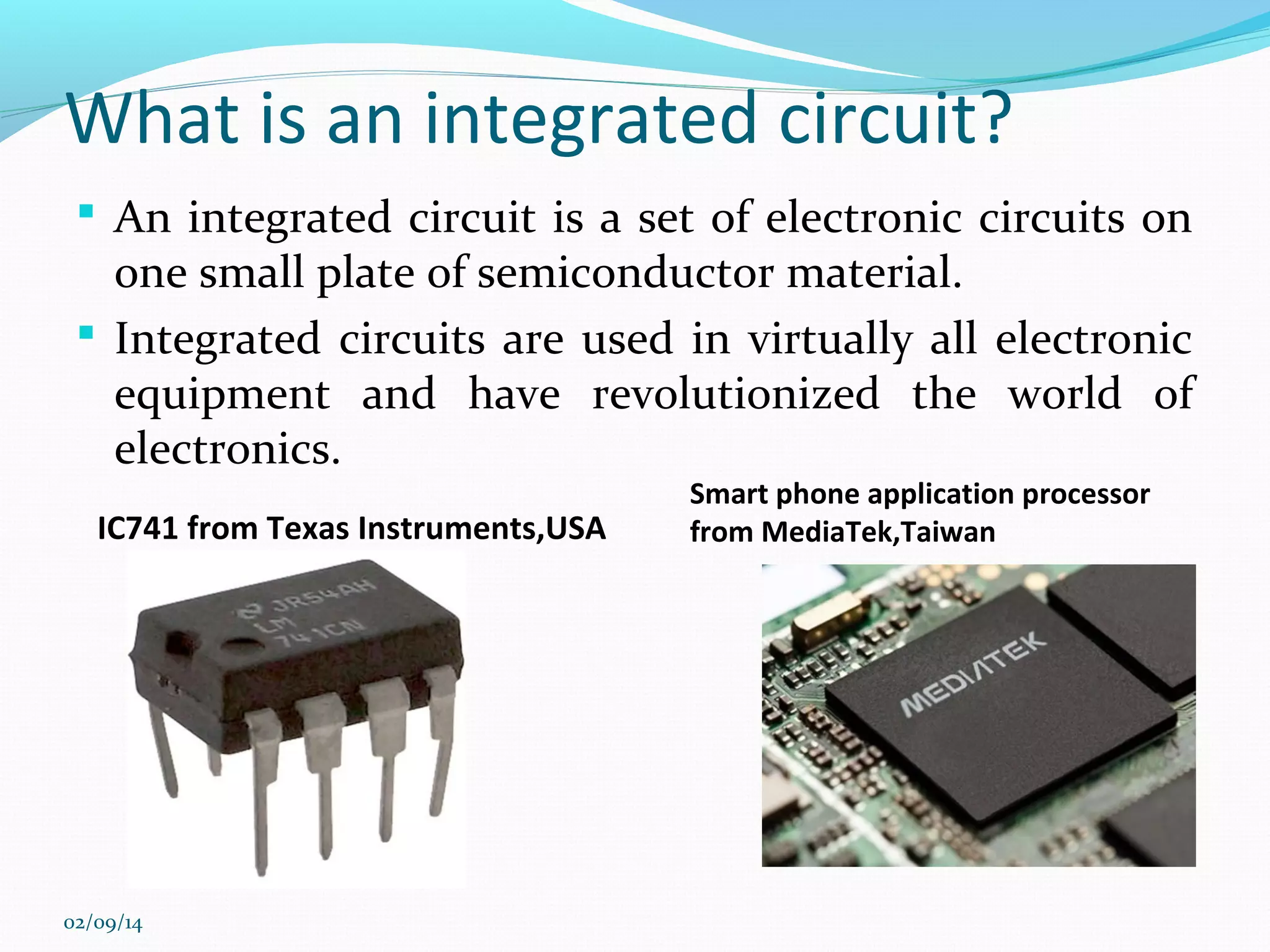
 An integrated circuit is a set of electronic circuits on

one small plate of semiconductor material.
 Integrated circuits are used in virtually all electronic
equipment and have revolutionized the world of
electronics.
IC741 from Texas Instruments,USA

02/09/14

Smart phone application processor
from MediaTek,Taiwan
Who invented the integrated
circuit?
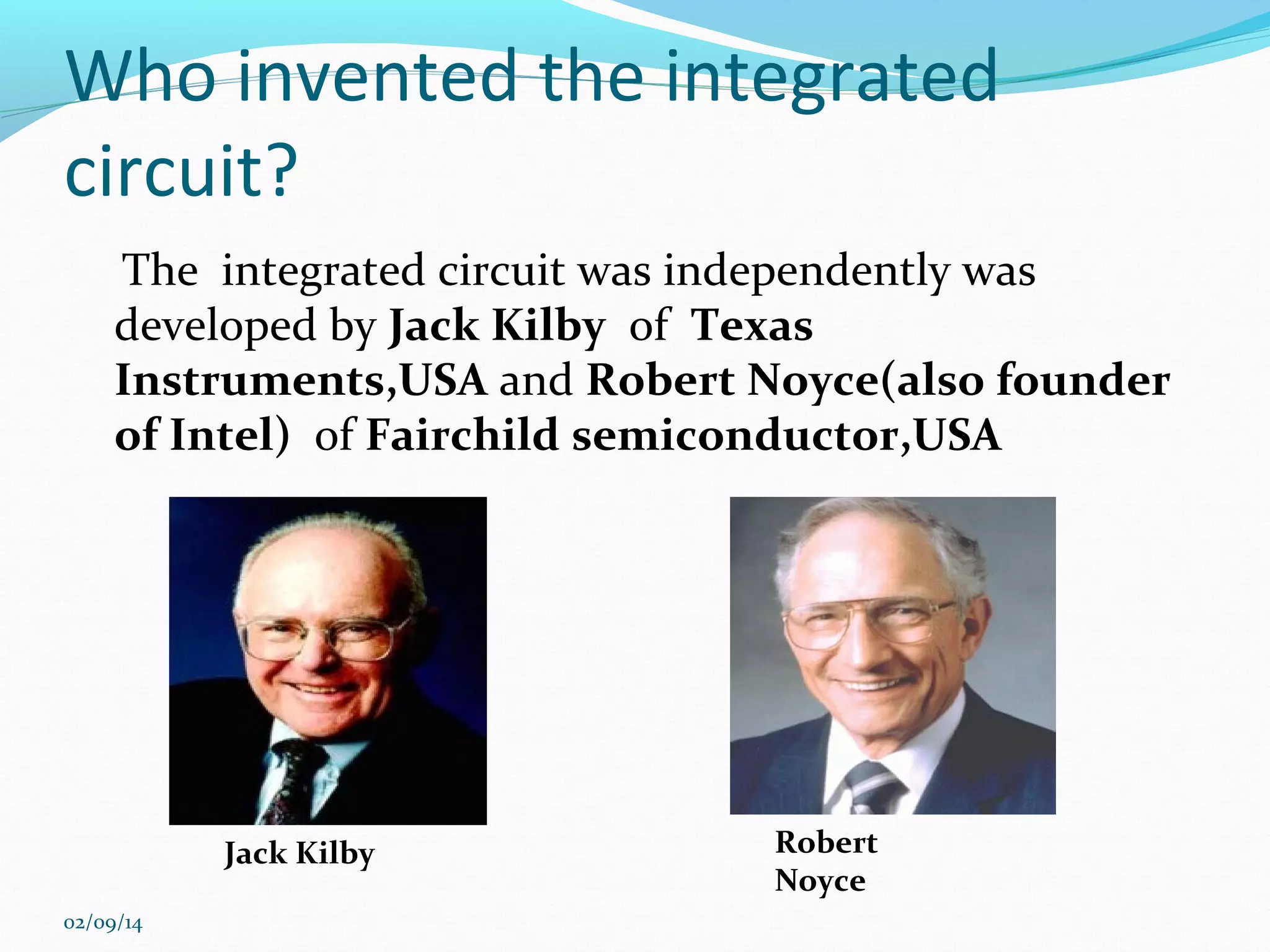
The integrated circuit was independently was
developed by Jack Kilby of Texas
Instruments,USA and Robert Noyce(also founder
of Intel) of Fairchild semiconductor,USA

Jack Kilby
02/09/14

Robert
Noyce
Types of Integrated Circuit
Based on application
 Analog IC
 Digital IC
 Mixed Signal IC

Based on number of components
 Small scale integration-SSI (Upto 100 components)
 Medium scale integration-MSI (100-3k)
 Large scale integration-LSI(3k-100k components)
 Very Large Scale Integration-VLSI(100k-1m components)
 Ultra Large Scale Integration-ULSI(above 1m
components)
02/09/14
Analog ICs
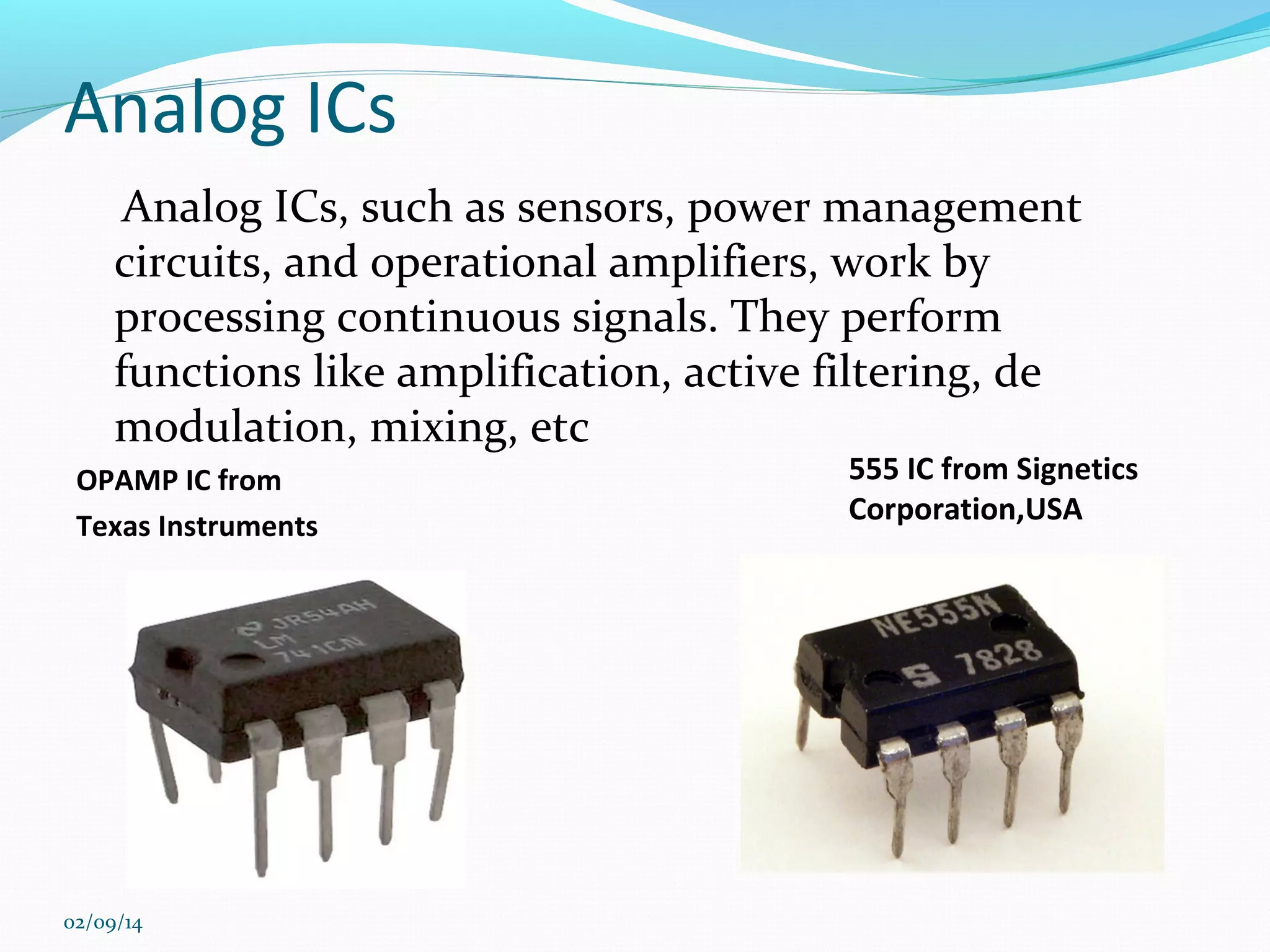
Analog ICs, such as sensors, power management
circuits, and operational amplifiers, work by
processing continuous signals. They perform
functions like amplification, active filtering, de
modulation, mixing, etc
OPAMP IC from
Texas Instruments

02/09/14

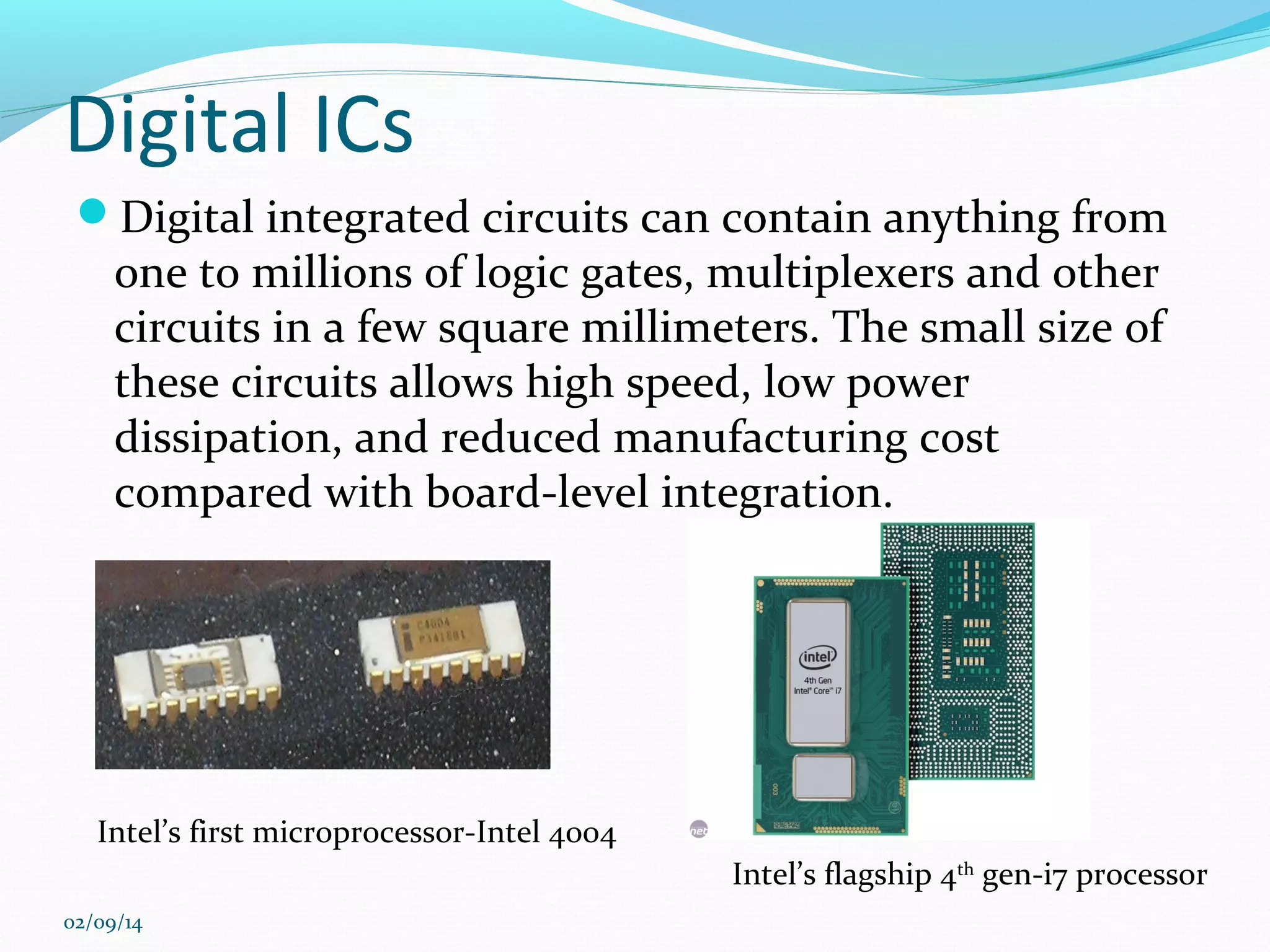
555 IC from Signetics
Corporation,USA
Digital ICs
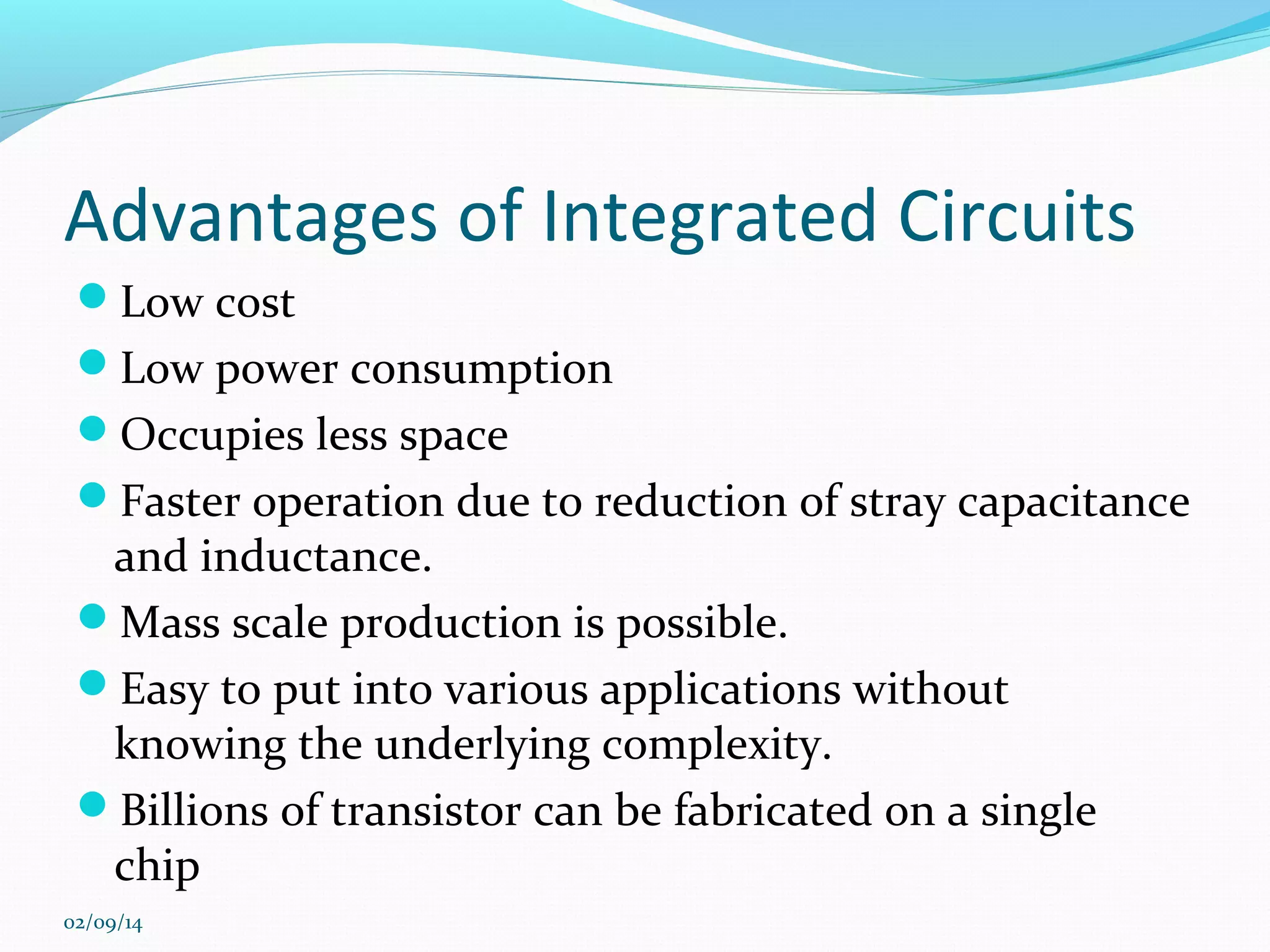
Digital integrated circuits can contain anything from

one to millions of logic gates, multiplexers and other
circuits in a few square millimeters. The small size of
these circuits allows high speed, low power
dissipation, and reduced manufacturing cost
compared with board-level integration.

Intel’s first microprocessor-Intel 4004
Intel’s flagship 4th gen-i7 processor
02/09/14
Advantages of Integrated Circuits
Low cost
Low power consumption
Occupies less space
Faster operation due to reduction of stray capacitance

and inductance.
Mass scale production is possible.
Easy to put into various applications without
knowing the underlying complexity.
Billions of transistor can be fabricated on a single
chip
02/09/14
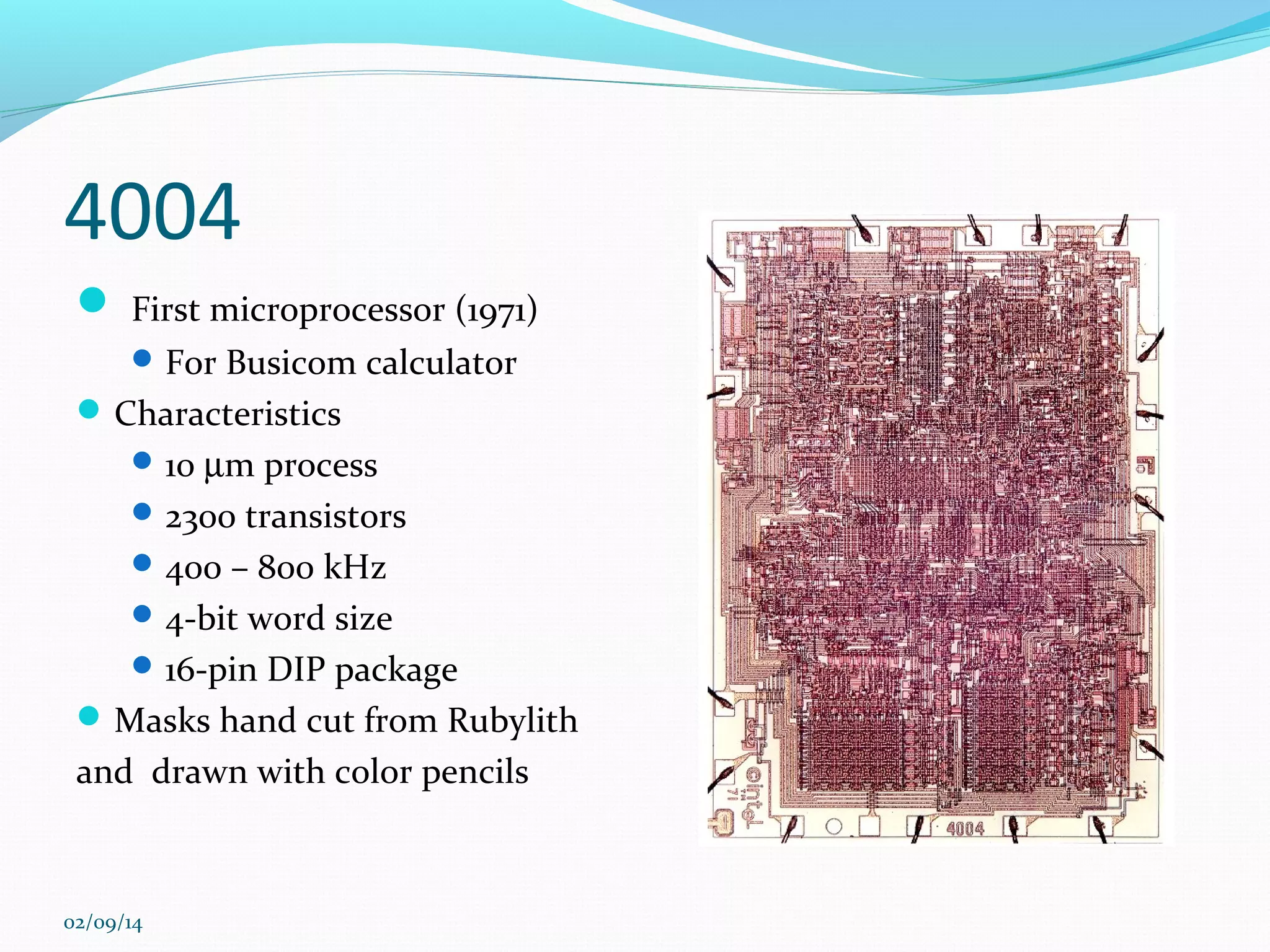
4004
 First microprocessor (1971)
 For Busicom calculator

 Characteristics
 10 µm process
 2300 transistors
 400 – 800 kHz
 4-bit word size
 16-pin DIP package

 Masks hand cut from Rubylith

and drawn with color pencils

02/09/14
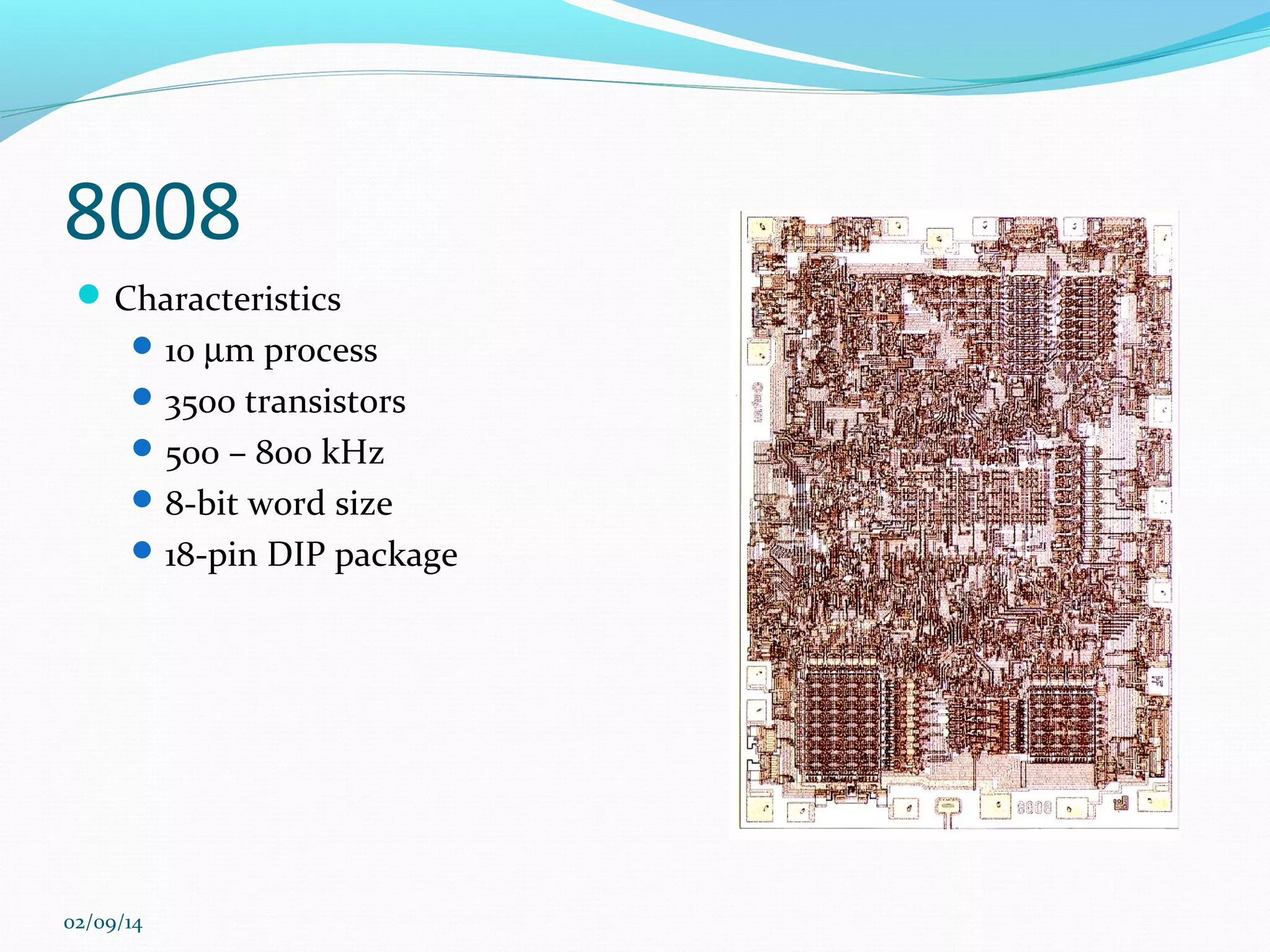
8008
 Characteristics
 10 µm process
 3500 transistors
 500 – 800 kHz
 8-bit word size
 18-pin DIP package

02/09/14
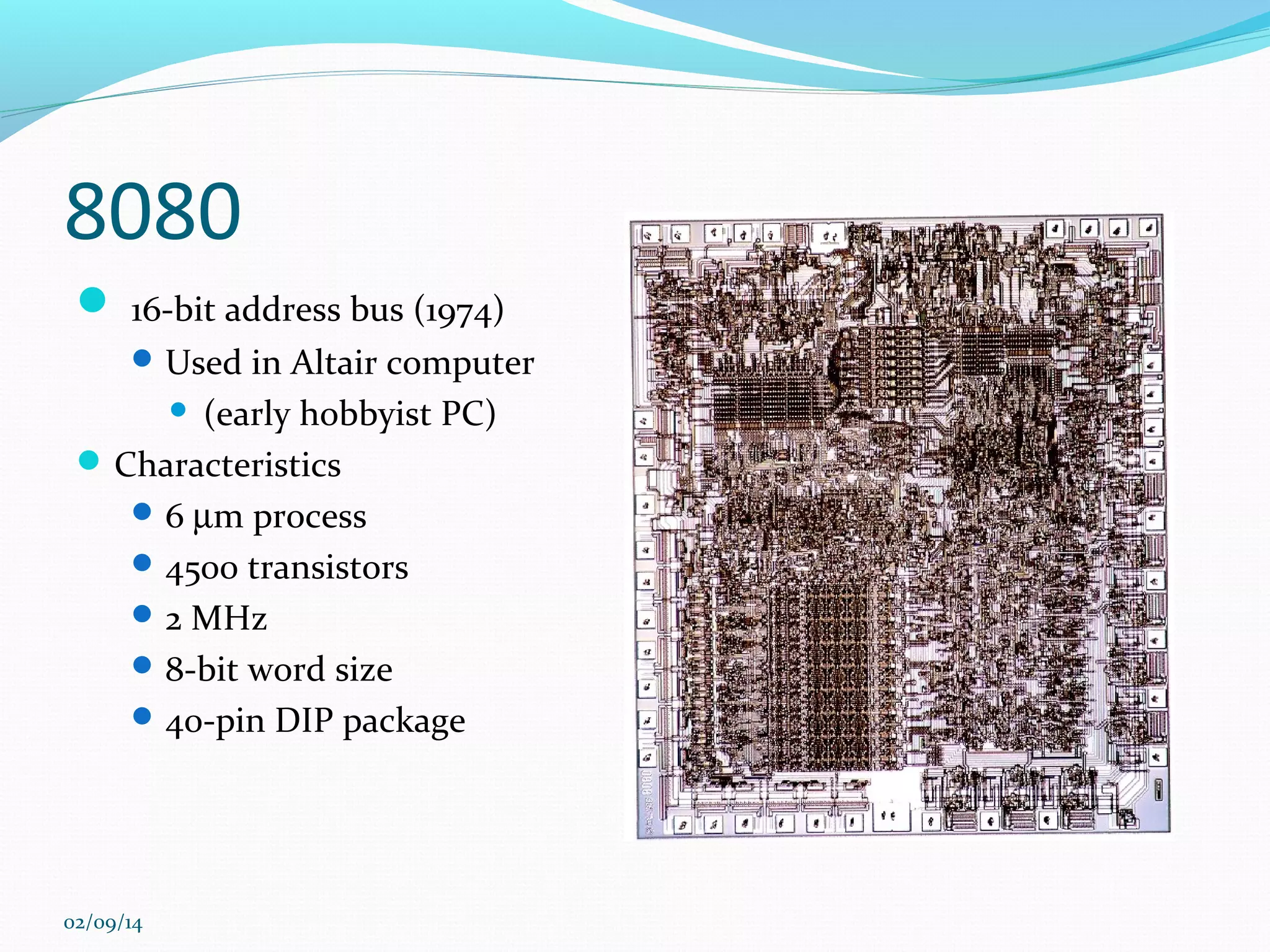
8080
 16-bit address bus (1974)
 Used in Altair computer

(early hobbyist PC)
 Characteristics
 6 µm process
 4500 transistors
 2 MHz
 8-bit word size
 40-pin DIP package


02/09/14
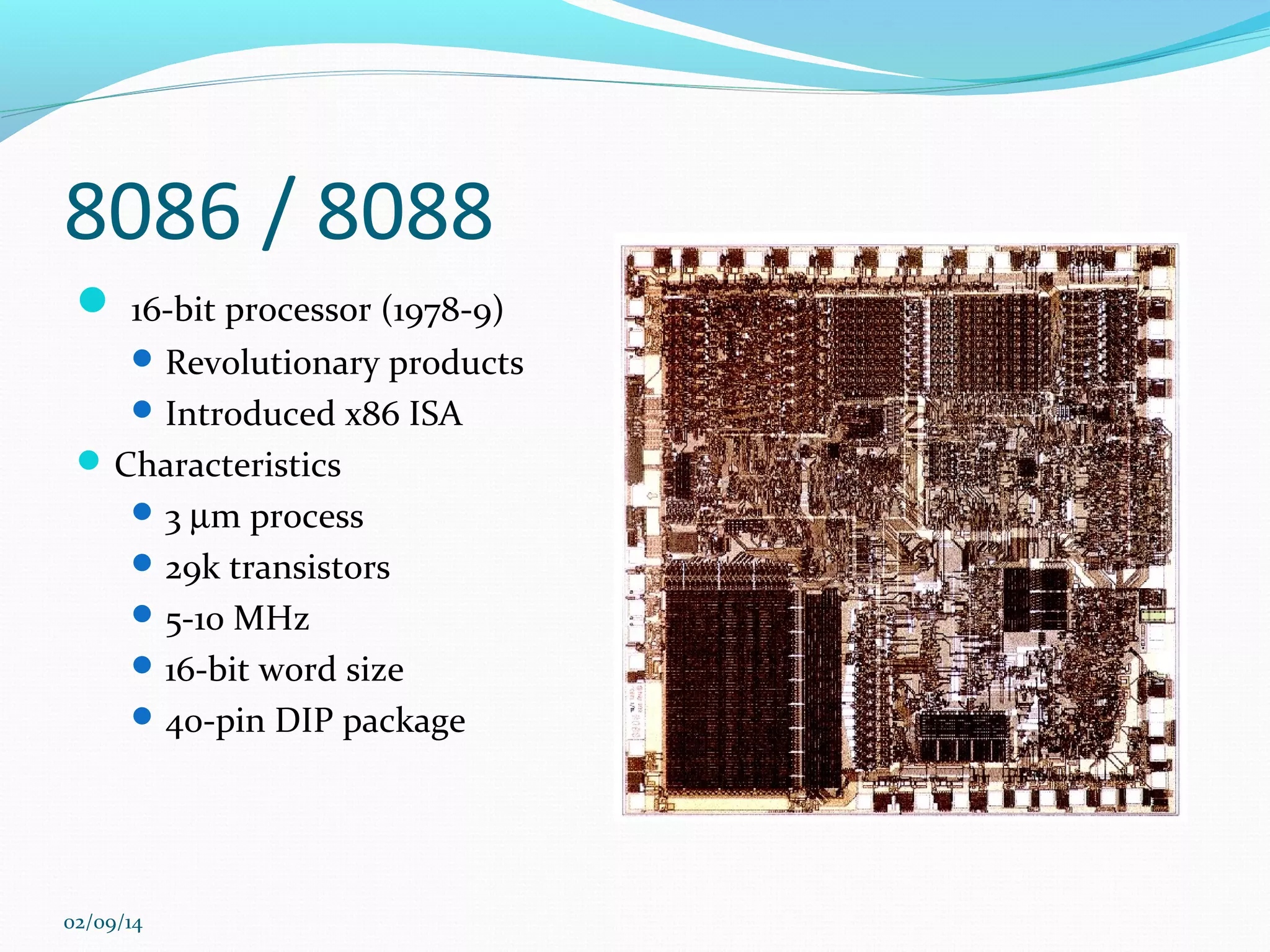
8086 / 8088
 16-bit processor (1978-9)
 Revolutionary products
 Introduced x86 ISA

 Characteristics
 3 µm process
 29k transistors
 5-10 MHz
 16-bit word size
 40-pin DIP package

02/09/14
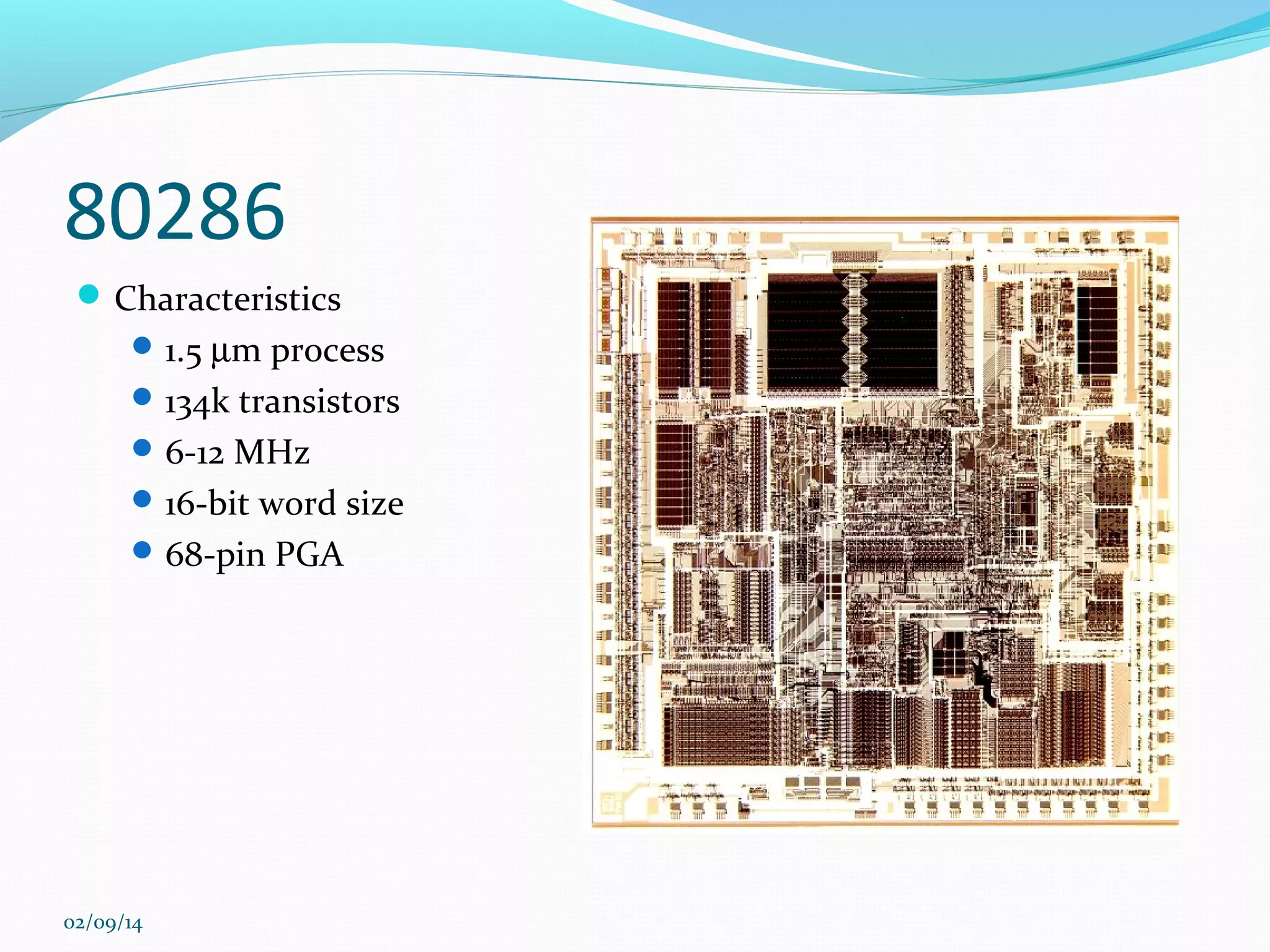
80286
 Characteristics
 1.5 µm process
 134k transistors
 6-12 MHz
 16-bit word size
 68-pin PGA

02/09/14
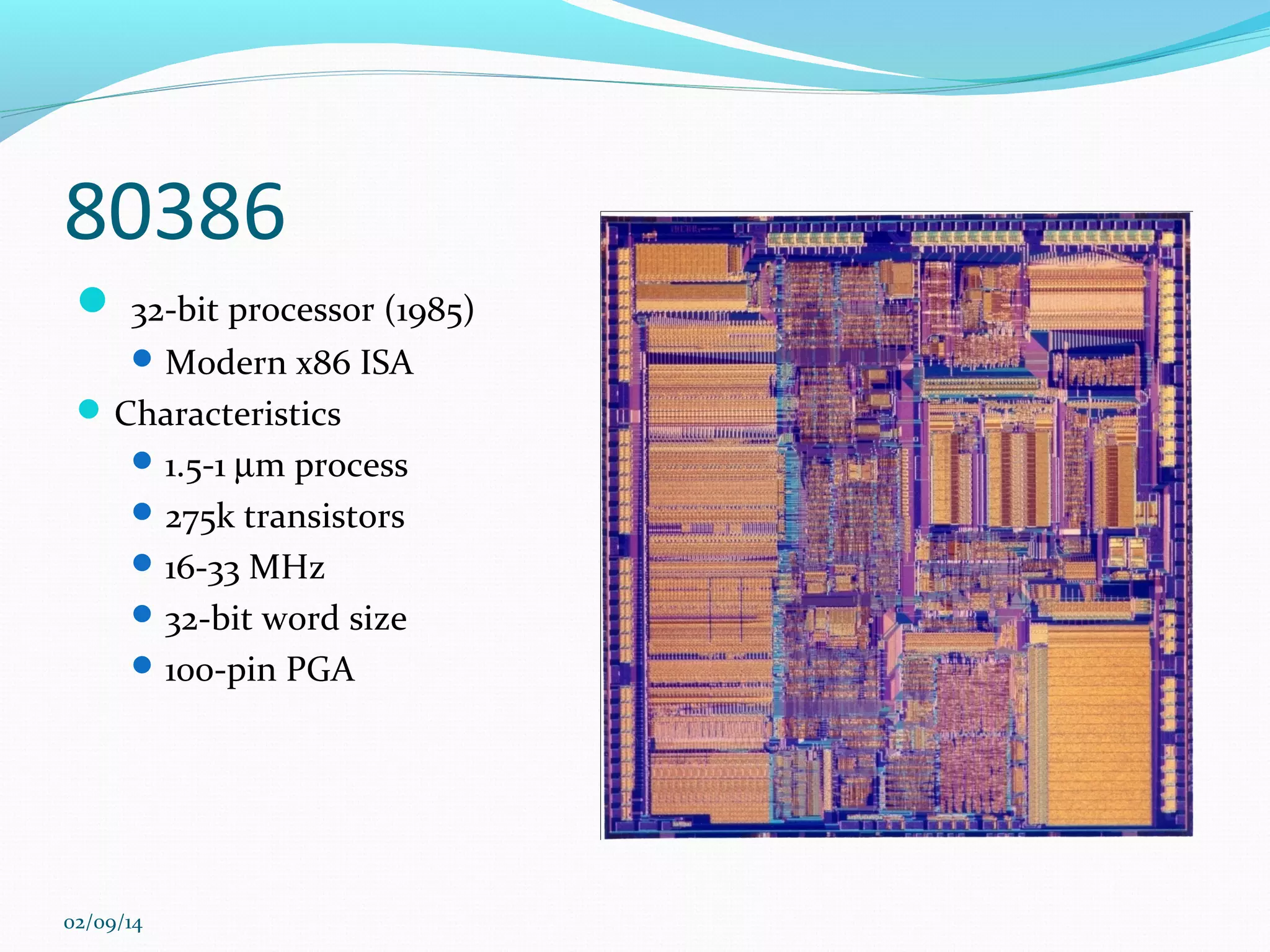
80386
 32-bit processor (1985)
 Modern x86 ISA

 Characteristics
 1.5-1 µm process
 275k transistors
 16-33 MHz
 32-bit word size
 100-pin PGA

02/09/14
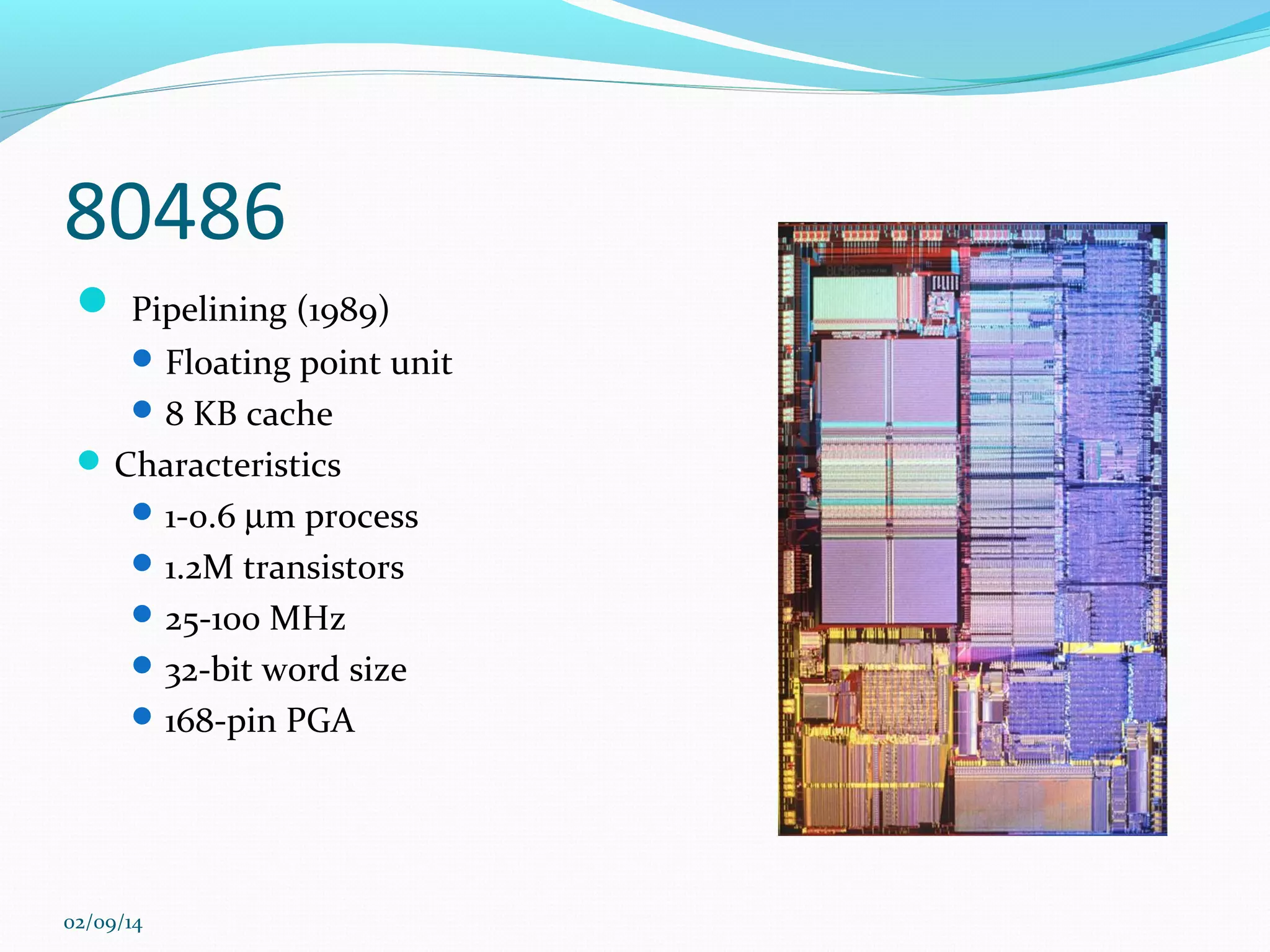
80486
 Pipelining (1989)
 Floating point unit
 8 KB cache

 Characteristics
 1-0.6 µm process
 1.2M transistors
 25-100 MHz
 32-bit word size
 168-pin PGA

02/09/14
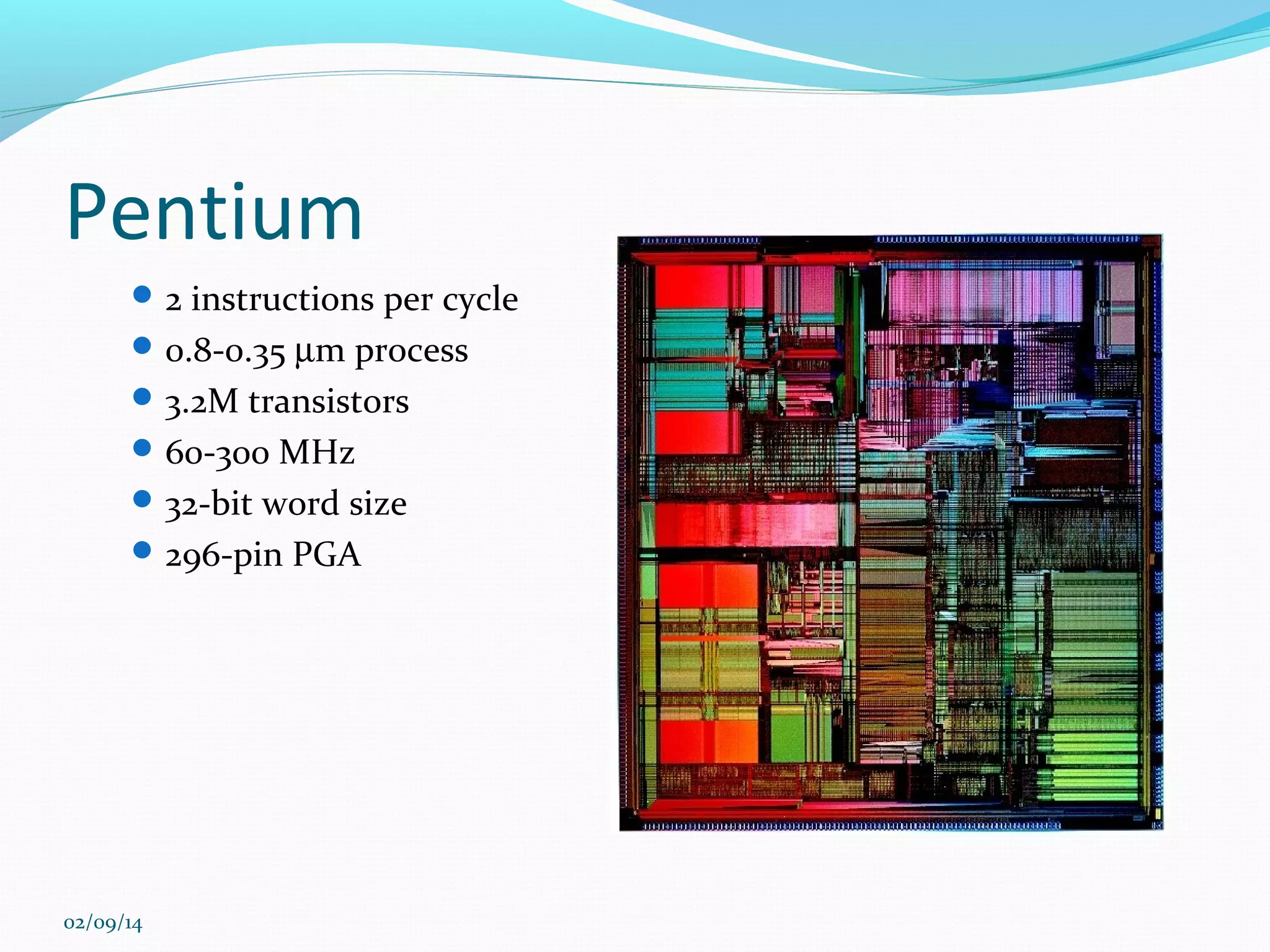
Pentium
 2 instructions per cycle
 0.8-0.35 µm process
 3.2M transistors
 60-300 MHz
 32-bit word size
 296-pin PGA

02/09/14
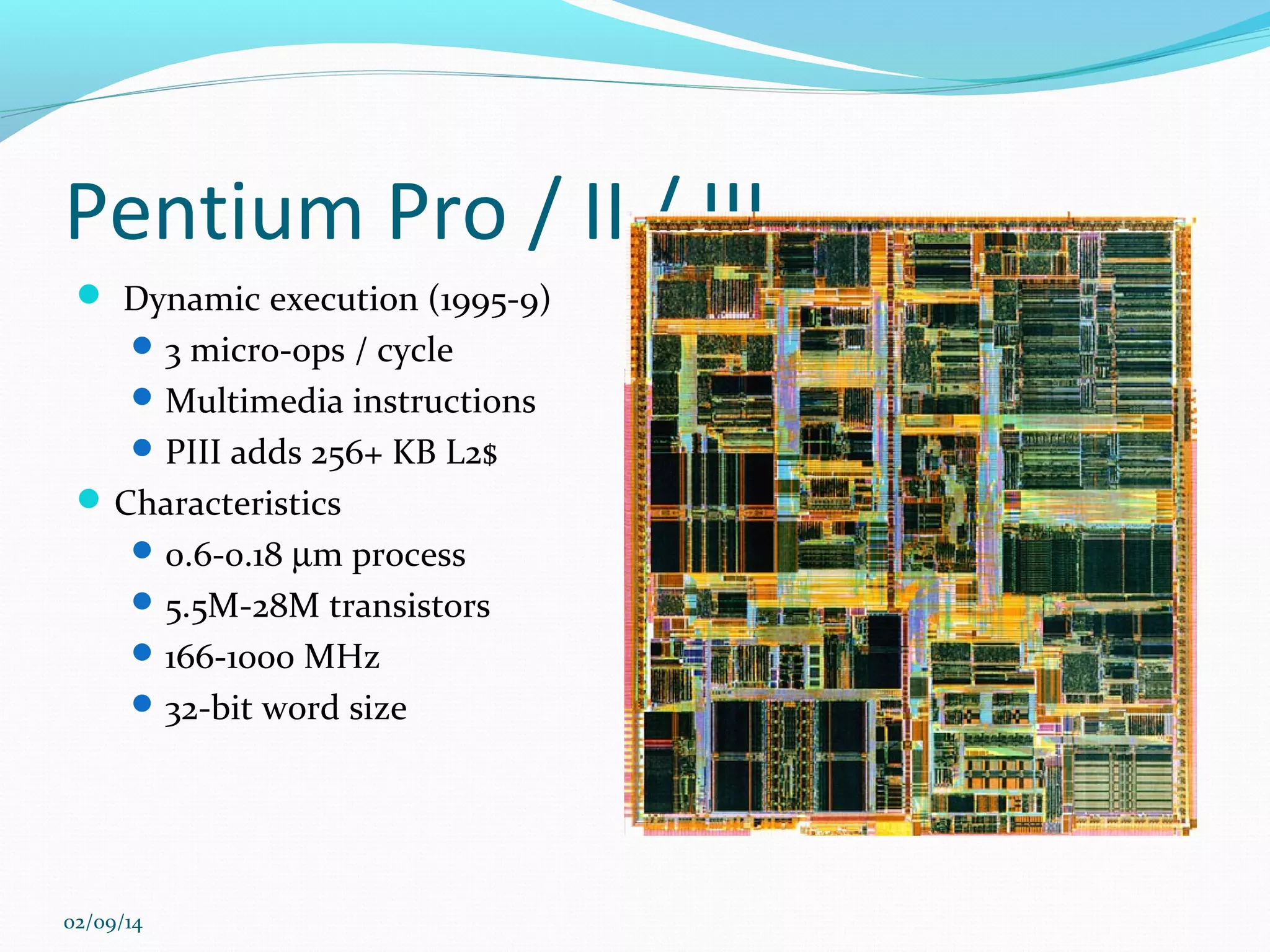
Pentium Pro / II / III
 Dynamic execution (1995-9)
 3 micro-ops / cycle
 Multimedia instructions
 PIII adds 256+ KB L2$

 Characteristics
 0.6-0.18 µm process
 5.5M-28M transistors
 166-1000 MHz
 32-bit word size

02/09/14
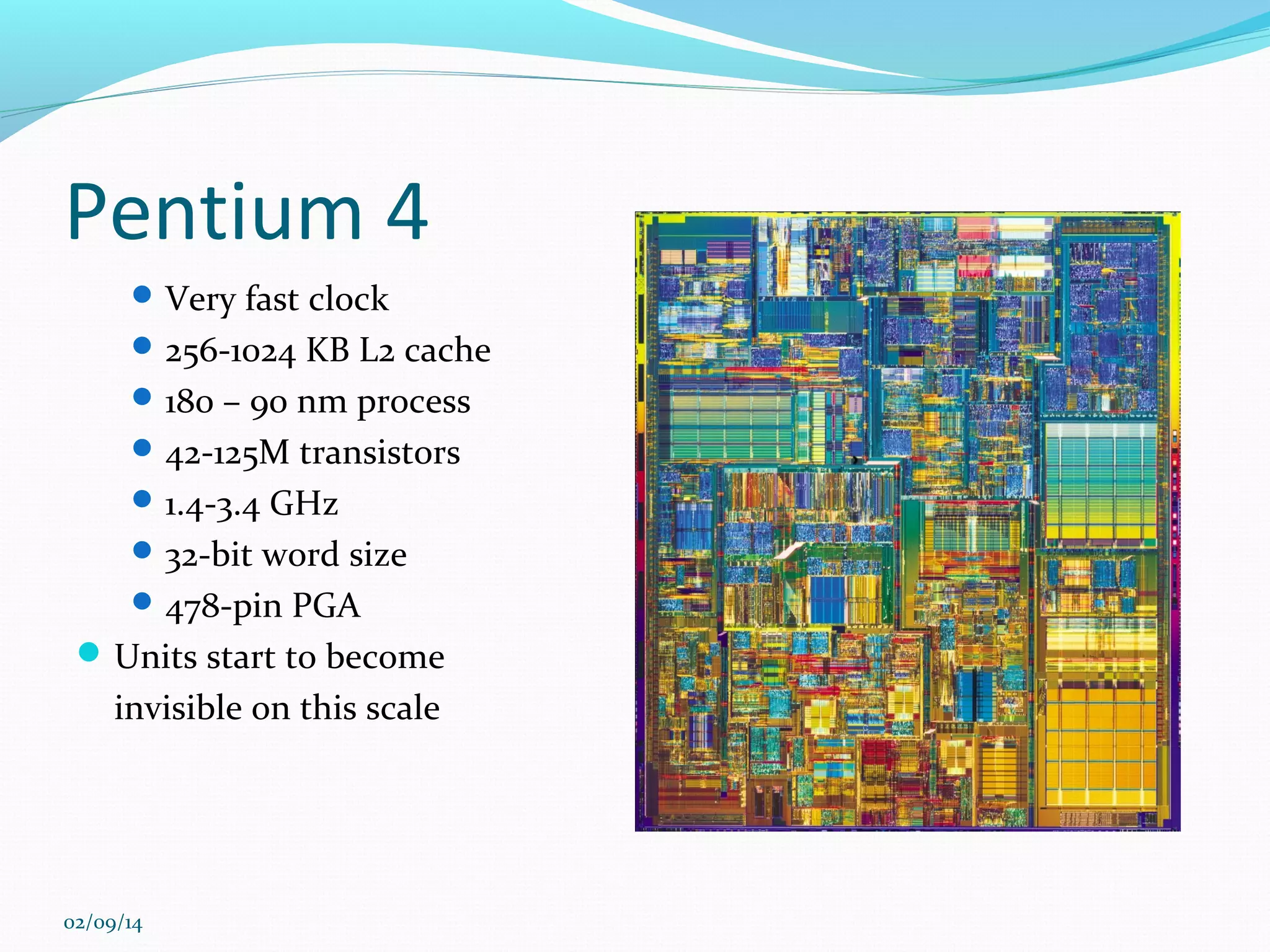
Pentium 4
 Very fast clock
 256-1024 KB L2 cache
 180 – 90 nm process
 42-125M transistors
 1.4-3.4 GHz
 32-bit word size
 478-pin PGA

 Units start to become

invisible on this scale

02/09/14
Intel Core
65 nm process
Over 400 million transistors.
Max. 2MB L2 cache
SSE3 instruction set
LGA socket
Multiple cores
64-bit

Additional feature in Core 2
 Intel VT-x
 Hardware Security extensions
02/09/14
i-series
Came to market at beginning of 2010
New line of processors
i3 (Low end)
i5 (Mid range)
i7 (High end)

Integrated Graphics support
VT-x on all processors
VT-d on specific processors
Turbo Boost on K-type processors
Extensive support to newer technologies like USB

3.0,WiDi

02/09/14
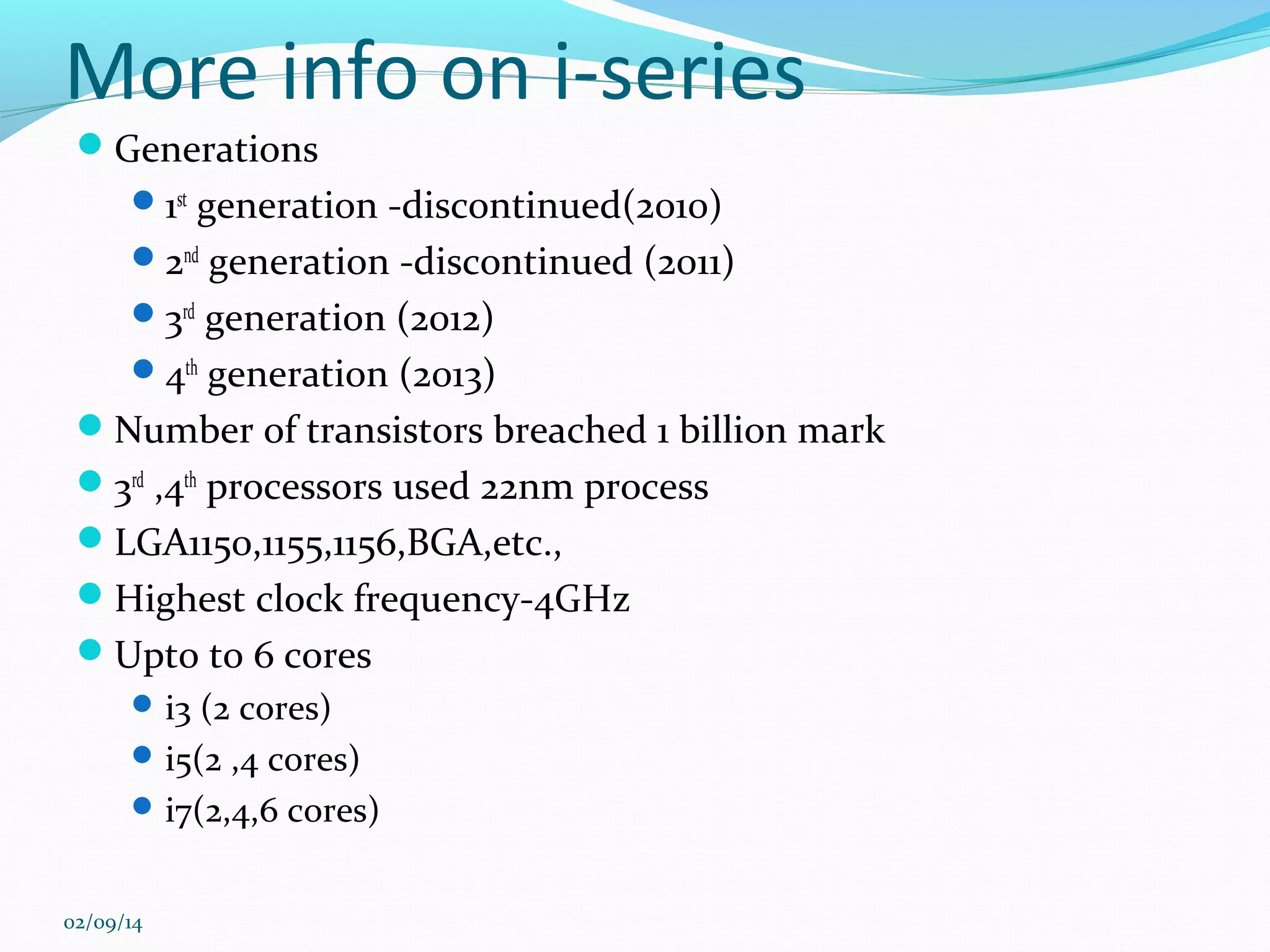
More info on i-series
Generations
 1st generation -discontinued(2010)
 2nd generation -discontinued (2011)
 3rd generation (2012)
 4th generation (2013)

Number of transistors breached 1 billion mark
3rd ,4th processors used 22nm process
LGA1150,1155,1156,BGA,etc.,
Highest clock frequency-4GHz
Upto to 6 cores
 i3 (2 cores)
 i5(2 ,4 cores)
 i7(2,4,6 cores)

02/09/14
Moore’s Law
In 1965, Gordon Moore predicted the exponential

growth of the number of transistors on an IC
Transistor count doubled
every year since invention
Predicted > 65,000
transistors by 1975!
Growth limited by power

[Moore65]

02/09/14
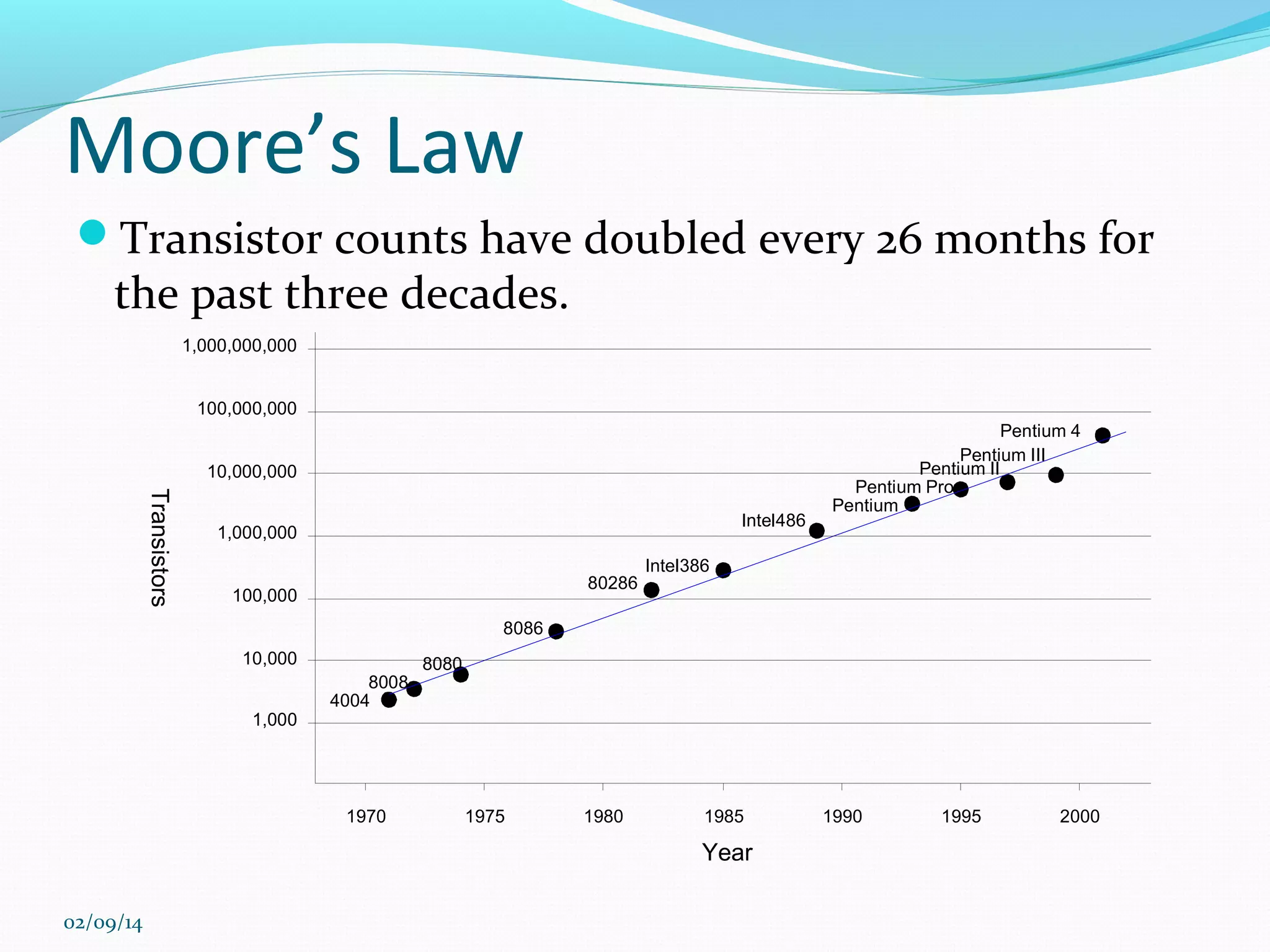
Moore’s Law
Transistor counts have doubled every 26 months for

the past three decades.
1,000,000,000
100,000,000
10,000,000

Transistors

Intel486

1,000,000
80286

100,000

Pentium 4
Pentium III
Pentium II
Pentium Pro
Pentium

Intel386

8086
10,000
1,000

8008
4004

1970

8080

1975

1980

1985

Year
02/09/14

1990

1995

2000
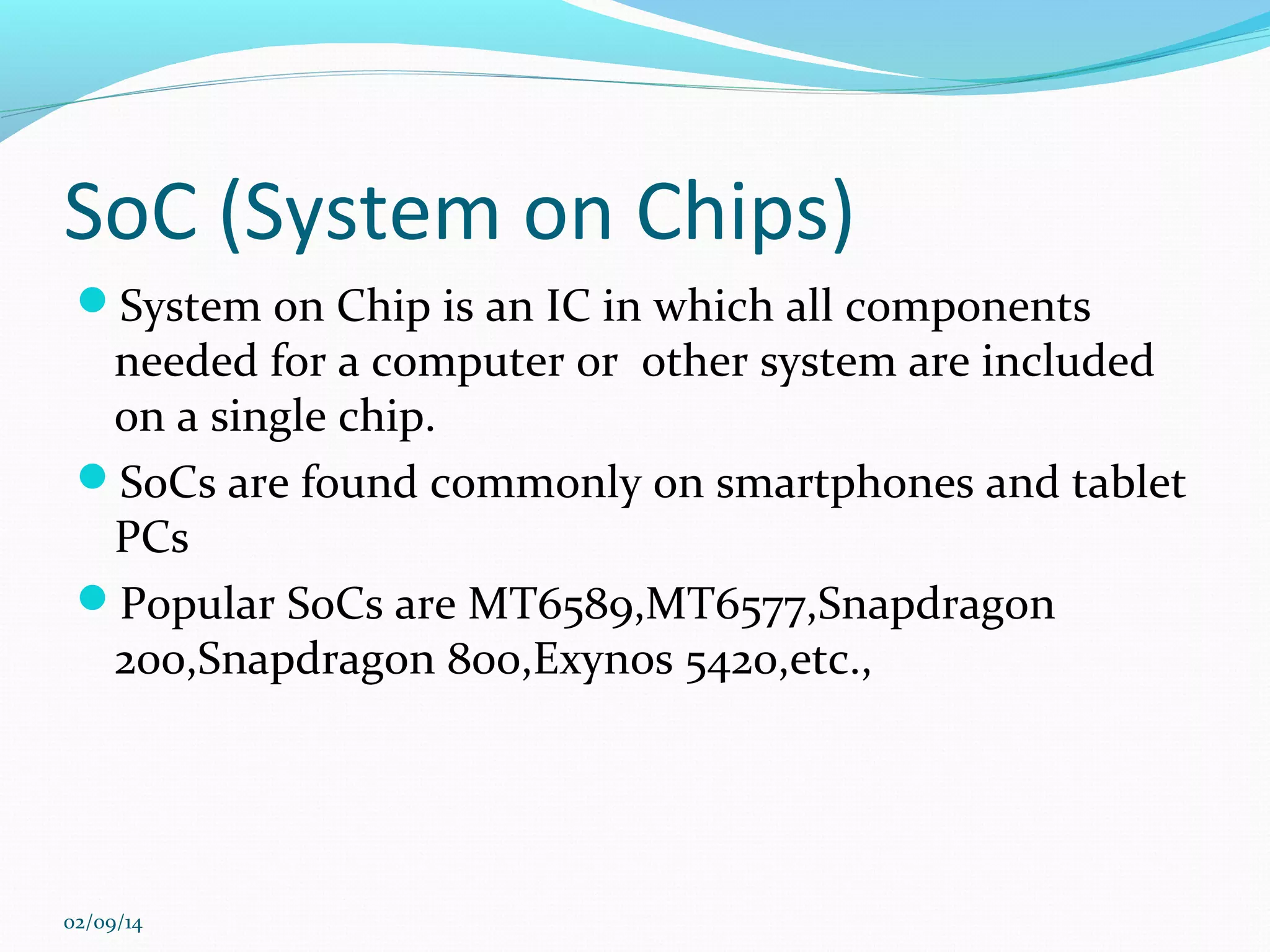
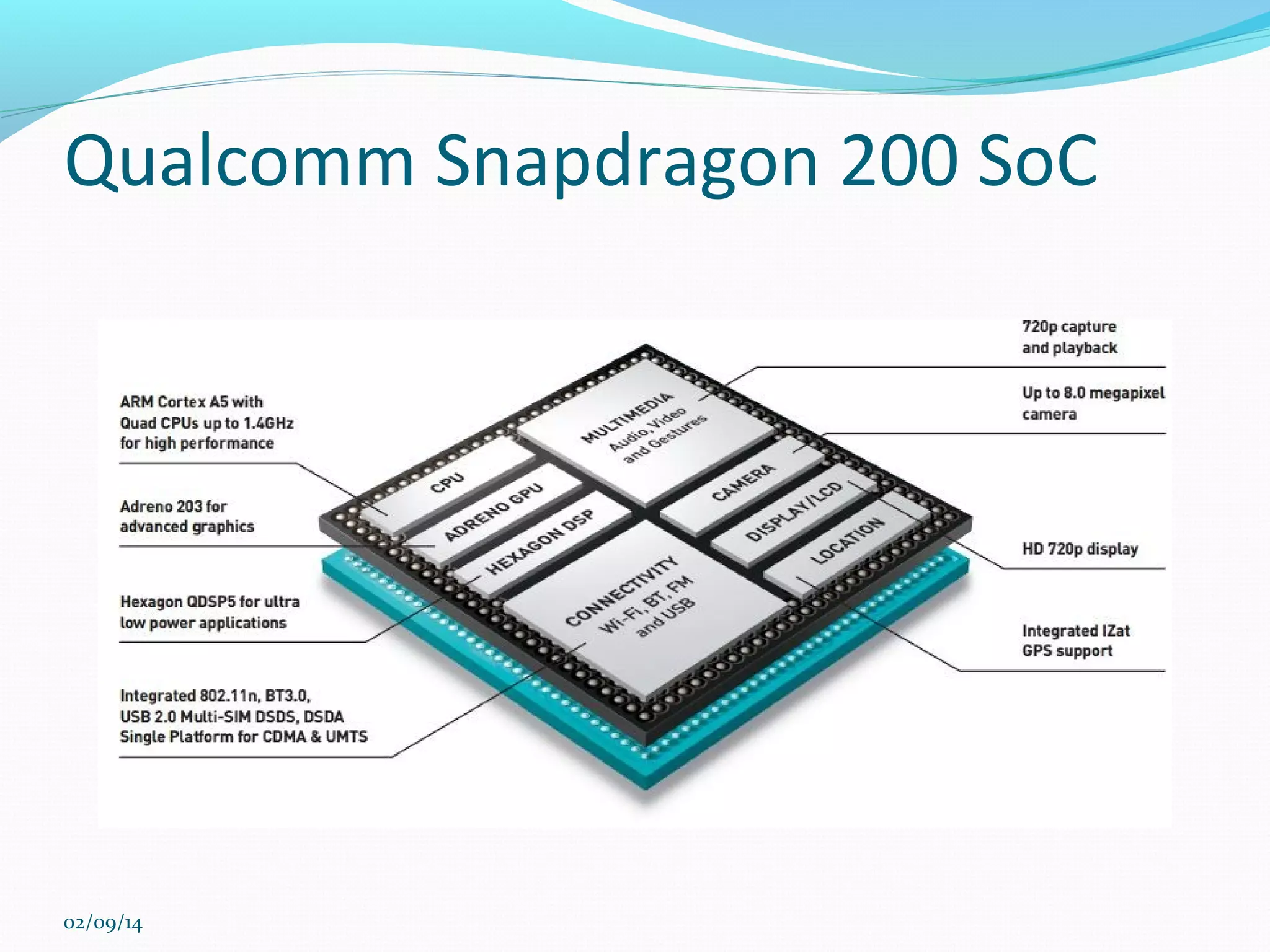
SoC (System on Chips)
System on Chip is an IC in which all components

needed for a computer or other system are included
on a single chip.
SoCs are found commonly on smartphones and tablet
PCs
Popular SoCs are MT6589,MT6577,Snapdragon
200,Snapdragon 800,Exynos 5420,etc.,

02/09/14
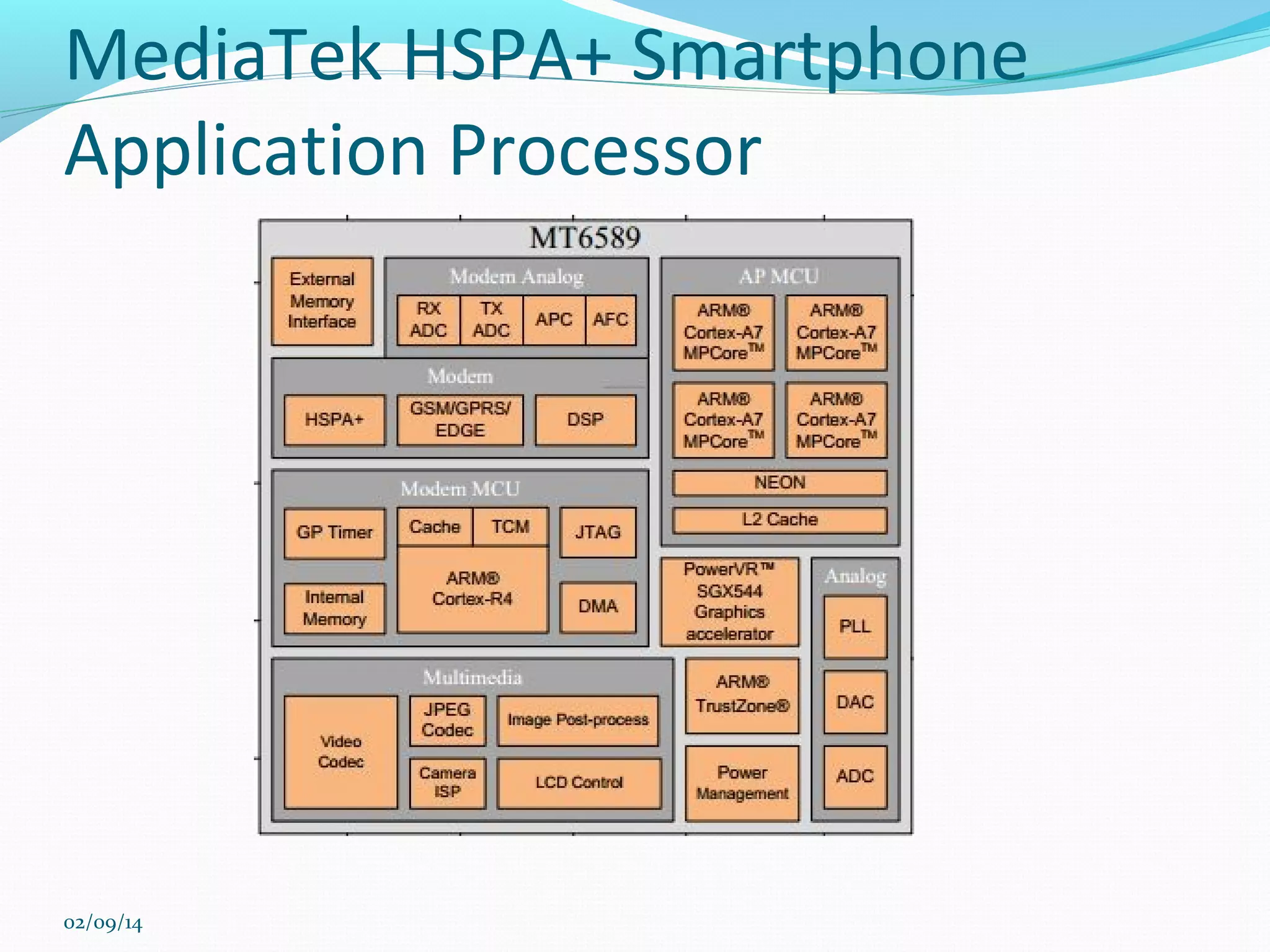
MediaTek HSPA+ Smartphone
Application Processor

02/09/14
Qualcomm Snapdragon 200 SoC

02/09/14
1.http://www.intel.com
2.http://ark.intel.com
3.http://www.mediatek.com
4.http://www.qualcomm.co.in
5.http://www.Wikipedia.org

02/09/14
02/09/14

VLSI Design

  • 1.
    JABEZ WINSTON C 11EE16 713811105016 SRIRAMAKRISHNA INSTITUTE OF TECHNOLOGY 02/09/14
  • 2.
     What isan integrated circuit?  Types of integrated circuit  Advantages of integrated circuit  Microprocessors from Intel  Moore’s Law  System-on-chip(SoC) 02/09/14
  • 3.
    What is anintegrated circuit?  An integrated circuit is a set of electronic circuits on one small plate of semiconductor material.  Integrated circuits are used in virtually all electronic equipment and have revolutionized the world of electronics. IC741 from Texas Instruments,USA 02/09/14 Smart phone application processor from MediaTek,Taiwan
  • 4.
    Who invented theintegrated circuit? The integrated circuit was independently was developed by Jack Kilby of Texas Instruments,USA and Robert Noyce(also founder of Intel) of Fairchild semiconductor,USA Jack Kilby 02/09/14 Robert Noyce
  • 5.
    Types of IntegratedCircuit Based on application  Analog IC  Digital IC  Mixed Signal IC Based on number of components  Small scale integration-SSI (Upto 100 components)  Medium scale integration-MSI (100-3k)  Large scale integration-LSI(3k-100k components)  Very Large Scale Integration-VLSI(100k-1m components)  Ultra Large Scale Integration-ULSI(above 1m components) 02/09/14
  • 6.
    Analog ICs Analog ICs,such as sensors, power management circuits, and operational amplifiers, work by processing continuous signals. They perform functions like amplification, active filtering, de modulation, mixing, etc OPAMP IC from Texas Instruments 02/09/14 555 IC from Signetics Corporation,USA
  • 7.
    Digital ICs Digital integratedcircuits can contain anything from one to millions of logic gates, multiplexers and other circuits in a few square millimeters. The small size of these circuits allows high speed, low power dissipation, and reduced manufacturing cost compared with board-level integration. Intel’s first microprocessor-Intel 4004 Intel’s flagship 4th gen-i7 processor 02/09/14
  • 8.
    Advantages of IntegratedCircuits Low cost Low power consumption Occupies less space Faster operation due to reduction of stray capacitance and inductance. Mass scale production is possible. Easy to put into various applications without knowing the underlying complexity. Billions of transistor can be fabricated on a single chip 02/09/14
  • 9.
    4004  First microprocessor(1971)  For Busicom calculator  Characteristics  10 µm process  2300 transistors  400 – 800 kHz  4-bit word size  16-pin DIP package  Masks hand cut from Rubylith and drawn with color pencils 02/09/14
  • 10.
    8008  Characteristics  10µm process  3500 transistors  500 – 800 kHz  8-bit word size  18-pin DIP package 02/09/14
  • 11.
    8080  16-bit addressbus (1974)  Used in Altair computer (early hobbyist PC)  Characteristics  6 µm process  4500 transistors  2 MHz  8-bit word size  40-pin DIP package  02/09/14
  • 12.
    8086 / 8088 16-bit processor (1978-9)  Revolutionary products  Introduced x86 ISA  Characteristics  3 µm process  29k transistors  5-10 MHz  16-bit word size  40-pin DIP package 02/09/14
  • 13.
    80286  Characteristics  1.5µm process  134k transistors  6-12 MHz  16-bit word size  68-pin PGA 02/09/14
  • 14.
    80386  32-bit processor(1985)  Modern x86 ISA  Characteristics  1.5-1 µm process  275k transistors  16-33 MHz  32-bit word size  100-pin PGA 02/09/14
  • 15.
    80486  Pipelining (1989) Floating point unit  8 KB cache  Characteristics  1-0.6 µm process  1.2M transistors  25-100 MHz  32-bit word size  168-pin PGA 02/09/14
  • 16.
    Pentium  2 instructionsper cycle  0.8-0.35 µm process  3.2M transistors  60-300 MHz  32-bit word size  296-pin PGA 02/09/14
  • 17.
    Pentium Pro /II / III  Dynamic execution (1995-9)  3 micro-ops / cycle  Multimedia instructions  PIII adds 256+ KB L2$  Characteristics  0.6-0.18 µm process  5.5M-28M transistors  166-1000 MHz  32-bit word size 02/09/14
  • 18.
    Pentium 4  Veryfast clock  256-1024 KB L2 cache  180 – 90 nm process  42-125M transistors  1.4-3.4 GHz  32-bit word size  478-pin PGA  Units start to become invisible on this scale 02/09/14
  • 19.
    Intel Core 65 nmprocess Over 400 million transistors. Max. 2MB L2 cache SSE3 instruction set LGA socket Multiple cores 64-bit Additional feature in Core 2  Intel VT-x  Hardware Security extensions 02/09/14
  • 20.
    i-series Came to marketat beginning of 2010 New line of processors i3 (Low end) i5 (Mid range) i7 (High end) Integrated Graphics support VT-x on all processors VT-d on specific processors Turbo Boost on K-type processors Extensive support to newer technologies like USB 3.0,WiDi 02/09/14
  • 21.
    More info oni-series Generations  1st generation -discontinued(2010)  2nd generation -discontinued (2011)  3rd generation (2012)  4th generation (2013) Number of transistors breached 1 billion mark 3rd ,4th processors used 22nm process LGA1150,1155,1156,BGA,etc., Highest clock frequency-4GHz Upto to 6 cores  i3 (2 cores)  i5(2 ,4 cores)  i7(2,4,6 cores) 02/09/14
  • 22.
    Moore’s Law In 1965,Gordon Moore predicted the exponential growth of the number of transistors on an IC Transistor count doubled every year since invention Predicted > 65,000 transistors by 1975! Growth limited by power [Moore65] 02/09/14
  • 23.
    Moore’s Law Transistor countshave doubled every 26 months for the past three decades. 1,000,000,000 100,000,000 10,000,000 Transistors Intel486 1,000,000 80286 100,000 Pentium 4 Pentium III Pentium II Pentium Pro Pentium Intel386 8086 10,000 1,000 8008 4004 1970 8080 1975 1980 1985 Year 02/09/14 1990 1995 2000
  • 24.
    SoC (System onChips) System on Chip is an IC in which all components needed for a computer or other system are included on a single chip. SoCs are found commonly on smartphones and tablet PCs Popular SoCs are MT6589,MT6577,Snapdragon 200,Snapdragon 800,Exynos 5420,etc., 02/09/14
  • 25.
  • 26.
  • 27.
  • 28.